HARAMBE UNIVERSITY
Microprocessor and Assembly Language
CHAPTER 3
Instruction Set of 8086
 INSTRUCTION:- is specific operation performed by
micro -processors
 Chapter Objectives
 Upon completion of this chapter, you will be able
to:
◦ Explain the operation of each data movement instruction
with applicable addressing modes.
◦ Select the appropriate assembly language instruction to
accomplish a specific data movement task.
Cont..
 Instructions are classified on the basis of functions they
perform.
 They are categorized into the following main types:
 The 8086 instructions can be grouped in to six categories
 1. Data transfer instructions
 2.Arithmetic instructions
 3. Bit manipulation instructions
 4. String instructions
 5. Program execution transfer instructions
 6. Processor control instructions
Cont..

Cont..
1. DataTransfer instruction
 All the instructions which perform data movement come under this
category.
 The source data may be a register, memory location, port etc. the
destination may be a register, memory location or port.
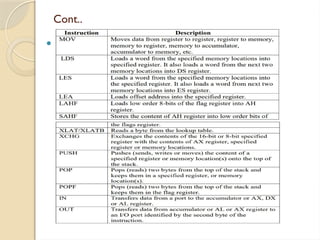
 The following instructions come under this category:
 The mov instruction allows you to copy the contents of one register
into another register. Each instruction can be used with different
modes of addressing. Some of them are: MOV, MOVS, MOVSB,
MOVSW etc.
 Used to transfer data from source operand to destination operand.
 All the store, move, load, exchange, input and output instructions
belong to this category.
Cont..
 I. General-Purpose Byte orWordTransfer Instructions:
 MOV Copy byte or word from source to destination.
 PUSH Copy specified word to top of stack.
 POP Copy word from top of stack to specified location.
 XCHG Exchange bytes or exchange words.
 XLAT Translate a byte in AL using a table in memory.
 II. Simple I/O port transfer instruction
 IN Copy a byte or word from specified port to accumulator.
 OUT Copy a byte or word from accumulator to specified port.
 III. Special address transfer instructions
 LEA Load effective address of operand into specified register.
 LDS Load DS and other specified register from memory.
 LES Load ES and other specified register from memory.
Cont..
 IV. Flag transfer instructions
 LAHF Load AH with the low byte of the flag
register.
 SAHF Store AH register to low byte of flag
register.
 PUSHF Copy flag register to top of stack.
 POPF Copy word at top of stack to flag register.
 These types of instructions are used to transfer
data from source operand to destination operand.
All the store, move, load, exchange, input and
output instructions belong to this category.
Cont’d...
 MOV (Move):- This data transfer instruction
transfers data from one register/memory
location to another register/memory
location.
 The source may be any one of the segment
registers or other general or special
purpose registers or memory location,
another register or memory location may
act as destination.
Definition
 The microprocessor is programmable device that takes in
numbers, performs on them arithmetic or logical
operations according to the program stored in memory and
then produces other numbers as a result.
Three basic characteristics differentiate microprocessors
are:
 Instruction set: The set of instructions that the
microprocessor can execute.
 Bandwidth: The number of bits processed in a single
instruction.
 Clock speed: Given in megahertz (MHz), the clock speed
determines how many instructions per second the processor
can execute.
Cont’d...
 Internally, the microprocessor is made up of
3 main units.
◦ The Arithmetic/Logic Unit (ALU)
◦ The Control Unit.
◦ An array of registers for holding data while it is
being manipulated.
Evolution of Microprocessors
 Fairchild Semiconductors (founded in 1957)
invented the first IC in 1959.
 In 1968, Robert Noyce, Gordan Moore,
Andrew Grove resigned from Fairchild
Semiconductors.
 They founded their own company Intel
(Integrated Electronics).
Cont..
 MP can be classified based on following criteria
 1. the width of data that can be processed
 2. the instruction set
 1. Classification of MP based on the data width,
based on data width MP can processing
instruction
◦ 4- BIT MICROPROCESSORS
◦ 8- BIT MICROPROCESSORS
◦ 16- BIT MICROPROCESSORS
◦ 32- BIT MICROPROCESSORS
◦ 64- BIT MICROPROCESSORS
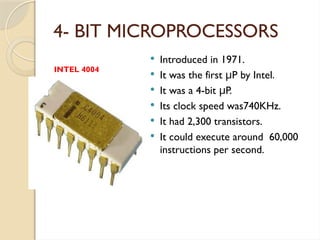
4- BIT MICROPROCESSORS
 Introduced in 1971.
 It was the first P by Intel.
μ
 It was a 4-bit P.
μ
 Its clock speed was740KHz.
 It had 2,300 transistors.
 It could execute around 60,000
instructions per second.
INTEL 4004
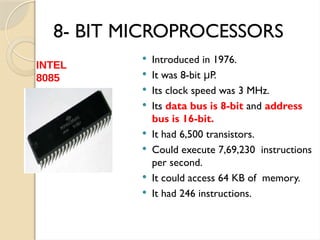
8- BIT MICROPROCESSORS
 Introduced in 1976.
 It was 8-bit P.
μ
 Its clock speed was 3 MHz.
 Its data bus is 8-bit and address
bus is 16-bit.
 It had 6,500 transistors.
 Could execute 7,69,230 instructions
per second.
 It could access 64 KB of memory.
 It had 246 instructions.
INTEL
8085
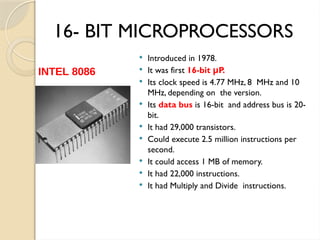
16- BIT MICROPROCESSORS
 Introduced in 1978.
 It was first 16-bit P.
μ
 Its clock speed is 4.77 MHz, 8 MHz and 10
MHz, depending on the version.
 Its data bus is 16-bit and address bus is 20-
bit.
 It had 29,000 transistors.
 Could execute 2.5 million instructions per
second.
 It could access 1 MB of memory.
 It had 22,000 instructions.
 It had Multiply and Divide instructions.
INTEL 8086
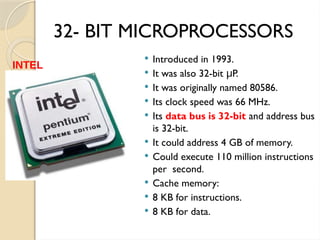
32- BIT MICROPROCESSORS
 Introduced in 1993.
 It was also 32-bit P.
μ
 It was originally named 80586.
 Its clock speed was 66 MHz.
 Its data bus is 32-bit and address bus
is 32-bit.
 It could address 4 GB of memory.
 Could execute 110 million instructions
per second.
 Cache memory:
 8 KB for instructions.
 8 KB for data.
INTEL
PENTIUM
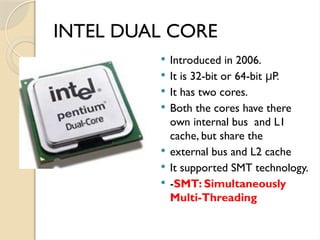
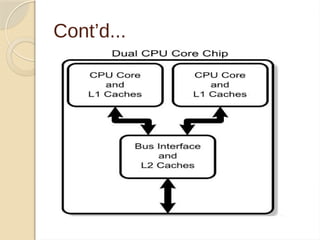
INTEL DUAL CORE
 Introduced in 2006.
 It is 32-bit or 64-bit P.
μ
 It has two cores.
 Both the cores have there
own internal bus and L1
cache, but share the
 external bus and L2 cache
 It supported SMT technology.
 -SMT: Simultaneously
Multi-Threading
Cont’d...
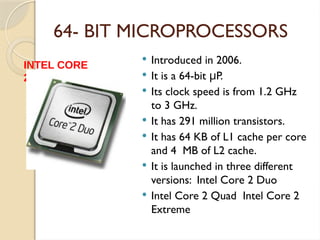
64- BIT MICROPROCESSORS
 Introduced in 2006.
 It is a 64-bit P.
μ
 Its clock speed is from 1.2 GHz
to 3 GHz.
 It has 291 million transistors.
 It has 64 KB of L1 cache per core
and 4 MB of L2 cache.
 It is launched in three different
versions: Intel Core 2 Duo
 Intel Core 2 Quad Intel Core 2
Extreme
INTEL CORE
2
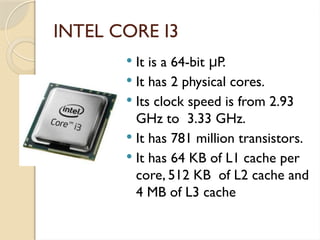
INTEL CORE I3
 It is a 64-bit P.
μ
 It has 2 physical cores.
 Its clock speed is from 2.93
GHz to 3.33 GHz.
 It has 781 million transistors.
 It has 64 KB of L1 cache per
core, 512 KB of L2 cache and
4 MB of L3 cache
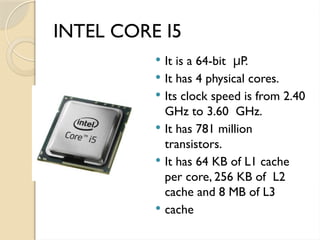
INTEL CORE I5
 It is a 64-bit P.
μ
 It has 4 physical cores.
 Its clock speed is from 2.40
GHz to 3.60 GHz.
 It has 781 million
transistors.
 It has 64 KB of L1 cache
per core, 256 KB of L2
cache and 8 MB of L3
 cache
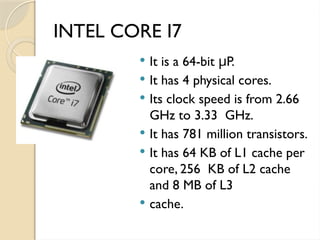
INTEL CORE I7
 It is a 64-bit P.
μ
 It has 4 physical cores.
 Its clock speed is from 2.66
GHz to 3.33 GHz.
 It has 781 million transistors.
 It has 64 KB of L1 cache per
core, 256 KB of L2 cache
and 8 MB of L3
 cache.
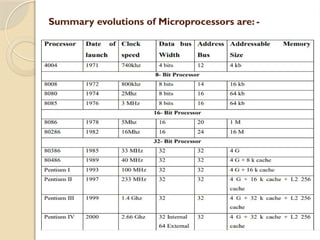
Summary evolutions of Microprocessors are: -
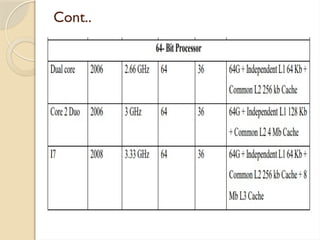
Cont..
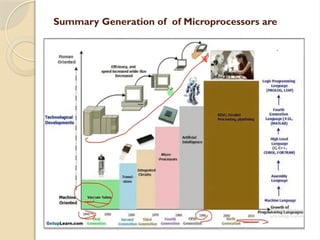
Summary Generation of of Microprocessors are
Processor specifications
 Processors can be identified by two main parameters:
how wide they are and how fast they are.
 The speed of a processor is a fairly simple concept.
Speed is counted in megahertz (MHz), which means
millions of cycles per second— and faster is better!
 The width of a processor : Three things to be
considered in a processor that are expressed in
width.They are:
 Internal registers
 Data input and output bus
 Memory address bus
Types of microprocessors
1. Complex Instruction Set Microprocessors
(CISC): they categorize a micro processor in
which orders can be executed together along
with other low level activities.
 It mainly performs the task of uploading,
downloading and recalling data into and from
the memory card.
 Apart from that it also does complex
mathematical calculations within a single
command.
Cont’d…
2. Reduced Instruction Set Computer (RISC): These kinds of
chips are made according to the function in which the
microprocessor can carry out small things within a particular
command.
 In this way it completes more commands at a faster rate.
3. Superscalar Processors: This is a processor that copies the
hardware on the microprocessor for performing numerous tasks
at a time.They can be used for arithmetic and as multipliers.
 They have several operational units and thus carry out more
than a one command by constantly transmitting various
instructions to the superfluous operational units inside the
processor.
Cont’d…
4.The Application Specific Integrated Circuit:This processor is
also known as ASIC. They are used for specific purposes that
comprises of automotive emissions control or personal digital
assistants computer.
 This kind of processor is made with proper specification but
apart from that it can also be made using the off the shelf
gears.
5. Digital Signal Multiprocessors:Also called as DSP’s, these are
used for encoding and decoding videos or to convert the digital
and video to analog and analog to digital.
 They need a microprocessor that is excellent in mathematical
calculations.
 The chips of this processor are employed in SONAR, RADAR,
home theaters audio gears, Mobile phones and TV set top
boxes.
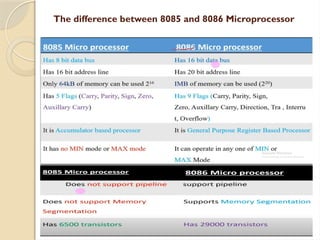
The difference between 8085 and 8086 Microprocessor
8086 INTERNAL
ARCHITECTURE
Cont…
 The Intel 8086 is a l6-bit
microprocessor that is intended to be
used as the CPU in a microcomputer.
 The 8O86 has a 2o-bit address bus.
Internal Architecture
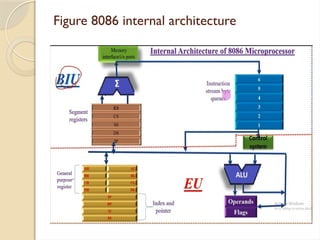
 The 8086 CPU is divided into two
independent functional parts:-
◦ The bus interface unit or BIU
◦ The execution unit or EU.
Figure 8086 internal architecture
cont.…
The BIU:-
◦ Sends out addresses
◦ Fetches Instructions from memory
◦ Reads data from ports and memory
◦ Writes data to ports and memory.
 The BIU handles all transfers of data and
addresses on the buses for the execution
unit.
Cont…
 The EU:-
◦ Tells the BIU where to fetch instructions or data
from
◦ Decodes instructions.
◦ Executes instructions.
The Execution Unit
 It contains:-
◦ Control circuitry which directs internal
operations.
◦ A decoder which translates instructions fetched
from memory into a series of actions which the
EU carries out.
◦ A l6-bit arithmetic logic unit which can add,
subtract,AND, OR, XOR, increment, decrement,
complement, or shift binary numbers.
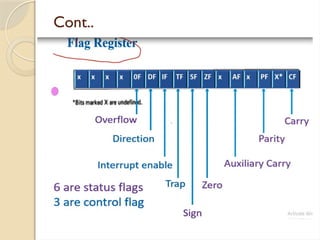
Flag Register
 A flag is a flip-flop which indicates some
condition produced by the execution of an
instruction or controls certain operations
of the EU.
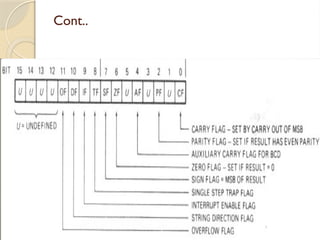
 A l6-bit flag register in the EU contains nine
active flags.
 Six of the nine flags are used to indicate
some condition produced by an instruction.
Cont…
 The six conditional flags in this group
are:-
◦ Carry Flag (CF)
◦ Parity Flag (PF)
◦ Auxiliary Flag (AF)
◦ Zero jag (ZF)
◦ Sign Flag (SF)
◦ Overflow Flag (OF).
Cont…
 The three remaining flags in the flag register
are used to control certain operations of the
processor.
 The six conditional flags are set or reset by
the EU on the basis of the results of some
arithmetic or logic operation.
Cont…
 The three control flags are:-
◦ Trap Flag (TF), which is used for single
stepping through a program.
◦ Interrupt Flag (IF), which is used to allow or
prohibit the interruption of a program.
◦ Direction Flag (DF), which is used with
string instructions.
Cont..
Cont..
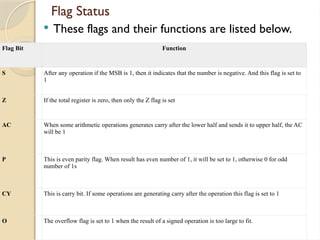
Flag Status
 These flags and their functions are listed below.
Flag Bit Function
S After any operation if the MSB is 1, then it indicates that the number is negative. And this flag is set to
1
Z If the total register is zero, then only the Z flag is set
AC When some arithmetic operations generates carry after the lower half and sends it to upper half, the AC
will be 1
P This is even parity flag. When result has even number of 1, it will be set to 1, otherwise 0 for odd
number of 1s
CY This is carry bit. If some operations are generating carry after the operation this flag is set to 1
O The overflow flag is set to 1 when the result of a signed operation is too large to fit.
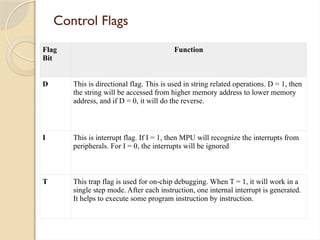
Control Flags
Flag
Bit
Function
D This is directional flag. This is used in string related operations. D = 1, then
the string will be accessed from higher memory address to lower memory
address, and if D = 0, it will do the reverse.
I This is interrupt flag. If I = 1, then MPU will recognize the interrupts from
peripherals. For I = 0, the interrupts will be ignored
T This trap flag is used for on-chip debugging. When T = 1, it will work in a
single step mode. After each instruction, one internal interrupt is generated.
It helps to execute some program instruction by instruction.
General Purpose Register
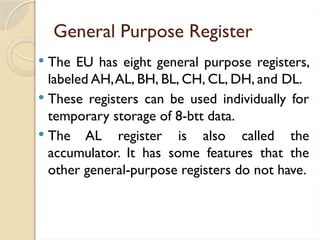
 The EU has eight general purpose registers,
labeled AH,AL, BH, BL, CH, CL, DH, and DL.
 These registers can be used individually for
temporary storage of 8-btt data.
 The AL register is also called the
accumulator. It has some features that the
other general-purpose registers do not have.
CONT. . .
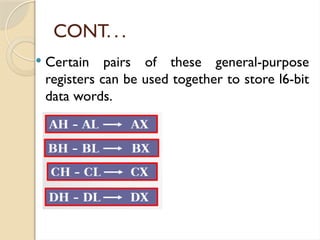
 Certain pairs of these general-purpose
registers can be used together to store l6-bit
data words.
Cont’d...
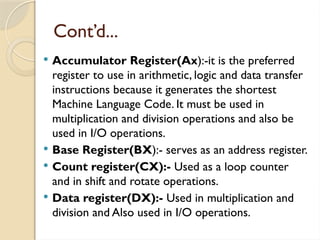
 Accumulator Register(Ax):-it is the preferred
register to use in arithmetic, logic and data transfer
instructions because it generates the shortest
Machine Language Code. It must be used in
multiplication and division operations and also be
used in I/O operations.
 Base Register(BX):- serves as an address register.
 Count register(CX):- Used as a loop counter
and in shift and rotate operations.
 Data register(DX):- Used in multiplication and
division and Also used in I/O operations.
The Queue
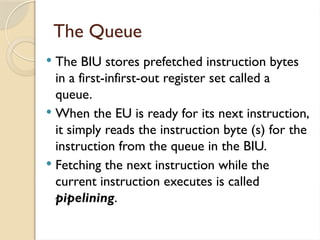
 The BIU stores prefetched instruction bytes
in a first-infirst-out register set called a
queue.
 When the EU is ready for its next instruction,
it simply reads the instruction byte (s) for the
instruction from the queue in the BIU.
 Fetching the next instruction while the
current instruction executes is called
pipelining.

Cont..

Microprocessor and assembly language.pptx

  • 1.
    HARAMBE UNIVERSITY Microprocessor andAssembly Language CHAPTER 3 Instruction Set of 8086
  • 2.
    Instruction Set of8086  INSTRUCTION:- is specific operation performed by micro -processors  Chapter Objectives  Upon completion of this chapter, you will be able to: ◦ Explain the operation of each data movement instruction with applicable addressing modes. ◦ Select the appropriate assembly language instruction to accomplish a specific data movement task.
  • 3.
    Cont..  Instructions areclassified on the basis of functions they perform.  They are categorized into the following main types:  The 8086 instructions can be grouped in to six categories  1. Data transfer instructions  2.Arithmetic instructions  3. Bit manipulation instructions  4. String instructions  5. Program execution transfer instructions  6. Processor control instructions
  • 4.
  • 5.
    Cont.. 1. DataTransfer instruction All the instructions which perform data movement come under this category.  The source data may be a register, memory location, port etc. the destination may be a register, memory location or port.  The following instructions come under this category:  The mov instruction allows you to copy the contents of one register into another register. Each instruction can be used with different modes of addressing. Some of them are: MOV, MOVS, MOVSB, MOVSW etc.  Used to transfer data from source operand to destination operand.  All the store, move, load, exchange, input and output instructions belong to this category.
  • 6.
    Cont..  I. General-PurposeByte orWordTransfer Instructions:  MOV Copy byte or word from source to destination.  PUSH Copy specified word to top of stack.  POP Copy word from top of stack to specified location.  XCHG Exchange bytes or exchange words.  XLAT Translate a byte in AL using a table in memory.  II. Simple I/O port transfer instruction  IN Copy a byte or word from specified port to accumulator.  OUT Copy a byte or word from accumulator to specified port.  III. Special address transfer instructions  LEA Load effective address of operand into specified register.  LDS Load DS and other specified register from memory.  LES Load ES and other specified register from memory.
  • 7.
    Cont..  IV. Flagtransfer instructions  LAHF Load AH with the low byte of the flag register.  SAHF Store AH register to low byte of flag register.  PUSHF Copy flag register to top of stack.  POPF Copy word at top of stack to flag register.  These types of instructions are used to transfer data from source operand to destination operand. All the store, move, load, exchange, input and output instructions belong to this category.
  • 8.
    Cont’d...  MOV (Move):-This data transfer instruction transfers data from one register/memory location to another register/memory location.  The source may be any one of the segment registers or other general or special purpose registers or memory location, another register or memory location may act as destination.
  • 9.
    Definition  The microprocessoris programmable device that takes in numbers, performs on them arithmetic or logical operations according to the program stored in memory and then produces other numbers as a result. Three basic characteristics differentiate microprocessors are:  Instruction set: The set of instructions that the microprocessor can execute.  Bandwidth: The number of bits processed in a single instruction.  Clock speed: Given in megahertz (MHz), the clock speed determines how many instructions per second the processor can execute.
  • 10.
    Cont’d...  Internally, themicroprocessor is made up of 3 main units. ◦ The Arithmetic/Logic Unit (ALU) ◦ The Control Unit. ◦ An array of registers for holding data while it is being manipulated.
  • 11.
    Evolution of Microprocessors Fairchild Semiconductors (founded in 1957) invented the first IC in 1959.  In 1968, Robert Noyce, Gordan Moore, Andrew Grove resigned from Fairchild Semiconductors.  They founded their own company Intel (Integrated Electronics).
  • 12.
    Cont..  MP canbe classified based on following criteria  1. the width of data that can be processed  2. the instruction set  1. Classification of MP based on the data width, based on data width MP can processing instruction ◦ 4- BIT MICROPROCESSORS ◦ 8- BIT MICROPROCESSORS ◦ 16- BIT MICROPROCESSORS ◦ 32- BIT MICROPROCESSORS ◦ 64- BIT MICROPROCESSORS
  • 13.
    4- BIT MICROPROCESSORS Introduced in 1971.  It was the first P by Intel. μ  It was a 4-bit P. μ  Its clock speed was740KHz.  It had 2,300 transistors.  It could execute around 60,000 instructions per second. INTEL 4004
  • 14.
    8- BIT MICROPROCESSORS Introduced in 1976.  It was 8-bit P. μ  Its clock speed was 3 MHz.  Its data bus is 8-bit and address bus is 16-bit.  It had 6,500 transistors.  Could execute 7,69,230 instructions per second.  It could access 64 KB of memory.  It had 246 instructions. INTEL 8085
  • 15.
    16- BIT MICROPROCESSORS Introduced in 1978.  It was first 16-bit P. μ  Its clock speed is 4.77 MHz, 8 MHz and 10 MHz, depending on the version.  Its data bus is 16-bit and address bus is 20- bit.  It had 29,000 transistors.  Could execute 2.5 million instructions per second.  It could access 1 MB of memory.  It had 22,000 instructions.  It had Multiply and Divide instructions. INTEL 8086
  • 16.
    32- BIT MICROPROCESSORS Introduced in 1993.  It was also 32-bit P. μ  It was originally named 80586.  Its clock speed was 66 MHz.  Its data bus is 32-bit and address bus is 32-bit.  It could address 4 GB of memory.  Could execute 110 million instructions per second.  Cache memory:  8 KB for instructions.  8 KB for data. INTEL PENTIUM
  • 17.
    INTEL DUAL CORE Introduced in 2006.  It is 32-bit or 64-bit P. μ  It has two cores.  Both the cores have there own internal bus and L1 cache, but share the  external bus and L2 cache  It supported SMT technology.  -SMT: Simultaneously Multi-Threading
  • 18.
  • 19.
    64- BIT MICROPROCESSORS Introduced in 2006.  It is a 64-bit P. μ  Its clock speed is from 1.2 GHz to 3 GHz.  It has 291 million transistors.  It has 64 KB of L1 cache per core and 4 MB of L2 cache.  It is launched in three different versions: Intel Core 2 Duo  Intel Core 2 Quad Intel Core 2 Extreme INTEL CORE 2
  • 20.
    INTEL CORE I3 It is a 64-bit P. μ  It has 2 physical cores.  Its clock speed is from 2.93 GHz to 3.33 GHz.  It has 781 million transistors.  It has 64 KB of L1 cache per core, 512 KB of L2 cache and 4 MB of L3 cache
  • 21.
    INTEL CORE I5 It is a 64-bit P. μ  It has 4 physical cores.  Its clock speed is from 2.40 GHz to 3.60 GHz.  It has 781 million transistors.  It has 64 KB of L1 cache per core, 256 KB of L2 cache and 8 MB of L3  cache
  • 22.
    INTEL CORE I7 It is a 64-bit P. μ  It has 4 physical cores.  Its clock speed is from 2.66 GHz to 3.33 GHz.  It has 781 million transistors.  It has 64 KB of L1 cache per core, 256 KB of L2 cache and 8 MB of L3  cache.
  • 23.
    Summary evolutions ofMicroprocessors are: -
  • 24.
  • 25.
    Summary Generation ofof Microprocessors are
  • 26.
    Processor specifications  Processorscan be identified by two main parameters: how wide they are and how fast they are.  The speed of a processor is a fairly simple concept. Speed is counted in megahertz (MHz), which means millions of cycles per second— and faster is better!  The width of a processor : Three things to be considered in a processor that are expressed in width.They are:  Internal registers  Data input and output bus  Memory address bus
  • 27.
    Types of microprocessors 1.Complex Instruction Set Microprocessors (CISC): they categorize a micro processor in which orders can be executed together along with other low level activities.  It mainly performs the task of uploading, downloading and recalling data into and from the memory card.  Apart from that it also does complex mathematical calculations within a single command.
  • 28.
    Cont’d… 2. Reduced InstructionSet Computer (RISC): These kinds of chips are made according to the function in which the microprocessor can carry out small things within a particular command.  In this way it completes more commands at a faster rate. 3. Superscalar Processors: This is a processor that copies the hardware on the microprocessor for performing numerous tasks at a time.They can be used for arithmetic and as multipliers.  They have several operational units and thus carry out more than a one command by constantly transmitting various instructions to the superfluous operational units inside the processor.
  • 29.
    Cont’d… 4.The Application SpecificIntegrated Circuit:This processor is also known as ASIC. They are used for specific purposes that comprises of automotive emissions control or personal digital assistants computer.  This kind of processor is made with proper specification but apart from that it can also be made using the off the shelf gears. 5. Digital Signal Multiprocessors:Also called as DSP’s, these are used for encoding and decoding videos or to convert the digital and video to analog and analog to digital.  They need a microprocessor that is excellent in mathematical calculations.  The chips of this processor are employed in SONAR, RADAR, home theaters audio gears, Mobile phones and TV set top boxes.
  • 30.
    The difference between8085 and 8086 Microprocessor
  • 31.
  • 32.
    Cont…  The Intel8086 is a l6-bit microprocessor that is intended to be used as the CPU in a microcomputer.  The 8O86 has a 2o-bit address bus.
  • 33.
    Internal Architecture  The8086 CPU is divided into two independent functional parts:- ◦ The bus interface unit or BIU ◦ The execution unit or EU.
  • 34.
  • 35.
    cont.… The BIU:- ◦ Sendsout addresses ◦ Fetches Instructions from memory ◦ Reads data from ports and memory ◦ Writes data to ports and memory.  The BIU handles all transfers of data and addresses on the buses for the execution unit.
  • 36.
    Cont…  The EU:- ◦Tells the BIU where to fetch instructions or data from ◦ Decodes instructions. ◦ Executes instructions.
  • 37.
    The Execution Unit It contains:- ◦ Control circuitry which directs internal operations. ◦ A decoder which translates instructions fetched from memory into a series of actions which the EU carries out. ◦ A l6-bit arithmetic logic unit which can add, subtract,AND, OR, XOR, increment, decrement, complement, or shift binary numbers.
  • 38.
    Flag Register  Aflag is a flip-flop which indicates some condition produced by the execution of an instruction or controls certain operations of the EU.  A l6-bit flag register in the EU contains nine active flags.  Six of the nine flags are used to indicate some condition produced by an instruction.
  • 39.
    Cont…  The sixconditional flags in this group are:- ◦ Carry Flag (CF) ◦ Parity Flag (PF) ◦ Auxiliary Flag (AF) ◦ Zero jag (ZF) ◦ Sign Flag (SF) ◦ Overflow Flag (OF).
  • 40.
    Cont…  The threeremaining flags in the flag register are used to control certain operations of the processor.  The six conditional flags are set or reset by the EU on the basis of the results of some arithmetic or logic operation.
  • 41.
    Cont…  The threecontrol flags are:- ◦ Trap Flag (TF), which is used for single stepping through a program. ◦ Interrupt Flag (IF), which is used to allow or prohibit the interruption of a program. ◦ Direction Flag (DF), which is used with string instructions.
  • 42.
  • 43.
  • 44.
    Flag Status  Theseflags and their functions are listed below. Flag Bit Function S After any operation if the MSB is 1, then it indicates that the number is negative. And this flag is set to 1 Z If the total register is zero, then only the Z flag is set AC When some arithmetic operations generates carry after the lower half and sends it to upper half, the AC will be 1 P This is even parity flag. When result has even number of 1, it will be set to 1, otherwise 0 for odd number of 1s CY This is carry bit. If some operations are generating carry after the operation this flag is set to 1 O The overflow flag is set to 1 when the result of a signed operation is too large to fit.
  • 45.
    Control Flags Flag Bit Function D Thisis directional flag. This is used in string related operations. D = 1, then the string will be accessed from higher memory address to lower memory address, and if D = 0, it will do the reverse. I This is interrupt flag. If I = 1, then MPU will recognize the interrupts from peripherals. For I = 0, the interrupts will be ignored T This trap flag is used for on-chip debugging. When T = 1, it will work in a single step mode. After each instruction, one internal interrupt is generated. It helps to execute some program instruction by instruction.
  • 46.
    General Purpose Register The EU has eight general purpose registers, labeled AH,AL, BH, BL, CH, CL, DH, and DL.  These registers can be used individually for temporary storage of 8-btt data.  The AL register is also called the accumulator. It has some features that the other general-purpose registers do not have.
  • 47.
    CONT. . . Certain pairs of these general-purpose registers can be used together to store l6-bit data words.
  • 48.
    Cont’d...  Accumulator Register(Ax):-itis the preferred register to use in arithmetic, logic and data transfer instructions because it generates the shortest Machine Language Code. It must be used in multiplication and division operations and also be used in I/O operations.  Base Register(BX):- serves as an address register.  Count register(CX):- Used as a loop counter and in shift and rotate operations.  Data register(DX):- Used in multiplication and division and Also used in I/O operations.
  • 49.
    The Queue  TheBIU stores prefetched instruction bytes in a first-infirst-out register set called a queue.  When the EU is ready for its next instruction, it simply reads the instruction byte (s) for the instruction from the queue in the BIU.  Fetching the next instruction while the current instruction executes is called pipelining.
  • 50.