





Introduction  Learn How To Run A  Discrete Choice Conjoint Analysis Project in Just  1 Hour
Who is SurveyAnalytics? Started in 2002 in Seattle, WA #172 on Inc. 500 Fastest Growing Private Companies #12 on Puget Sound Journal's Top 100 in Washington  Over 6K+ clients and growing! QuestionPro, SurveyAnalytics, IdeaScale, MicroPoll Esther LaVielle Chief Education Director  
Speaker: Andrew Jeavons * SurveyAnalytics Executive Vice President, Andrew Jeavons has over 25 years in the market research industry. *He is a frequent writer and speaker for various publications and events around the country. He has a background in psychology and statistics, and currently focuses on innovation within survey research. Studied Neuropsychology at Birkbeck College in London UK, he then worked in the medical statistics department of the Institute of Neurology in London UK.  Ten years + experience working with software companies in a marketing, sales and strategic development capacity. He has also written numerous articles for ESOMAR publications and a range of international conferences. *He is currently Western area convener for the New MR 2010 conference ( www.newmr.org)
What is Conjoint Analysis? 2. When & Why to Choose SurveyAnalytics Over SawTooth? 3. How to Put together a Conjoint Analysis Question   Features (Attributes) and Levels for each of the features 4.   Adding Conjoint Design Parameters   5. Preview Survey  6.  Review Data:  Utility Calculation & Relative Importance     7.  Market Segmentation Tool Filter the data based on criteria and then run Relative Importance calculations   8.  Best Practice & Tips / Q&A   Webinar Agenda
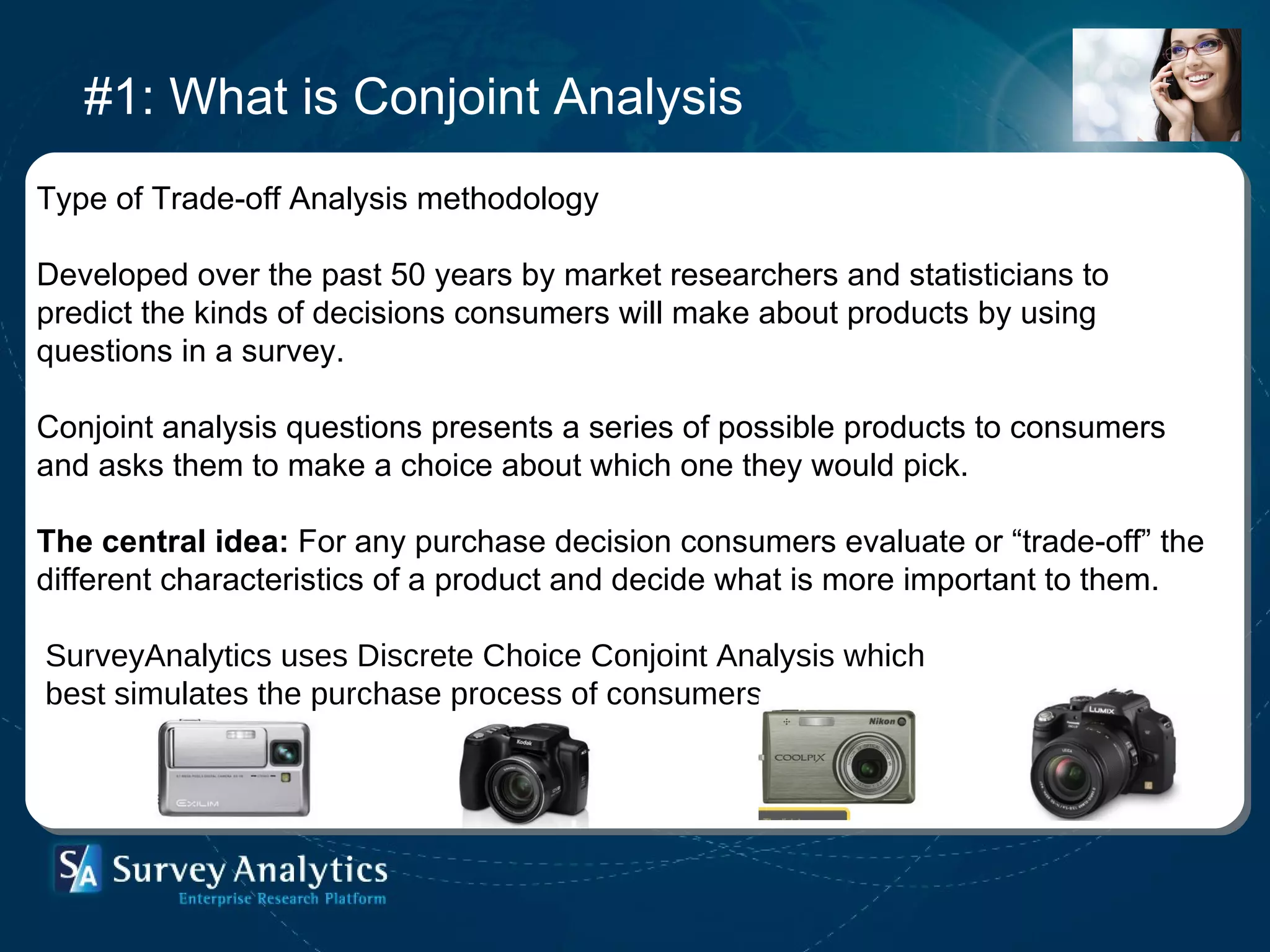
#1: What is Conjoint Analysis Type of Trade-off Analysis methodology Developed over the past 50 years by market researchers and statisticians to  predict the kinds of decisions consumers will make about products by using questions in a survey.  Conjoint analysis questions presents a series of possible products to consumers and asks them to make a choice about which one they would pick.  The central idea:  For any purchase decision consumers evaluate or “trade-off” the different characteristics of a product and decide what is more important to them.  SurveyAnalytics uses Discrete Choice Conjoint Analysis which  best simulates the purchase process of consumers
Why use Conjoint Analysis? -It will help you evaluate new products or variations against an existing range of products already offered by your company or within the marketplace. -It’s much cheaper than developing new products for the marketplace with no guarantee of success.  -Get real-time feedback on new products or variations of existing products. -Simulates the decisions your target consumers would make in the market place.  -Gives you an idea how a new product with be received in the marketplace. -Gauge the affect on the choice/price relationship relative to existing products and features presented.
Analysis: How do we come up with our #s? 1) SurveyAnalytics uses  Multinomial Logistic Regression  for part worth  (Utility Value) calculations.   *Variables in question are nominal & have 2 + categories * Used cases where the response is not ordinal in nature EXAMPLE:  Determine what factors predict which major college students choose   (2) SurveyAnalytics use an  Orthogonal Profile Generation function   *Any set of attributes will have a minimal set of profiles that can be generated to form a balanced design.    Have greater confidence in the  results you receive!
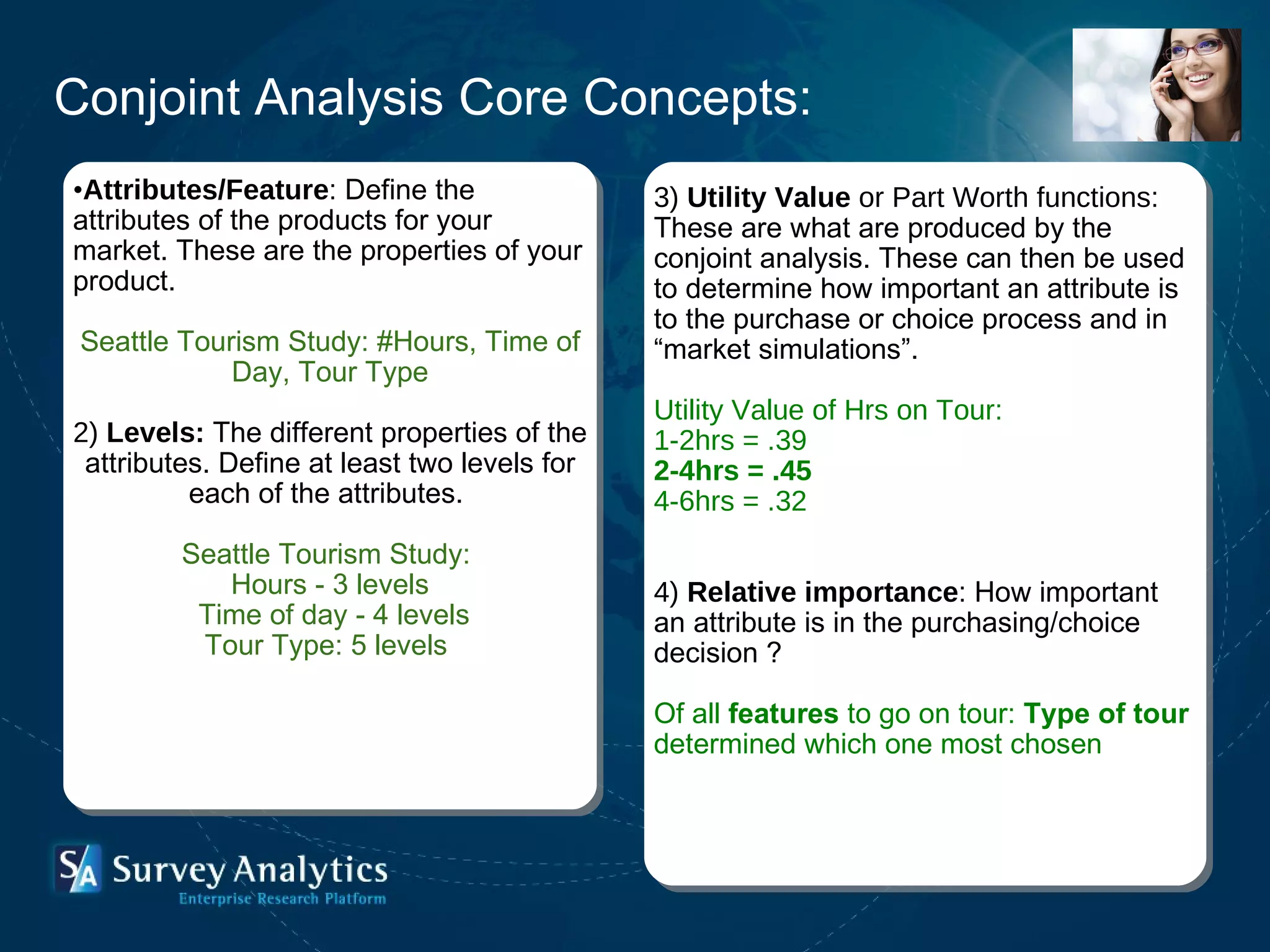
Conjoint Analysis Core Concepts: Attributes/Feature :  Define the attributes of the products for your market. These are the properties of your product. Seattle Tourism Study: #Hours, Time of Day, Tour Type 2)  Levels:   The different properties of the attributes. Define at least two levels for each of the attributes.  Seattle Tourism Study:  Hours - 3 levels Time of day - 4 levels Tour Type: 5 levels  3)  Utility Value  or Part Worth functions:  These are what are produced by the conjoint analysis. These can then be used to determine how important an attribute is to the purchase or choice process and in “market simulations”.   Utility Value of Hrs on Tour: 1-2hrs = .39 2-4hrs = .45 4-6hrs = .32 4)  Relative importance :  How important an attribute is in the purchasing/choice decision ? Of all  features  to go on tour:  Type of tour  determined which one most chosen
# 2: When & Why to Choose SurveyAnalytics Over Sawtooth Software:   Discrete Choice Conjoint Analysis Flexible pricing available  (Contact Esther) Most User-friendly Conjoint Tool In The Market Real-time Reporting  Pricing includes integrated research tools that would enhance efficiencies and depth and research strategies  Dedicated account management and support included
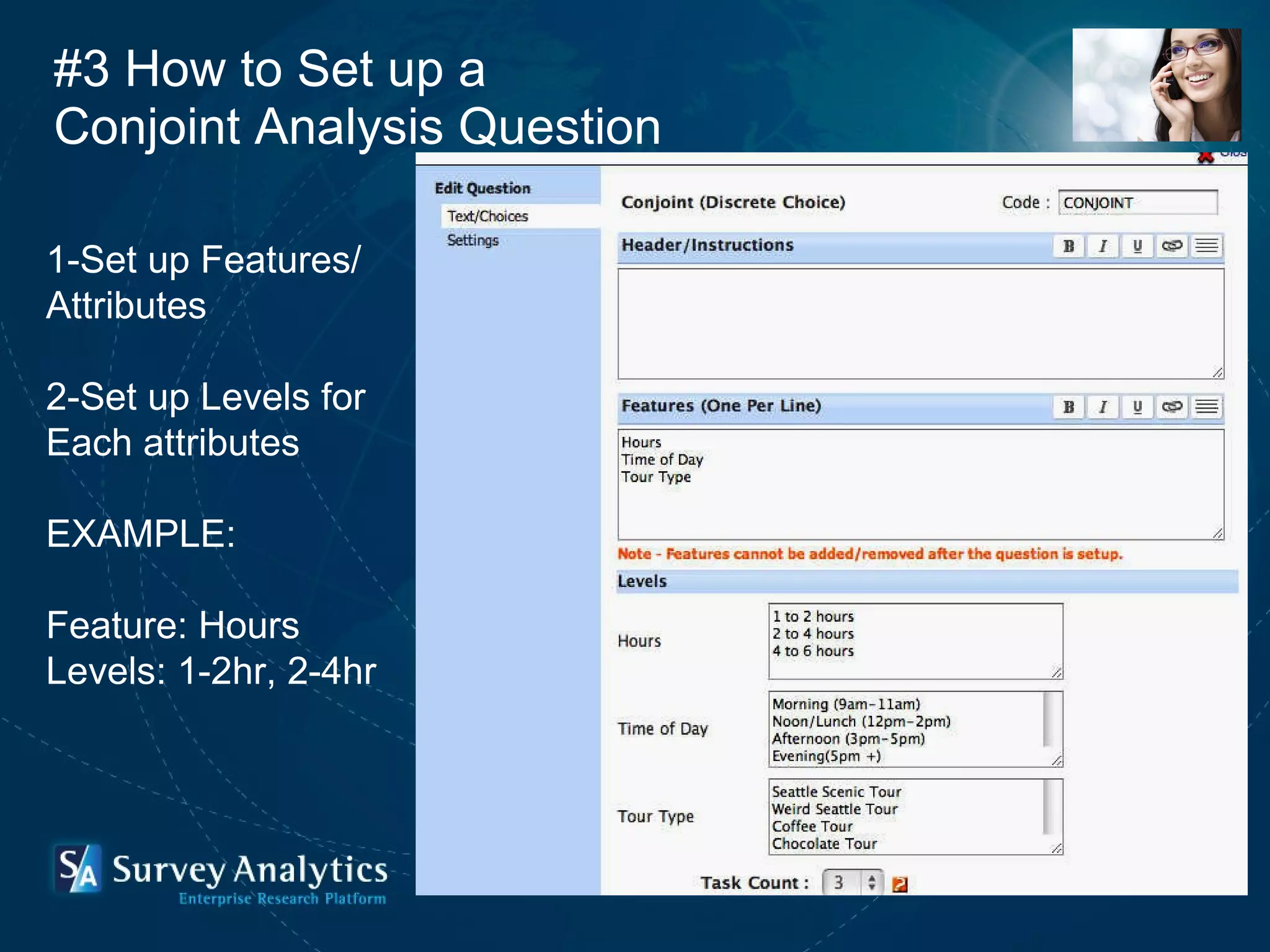
#3 How to Set up a  Conjoint Analysis Question 1-Set up Features/ Attributes 2-Set up Levels for Each attributes EXAMPLE: Feature: Hours Levels: 1-2hr, 2-4hr
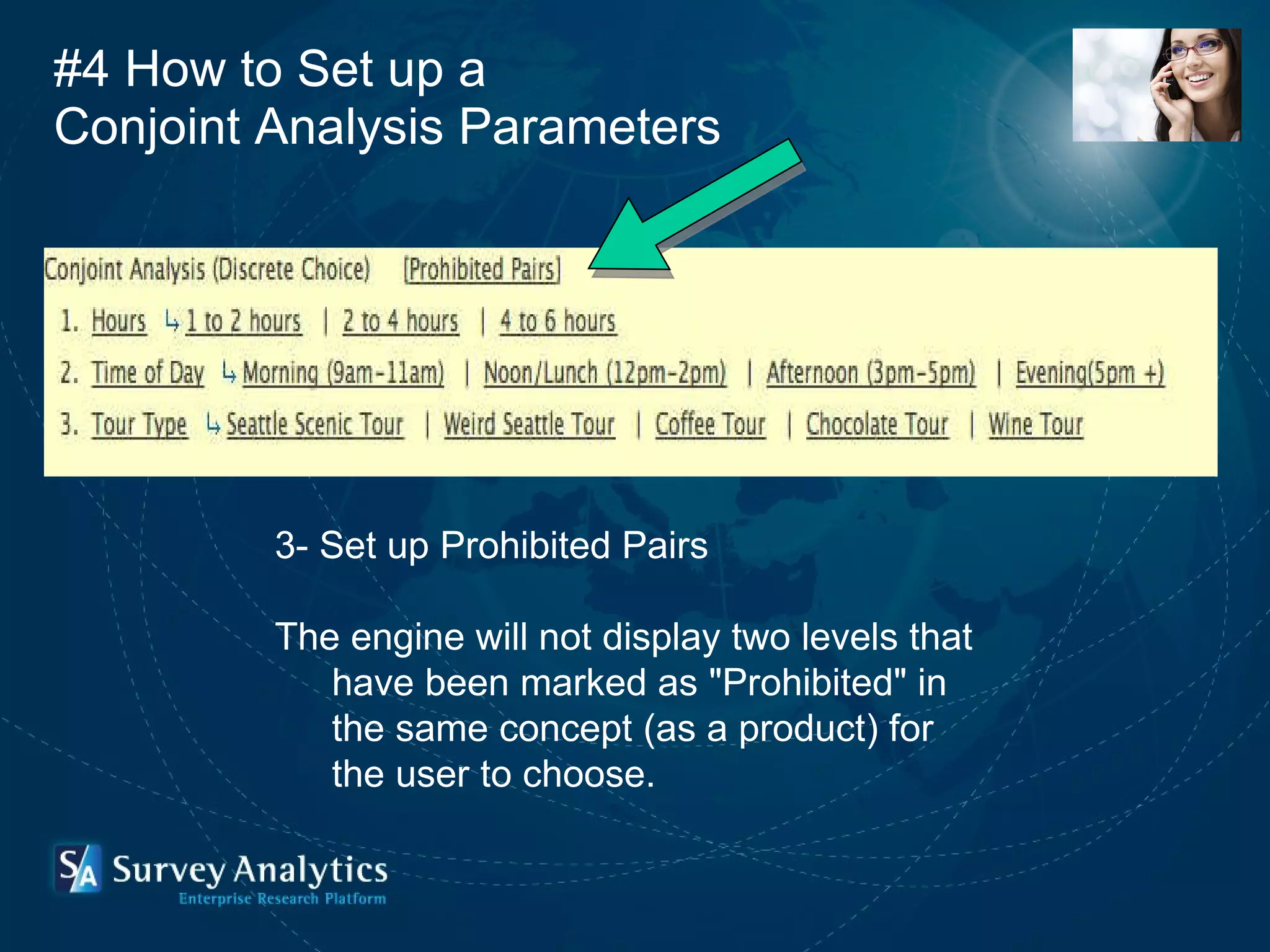
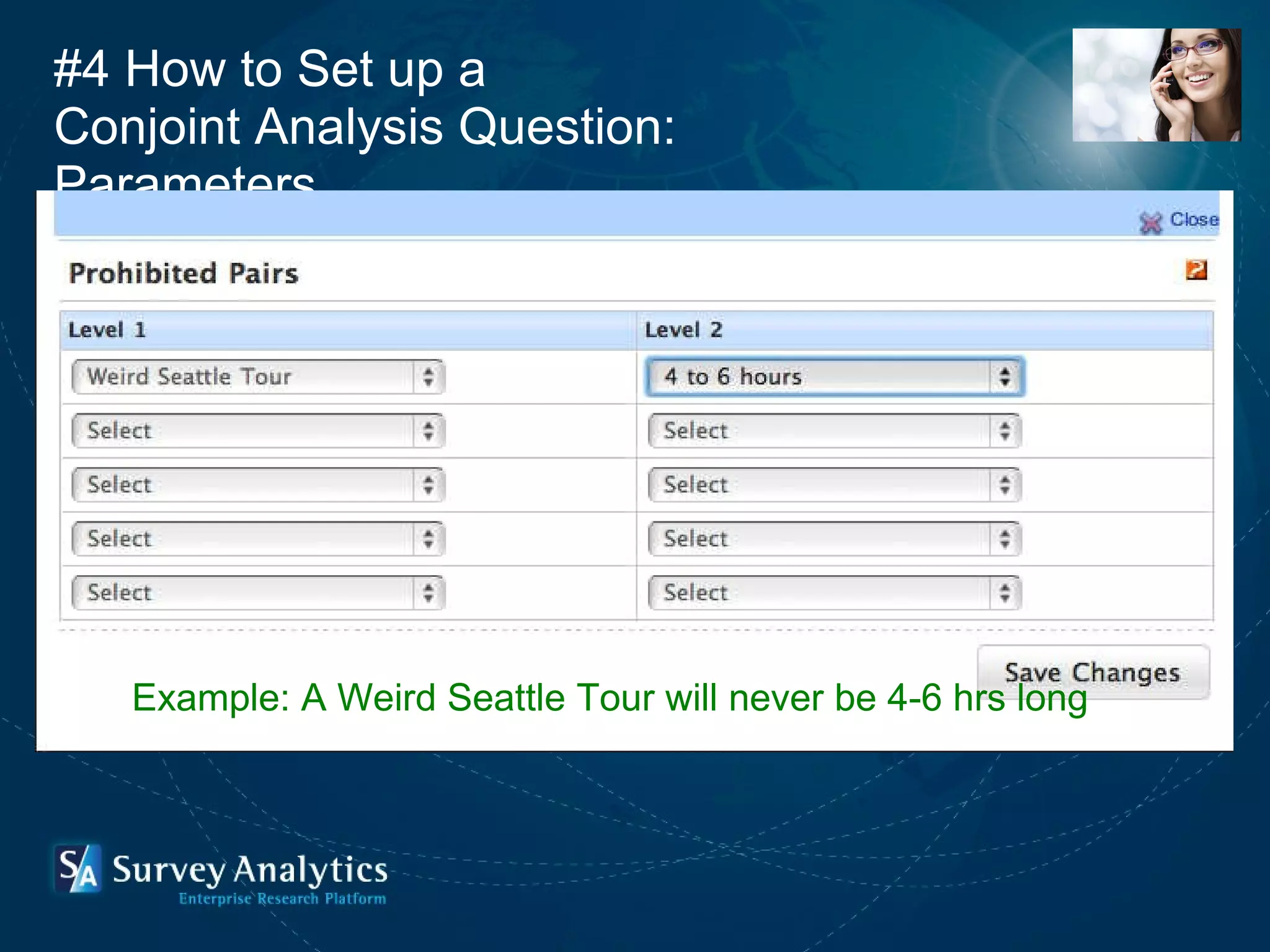
#4 How to Set up a  Conjoint Analysis Parameters 3- Set up Prohibited Pairs The engine will not display two levels that have been marked as "Prohibited" in the same concept (as a product) for the user to choose.
#4 How to Set up a  Conjoint Analysis Question: Parameters Example: A Weird Seattle Tour will never be 4-6 hrs long
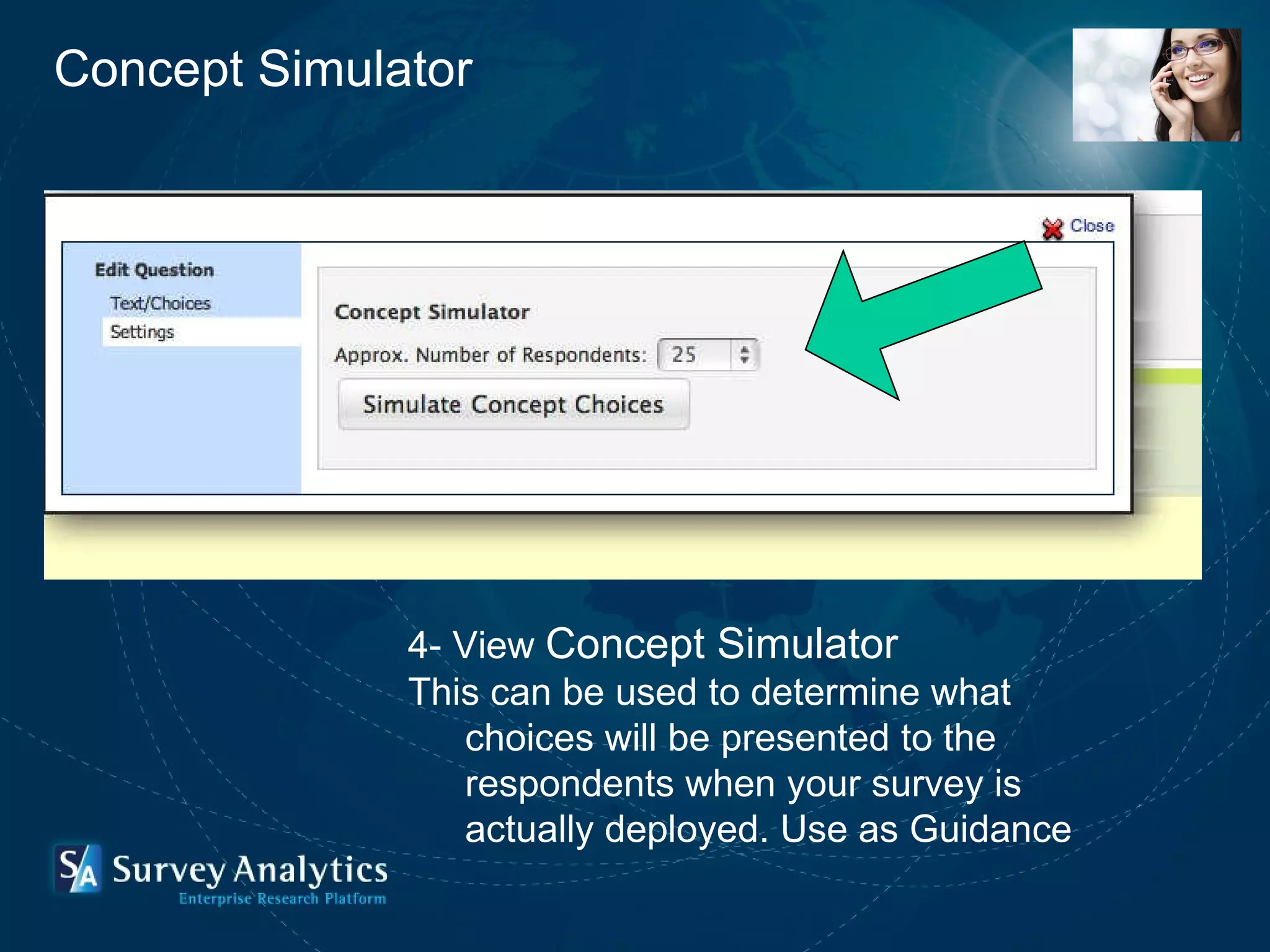
Concept Simulator 4- View  Concept Simulator This can be used to determine what choices will be presented to the respondents when your survey is actually deployed. Use as Guidance
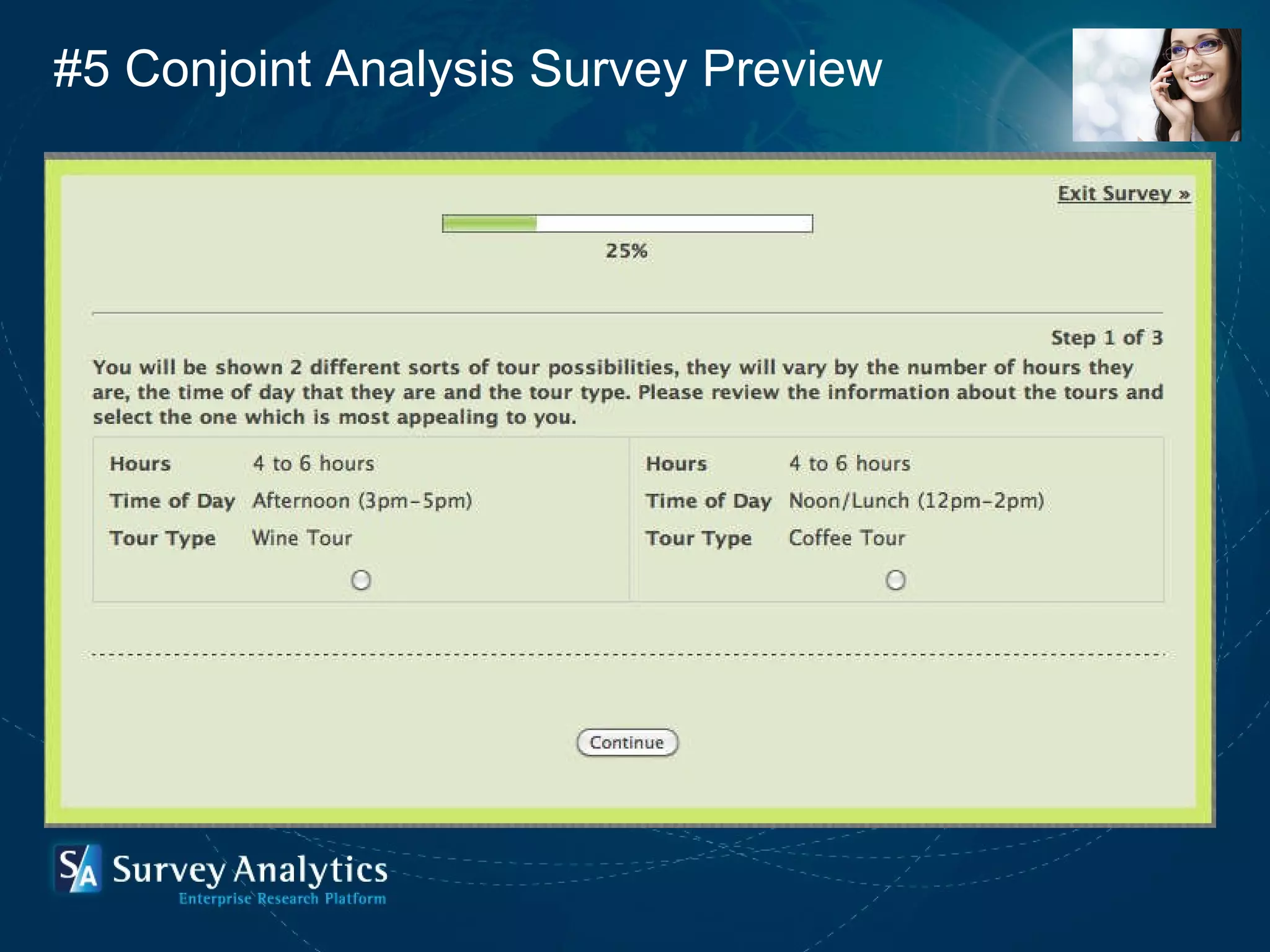
#5 Conjoint Analysis Survey Preview
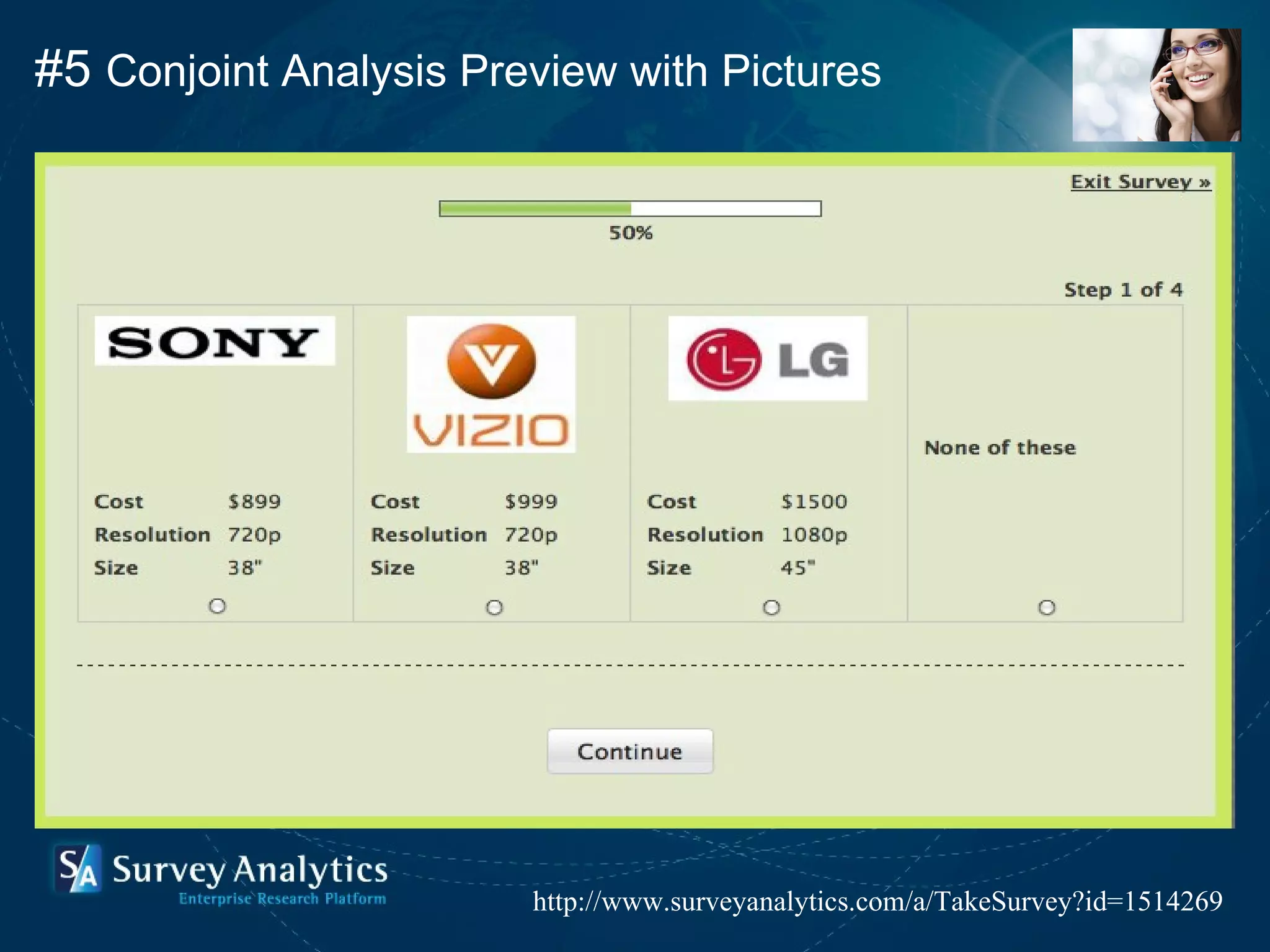
#5  Conjoint Analysis Preview with Pictures http://www.surveyanalytics.com/a/TakeSurvey?id=1514269
  #6:  Review Data:  Utility Calculation & Relative Importance
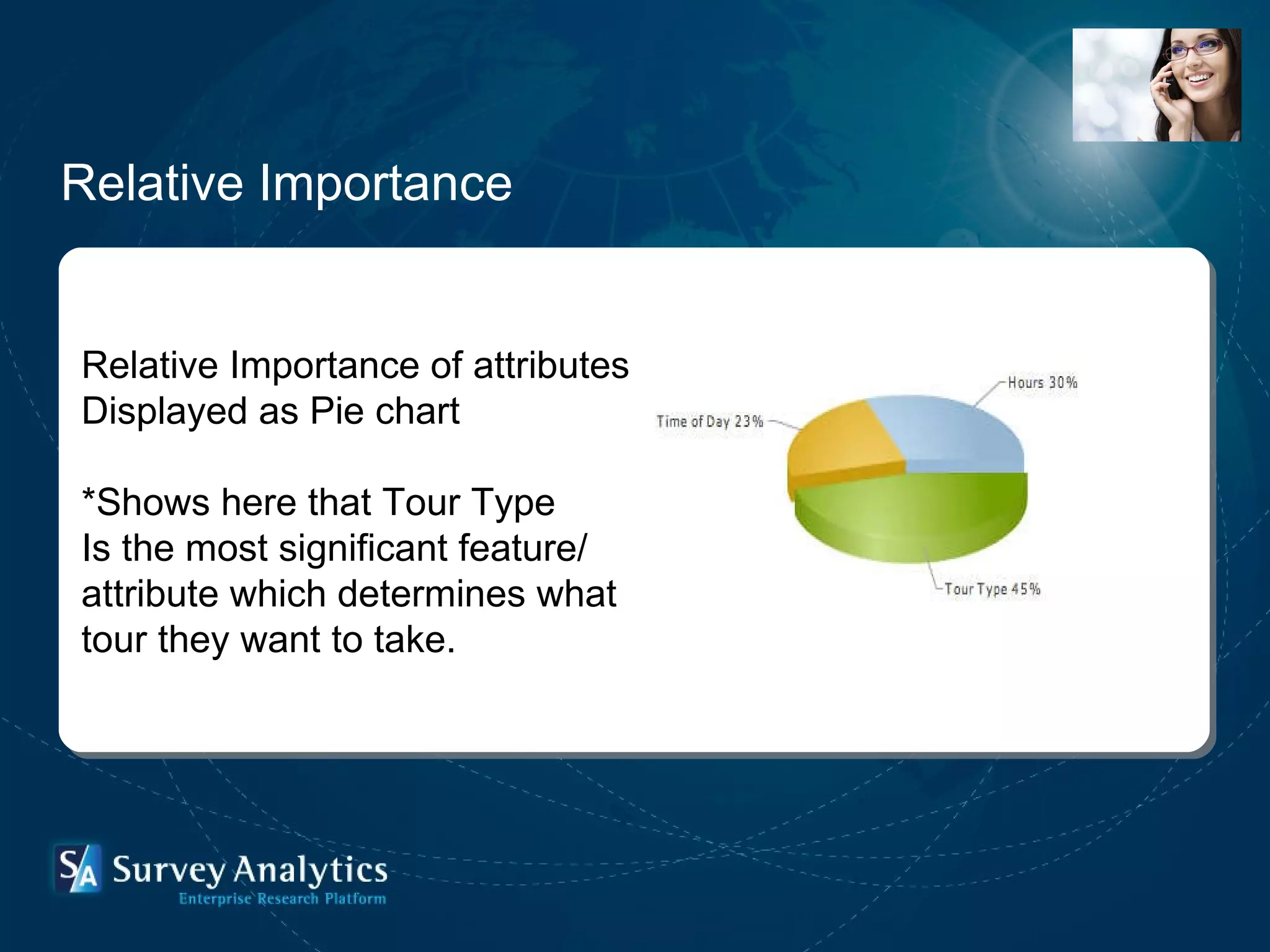
Relative Importance of attributes Displayed as Pie chart *Shows here that Tour Type Is the most significant feature/ attribute which determines what  tour they want to take. Relative Importance
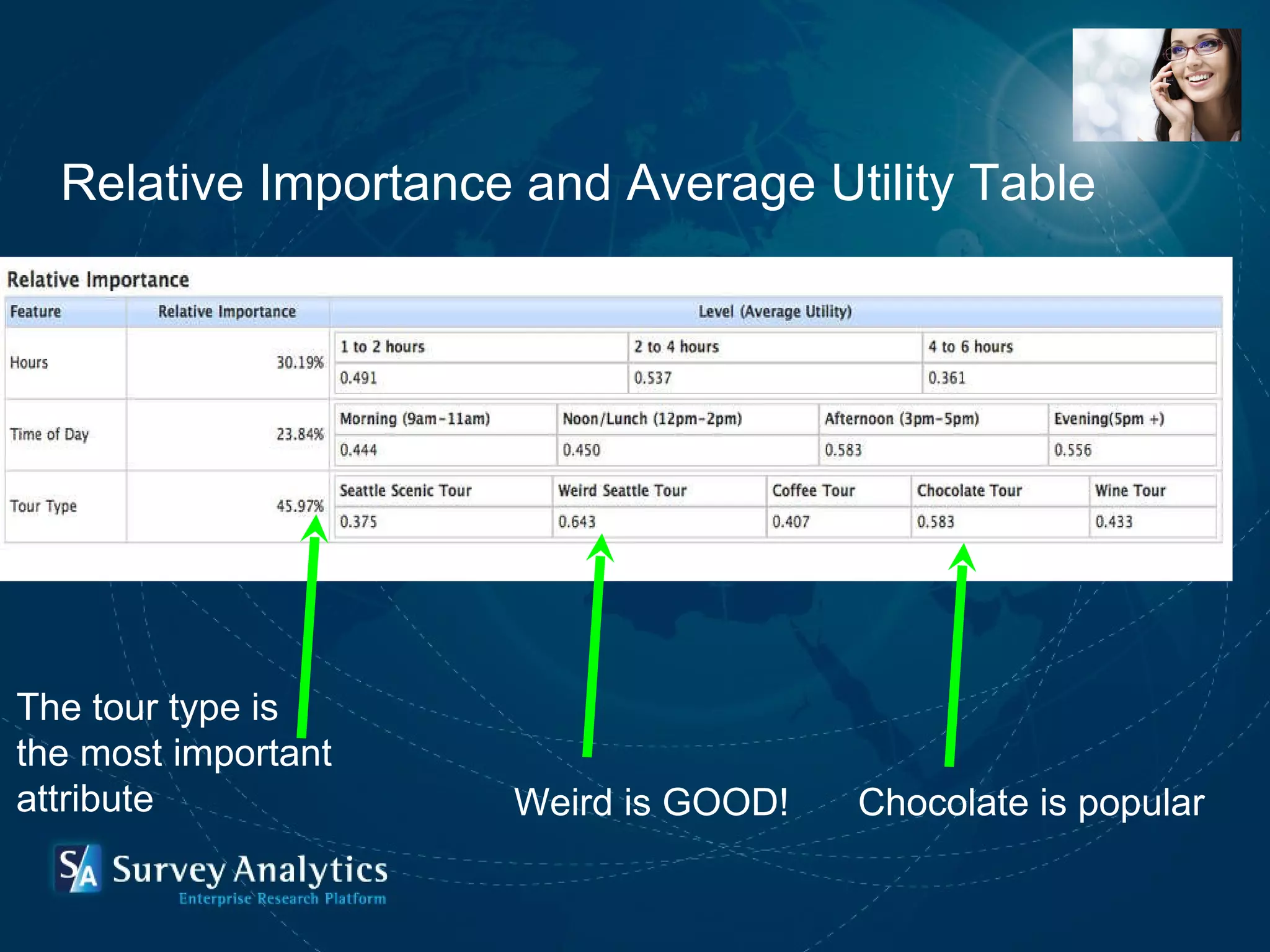
Relative Importance and Average Utility Table The tour type is the most important attribute Weird is GOOD! Chocolate is popular
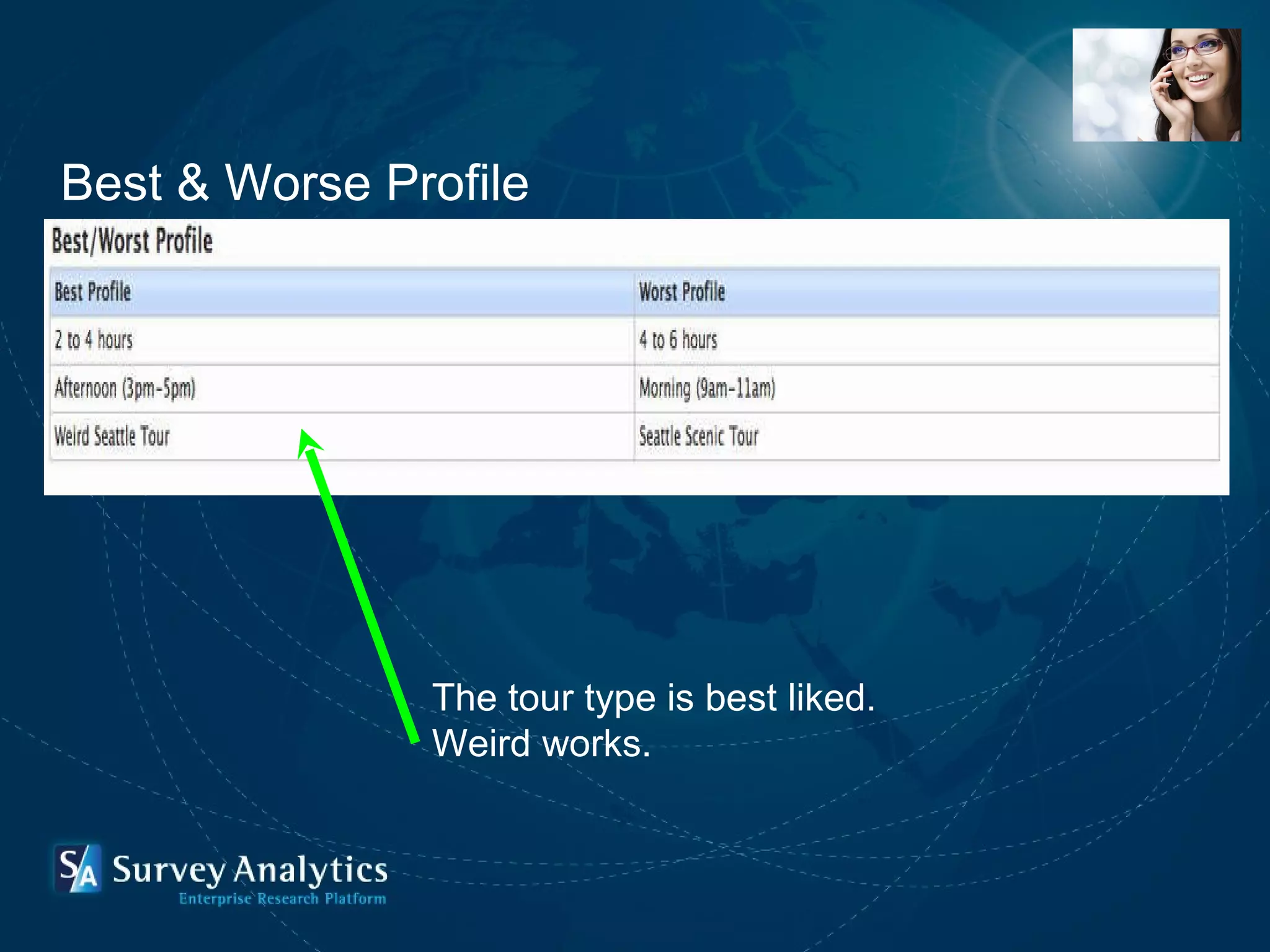
Best & Worse Profile The tour type is best liked. Weird works. The tour type is best liked. Weird works.
#7 Market Segmentation Simulator Using existing Data from Conjoint Analysis
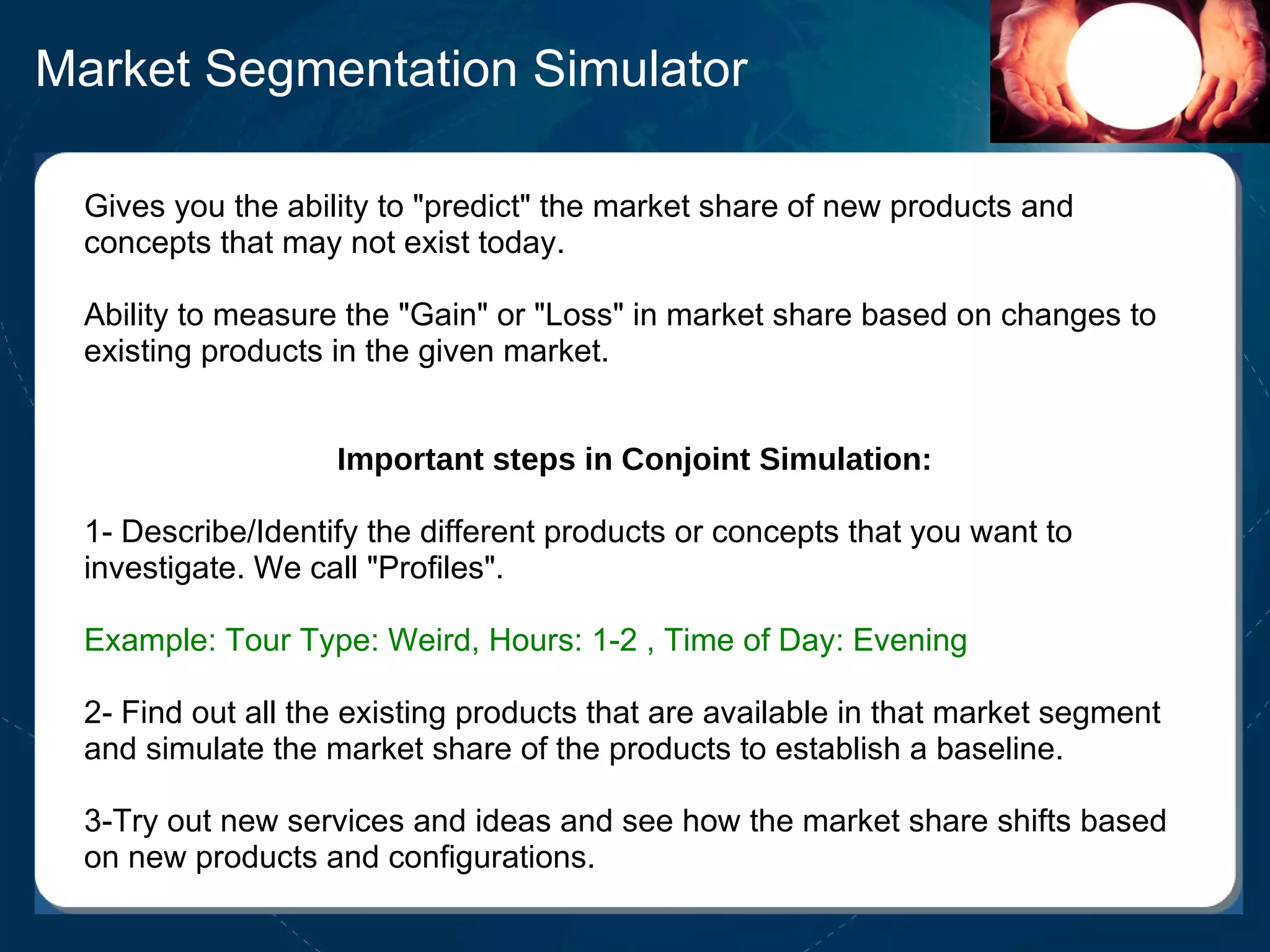
Market Segmentation Simulator Gives you the ability to "predict" the market share of new products and concepts that may not exist today.  Ability to measure the "Gain" or "Loss" in market share based on changes to existing products in the given market. Important steps in Conjoint Simulation: 1- Describe/Identify the different products or concepts that you want to investigate. We call "Profiles". Example: Tour Type: Weird, Hours: 1-2 , Time of Day: Evening 2- Find out all the existing products that are available in that market segment and simulate the market share of the products to establish a baseline.  3-Try out new services and ideas and see how the market share shifts based on new products and configurations.
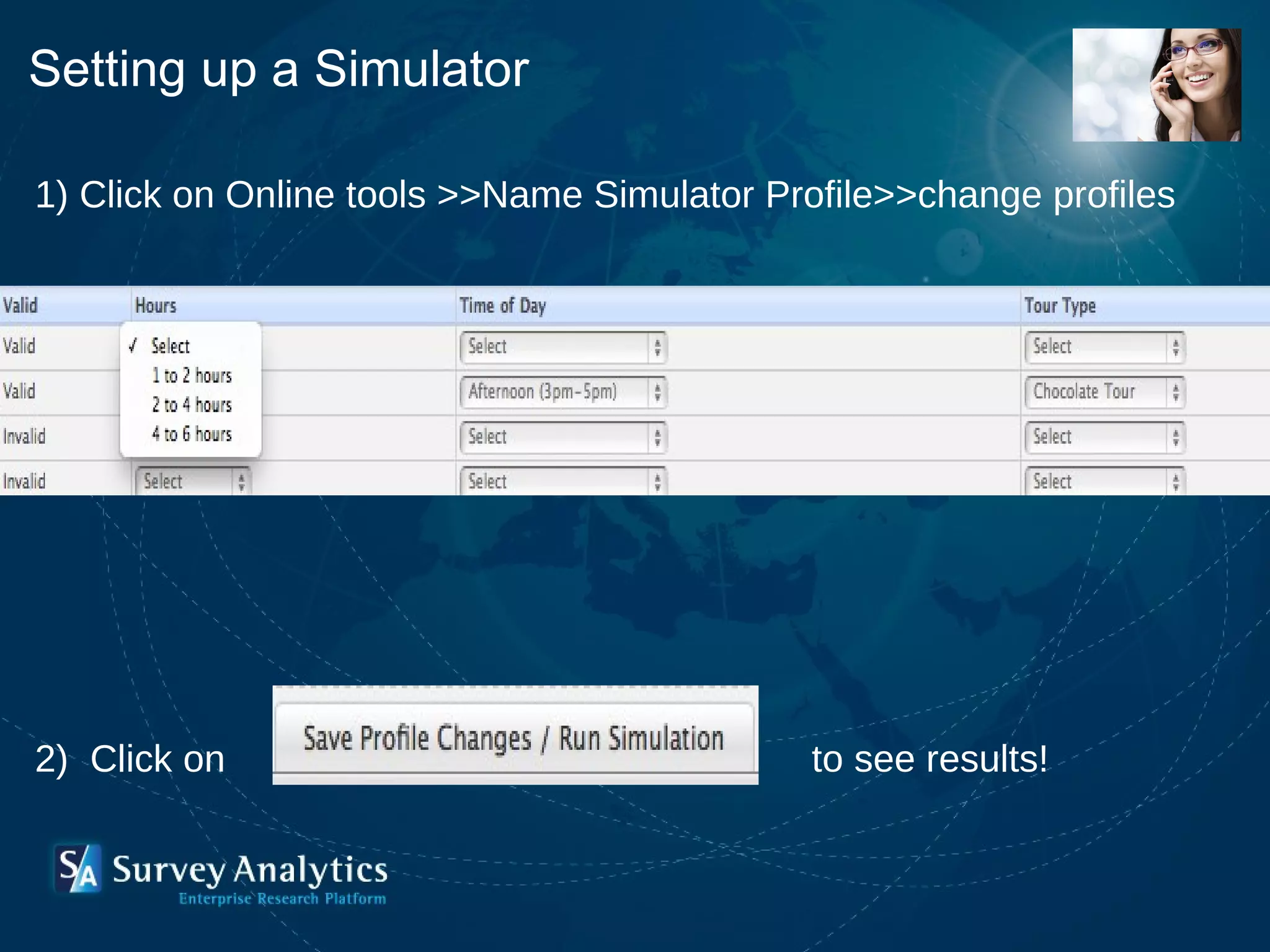
Setting up a Simulator 1) Click on Online tools >>Name Simulator Profile>>change profiles 2)  Click on  to see results!
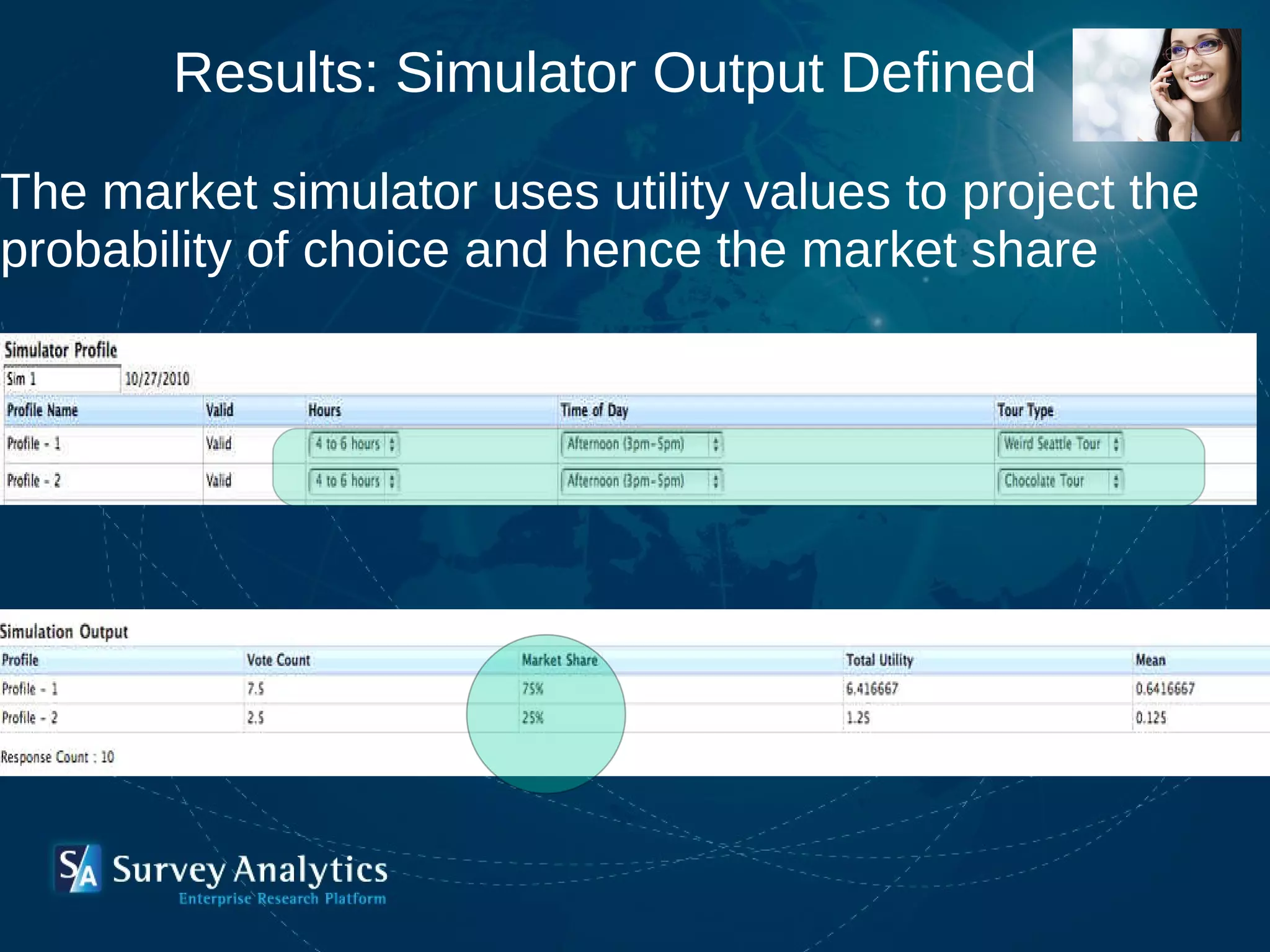
Results: Simulator Output Defined   The market simulator uses utility values to project the probability of choice and hence the market share
  Now that we know  how to use this . .      What can we ask and find out with the  Market Segmentation Simulator?
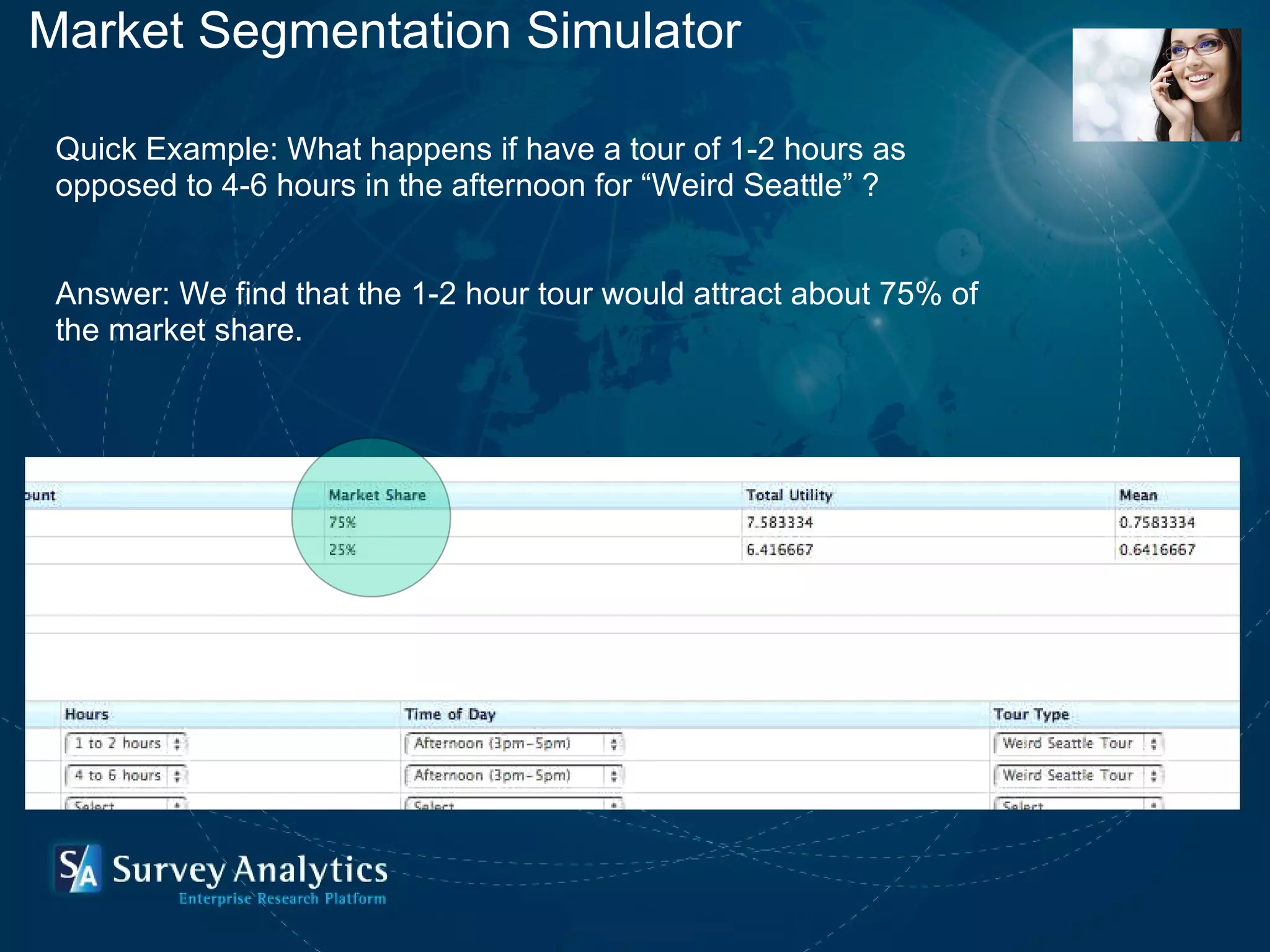
Market Segmentation Simulator Quick Example: What happens if have a tour of 1-2 hours as opposed to 4-6 hours in the afternoon for “Weird Seattle” ? Answer: We find that the 1-2 hour tour would attract about 75% of the market share.
# 8 BEST PRACTICES: Tips for A  Successful Conjoint Analysis Project
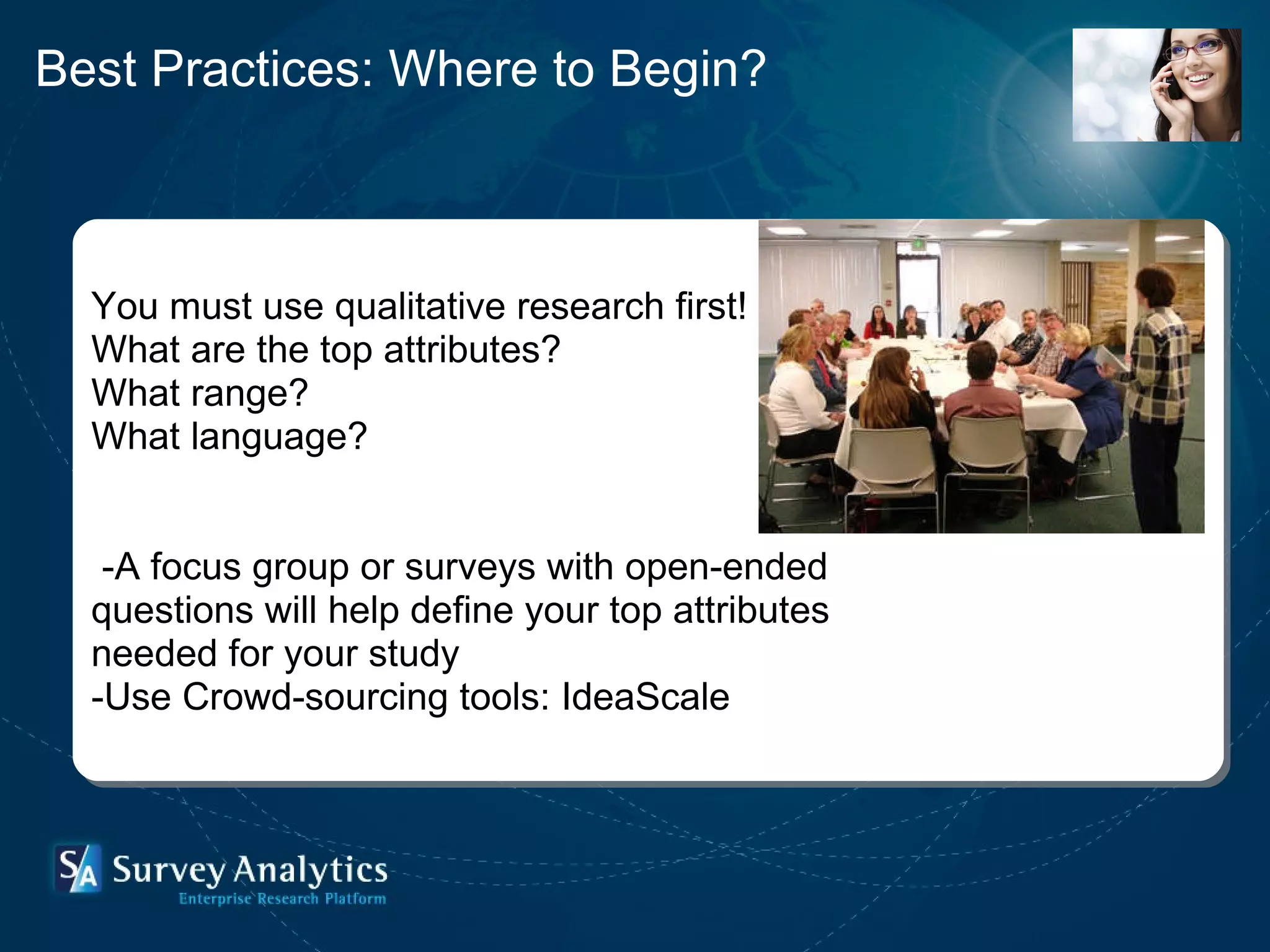
You must use qualitative research first! What are the top attributes?  What range?  What language?   -A focus group or surveys with open-ended  questions will help define your top attributes  needed for your study -Use Crowd-sourcing tools: IdeaScale  Best Practices: Where to Begin?
Sample size is a question that comes up very frequently. Richard Johnson, one of the inventors of conjoint analysis, has presented the following rule of thumb for sample size in choice based conjoint: (nta/C) > 1000 Where n = the number of respondents x t= the number of tasks x a=the number of  alternatives per task / C= the largest number of level for any one attribute. So if you have 500 respondents, 3 tasks per respondent, 2 alternatives per task  and the maximum number of levels on an attribute is 3 you get: (500 x 3 x 2) / 3 = 1000 Generally speaking sample sizes tend to be around 200 – 1200 respondents, admittedly  a wide range. 300 comes up most often for a single homogeneous group of subjects. Best Practices: Sample Size to start with?
Keep the options clear and simple as possible No more than 10-12 trade-off exercises (5-7 standard) No more than 5-6 attributes Keep the ranges simple   You can ask more intimate questions of current customers than potential  customers, but don’t let that stop you from trying! Follow general good online survey techniques  Test your survey Make it clear responses are kept strictly confidential Keep survey to 15-20 minutes Provide incentives Best Practices & Tips: Surveys with CA
Esther LaVielle SurveyAnalytics  http://www.surveyanalytics.com [email_address] Andrew Jeavons [email_address] Questions?  Conclusion

Survey analytics conjointanalysis_1

  • 1.
    Introduction LearnHow To Run A Discrete Choice Conjoint Analysis Project in Just 1 Hour
  • 2.
    Who is SurveyAnalytics?Started in 2002 in Seattle, WA #172 on Inc. 500 Fastest Growing Private Companies #12 on Puget Sound Journal's Top 100 in Washington Over 6K+ clients and growing! QuestionPro, SurveyAnalytics, IdeaScale, MicroPoll Esther LaVielle Chief Education Director  
  • 3.
    Speaker: Andrew Jeavons* SurveyAnalytics Executive Vice President, Andrew Jeavons has over 25 years in the market research industry. *He is a frequent writer and speaker for various publications and events around the country. He has a background in psychology and statistics, and currently focuses on innovation within survey research. Studied Neuropsychology at Birkbeck College in London UK, he then worked in the medical statistics department of the Institute of Neurology in London UK. Ten years + experience working with software companies in a marketing, sales and strategic development capacity. He has also written numerous articles for ESOMAR publications and a range of international conferences. *He is currently Western area convener for the New MR 2010 conference ( www.newmr.org)
  • 4.
    What is ConjointAnalysis? 2. When & Why to Choose SurveyAnalytics Over SawTooth? 3. How to Put together a Conjoint Analysis Question   Features (Attributes) and Levels for each of the features 4.  Adding Conjoint Design Parameters   5. Preview Survey 6. Review Data: Utility Calculation & Relative Importance   7. Market Segmentation Tool Filter the data based on criteria and then run Relative Importance calculations   8. Best Practice & Tips / Q&A Webinar Agenda
  • 5.
    #1: What isConjoint Analysis Type of Trade-off Analysis methodology Developed over the past 50 years by market researchers and statisticians to predict the kinds of decisions consumers will make about products by using questions in a survey. Conjoint analysis questions presents a series of possible products to consumers and asks them to make a choice about which one they would pick. The central idea: For any purchase decision consumers evaluate or “trade-off” the different characteristics of a product and decide what is more important to them. SurveyAnalytics uses Discrete Choice Conjoint Analysis which best simulates the purchase process of consumers
  • 6.
    Why use ConjointAnalysis? -It will help you evaluate new products or variations against an existing range of products already offered by your company or within the marketplace. -It’s much cheaper than developing new products for the marketplace with no guarantee of success. -Get real-time feedback on new products or variations of existing products. -Simulates the decisions your target consumers would make in the market place. -Gives you an idea how a new product with be received in the marketplace. -Gauge the affect on the choice/price relationship relative to existing products and features presented.
  • 7.
    Analysis: How dowe come up with our #s? 1) SurveyAnalytics uses Multinomial Logistic Regression for part worth (Utility Value) calculations.   *Variables in question are nominal & have 2 + categories * Used cases where the response is not ordinal in nature EXAMPLE: Determine what factors predict which major college students choose   (2) SurveyAnalytics use an Orthogonal Profile Generation function   *Any set of attributes will have a minimal set of profiles that can be generated to form a balanced design.    Have greater confidence in the results you receive!
  • 8.
    Conjoint Analysis CoreConcepts: Attributes/Feature : Define the attributes of the products for your market. These are the properties of your product. Seattle Tourism Study: #Hours, Time of Day, Tour Type 2) Levels: The different properties of the attributes. Define at least two levels for each of the attributes.  Seattle Tourism Study: Hours - 3 levels Time of day - 4 levels Tour Type: 5 levels 3) Utility Value or Part Worth functions: These are what are produced by the conjoint analysis. These can then be used to determine how important an attribute is to the purchase or choice process and in “market simulations”. Utility Value of Hrs on Tour: 1-2hrs = .39 2-4hrs = .45 4-6hrs = .32 4) Relative importance : How important an attribute is in the purchasing/choice decision ? Of all features to go on tour: Type of tour determined which one most chosen
  • 9.
    # 2: When& Why to Choose SurveyAnalytics Over Sawtooth Software:   Discrete Choice Conjoint Analysis Flexible pricing available (Contact Esther) Most User-friendly Conjoint Tool In The Market Real-time Reporting Pricing includes integrated research tools that would enhance efficiencies and depth and research strategies Dedicated account management and support included
  • 10.
    #3 How toSet up a Conjoint Analysis Question 1-Set up Features/ Attributes 2-Set up Levels for Each attributes EXAMPLE: Feature: Hours Levels: 1-2hr, 2-4hr
  • 11.
    #4 How toSet up a Conjoint Analysis Parameters 3- Set up Prohibited Pairs The engine will not display two levels that have been marked as "Prohibited" in the same concept (as a product) for the user to choose.
  • 12.
    #4 How toSet up a Conjoint Analysis Question: Parameters Example: A Weird Seattle Tour will never be 4-6 hrs long
  • 13.
    Concept Simulator 4-View Concept Simulator This can be used to determine what choices will be presented to the respondents when your survey is actually deployed. Use as Guidance
  • 14.
    #5 Conjoint AnalysisSurvey Preview
  • 15.
    #5 ConjointAnalysis Preview with Pictures http://www.surveyanalytics.com/a/TakeSurvey?id=1514269
  • 16.
      #6: Review Data: Utility Calculation & Relative Importance
  • 17.
    Relative Importance ofattributes Displayed as Pie chart *Shows here that Tour Type Is the most significant feature/ attribute which determines what tour they want to take. Relative Importance
  • 18.
    Relative Importance andAverage Utility Table The tour type is the most important attribute Weird is GOOD! Chocolate is popular
  • 19.
    Best & WorseProfile The tour type is best liked. Weird works. The tour type is best liked. Weird works.
  • 20.
    #7 Market SegmentationSimulator Using existing Data from Conjoint Analysis
  • 21.
    Market Segmentation SimulatorGives you the ability to "predict" the market share of new products and concepts that may not exist today. Ability to measure the "Gain" or "Loss" in market share based on changes to existing products in the given market. Important steps in Conjoint Simulation: 1- Describe/Identify the different products or concepts that you want to investigate. We call "Profiles". Example: Tour Type: Weird, Hours: 1-2 , Time of Day: Evening 2- Find out all the existing products that are available in that market segment and simulate the market share of the products to establish a baseline. 3-Try out new services and ideas and see how the market share shifts based on new products and configurations.
  • 22.
    Setting up aSimulator 1) Click on Online tools >>Name Simulator Profile>>change profiles 2) Click on to see results!
  • 23.
    Results: Simulator OutputDefined   The market simulator uses utility values to project the probability of choice and hence the market share
  • 24.
      Now thatwe know  how to use this . .     What can we ask and find out with the  Market Segmentation Simulator?
  • 25.
    Market Segmentation SimulatorQuick Example: What happens if have a tour of 1-2 hours as opposed to 4-6 hours in the afternoon for “Weird Seattle” ? Answer: We find that the 1-2 hour tour would attract about 75% of the market share.
  • 26.
    # 8 BESTPRACTICES: Tips for A Successful Conjoint Analysis Project
  • 27.
    You must usequalitative research first! What are the top attributes?  What range?  What language?   -A focus group or surveys with open-ended  questions will help define your top attributes  needed for your study -Use Crowd-sourcing tools: IdeaScale Best Practices: Where to Begin?
  • 28.
    Sample size isa question that comes up very frequently. Richard Johnson, one of the inventors of conjoint analysis, has presented the following rule of thumb for sample size in choice based conjoint: (nta/C) > 1000 Where n = the number of respondents x t= the number of tasks x a=the number of alternatives per task / C= the largest number of level for any one attribute. So if you have 500 respondents, 3 tasks per respondent, 2 alternatives per task and the maximum number of levels on an attribute is 3 you get: (500 x 3 x 2) / 3 = 1000 Generally speaking sample sizes tend to be around 200 – 1200 respondents, admittedly a wide range. 300 comes up most often for a single homogeneous group of subjects. Best Practices: Sample Size to start with?
  • 29.
    Keep the optionsclear and simple as possible No more than 10-12 trade-off exercises (5-7 standard) No more than 5-6 attributes Keep the ranges simple   You can ask more intimate questions of current customers than potential customers, but don’t let that stop you from trying! Follow general good online survey techniques Test your survey Make it clear responses are kept strictly confidential Keep survey to 15-20 minutes Provide incentives Best Practices & Tips: Surveys with CA
  • 30.
    Esther LaVielle SurveyAnalytics http://www.surveyanalytics.com [email_address] Andrew Jeavons [email_address] Questions? Conclusion

Editor's Notes

  • #6 Below you will see 4 different digital cameras: Which one would you choose to buy? Before you would make that decision many people would look at the features such as memory storage, battery, wireless capabilities, video, zoom, flash, pixels, & pricing. Within those features you would compare the differences within those features: Zoom: 1x vs 5x zoom, Video: 2min or 5 min max length.