New Ways to Answer Old Questions:  Conjoint analysis takes the guesswork out of pharmaceutical marketing decisions Presented By: Phil Serak Crystal Behrendt
In today’s world of marketing, these are questions frequently asked by marketing managers. How should I price my new product? Will I be able to maintain sales revenues given the new competition? How sensitive is my market share? Are my products positioned well in the market? Can I improve my product and market position?
Problems Discussed Chances are excellent that the market for a company’s product or service offering has changed or is about to change. Constant growth of private labels and generics Innovative new products New marketing practices Consumers change of preference The forces of intensified competition and changing consumer preferences pose significant and real threats to the cherished consumer franchises.
Beta Company Specializes in a liquid dietary supplement Competitors: Gamma and Delta  Concerns:  Changes in product   attributes  What's the ideal product to add What are the competitors ideal products that they can add?
Background Information (Cont.) Past Present In the past the mentioned questions on our first slide were used to provide information about a market.  Often times though, they couldn’t gather the needed information because consumer’s preferences couldn’t be assessed correctly and any info gathered was in fact useless  New developments in marketing research have made it possible for information to be gathered more accurately (info such as trade-offs consumers make, gains/loses in market share, sales volume, gross profit)
Methodology Conjoint Analysis First introduced in marketing in the early 1960’s Every year hundreds of conjoint studies are performed  Found in many areas Popular in the telecommunication and Pharmaceutical sectors
Methodology Conjoint Analysis Requires participants to make a series of trade-offs between products The analysis of the trade-off reveals the importance of the attributes of each product being decided between
Solutions Proposed  Line Extension: Introduce new product, Beta2 Change product attributes: Turn current product into ideal product
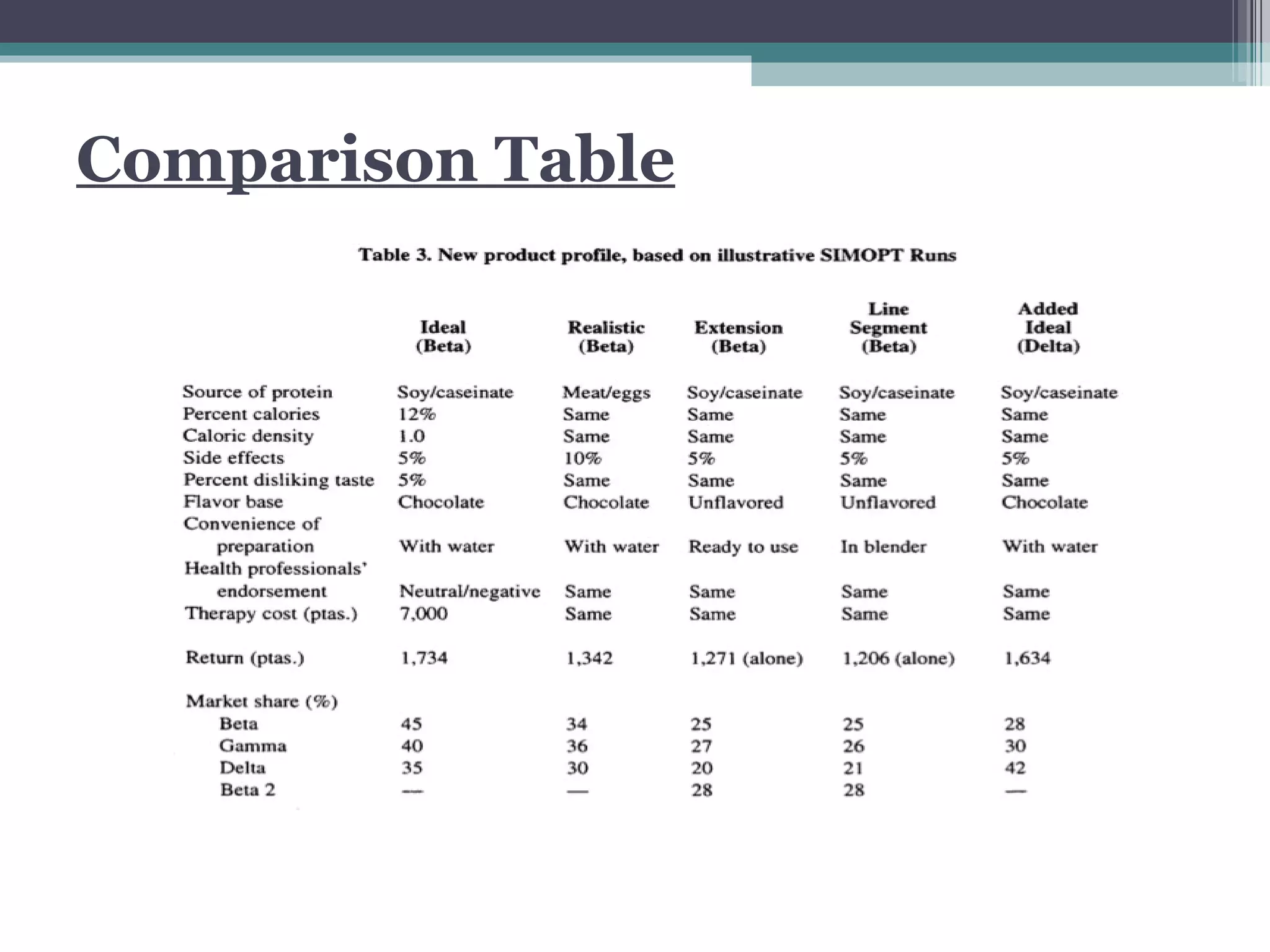
Comparison Table
Solutions Proposed (Cont.) After studying the alternative choices Beta Company decided to introduce the line extension Beta2 Though no market share information and info about their financial return were given in the article, the extension itself had been viewed as successful
Take Home lessons Conjoint analysis is used in many different industries:  Marketing Product Management Operations Research Also used for many different reasons:  Test customer acceptance of new product designs Appeal of advertisements Service design  Product positioning
Limitations Designing conjoint studies can be complex With too many options, respondents resort to simplification strategies Difficult to use for product positioning research because there is no procedure for converting perceptions about actual features to perceptions about a reduced set of underlying features Respondents are unable to articulate attitudes toward new categories, or may feel forced to think about issues they would otherwise not give much thought to Poorly designed studies may over-value emotional/preference variables and undervalue concrete variables Does not take into account the number items per purchase so it can give a poor reading of market share
Questions?

Conjoint Analysis

  • 1.
    New Ways toAnswer Old Questions: Conjoint analysis takes the guesswork out of pharmaceutical marketing decisions Presented By: Phil Serak Crystal Behrendt
  • 2.
    In today’s worldof marketing, these are questions frequently asked by marketing managers. How should I price my new product? Will I be able to maintain sales revenues given the new competition? How sensitive is my market share? Are my products positioned well in the market? Can I improve my product and market position?
  • 3.
    Problems Discussed Chancesare excellent that the market for a company’s product or service offering has changed or is about to change. Constant growth of private labels and generics Innovative new products New marketing practices Consumers change of preference The forces of intensified competition and changing consumer preferences pose significant and real threats to the cherished consumer franchises.
  • 4.
    Beta Company Specializesin a liquid dietary supplement Competitors: Gamma and Delta Concerns: Changes in product attributes What's the ideal product to add What are the competitors ideal products that they can add?
  • 5.
    Background Information (Cont.)Past Present In the past the mentioned questions on our first slide were used to provide information about a market. Often times though, they couldn’t gather the needed information because consumer’s preferences couldn’t be assessed correctly and any info gathered was in fact useless New developments in marketing research have made it possible for information to be gathered more accurately (info such as trade-offs consumers make, gains/loses in market share, sales volume, gross profit)
  • 6.
    Methodology Conjoint AnalysisFirst introduced in marketing in the early 1960’s Every year hundreds of conjoint studies are performed Found in many areas Popular in the telecommunication and Pharmaceutical sectors
  • 7.
    Methodology Conjoint AnalysisRequires participants to make a series of trade-offs between products The analysis of the trade-off reveals the importance of the attributes of each product being decided between
  • 8.
    Solutions Proposed Line Extension: Introduce new product, Beta2 Change product attributes: Turn current product into ideal product
  • 9.
  • 10.
    Solutions Proposed (Cont.)After studying the alternative choices Beta Company decided to introduce the line extension Beta2 Though no market share information and info about their financial return were given in the article, the extension itself had been viewed as successful
  • 11.
    Take Home lessonsConjoint analysis is used in many different industries: Marketing Product Management Operations Research Also used for many different reasons: Test customer acceptance of new product designs Appeal of advertisements Service design Product positioning
  • 12.
    Limitations Designing conjointstudies can be complex With too many options, respondents resort to simplification strategies Difficult to use for product positioning research because there is no procedure for converting perceptions about actual features to perceptions about a reduced set of underlying features Respondents are unable to articulate attitudes toward new categories, or may feel forced to think about issues they would otherwise not give much thought to Poorly designed studies may over-value emotional/preference variables and undervalue concrete variables Does not take into account the number items per purchase so it can give a poor reading of market share
  • 13.

Editor's Notes

  • #4 In some industries competition comes from the constant growth of private labels and generics, in others it comes from innovative new products, and marketing practices like everyday low pricing. But on the other hand, there are the consumers who change their preferences over the years which also creates constant competition.
  • #5 Background Information -had a case study in the article about a pharmaceutical firm known as the Beta Company that specializes in a liquid dietary supplement that was primarily sold to hospitals -they received competition from counterparts Gamma and Delta who were the remaining major suppliers in the market (coincidence they’re all Greek letters?) -because of strong competition, Beta wanted answers to: -how sensitive is Beta’s market share and return to changes in product attributes such as source of protein, % calories from protein? Etc -w/ no change in competitors offerings, what’s Beta’s product profile from a financial return viewpoint? -assuming Beta wants to add another product, what would the ideal product be given the existing product line and competition from Delta/Gamma? -what should the new product be/what’s the return to Beta? -if Beta offers a new product, what is Delta’s ideal product offering? results found are measured in values known as part-worths (revealed importance of an attribute)
  • #7 Found in many areas such as bar soaps, shampoos, car cleaners, financial services, industrial goods and transportation.
  • #8 Conjoint analysis estimates psychological tradeoffs that consumers make when evaluating several attributes together. It measures the preference of each attribute at the individual level
  • #9 Management at Beta Company wanted to evaluate the impact of adding a second product to its existing line. After using conjoint analysis they found that if they added a new product the effect of cannibalization would reduce Beta’s market share to 25% from 36%. The new product, Beta2, would achieve market share of 28%. Total market share would equal 53% Beta Company also considered changing the product attributes of their current product. If they replaced their current Beta with the ideal product, their market share would theoretically increase from 36% to 45%.
  • #10 This is the table Beta Company used to compare outcomes of introducing a new product and changing their current product. This table also takes into account what the competitor’s retaliation would be.
  • #11 After studying the alternative choices Beta Company decided to introduce the line extension Beta2. the extension itself had been viewed as successful
  • #12 Today it is used in many of the social sciences and applied sciences including marketing , product management , and operations research . It is used frequently in testing customer acceptance of new product designs , in assessing the appeal of advertisements and in service design . It has been used in product positioning . But there are some who raise problems with this application of conjoint analysis
  • #13 Conjoint analysis has many limitations. It can be complex, respondents may feel overwhelmed with too many options, poorly developed studies may over-value and under-value certain variables, and it doesn’t always give an accurate reading of the market share.