Global Academy Of Technology
Department of CSE
10CS85 - A Decentralized Cloud Firewall
Framework with Resources Provisioning
Cost Optimization
GUIDE – Dr. LATHA C A ALOK KUMAR(1GA12CS007)
Professor G. AISHWARYA(1GA12CS024)
GAURAV KUMAR MISHRA(1GA12CS025)
KULKARNI KEDAR RAVINDRA(1GA12CS042)
Index
• Objective
• Introduction
• Proposed System
• Architecture
• System requirement
• System Design
• Implementation
• Testing
• Conclusion
• Bibliography
2
Objective
• To optimize resources provisioning cost, while satisfying QoS
requirement at the same time.
• To establish a firewall to protect the cloud resources from the
attacks.
Introduction
• Cloud computing is a new flexible approach for providing higher
computational power in shared medium.
• It provides the distributed model based on self-evaluating techniques to
improve the processing capabilities of the system with lesser managerial
concerns.
• It is made up of client, application, platform, servers and infrastructures.
• we propose a decentralized cloud firewall framework.
• Firewalls are the first line when defending against malicious traffic.
• The cloud firewall is offered by Cloud Service Providers (CSP) and placed
at access points between cloud data center and the Internet.
Proposed System
• In proposed system, the system propose a decentralized cloud
firewall framework for individual cloud customers.
• We introduce novel queuing theory based model M/Geo/1 or
M/Geo/m for performance analysis of the proposed cloud
firewall.
• The system establish a mathematical model according to cloud
firewall rule matching discipline and derive that system
service times follow geometric distribution.
ADVANTAGES
• Resources are dynamically allocated to optimize the
provisioning cost, and guarantee QoS requirement specified by
customers at the same time.
• The simulation results claim that geometric distribution is
more suitable for firewall system modeling.
• It give a deep insight into tradeoff among optimal resources
provisioning cost.
• The system formulate the resources provisioning cost.
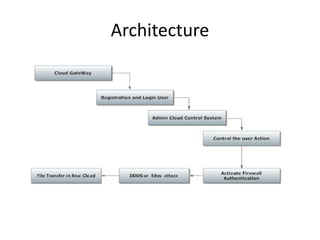
Architecture
System Requirements
SOFTWARE REQUIREMENTS:
• O/S : Windows XP / 7 / 8
• Language : Java.
• IDE : Eclipse
• Data Base : MySql
System Requirements
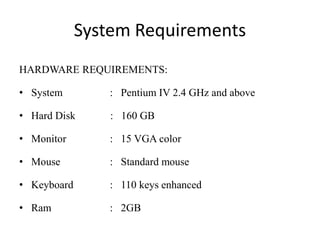
HARDWARE REQUIREMENTS:
• System : Pentium IV 2.4 GHz and above
• Hard Disk : 160 GB
• Monitor : 15 VGA color
• Mouse : Standard mouse
• Keyboard : 110 keys enhanced
• Ram : 2GB
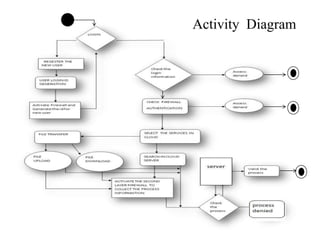
Activity Diagram
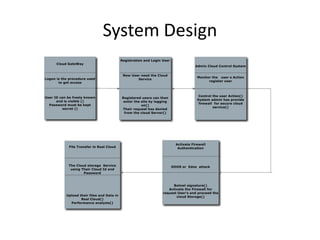
System Design
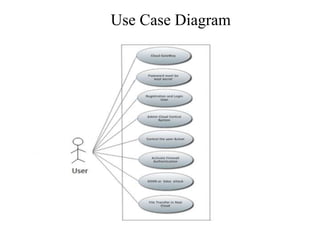
Use Case Diagram
Implementation
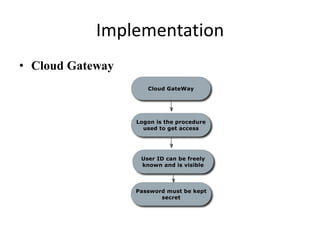
Cloud Gateway
• In general computer usage, login is the procedure used to get access to an
operating system or application,
• The user ID can be freely known and is visible when entered at a keyboard
or other input device.
• The password must be kept secret (and is not displayed as it is entered).
• The Users and admin has login using this panel If the client is a user, they
go users further more Action, if the person is admin.
• They go the Admin login panel for proceed their Action
Implementation
• Cloud Gateway
Implementation
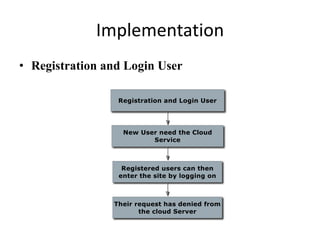
Registration and Login User
• If new User need the Cloud Service.
• That users should register in site to use our service , registered users can
then enter the site by logging on.
• Who’s doesn’t have register in cloud they doesn’t use the cloud
services. And their request has denied from the cloud Server.
Implementation
• Registration and Login User
Implementation
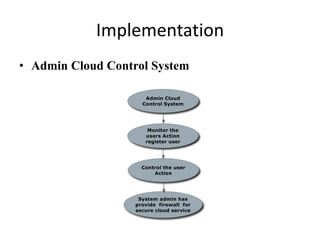
Admin Cloud Control System
• System Admin Monitor the user s Action register user action if
untrusted means, their permission’s are denied, that user id has removed
from server.
• Control the user Action.
• If user request the firewall. System admin has provide firewall for
secure cloud service.
• So they monitor Firewall cloud user and all users.
Implementation
• Admin Cloud Control System
Implementation
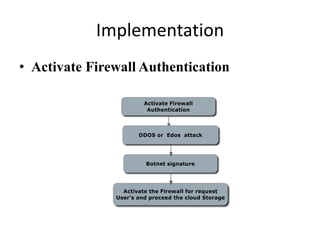
Activate Firewall Authentication
• If the User need Cloud Storage , they should have Firewall.
• Because maximum of the user request has DDOS or Edos attack or Botnet
signature in their file.
• This virus signature File affect the cloud service in server level. And total it
collapse the and attack is launch in server level.
• To Avoid these Attacks and prevent the cloud by way the Activate firewall.
• So here the user id and password we Request the firewall to the System admin.
Admin has Activate the Firewall for request User’s and proceed the cloud Storage.
Implementation
• Activate Firewall Authentication
Implementation
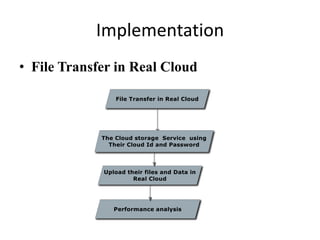
File Transfer in Real Cloud
• The User enter The Cloud storage Service using Their Cloud Id and
Password.
• But The User Store their Detail in real Cloud They must have Activate
Firewall.
• After Verify The Firewall Id And Then we upload The Our files and Data
in Real Cloud.
• The Users Doesn’t have Firewall Activation their Cloud service Has
Denied.
• Because The file Maybe attached in Virus signature.
Implementation
• File Transfer in Real Cloud
Testing
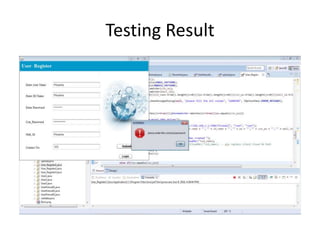
• Test Case ID: 2
• Description: Manual Testing on User Registration
• Modules: Registration and Login User
• Prepared By: Gaurav Kumar Mishra
• Date Prepared: 26/04/2016
• Reviewed / Updated: G. Aishwarya
• Date Reviewed: 27/04/2016
• Tested By: Kedar Ravindra Kulkarni
• Date Tested: 27/04/2016
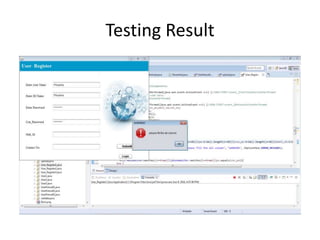
• Step Description: If new User, Registration should be done
• Expected Results: User should enter all his/her details and
successfully register. Once registration is done, one new row should be
created in user table.
• Actual Result: Pass
Testing Result
Testing Result
Testing
• Test Case ID:10
• Description: Manual Testing on User Login Module
• Modules: Registration and Login User
• Prepared By: Gaurav Kumar Mishra
• Date Prepared: 26/04/2016
• Reviewed / Updated: Kedar Ravindra Kulkarni, Alok Kumar
• Date Reviewed: 27/04/2016
• Tested By: Alok Kumar
• Date Tested: 27/04/2016
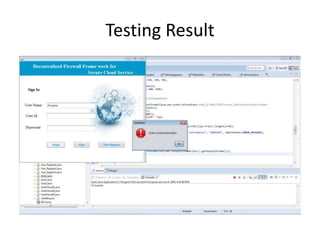
• Step Description: Admin view the user details
• Expected Results: Admin should be able to view the user details and
firewall details.
• Actual Result: Pass
Testing Result
Conclusion
• We propose a Cloud Trust framework, where several firewall
running in parallel to guarantee QoS requirement.
• As resources are dynamically allocated in Cloud Trust, we
investigate how to optimize the resources provisioning cost.
• We establish novel queuing theory based model for
performance analysis of the proposed Cloud Trust, where
firewall service times are modeled to follow geometric
distribution.
• Extensive simulations confirm that M/Geo/1 reflects the
Cloud Trust real system better than traditional Model.
Bibliography
• Z. Xiao and Y. Xiao, “Security and privacy in cloud computing,”IEEE Commun.
Surveys Tuts., vol. 15, no. 2, pp. 843–859, May 2013.
• C. Hoff. (2008). Cloud computing security: From ddos attack (dis-tributed denial
of servie) to edos (economic denial of sustainabil-ity) [Online]. Available:
http://www.rationalsurvivability.com/blog/?p=66.
• T. Ristenpart, E. Tromer, H. Shacham, and S. Savage, “Hey, you, get off of my
cloud: Exploring information leakage in third-party compute clouds,” in Proc. 16th
ACM Conf. Comput. Commun. Secu-rity , 2009, pp. 199–212.
• K. Salah, K. Elbadawi, and R. Boutaba, “Performance modeling and analysis of
network firewalls,” IEEE Trans. Netw. Serv. Man-age. , vol. 9, no. 1, pp. 12–21,
Mar. 2012