T.SRAVANI
(11541A0538)
G.KOTESWARA RAO M.ABHILASH
(11541A0509) (11541A0521)
P.SHEETALCHAITANYA M.VASUDEVA REDDY
(11541A0529) (11541A0515)
Under The Guidence Of
G.SURESH KUMAR, M.Tech
CONTENTS
 Introduction
 Abstract
 Existing System
 Proposed System
 System Architecture
 Modules
 System Requirements
INTRODUCTION
 The word Cloud Computing mean?
 What does Cloud Computing mean?
 In the Cloud Computing the apps and files are hosted
consisting of thousands of computers and servers &and
linked together ,they are accessed via internet.
 By using Cloud Computing we can access all the apps and
documents from anywhere in the world.
ABSTRACT
 Data sharing is an important functionality in cloud storage.
 Here we show how to securely, efficiently, and flexibly
share data with others in cloud storage.
 We describe new public-key cryptosystems that produce
constant-size ciphertexts.
 One can aggregate any set of secret keys and make them as
compact as a single key, but encompassing the power of all
the keys being aggregated.
 The secret key holder can release a constant-size
aggregate key for flexible choices of ciphertext set.
 This compact aggregate key can be conveniently sent
to others or be stored in a smart card with very
limited secure storage.
 We also describe other application of our schemes.
 In particular, our schemes give the first public-key
patient-controlled encryption for flexible hierarchy,
which was yet to be known.
EXISTING SYSTEM
 Considering data privacy, a traditional way to ensure
it is to access control after authentication, which
means any unexpected privilege escalation will
expose all data.
 In a shared-tenancy cloud computing environment,
things become even worse.
 Regarding availability of files, there are a series of
cryptographic schemes which go as far as allowing a
third-party auditor to check the availability of files of
the data owner without leaking
DISADVANTAGES OF EXISTING SYSTEM
 The costs and complexities involved generally
increase with the number of the decryption keys
to be shared.
 The encryption key and decryption key are
different in publickey encryption.
PROPOSED SYSTEM
 In this paper, we study how to make a decryption key
more powerful in the sense that it allows decryption
of multiple ciphertexts, without increasing its size.
 Specifically, our problem statement is “To design an
efficient public-key encryption scheme which
supports flexible delegation in the sense that
any subset of the ciphertexts is decry ptable by a
constant-size decryption key ”.
 We solve this problem by introducing a special type
of public-key encryption which we call key-aggregate
cryptosystem (KAC).
 In KAC, users encrypt a message not only under a
public-key, but also under an identifier of
ciphertext called class.
 The key owner holds a master-secret called
master-secret key, which can be used to extract
secret keys for different classes.
 the extracted key have can be an aggregate key
which is as compact as a secret key for a single
class, but aggregates the power of many such
keys
ADVANTAGES OF PROPOSED SYSTEM
 The extracted key have can be an aggregate key
which is as compact as a secret key for a single
class.
 The delegation of decryption can be efficiently
implemented with the aggregate key.
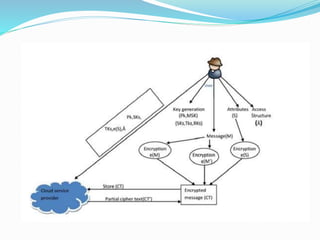
SYSTEM ARCHITECTURE
MODULES
 Setup Phase
 Encrypt Phase
 Key Gen Phase
 Decrypt Phase
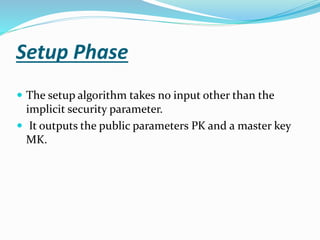
Setup Phase
 The setup algorithm takes no input other than the
implicit security parameter.
 It outputs the public parameters PK and a master key
MK.
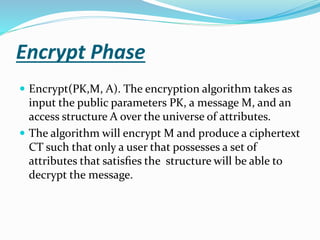
Encrypt Phase
 Encrypt(PK,M, A). The encryption algorithm takes as
input the public parameters PK, a message M, and an
access structure A over the universe of attributes.
 The algorithm will encrypt M and produce a ciphertext
CT such that only a user that possesses a set of
attributes that satisfies the structure will be able to
decrypt the message.
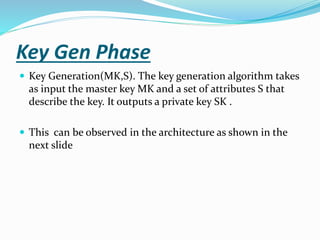
Key Gen Phase
 Key Generation(MK,S). The key generation algorithm takes
as input the master key MK and a set of attributes S that
describe the key. It outputs a private key SK .
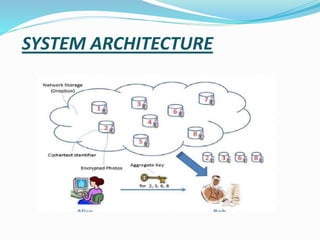
 This can be observed in the architecture as shown in the
next slide
Decrypt Phase
 Decrypt(PK, CT, SK). The decryption algorithm takes
as input the public parameters PK, a ciphertext CT,
which contains an access policy A, and a privatekey SK,
which is a private key for a set S of attributes.
 If the set S of attributes satisfies the access structure A
then the algorithm will decrypt the ciphertext and
return a message M.
SYSTEM REQUIREMENTS
HARDWARE REQUIREMENTS:-
 System : Intel i3 processor
 Hard Disk : 40 GB
 Monitor : 15 VGA Colour
 Ram : 1 Gb
SOFTWARE REQUIREMENTS:-
 Operating system : Windows XP/7.
 Coding Language : JAVA/J2EE
 IDE : Netbeans 7.4
 Database : MYSQL
Key aggregate cryptosystem for scalable data sharing in cloud

Key aggregate cryptosystem for scalable data sharing in cloud

  • 1.
    T.SRAVANI (11541A0538) G.KOTESWARA RAO M.ABHILASH (11541A0509)(11541A0521) P.SHEETALCHAITANYA M.VASUDEVA REDDY (11541A0529) (11541A0515) Under The Guidence Of G.SURESH KUMAR, M.Tech
  • 2.
    CONTENTS  Introduction  Abstract Existing System  Proposed System  System Architecture  Modules  System Requirements
  • 3.
    INTRODUCTION  The wordCloud Computing mean?  What does Cloud Computing mean?  In the Cloud Computing the apps and files are hosted consisting of thousands of computers and servers &and linked together ,they are accessed via internet.  By using Cloud Computing we can access all the apps and documents from anywhere in the world.
  • 4.
    ABSTRACT  Data sharingis an important functionality in cloud storage.  Here we show how to securely, efficiently, and flexibly share data with others in cloud storage.  We describe new public-key cryptosystems that produce constant-size ciphertexts.  One can aggregate any set of secret keys and make them as compact as a single key, but encompassing the power of all the keys being aggregated.
  • 5.
     The secretkey holder can release a constant-size aggregate key for flexible choices of ciphertext set.  This compact aggregate key can be conveniently sent to others or be stored in a smart card with very limited secure storage.  We also describe other application of our schemes.  In particular, our schemes give the first public-key patient-controlled encryption for flexible hierarchy, which was yet to be known.
  • 6.
    EXISTING SYSTEM  Consideringdata privacy, a traditional way to ensure it is to access control after authentication, which means any unexpected privilege escalation will expose all data.  In a shared-tenancy cloud computing environment, things become even worse.  Regarding availability of files, there are a series of cryptographic schemes which go as far as allowing a third-party auditor to check the availability of files of the data owner without leaking
  • 7.
    DISADVANTAGES OF EXISTINGSYSTEM  The costs and complexities involved generally increase with the number of the decryption keys to be shared.  The encryption key and decryption key are different in publickey encryption.
  • 8.
    PROPOSED SYSTEM  Inthis paper, we study how to make a decryption key more powerful in the sense that it allows decryption of multiple ciphertexts, without increasing its size.  Specifically, our problem statement is “To design an efficient public-key encryption scheme which supports flexible delegation in the sense that any subset of the ciphertexts is decry ptable by a constant-size decryption key ”.  We solve this problem by introducing a special type of public-key encryption which we call key-aggregate cryptosystem (KAC).
  • 9.
     In KAC,users encrypt a message not only under a public-key, but also under an identifier of ciphertext called class.  The key owner holds a master-secret called master-secret key, which can be used to extract secret keys for different classes.  the extracted key have can be an aggregate key which is as compact as a secret key for a single class, but aggregates the power of many such keys
  • 10.
    ADVANTAGES OF PROPOSEDSYSTEM  The extracted key have can be an aggregate key which is as compact as a secret key for a single class.  The delegation of decryption can be efficiently implemented with the aggregate key.
  • 11.
  • 12.
    MODULES  Setup Phase Encrypt Phase  Key Gen Phase  Decrypt Phase
  • 13.
    Setup Phase  Thesetup algorithm takes no input other than the implicit security parameter.  It outputs the public parameters PK and a master key MK.
  • 14.
    Encrypt Phase  Encrypt(PK,M,A). The encryption algorithm takes as input the public parameters PK, a message M, and an access structure A over the universe of attributes.  The algorithm will encrypt M and produce a ciphertext CT such that only a user that possesses a set of attributes that satisfies the structure will be able to decrypt the message.
  • 15.
    Key Gen Phase Key Generation(MK,S). The key generation algorithm takes as input the master key MK and a set of attributes S that describe the key. It outputs a private key SK .  This can be observed in the architecture as shown in the next slide
  • 17.
    Decrypt Phase  Decrypt(PK,CT, SK). The decryption algorithm takes as input the public parameters PK, a ciphertext CT, which contains an access policy A, and a privatekey SK, which is a private key for a set S of attributes.  If the set S of attributes satisfies the access structure A then the algorithm will decrypt the ciphertext and return a message M.
  • 18.
    SYSTEM REQUIREMENTS HARDWARE REQUIREMENTS:- System : Intel i3 processor  Hard Disk : 40 GB  Monitor : 15 VGA Colour  Ram : 1 Gb SOFTWARE REQUIREMENTS:-  Operating system : Windows XP/7.  Coding Language : JAVA/J2EE  IDE : Netbeans 7.4  Database : MYSQL