
By,
KAVYA.P.HEGDE(1AM11IS028)
CHARUMATHI.M.N(1AM11IS033)
MANASA.D(1AM11IS034)
POOJA.M.SHETTY(1AM11IS048)
Under the Guidance of
Mr. J Selvin Paul Peter
HOD, Dpt Of ISE
AMCEC
 Cloud data services stores data in the cloud as well
as shares data among many users.
 Preserving the data in cloud is very difficult.
 To overcome this problem privacy –preserving
mechanism is designed which supports public
auditing on shared data stored in the cloud.
 Cloud computing is a class of network based
computing through internet.
 It is a computing in which large groups of remote
servers are networked to allow centralized data
storage and online access to computer services.
 Clouds can be classified as public, private, or hybrid.
 Cloud Computing provides various service models
i.e. PaaS,SaaS,IaaS,DaaS,STaaS,SECaaS ,etc.
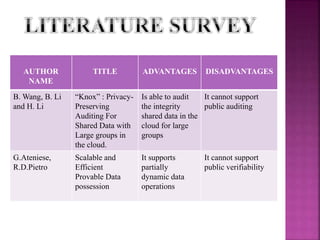
AUTHOR
NAME
TITLE ADVANTAGES DISADVANTAGES
B. Wang, B. Li
and H. Li
“Knox” : Privacy-
Preserving
Auditing For
Shared Data with
Large groups in
the cloud.
Is able to audit
the integrity
shared data in the
cloud for large
groups
It cannot support
public auditing
G.Ateniese,
R.D.Pietro
Scalable and
Efficient
Provable Data
possession
It supports
partially
dynamic data
operations
It cannot support
public verifiability
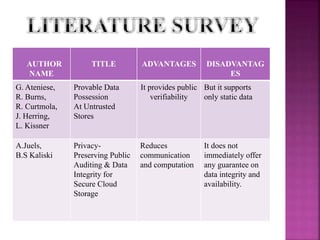
AUTHOR
NAME
TITLE ADVANTAGES DISADVANTAG
ES
G. Ateniese,
R. Burns,
R. Curtmola,
J. Herring,
L. Kissner
Provable Data
Possession
At Untrusted
Stores
It provides public
verifiability
But it supports
only static data
A.Juels,
B.S Kaliski
Privacy-
Preserving Public
Auditing & Data
Integrity for
Secure Cloud
Storage
Reduces
communication
and computation
It does not
immediately offer
any guarantee on
data integrity and
availability.
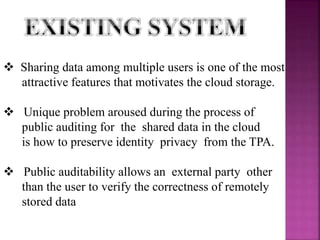
 Sharing data among multiple users is one of the most
attractive features that motivates the cloud storage.
 Unique problem aroused during the process of
public auditing for the shared data in the cloud
is how to preserve identity privacy from the TPA.
 Public auditability allows an external party other
than the user to verify the correctness of remotely
stored data
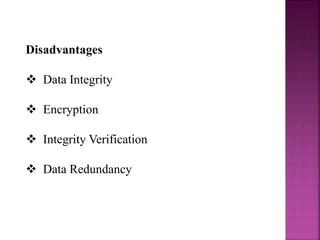
Disadvantages
 Data Integrity
 Encryption
 Integrity Verification
 Data Redundancy
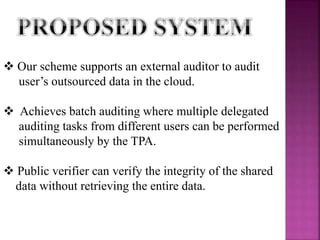
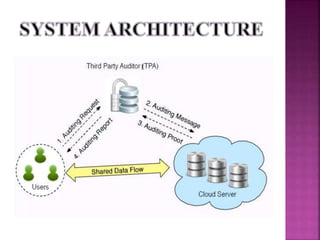
 Our scheme supports an external auditor to audit
user’s outsourced data in the cloud.
 Achieves batch auditing where multiple delegated
auditing tasks from different users can be performed
simultaneously by the TPA.
 Public verifier can verify the integrity of the shared
data without retrieving the entire data.
Advantages
 Public Auditability
 Storage Correctness
 Privacy Preserving
 Batch Auditing
 Light Weight
 Operating system: Windows 7
 Coding Language : ASP .NET with C#
 Data Base : SQL Server 2008 R2
 Tool: VISUAL STUDIO 2010
 Processor – Pentium –IV
 Speed – 1.1 GHz
 RAM – 512 MB(min)
 Hard Disk – 40 GB
 Key Board – Standard Windows Keyboard
 Monitor – LCD/LED
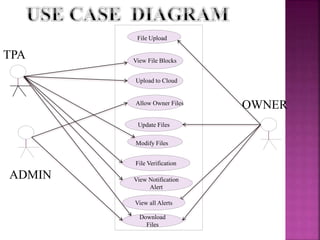
View Notification
Alert
File Upload
View File Blocks
Upload to Cloud
View all Alerts
Download
Files
TPA
ADMIN
OWNERAllow Owner Files
Modify Files
Update Files
File Verification
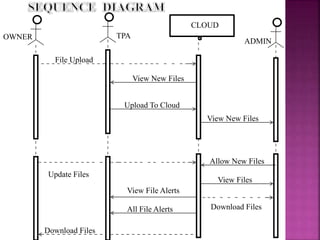
OWNER TPA
CLOUD
ADMIN
View New Files
Upload To Cloud
View New Files
Allow New Files
View Files
View File Alerts
All File Alerts
File Upload
Download Files
Download Files
Update Files
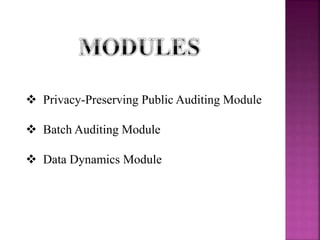
 Privacy-Preserving Public Auditing Module
 Batch Auditing Module
 Data Dynamics Module
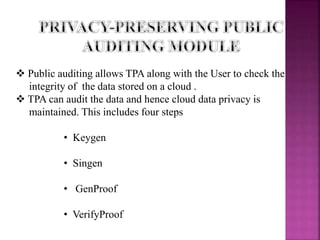
 Public auditing allows TPA along with the User to check the
integrity of the data stored on a cloud .
 TPA can audit the data and hence cloud data privacy is
maintained. This includes four steps
• Keygen
• Singen
• GenProof
• VerifyProof
It is divided in to two parts with Setup phase and
Audit phase :
 Setup Phase
 Audit Phase
 TPA may concurrently handle multiple
auditing delegations upon different user’s
requests.
The individual auditing of these tasks for TPA
can be tedious and very inefficient.
Batch auditing also greatly reduces the
computation cost on the TPA side.
 It also supports operations such as INSERT,
DELETE & MODIFY
 It supports data dynamics where user can
frequently update the data stored on the cloud
 In our Project we proposed ORUTA, the first
Privacy Preserving Public Auditing Mechanism for
shared data in the cloud.
 To improve the Efficiency of verification for multiple
auditing tasks we further extend our mechanism to
support batch auditing.
 C. Wang, Q. Wang, K. Ren, and W. Lou, “Ensuring Data Storage
Security in Cloud Computing,” in Proc. IEEE/ACM International
Workshop on Quality of Service (IWQoS), 2009, pp. 1–9.
 G. Ateniese, R. Burns, R. Curtmola, J. Herring, L. Kissner, Z.
Peterson, and D. Song, “Provable Data Possession at Untrusted
Stores,” in Proc. ACM Conference on Computer and
Communications Security (CCS), 2007, pp. 598–610.
 C. Wang, Q. Wang, K. Ren, and W. Lou, “Privacy-Preserving Public
Auditing for Data Storage Security in Cloud Computing,” in Proc.
IEEE International Conference on Computer Communications
(INFOCOM), 2010, pp. 525–533.
Oruta

Oruta

  • 1.
  • 2.
     Cloud dataservices stores data in the cloud as well as shares data among many users.  Preserving the data in cloud is very difficult.  To overcome this problem privacy –preserving mechanism is designed which supports public auditing on shared data stored in the cloud.
  • 3.
     Cloud computingis a class of network based computing through internet.  It is a computing in which large groups of remote servers are networked to allow centralized data storage and online access to computer services.  Clouds can be classified as public, private, or hybrid.  Cloud Computing provides various service models i.e. PaaS,SaaS,IaaS,DaaS,STaaS,SECaaS ,etc.
  • 4.
    AUTHOR NAME TITLE ADVANTAGES DISADVANTAGES B.Wang, B. Li and H. Li “Knox” : Privacy- Preserving Auditing For Shared Data with Large groups in the cloud. Is able to audit the integrity shared data in the cloud for large groups It cannot support public auditing G.Ateniese, R.D.Pietro Scalable and Efficient Provable Data possession It supports partially dynamic data operations It cannot support public verifiability
  • 5.
    AUTHOR NAME TITLE ADVANTAGES DISADVANTAG ES G.Ateniese, R. Burns, R. Curtmola, J. Herring, L. Kissner Provable Data Possession At Untrusted Stores It provides public verifiability But it supports only static data A.Juels, B.S Kaliski Privacy- Preserving Public Auditing & Data Integrity for Secure Cloud Storage Reduces communication and computation It does not immediately offer any guarantee on data integrity and availability.
  • 6.
     Sharing dataamong multiple users is one of the most attractive features that motivates the cloud storage.  Unique problem aroused during the process of public auditing for the shared data in the cloud is how to preserve identity privacy from the TPA.  Public auditability allows an external party other than the user to verify the correctness of remotely stored data
  • 7.
    Disadvantages  Data Integrity Encryption  Integrity Verification  Data Redundancy
  • 8.
     Our schemesupports an external auditor to audit user’s outsourced data in the cloud.  Achieves batch auditing where multiple delegated auditing tasks from different users can be performed simultaneously by the TPA.  Public verifier can verify the integrity of the shared data without retrieving the entire data.
  • 9.
    Advantages  Public Auditability Storage Correctness  Privacy Preserving  Batch Auditing  Light Weight
  • 10.
     Operating system:Windows 7  Coding Language : ASP .NET with C#  Data Base : SQL Server 2008 R2  Tool: VISUAL STUDIO 2010
  • 11.
     Processor –Pentium –IV  Speed – 1.1 GHz  RAM – 512 MB(min)  Hard Disk – 40 GB  Key Board – Standard Windows Keyboard  Monitor – LCD/LED
  • 13.
    View Notification Alert File Upload ViewFile Blocks Upload to Cloud View all Alerts Download Files TPA ADMIN OWNERAllow Owner Files Modify Files Update Files File Verification
  • 14.
    OWNER TPA CLOUD ADMIN View NewFiles Upload To Cloud View New Files Allow New Files View Files View File Alerts All File Alerts File Upload Download Files Download Files Update Files
  • 15.
     Privacy-Preserving PublicAuditing Module  Batch Auditing Module  Data Dynamics Module
  • 16.
     Public auditingallows TPA along with the User to check the integrity of the data stored on a cloud .  TPA can audit the data and hence cloud data privacy is maintained. This includes four steps • Keygen • Singen • GenProof • VerifyProof
  • 17.
    It is dividedin to two parts with Setup phase and Audit phase :  Setup Phase  Audit Phase
  • 18.
     TPA mayconcurrently handle multiple auditing delegations upon different user’s requests. The individual auditing of these tasks for TPA can be tedious and very inefficient. Batch auditing also greatly reduces the computation cost on the TPA side.
  • 19.
     It alsosupports operations such as INSERT, DELETE & MODIFY  It supports data dynamics where user can frequently update the data stored on the cloud
  • 20.
     In ourProject we proposed ORUTA, the first Privacy Preserving Public Auditing Mechanism for shared data in the cloud.  To improve the Efficiency of verification for multiple auditing tasks we further extend our mechanism to support batch auditing.
  • 21.
     C. Wang,Q. Wang, K. Ren, and W. Lou, “Ensuring Data Storage Security in Cloud Computing,” in Proc. IEEE/ACM International Workshop on Quality of Service (IWQoS), 2009, pp. 1–9.  G. Ateniese, R. Burns, R. Curtmola, J. Herring, L. Kissner, Z. Peterson, and D. Song, “Provable Data Possession at Untrusted Stores,” in Proc. ACM Conference on Computer and Communications Security (CCS), 2007, pp. 598–610.  C. Wang, Q. Wang, K. Ren, and W. Lou, “Privacy-Preserving Public Auditing for Data Storage Security in Cloud Computing,” in Proc. IEEE International Conference on Computer Communications (INFOCOM), 2010, pp. 525–533.

Editor's Notes