OPTIMIZE THE QOS AND
SECURITY ISSUES IN CLOUD
COMPUTING
CONTENT
• Introduction
• Why Cloud Computing
• Cloud Service Models
• Cloud Computing deployment
models
• Characteristics
• Cloud Computing Architectures
• Transparency of cloud
• Energy Management
• Security and Privacy Issues
• Azure Cloud
• Conclusion
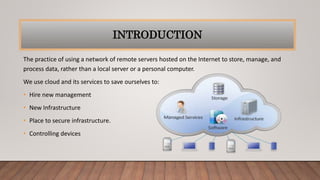
INTRODUCTION
The practice of using a network of remote servers hosted on the Internet to store, manage, and
process data, rather than a local server or a personal computer.
We use cloud and its services to save ourselves to:
• Hire new management
• New Infrastructure
• Place to secure infrastructure.
• Controlling devices
• Increase in performance.
• Easy access to advanced resources.
• Pay per use service.
• No need to indulge in back end
maintenance.
• Full utilization of server.
• Security about their data.
• Cloud ensures auditing process.
• Reporting and tracking.
• Three services and four deployment
models.
• On-demand self-service.
• Resource pooling.
• Flexibility and scalability.
• Skilled management and
maintenance.
• Resource sharing
WHY CLOUD COMPUTING
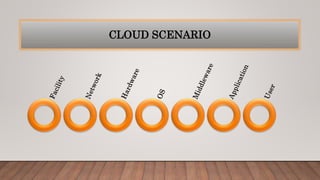
CLOUD SCENARIO
CLOUD SERVICE MODELS
Infrastructure as a service (IaaS):
• The cost reduces as the resources exist already in the cloud.
• User just had to pay for infrastructure and the usage of capacity, like disk space, CPU,
memory server, storage and network.
• Cost service using fixed prices per resources.
• Many major computing resources coexist on IaaS.
In this model users are searching for computing resources. It is like
self-contained IT structure.
CLOUD SERVICE MODELS
Software as a service (SaaS):
• The productivity of internal resources is improved without of managing
and maintenance.
• The updating of software will be immediately given
• The complexity decreases by managing the system from central location.
• Resources are available on the network they will be accessed any time as pay
per use basis.
CLOUD SERVICE MODELS
Platform as a service (PaaS):
• The cost to manage, maintain is lower.
• Management and maintenance is responsibility of vendor.
• System is now flexible and scalable.
• Services for development, testing, deployment collaboration, hosting are now in
same environment which is deployed in cloud.
• The web based creation tools are now easily implemented.
• I provide ease to create components that are needed for user interface.
CLOUD SERVICE MODELS
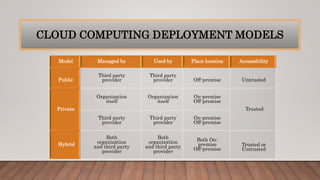
CLOUD COMPUTING DEPLOYMENT MODELS
Model Managed by Used by Place location Accessibility
Public
Third party
provider
Third party
provider Off-premise Untrusted
Private
Organization
itself
Organization
itself
On-premise
Off-premise
Trusted
Third party
provider
Third party
provider
On-premise
Off-premise
Hybrid
Both
organization
and third party
provider
Both
organization
and third party
provider
Both On-
premise
Off-premise
Trusted or
Untrusted
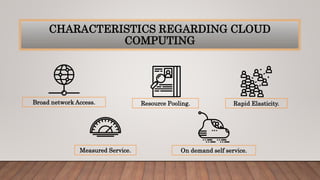
CHARACTERISTICS REGARDING CLOUD
COMPUTING
Broad network Access. Resource Pooling. Rapid Elasticity.
Measured Service. On demand self service.
CLOUD COMPUTING ARCHITECTURES
Cloud have different Architecture:
• Aneka
• Market-oriented Cloud Architecture
• Service-Oriented Architecture
• Service-Oriented Cloud Computing Architecture (SOCCA)
• Layered Architecture of Service-Oriented Cloud Computing Architecture
• Comparison of Cloud Architectures
• Importance of Service-Oriented Architecture to Cloud Computing
SECURITY AND PRIVACY ISSUES
• What are the user privileges?
• At which level are regulatory compliance being?
• Is the data located at data center is safe enough?
• What are the issues regarding segregation of data?
• If the data is lost or damaged what are the recovery methods, Is there is any
support for investigation?
• What are the long-term planning of viability?
There are many security issues arises when we talk about cloud computing:
• Authentication.
• Authorization and confidentiality.
• Availability.
• Integrity.
CLOUD COMPUTING SECURITY ISSUES
SOLUTIONS
Integration of policies:
• Different servers have different set of policies
Controlling the Access Method:
• The most important method is the (RBAC) role based access control method.
Method of Encryption:
• Symmetric encryption
• Asymmetric encryption
METHOD PROVIDED BY AWS & AZURE
• Amazon’s web services and Microsoft Azure system gave the facility to decide the
geographic regions for their users.
• It gives assurance that data will remain there as far as they want.
• The regions are of North West, USA and some of the regions of UK.
• Now a day’s some regions of Asia are also included.
TRANSPARENCY OF CLOUD
• Transparency mean the policies will be clear to the clients and to the service providers.
• An important protocol regarding transparency is the SLA (service level agreement), SLA
has the information about:
 Service that cloud provides
 Tracing and estimating
 Managing the problem
 Appropriate compliance
 Duties of customers
 Security
 Confidential information
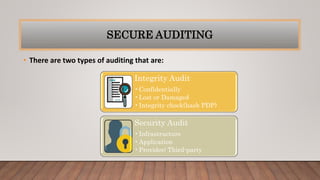
SECURE AUDITING
• There are two types of auditing that are:
Integrity Audit
•Confidentially
•Lost or Damaged
•Integrity check(hash PDP)
Security Audit
•Infrastructure
•Application
•Provider/ Third-party
VIRTUALIZATION ISSUES
• Virtualization concept is the building block for cloud computing.
• Basically there is a layer between hardware and operating system
that is introduced by virtualization.
• With virtualization concept the cloud computing become:
 Flexible
 Location independence
 Situations migration
• The difficulty with these virtual machines that are running on a single physical machine is to
manage them.
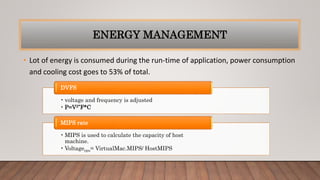
ENERGY MANAGEMENT
• Lot of energy is consumed during the run-time of application, power consumption
and cooling cost goes to 53% of total.
• voltage and frequency is adjusted
• P=V2*F*C
DVFS
• MIPS is used to calculate the capacity of host
machine.
• Voltagecpu= VirtualMac.MIPS/ HostMIPS
MIPS rate
ISSUES RELATED TO APPLICATION
• To ensure the security of the system there is a need to make the application secured.
• Security for the cloud application is very necessary because any hacker can easily be entered in
the system.
• Than make malicious attacks to the system.
• We have to take care of:
 Security of cloud Browser.
 Cloud Malware Attack.
 Distributed denial of service (DDoS) Attack.
 Debug and backdoor options.
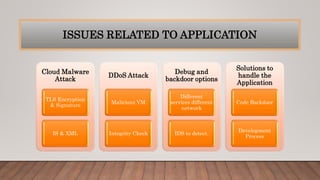
ISSUES RELATED TO APPLICATION
Cloud Malware
Attack
TLS Encryption
& Signature
IS & XML
DDoS Attack
Malicious VM
Integrity Check
Debug and
backdoor options
Different
services different
network
IDS to detect.
Solutions to
handle the
Application
Code Backdoor
Development
Process
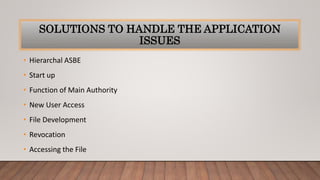
SOLUTIONS TO HANDLE THE APPLICATION
ISSUES
• Hierarchal ASBE
• Start up
• Function of Main Authority
• New User Access
• File Development
• Revocation
• Accessing the File
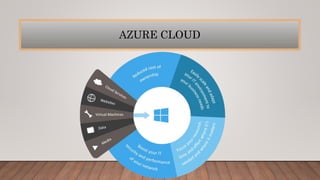
AZURE CLOUD
CONCLUSION
• What is Cloud.
• Implement the cloud computing.
• Architecture comparison.
• security and privacy.
• energy management.
• Application issues.
• Solutions of the issues.
• Azure Cloud.
FUTURE WORK
Researchers still have to work a lot to make this technology mature enough to adopt
easily:
• Complexity of the system.
• Strong check by enhancement in encryption/decryption process.
• Reduce the cost of the system.
• Auditing shell algorithm.
• Quad security layer.
It is an emerging technology so a lot of threats are there and organizations should have to
work together to make a big change in the IT world.

Cloud computing

  • 1.
    OPTIMIZE THE QOSAND SECURITY ISSUES IN CLOUD COMPUTING
  • 2.
    CONTENT • Introduction • WhyCloud Computing • Cloud Service Models • Cloud Computing deployment models • Characteristics • Cloud Computing Architectures • Cloud Computing Architectures • Transparency of cloud • Energy Management • Security and Privacy Issues • Azure Cloud • Conclusion
  • 3.
    INTRODUCTION The practice ofusing a network of remote servers hosted on the Internet to store, manage, and process data, rather than a local server or a personal computer. We use cloud and its services to save ourselves to: • Hire new management • New Infrastructure • Place to secure infrastructure. • Controlling devices
  • 4.
    • Increase inperformance. • Easy access to advanced resources. • Pay per use service. • No need to indulge in back end maintenance. • Full utilization of server. • Security about their data. • Cloud ensures auditing process. • Reporting and tracking. • Three services and four deployment models. • On-demand self-service. • Resource pooling. • Flexibility and scalability. • Skilled management and maintenance. • Resource sharing WHY CLOUD COMPUTING
  • 5.
  • 6.
    CLOUD SERVICE MODELS Infrastructureas a service (IaaS): • The cost reduces as the resources exist already in the cloud. • User just had to pay for infrastructure and the usage of capacity, like disk space, CPU, memory server, storage and network. • Cost service using fixed prices per resources. • Many major computing resources coexist on IaaS. In this model users are searching for computing resources. It is like self-contained IT structure. CLOUD SERVICE MODELS
  • 7.
    Software as aservice (SaaS): • The productivity of internal resources is improved without of managing and maintenance. • The updating of software will be immediately given • The complexity decreases by managing the system from central location. • Resources are available on the network they will be accessed any time as pay per use basis. CLOUD SERVICE MODELS
  • 8.
    Platform as aservice (PaaS): • The cost to manage, maintain is lower. • Management and maintenance is responsibility of vendor. • System is now flexible and scalable. • Services for development, testing, deployment collaboration, hosting are now in same environment which is deployed in cloud. • The web based creation tools are now easily implemented. • I provide ease to create components that are needed for user interface. CLOUD SERVICE MODELS
  • 9.
    CLOUD COMPUTING DEPLOYMENTMODELS Model Managed by Used by Place location Accessibility Public Third party provider Third party provider Off-premise Untrusted Private Organization itself Organization itself On-premise Off-premise Trusted Third party provider Third party provider On-premise Off-premise Hybrid Both organization and third party provider Both organization and third party provider Both On- premise Off-premise Trusted or Untrusted
  • 10.
    CHARACTERISTICS REGARDING CLOUD COMPUTING Broadnetwork Access. Resource Pooling. Rapid Elasticity. Measured Service. On demand self service.
  • 11.
    CLOUD COMPUTING ARCHITECTURES Cloudhave different Architecture: • Aneka • Market-oriented Cloud Architecture • Service-Oriented Architecture • Service-Oriented Cloud Computing Architecture (SOCCA) • Layered Architecture of Service-Oriented Cloud Computing Architecture • Comparison of Cloud Architectures • Importance of Service-Oriented Architecture to Cloud Computing
  • 12.
    SECURITY AND PRIVACYISSUES • What are the user privileges? • At which level are regulatory compliance being? • Is the data located at data center is safe enough? • What are the issues regarding segregation of data? • If the data is lost or damaged what are the recovery methods, Is there is any support for investigation? • What are the long-term planning of viability?
  • 13.
    There are manysecurity issues arises when we talk about cloud computing: • Authentication. • Authorization and confidentiality. • Availability. • Integrity. CLOUD COMPUTING SECURITY ISSUES
  • 14.
    SOLUTIONS Integration of policies: •Different servers have different set of policies Controlling the Access Method: • The most important method is the (RBAC) role based access control method. Method of Encryption: • Symmetric encryption • Asymmetric encryption
  • 15.
    METHOD PROVIDED BYAWS & AZURE • Amazon’s web services and Microsoft Azure system gave the facility to decide the geographic regions for their users. • It gives assurance that data will remain there as far as they want. • The regions are of North West, USA and some of the regions of UK. • Now a day’s some regions of Asia are also included.
  • 16.
    TRANSPARENCY OF CLOUD •Transparency mean the policies will be clear to the clients and to the service providers. • An important protocol regarding transparency is the SLA (service level agreement), SLA has the information about:  Service that cloud provides  Tracing and estimating  Managing the problem  Appropriate compliance  Duties of customers  Security  Confidential information
  • 17.
    SECURE AUDITING • Thereare two types of auditing that are: Integrity Audit •Confidentially •Lost or Damaged •Integrity check(hash PDP) Security Audit •Infrastructure •Application •Provider/ Third-party
  • 18.
    VIRTUALIZATION ISSUES • Virtualizationconcept is the building block for cloud computing. • Basically there is a layer between hardware and operating system that is introduced by virtualization. • With virtualization concept the cloud computing become:  Flexible  Location independence  Situations migration • The difficulty with these virtual machines that are running on a single physical machine is to manage them.
  • 19.
    ENERGY MANAGEMENT • Lotof energy is consumed during the run-time of application, power consumption and cooling cost goes to 53% of total. • voltage and frequency is adjusted • P=V2*F*C DVFS • MIPS is used to calculate the capacity of host machine. • Voltagecpu= VirtualMac.MIPS/ HostMIPS MIPS rate
  • 20.
    ISSUES RELATED TOAPPLICATION • To ensure the security of the system there is a need to make the application secured. • Security for the cloud application is very necessary because any hacker can easily be entered in the system. • Than make malicious attacks to the system. • We have to take care of:  Security of cloud Browser.  Cloud Malware Attack.  Distributed denial of service (DDoS) Attack.  Debug and backdoor options.
  • 21.
    ISSUES RELATED TOAPPLICATION Cloud Malware Attack TLS Encryption & Signature IS & XML DDoS Attack Malicious VM Integrity Check Debug and backdoor options Different services different network IDS to detect. Solutions to handle the Application Code Backdoor Development Process
  • 22.
    SOLUTIONS TO HANDLETHE APPLICATION ISSUES • Hierarchal ASBE • Start up • Function of Main Authority • New User Access • File Development • Revocation • Accessing the File
  • 23.
  • 24.
    CONCLUSION • What isCloud. • Implement the cloud computing. • Architecture comparison. • security and privacy. • energy management. • Application issues. • Solutions of the issues. • Azure Cloud.
  • 25.
    FUTURE WORK Researchers stillhave to work a lot to make this technology mature enough to adopt easily: • Complexity of the system. • Strong check by enhancement in encryption/decryption process. • Reduce the cost of the system. • Auditing shell algorithm. • Quad security layer. It is an emerging technology so a lot of threats are there and organizations should have to work together to make a big change in the IT world.

Editor's Notes

  • #26 Secure Transmission of Data Encrypted Data and Encrypted Data Processing Database Secure Shell Internal and external Auditing