•The DC supply system within a power station is of
paramount importance and it’s failure could lead to
catastrophic consequences due to protection system and
vital control system being rendered inoperative.
•The Station DC Supply system is designed with the
intention of minimising the risk of such failure. The
entire protection
•philosophy is based on the assumption that DC failures,
is an unlikely event.
23 July 2023 3
Duties
DC Loads
DC system
Types of Batteries
Presentation outline
23 July 2023 4
DC SYSTEM IS DESIGNED
 TO SUPPLY HIGH STANDARD OF RELIABLE &
SECURE DC POWER
 TO PROVIDE CONTINUOUS & QUALITY
POWER AS AND WHEN REQUIRED
 UNDER NORMAL & ABNORMAL OPERATING
CONDITIONS
 ULTIMATE & FINAL DC BACK-UP POWER TO
EQUIPMENT AND DC DRIVES WHEN TOTAL AC
SUPPLY FAILS
 HENCE THEY ARE BATTERY BACKED
23 July 2023 5
DUTIES
 TO SUPPLY EQUIPMENT WHICH REQUIRES DC
DURING NORMAL CONDITIONS
 TO SUPPLY STANDBY EQUIPMENT/DC DRIVES
 TO SUPPLY STARTERS OF VARIOUS
EQUIPMENT
 TO SUPPLY EQUIPMENT WHEN AC SUPPLIES
HAVE BEEN LOST
23 July 2023 6
DC Power Supply
 Various Critical Drives
 Emergency DC Lighting
 Switchgear Control Supply for closing & tripping
 Control, Protection And Interlocks
 Indication, Annunciation & Alarm System
 Public Address System
 DAS And Communication System
23 July 2023 7
DC Supplies……………Why?
• Emergency Lube Oil Pump
• Emergency Jacking Oil Pump(st#2)
• Emergency Scanner Air Fan
• Emergency Seal Oil Pump
• Breaker/Unit Protections
• Emergency Lighting
23 July 2023 8
The Ultimate Backup
In case of unit tripping / grid failure, either station
changeover takes place / DG would start.
Normally, grid supply would be restored in minimum
possible time and DG would shut down.
In case of DG failure, the DC backup comes in to service
to facilitate safe shut down.
23 July 2023 9
Selection of voltage -DC POWER SUPPLY
 In power plant D.C. pumps, lighting require comparatively
high voltage due to their high power requirement. Hence as
a standard these applications are designed with 220V level.
 It is desirable to have comparatively lower voltage-
24V/48V/110V for control/indications/annunciation due to
safety reasons. we have adopted uniform 220V DC voltage
for plant electrical systems for switchgear control,
protection and interlock operation.
23 July 2023 10
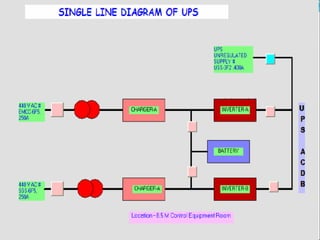
DC POWER SUPPLY SCHEME
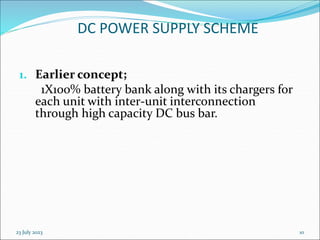
1. Earlier concept;
1X100% battery bank along with its chargers for
each unit with inter-unit interconnection
through high capacity DC bus bar.
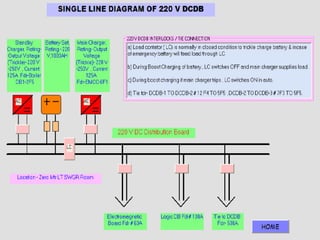
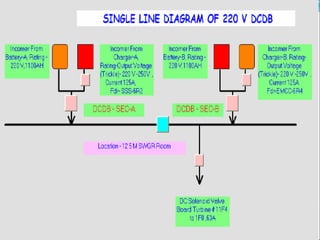
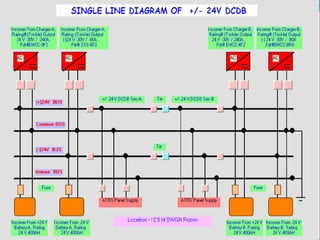
Present concept;
 In view of the reasons explained above 2x100%
capacity DC system is provided for each unit and
switchyard separately.
23 July 2023 18
DC System
 Battery
 Battery Charger
23 July 2023 19
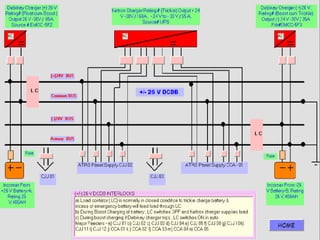
DC SYSTEM
 BATTERY CHARGERS [TWO/THREE]
 BATTERY BANKS [ONE/TWO]
 DC DISTRIBUTION BOARDS [ONE/TWO]
 DC FUSE BOARDS
 UN EARTHED SYSTEM
 CHARGER TROUBLE, DC EARTH FAULT AND DC
VOLTAGE ABNORMAL ALARMS IN UCB
23 July 2023 20
220 V DC
 FSSS
 HT Breakers
 Vacuum Breakers
 HOTV/HORV
 Deaerator Overflow Valve
 GRP
 HP Heater Protections
 DC Fans & Pumps
 SADC
 Trim Device
 Load Shedding Relay
 Scanner Air Fan Outlet & Emergency Damper
 All DC Lights
23 July 2023 21
23 July 2023 22
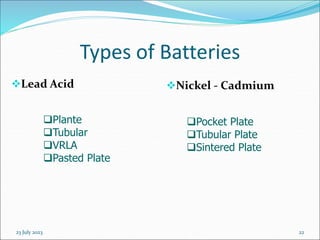
Types of Batteries
Lead Acid Nickel - Cadmium
Plante
Tubular
VRLA
Pasted Plate
Pocket Plate
Tubular Plate
Sintered Plate
23 July 2023 23
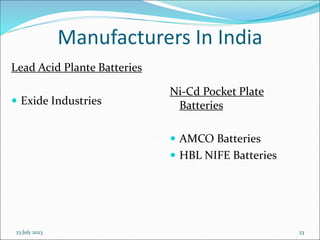
Manufacturers In India
Lead Acid Plante Batteries
 Exide Industries
Ni-Cd Pocket Plate
Batteries
 AMCO Batteries
 HBL NIFE Batteries
23 July 2023 24
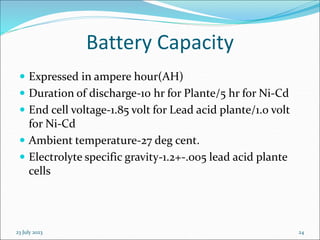
Battery Capacity
 Expressed in ampere hour(AH)
 Duration of discharge-10 hr for Plante/5 hr for Ni-Cd
 End cell voltage-1.85 volt for Lead acid plante/1.0 volt
for Ni-Cd
 Ambient temperature-27 deg cent.
 Electrolyte specific gravity-1.2+-.005 lead acid plante
cells
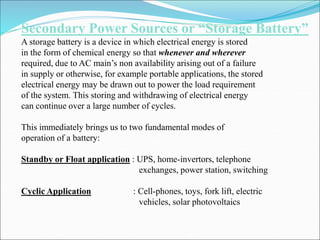
Secondary Power Sources or “Storage Battery”
A storage battery is a device in which electrical energy is stored
in the form of chemical energy so that whenever and wherever
required, due to AC main’s non availability arising out of a failure
in supply or otherwise, for example portable applications, the stored
electrical energy may be drawn out to power the load requirement
of the system. This storing and withdrawing of electrical energy
can continue over a large number of cycles.
This immediately brings us to two fundamental modes of
operation of a battery:
Standby or Float application : UPS, home-invertors, telephone
exchanges, power station, switching
Cyclic Application : Cell-phones, toys, fork lift, electric
vehicles, solar photovoltaics
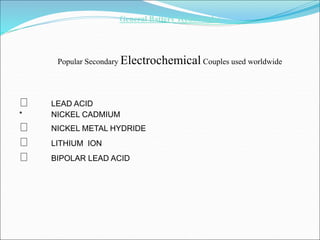
LEAD ACID
* NICKEL CADMIUM
NICKEL METAL HYDRIDE
LITHIUM ION
BIPOLAR LEAD ACID
General Battery Technologies
Popular Secondary Electrochemical Couples used worldwide
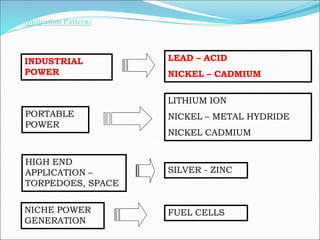
INDUSTRIAL
POWER
LEAD – ACID
NICKEL – CADMIUM
PORTABLE
POWER
LITHIUM ION
NICKEL – METAL HYDRIDE
NICKEL CADMIUM
HIGH END
APPLICATION –
TORPEDOES, SPACE
SILVER - ZINC
NICHE POWER
GENERATION
FUEL CELLS
Application Pattern:
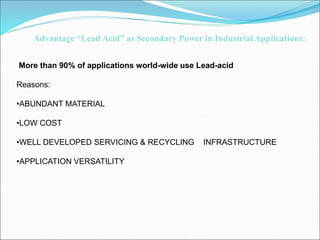
More than 90% of applications world-wide use Lead-acid
Reasons:
•ABUNDANT MATERIAL
•LOW COST
•WELL DEVELOPED SERVICING & RECYCLING INFRASTRUCTURE
•APPLICATION VERSATILITY
Advantage “Lead Acid” as Secondary Power in Industrial Applications:
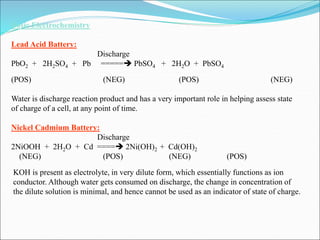
Basic Electrochemistry
Lead Acid Battery:
Discharge
PbO2 + 2H2SO4 + Pb ===== PbSO4 + 2H2O + PbSO4
(POS) (NEG) (POS) (NEG)
Water is discharge reaction product and has a very important role in helping assess state
of charge of a cell, at any point of time.
Nickel Cadmium Battery:
Discharge
2NiOOH + 2H2O + Cd ==== 2Ni(OH)2 + Cd(OH)2
(NEG) (POS) (NEG) (POS)
KOH is present as electrolyte, in very dilute form, which essentially functions as ion
conductor. Although water gets consumed on discharge, the change in concentration of
the dilute solution is minimal, and hence cannot be used as an indicator of state of charge.
Whilst lead-acid system has overwhelmingly dominated the
industrial application worldwide, the nickel-cadmium system too,
has served “niche” applications because of a few of its intrinsic
characteristics which suit such applications very well.
Some of these are:
•Excellent charge-discharge cycling capability
•Excellent recovery from deep discharge
•Compact, low weight
The Lead-Acid Technology
The lead acid battery comes in two basic configurations;
a. The ‘Flooded Electrolyte’ version
Towards the end of charge, a large part of the energy supplied
to the cell is dissipated in ‘breaking’ of water and evolution of
gases, oxygen and hydrogen at the positive and negative
electrodes respectively.
This loss of water through electrolysis is unavoidable and hence
replenishment has to be made periodically to ensure life as well
as performance of the product.
The rate of loss of water is a function of grid alloys, charging voltages,
temperature, age of battery.
The Lead-Acid Technology
b. The sealed ‘Maintenance Free’ version. This is more popularly
known as “Valve Regulated Lead Acid (VRLA)” battery
This again comes in two basic forms:
** The absorptive glass mat (AGM) technology
** The ‘Gel’ technology with ‘flat’ or ‘tubular’ plates.
The design, in terms of alloys used, as well as the geometry
of the POSITIVE plate of a lead acid battery, determines the
performance as well as life of the product.
A plate comprises of two distinct aspects:
a. The grid – which acts as - support of the ‘active material’
- current conductor
b. The ‘active material’ itself.
The Lead Acid battery positive plates come in the following
Three basic geometries:
- the ‘Flat Plates’
- the ‘Tubular Plates
- the ‘Plante’ Plates

DC SUPPLY SYSTEM.ppt

  • 2.
    •The DC supplysystem within a power station is of paramount importance and it’s failure could lead to catastrophic consequences due to protection system and vital control system being rendered inoperative. •The Station DC Supply system is designed with the intention of minimising the risk of such failure. The entire protection •philosophy is based on the assumption that DC failures, is an unlikely event.
  • 3.
    23 July 20233 Duties DC Loads DC system Types of Batteries Presentation outline
  • 4.
    23 July 20234 DC SYSTEM IS DESIGNED  TO SUPPLY HIGH STANDARD OF RELIABLE & SECURE DC POWER  TO PROVIDE CONTINUOUS & QUALITY POWER AS AND WHEN REQUIRED  UNDER NORMAL & ABNORMAL OPERATING CONDITIONS  ULTIMATE & FINAL DC BACK-UP POWER TO EQUIPMENT AND DC DRIVES WHEN TOTAL AC SUPPLY FAILS  HENCE THEY ARE BATTERY BACKED
  • 5.
    23 July 20235 DUTIES  TO SUPPLY EQUIPMENT WHICH REQUIRES DC DURING NORMAL CONDITIONS  TO SUPPLY STANDBY EQUIPMENT/DC DRIVES  TO SUPPLY STARTERS OF VARIOUS EQUIPMENT  TO SUPPLY EQUIPMENT WHEN AC SUPPLIES HAVE BEEN LOST
  • 6.
    23 July 20236 DC Power Supply  Various Critical Drives  Emergency DC Lighting  Switchgear Control Supply for closing & tripping  Control, Protection And Interlocks  Indication, Annunciation & Alarm System  Public Address System  DAS And Communication System
  • 7.
    23 July 20237 DC Supplies……………Why? • Emergency Lube Oil Pump • Emergency Jacking Oil Pump(st#2) • Emergency Scanner Air Fan • Emergency Seal Oil Pump • Breaker/Unit Protections • Emergency Lighting
  • 8.
    23 July 20238 The Ultimate Backup In case of unit tripping / grid failure, either station changeover takes place / DG would start. Normally, grid supply would be restored in minimum possible time and DG would shut down. In case of DG failure, the DC backup comes in to service to facilitate safe shut down.
  • 9.
    23 July 20239 Selection of voltage -DC POWER SUPPLY  In power plant D.C. pumps, lighting require comparatively high voltage due to their high power requirement. Hence as a standard these applications are designed with 220V level.  It is desirable to have comparatively lower voltage- 24V/48V/110V for control/indications/annunciation due to safety reasons. we have adopted uniform 220V DC voltage for plant electrical systems for switchgear control, protection and interlock operation.
  • 10.
    23 July 202310 DC POWER SUPPLY SCHEME 1. Earlier concept; 1X100% battery bank along with its chargers for each unit with inter-unit interconnection through high capacity DC bus bar.
  • 14.
    Present concept;  Inview of the reasons explained above 2x100% capacity DC system is provided for each unit and switchyard separately.
  • 18.
    23 July 202318 DC System  Battery  Battery Charger
  • 19.
    23 July 202319 DC SYSTEM  BATTERY CHARGERS [TWO/THREE]  BATTERY BANKS [ONE/TWO]  DC DISTRIBUTION BOARDS [ONE/TWO]  DC FUSE BOARDS  UN EARTHED SYSTEM  CHARGER TROUBLE, DC EARTH FAULT AND DC VOLTAGE ABNORMAL ALARMS IN UCB
  • 20.
    23 July 202320 220 V DC  FSSS  HT Breakers  Vacuum Breakers  HOTV/HORV  Deaerator Overflow Valve  GRP  HP Heater Protections  DC Fans & Pumps  SADC  Trim Device  Load Shedding Relay  Scanner Air Fan Outlet & Emergency Damper  All DC Lights
  • 21.
  • 22.
    23 July 202322 Types of Batteries Lead Acid Nickel - Cadmium Plante Tubular VRLA Pasted Plate Pocket Plate Tubular Plate Sintered Plate
  • 23.
    23 July 202323 Manufacturers In India Lead Acid Plante Batteries  Exide Industries Ni-Cd Pocket Plate Batteries  AMCO Batteries  HBL NIFE Batteries
  • 24.
    23 July 202324 Battery Capacity  Expressed in ampere hour(AH)  Duration of discharge-10 hr for Plante/5 hr for Ni-Cd  End cell voltage-1.85 volt for Lead acid plante/1.0 volt for Ni-Cd  Ambient temperature-27 deg cent.  Electrolyte specific gravity-1.2+-.005 lead acid plante cells
  • 25.
    Secondary Power Sourcesor “Storage Battery” A storage battery is a device in which electrical energy is stored in the form of chemical energy so that whenever and wherever required, due to AC main’s non availability arising out of a failure in supply or otherwise, for example portable applications, the stored electrical energy may be drawn out to power the load requirement of the system. This storing and withdrawing of electrical energy can continue over a large number of cycles. This immediately brings us to two fundamental modes of operation of a battery: Standby or Float application : UPS, home-invertors, telephone exchanges, power station, switching Cyclic Application : Cell-phones, toys, fork lift, electric vehicles, solar photovoltaics
  • 26.
    LEAD ACID * NICKELCADMIUM NICKEL METAL HYDRIDE LITHIUM ION BIPOLAR LEAD ACID General Battery Technologies Popular Secondary Electrochemical Couples used worldwide
  • 27.
    INDUSTRIAL POWER LEAD – ACID NICKEL– CADMIUM PORTABLE POWER LITHIUM ION NICKEL – METAL HYDRIDE NICKEL CADMIUM HIGH END APPLICATION – TORPEDOES, SPACE SILVER - ZINC NICHE POWER GENERATION FUEL CELLS Application Pattern:
  • 28.
    More than 90%of applications world-wide use Lead-acid Reasons: •ABUNDANT MATERIAL •LOW COST •WELL DEVELOPED SERVICING & RECYCLING INFRASTRUCTURE •APPLICATION VERSATILITY Advantage “Lead Acid” as Secondary Power in Industrial Applications:
  • 29.
    Basic Electrochemistry Lead AcidBattery: Discharge PbO2 + 2H2SO4 + Pb ===== PbSO4 + 2H2O + PbSO4 (POS) (NEG) (POS) (NEG) Water is discharge reaction product and has a very important role in helping assess state of charge of a cell, at any point of time. Nickel Cadmium Battery: Discharge 2NiOOH + 2H2O + Cd ==== 2Ni(OH)2 + Cd(OH)2 (NEG) (POS) (NEG) (POS) KOH is present as electrolyte, in very dilute form, which essentially functions as ion conductor. Although water gets consumed on discharge, the change in concentration of the dilute solution is minimal, and hence cannot be used as an indicator of state of charge.
  • 30.
    Whilst lead-acid systemhas overwhelmingly dominated the industrial application worldwide, the nickel-cadmium system too, has served “niche” applications because of a few of its intrinsic characteristics which suit such applications very well. Some of these are: •Excellent charge-discharge cycling capability •Excellent recovery from deep discharge •Compact, low weight
  • 31.
    The Lead-Acid Technology Thelead acid battery comes in two basic configurations; a. The ‘Flooded Electrolyte’ version Towards the end of charge, a large part of the energy supplied to the cell is dissipated in ‘breaking’ of water and evolution of gases, oxygen and hydrogen at the positive and negative electrodes respectively. This loss of water through electrolysis is unavoidable and hence replenishment has to be made periodically to ensure life as well as performance of the product. The rate of loss of water is a function of grid alloys, charging voltages, temperature, age of battery.
  • 32.
    The Lead-Acid Technology b.The sealed ‘Maintenance Free’ version. This is more popularly known as “Valve Regulated Lead Acid (VRLA)” battery This again comes in two basic forms: ** The absorptive glass mat (AGM) technology ** The ‘Gel’ technology with ‘flat’ or ‘tubular’ plates.
  • 33.
    The design, interms of alloys used, as well as the geometry of the POSITIVE plate of a lead acid battery, determines the performance as well as life of the product. A plate comprises of two distinct aspects: a. The grid – which acts as - support of the ‘active material’ - current conductor b. The ‘active material’ itself. The Lead Acid battery positive plates come in the following Three basic geometries: - the ‘Flat Plates’ - the ‘Tubular Plates - the ‘Plante’ Plates