Lead Acid Batteries
Application & Maintenance
COMMON DEFINITIONS
• Battery
A storage battery is an electro chemical device . It
stores chemical energy which can be released as
electrical energy. A battery consists of one or
more electrochemical cells. Although the terms
battery and cell are often used interchangeably
cells are the building blocks of which batteries
are constructed. Batteries consist of one or more
cells that are electrically connected
Cells
 A cell normally consists of the four principal
components.
 A positive electrode that receives electrons from
the external circuit when the cell is discharged,
 a negative electrode that donates electrons to the
external circuit as the cell discharges,
 electrolyte which provides a mechanism for
charge to flow between positive and negative
electrodes, and
 a separator which electrically isolates the positive
and negative electrodes.
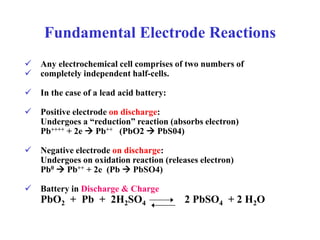
Fundamental Electrode Reactions
 Any electrochemical cell comprises of two numbers of
 completely independent half-cells.
 In the case of a lead acid battery:
 Positive electrode on discharge:
Undergoes a “reduction” reaction (absorbs electron)
Pb++++ + 2e  Pb++ (PbO2  PbS04)
 Negative electrode on discharge:
Undergoes on oxidation reaction (releases electron)
Pb0  Pb++ + 2e (Pb  PbSO4)
 Battery in Discharge & Charge
PbO2 + Pb + 2H2SO4 2 PbSO4 + 2 H2O
Application
• Automotive application
• Inverter/UPS application
• Solar application
• Railway Application
• Traction application
• Wind power application
• Defense Application
Types of batteries
• Plant Batteries
• Flat Plate batteries
• Low Maintenance Tubular batteries
• VRLA (Valve Regulated Lead Acid batteries
How to select the battery?
Basic information required to select the type and
calculate the required size of the battery are:
1. Load - in Amps, kVA, kW
2. Back-up time required
3. Nominal voltage of system
4. Minimum & maximum operating system voltages
5. Minimum & maximum operating temperature
6. Anticipated frequency of power outages
7. Anticipated frequency of long outages
8. Any limitation on space available
9. Any limitation on operating environment
10. Any limitation on maintenance – topping-up aspect
11. System criticality
12. Cost
How to select the battery?
In the list given above points 1,2,3,4,5 enable you to do the
Battery Ah sizing but does not tell about which type to be
Recommended.
The remaining points as well as the minimum and maximum
Operating temperature decides which type to be used.
The logic runs as follows:
 For super critical application like in a power station, sub-station
large process plant UPS application where the utmost
consideration is “reliability” ‘Low Maintenance tubular is
recommended.
 Where there is a major problem in periodic topping up, a
low maintenance tubular is selected.
How to select the battery?
 Where operating temperatures are anticipated for a major
portion of the operating life to be beyond 40C a VRLA is not
preferred, instead a tubular product serves better.
 For frequent discharges, particularly deep discharges a tubular
product is most preferred.
 If partial state-of-charge operation is anticipated the best option
is tubular.
 For widely varying operating temperature range both minimum
and maximum a tubular is preferred.
 Where ‘quick recharge’ feature is a must a tubular is best option.
 Frequent deep discharges with high temperature operation
a low-maintenance tubular is best option
 Where cost is concerned for moderate cycling application
a flat plate monobloc is best option.
 For adverse environment situation, say in a process plant where
gases like ammonia, chlorine etc, is present a VRLA is preferred
 Where non-spillabilty is a requirement a VRLA is only option
Calculation of Battery size:
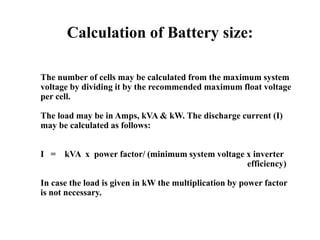
The number of cells may be calculated from the maximum system
voltage by dividing it by the recommended maximum float voltage
per cell.
The load may be in Amps, kVA & kW. The discharge current (I)
may be calculated as follows:
I = kVA x power factor/ (minimum system voltage x inverter
efficiency)
In case the load is given in kW the multiplication by power factor
is not necessary.
Calculation of Battery size:
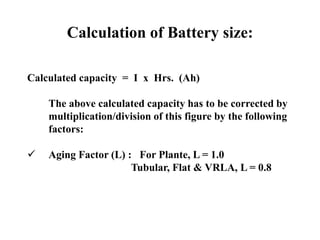
Calculated capacity = I x Hrs. (Ah)
The above calculated capacity has to be corrected by
multiplication/division of this figure by the following
factors:
 Aging Factor (L) : For Plante, L = 1.0
Tubular, Flat & VRLA, L = 0.8
Battery Maintenance
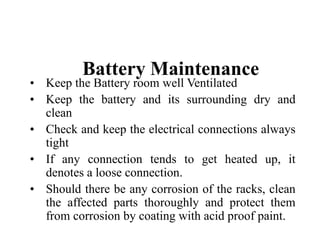
• Keep the Battery room well Ventilated
• Keep the battery and its surrounding dry and
clean
• Check and keep the electrical connections always
tight
• If any connection tends to get heated up, it
denotes a loose connection.
• Should there be any corrosion of the racks, clean
the affected parts thoroughly and protect them
from corrosion by coating with acid proof paint.
Battery Maintenance
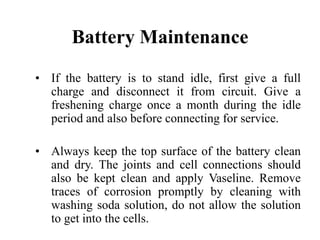
• If the battery is to stand idle, first give a full
charge and disconnect it from circuit. Give a
freshening charge once a month during the idle
period and also before connecting for service.
• Always keep the top surface of the battery clean
and dry. The joints and cell connections should
also be kept clean and apply Vaseline. Remove
traces of corrosion promptly by cleaning with
washing soda solution, do not allow the solution
to get into the cells.
Battery Maintenance
• Naked lights, which would be particularly
dangerous near the closed type cells, should
not be permitted in the battery room.
• When working on cells or connections care
should be taken not to bridge the terminals
with the spanner.
Battery Maintenance
 If through any cause a container is broken,
disconnect the cell/battery and place the
sections fully immersed in distilled water in
an acid resistant non-metalic vessel until
such time as the container can be replaced.
Topping Up…
• Always use distilled water to top up the cells
conforming to the Indian Standard Specification
Is:1069 and this should be done often to avoid the
necessity of adding a large quantity of water
which would cause a pronounced drop in the
specific gravity and deprive readings of some of
their values.
Topping Up…
• The level of the electrolyte should be kept such
that the bottom black mark of the float is just
visible above the crown of the float plug and the
level should never be allowed to go so low that
the red mark on the float stem comes in line with
the top surface of the plug.
Topping Up…
• It is advisable, if necessary to top up cells
during the early part of charging or before
charge so that the water would mix with the
electrolyte during charge.
TROUBLE SHOOTING
INSRUCTIONS
• Excessive gassing and progressive increase in
specific gravity during floating indicate that the
floating voltage is set high. Reduce the floating
voltage to a lower value and check.
• Progressive lower values of specific gravity
during floating indicates that the floating voltage
is set low. Increase the floating voltage & check.
TROUBLE SHOOTING
INSRUCTIONS
• Grounded circuits also circulate leakage
current, thereby discharging the battery.
Check for leakage of electrolyte or
grounding of current carrying conductors in
the charger as well as in the battery circuit.
• Check also the accuracy of voltmeter, if
necessary, if 1 or 2 happens.
TROUBLE SHOOTING
INSRUCTIONS
• Battery voltage failing too rapidly on
discharge may be due to loose connection or
corroded terminals. Check all connections
& tighten them, corroded parts should be
cleaned with dilute alkali, warm water &
dried. Then apply Vaseline on those parts
TROUBLE SHOOTING
INSRUCTIONS
• Continuous lowering of electrolyte level may be
due to leakage of electrolyte or loss of water in
the electrolyte due to evaporation by too high a
floating voltage or excessive charging. Replace
container immediately in case of leakage.
Addition of distilled water to maintain the
electrolyte level in the leaking cell will result in
diminution, of capacity and continuous lowering
of specific gravity
 Adjust the floating voltage to reduce the charging
rate.
PRECAUTIONS FOR SAFE
HANDLING AND USE
• Hygiene Practices:
wash hand thoroughly before eating,
drinking, or smoking after handling the
batteries.
• Respiratory Protection:
Wear safety glasses. Do not permit flames or
sparks in the vicinity of battery(s). If battery
electrolyte (acid) comes in contact with
clothing, discard clothing.
PRECAUTIONS FOR SAFE
HANDLING AND USE
• Protective Measures:
a. Remove combustible materials and all
sources of ignition. Cover sills with soda ash
(sodium carbonate) or quicklime (calcium
oxide). Mix well. Make certain mixture is
neutral then collect residue and place in a
drum or other suitable container. Dispose of
a hazardous waste.
b. Wear acid-resistant boots, chemical face
shield, chemical splash goggles, and acid-
resistant gloves. Do not release un-
neutralized acid.
PRECAUTIONS FOR SAFE
HANDLING AND USE
• Waste Disposal Method:
• Battery electrolyte (acid): Neutralize as
above for a spill, collect residue, and place in
a drum or suitable container. Dispose of as
hazardous waste. Do not flush lead
contaminated acid to sewer.
• Batteries: Send to lead smelter for
reclamation following applicable Federal,
state and local regulations.

Lead Acid Batteries Application & Maintenance

  • 2.
  • 3.
    COMMON DEFINITIONS • Battery Astorage battery is an electro chemical device . It stores chemical energy which can be released as electrical energy. A battery consists of one or more electrochemical cells. Although the terms battery and cell are often used interchangeably cells are the building blocks of which batteries are constructed. Batteries consist of one or more cells that are electrically connected
  • 4.
    Cells  A cellnormally consists of the four principal components.  A positive electrode that receives electrons from the external circuit when the cell is discharged,  a negative electrode that donates electrons to the external circuit as the cell discharges,  electrolyte which provides a mechanism for charge to flow between positive and negative electrodes, and  a separator which electrically isolates the positive and negative electrodes.
  • 5.
    Fundamental Electrode Reactions Any electrochemical cell comprises of two numbers of  completely independent half-cells.  In the case of a lead acid battery:  Positive electrode on discharge: Undergoes a “reduction” reaction (absorbs electron) Pb++++ + 2e  Pb++ (PbO2  PbS04)  Negative electrode on discharge: Undergoes on oxidation reaction (releases electron) Pb0  Pb++ + 2e (Pb  PbSO4)  Battery in Discharge & Charge PbO2 + Pb + 2H2SO4 2 PbSO4 + 2 H2O
  • 6.
    Application • Automotive application •Inverter/UPS application • Solar application • Railway Application • Traction application • Wind power application • Defense Application Types of batteries • Plant Batteries • Flat Plate batteries • Low Maintenance Tubular batteries • VRLA (Valve Regulated Lead Acid batteries
  • 7.
    How to selectthe battery? Basic information required to select the type and calculate the required size of the battery are: 1. Load - in Amps, kVA, kW 2. Back-up time required 3. Nominal voltage of system 4. Minimum & maximum operating system voltages 5. Minimum & maximum operating temperature 6. Anticipated frequency of power outages 7. Anticipated frequency of long outages 8. Any limitation on space available 9. Any limitation on operating environment 10. Any limitation on maintenance – topping-up aspect 11. System criticality 12. Cost
  • 8.
    How to selectthe battery? In the list given above points 1,2,3,4,5 enable you to do the Battery Ah sizing but does not tell about which type to be Recommended. The remaining points as well as the minimum and maximum Operating temperature decides which type to be used. The logic runs as follows:  For super critical application like in a power station, sub-station large process plant UPS application where the utmost consideration is “reliability” ‘Low Maintenance tubular is recommended.  Where there is a major problem in periodic topping up, a low maintenance tubular is selected.
  • 9.
    How to selectthe battery?  Where operating temperatures are anticipated for a major portion of the operating life to be beyond 40C a VRLA is not preferred, instead a tubular product serves better.  For frequent discharges, particularly deep discharges a tubular product is most preferred.  If partial state-of-charge operation is anticipated the best option is tubular.  For widely varying operating temperature range both minimum and maximum a tubular is preferred.  Where ‘quick recharge’ feature is a must a tubular is best option.  Frequent deep discharges with high temperature operation a low-maintenance tubular is best option  Where cost is concerned for moderate cycling application a flat plate monobloc is best option.  For adverse environment situation, say in a process plant where gases like ammonia, chlorine etc, is present a VRLA is preferred  Where non-spillabilty is a requirement a VRLA is only option
  • 10.
    Calculation of Batterysize: The number of cells may be calculated from the maximum system voltage by dividing it by the recommended maximum float voltage per cell. The load may be in Amps, kVA & kW. The discharge current (I) may be calculated as follows: I = kVA x power factor/ (minimum system voltage x inverter efficiency) In case the load is given in kW the multiplication by power factor is not necessary.
  • 11.
    Calculation of Batterysize: Calculated capacity = I x Hrs. (Ah) The above calculated capacity has to be corrected by multiplication/division of this figure by the following factors:  Aging Factor (L) : For Plante, L = 1.0 Tubular, Flat & VRLA, L = 0.8
  • 12.
    Battery Maintenance • Keepthe Battery room well Ventilated • Keep the battery and its surrounding dry and clean • Check and keep the electrical connections always tight • If any connection tends to get heated up, it denotes a loose connection. • Should there be any corrosion of the racks, clean the affected parts thoroughly and protect them from corrosion by coating with acid proof paint.
  • 13.
    Battery Maintenance • Ifthe battery is to stand idle, first give a full charge and disconnect it from circuit. Give a freshening charge once a month during the idle period and also before connecting for service. • Always keep the top surface of the battery clean and dry. The joints and cell connections should also be kept clean and apply Vaseline. Remove traces of corrosion promptly by cleaning with washing soda solution, do not allow the solution to get into the cells.
  • 14.
    Battery Maintenance • Nakedlights, which would be particularly dangerous near the closed type cells, should not be permitted in the battery room. • When working on cells or connections care should be taken not to bridge the terminals with the spanner.
  • 15.
    Battery Maintenance  Ifthrough any cause a container is broken, disconnect the cell/battery and place the sections fully immersed in distilled water in an acid resistant non-metalic vessel until such time as the container can be replaced.
  • 16.
    Topping Up… • Alwaysuse distilled water to top up the cells conforming to the Indian Standard Specification Is:1069 and this should be done often to avoid the necessity of adding a large quantity of water which would cause a pronounced drop in the specific gravity and deprive readings of some of their values.
  • 17.
    Topping Up… • Thelevel of the electrolyte should be kept such that the bottom black mark of the float is just visible above the crown of the float plug and the level should never be allowed to go so low that the red mark on the float stem comes in line with the top surface of the plug.
  • 18.
    Topping Up… • Itis advisable, if necessary to top up cells during the early part of charging or before charge so that the water would mix with the electrolyte during charge.
  • 19.
    TROUBLE SHOOTING INSRUCTIONS • Excessivegassing and progressive increase in specific gravity during floating indicate that the floating voltage is set high. Reduce the floating voltage to a lower value and check. • Progressive lower values of specific gravity during floating indicates that the floating voltage is set low. Increase the floating voltage & check.
  • 20.
    TROUBLE SHOOTING INSRUCTIONS • Groundedcircuits also circulate leakage current, thereby discharging the battery. Check for leakage of electrolyte or grounding of current carrying conductors in the charger as well as in the battery circuit. • Check also the accuracy of voltmeter, if necessary, if 1 or 2 happens.
  • 21.
    TROUBLE SHOOTING INSRUCTIONS • Batteryvoltage failing too rapidly on discharge may be due to loose connection or corroded terminals. Check all connections & tighten them, corroded parts should be cleaned with dilute alkali, warm water & dried. Then apply Vaseline on those parts
  • 22.
    TROUBLE SHOOTING INSRUCTIONS • Continuouslowering of electrolyte level may be due to leakage of electrolyte or loss of water in the electrolyte due to evaporation by too high a floating voltage or excessive charging. Replace container immediately in case of leakage. Addition of distilled water to maintain the electrolyte level in the leaking cell will result in diminution, of capacity and continuous lowering of specific gravity  Adjust the floating voltage to reduce the charging rate.
  • 23.
    PRECAUTIONS FOR SAFE HANDLINGAND USE • Hygiene Practices: wash hand thoroughly before eating, drinking, or smoking after handling the batteries. • Respiratory Protection: Wear safety glasses. Do not permit flames or sparks in the vicinity of battery(s). If battery electrolyte (acid) comes in contact with clothing, discard clothing.
  • 24.
    PRECAUTIONS FOR SAFE HANDLINGAND USE • Protective Measures: a. Remove combustible materials and all sources of ignition. Cover sills with soda ash (sodium carbonate) or quicklime (calcium oxide). Mix well. Make certain mixture is neutral then collect residue and place in a drum or other suitable container. Dispose of a hazardous waste. b. Wear acid-resistant boots, chemical face shield, chemical splash goggles, and acid- resistant gloves. Do not release un- neutralized acid.
  • 25.
    PRECAUTIONS FOR SAFE HANDLINGAND USE • Waste Disposal Method: • Battery electrolyte (acid): Neutralize as above for a spill, collect residue, and place in a drum or suitable container. Dispose of as hazardous waste. Do not flush lead contaminated acid to sewer. • Batteries: Send to lead smelter for reclamation following applicable Federal, state and local regulations.