 INTERRUPTION OF
    CAPACITIVE CURRENT

   Dc circuit
    breaking     by
                 A.Janani
                 EEE,SREC
INTERRUPTION OF CAPACITIVE CURRENT
Effect:
 The interruption of capacitive current produces high
  voltage transients across the gap of the circuit
  breaker.

When?
 This occurs when an unloaded long transmission
  line or a capacitor bank is switched off.
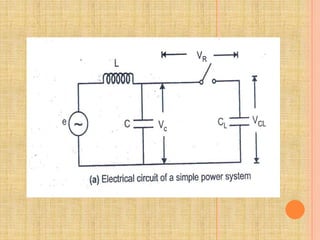
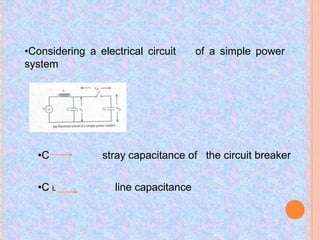
•Considering a electrical circuit     of a simple power
system


  •C            stray capacitance of the circuit breaker


  •C L             line capacitance
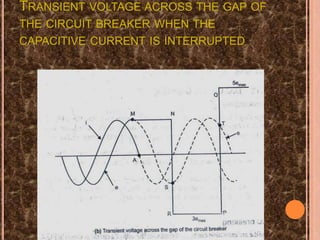
TRANSIENT VOLTAGE ACROSS THE GAP OF
THE CIRCUIT BREAKER WHEN THE
CAPACITIVE CURRENT IS INTERRUPTED
At the instant M
 The capacitive current is 0.
 System voltage is maximum

   If interruption occurs
   Capacitor CL remains charged at the maximum value of
    system voltage.


After the instant M
   Voltage across the breaker gap is
    the difference of Vc and VcL.
At the instant N
 The voltage across the gap is twice the maximum

 Value of Vc.

If the breaker restrikes
 The voltage across the gap become partially zero.
 Voltage falls from 2Vcmax to zero.

 A severe high frequency oscillation occurs (about
  the point S)
 Interrupted again.( if restriking current=0)

 The capacitor CL at the voltage -3emax.
At the instant P
 The system voltage reaches its positive maximum.(point
  T)
 Voltage across the gap becomes 4emax.

 The capacitive current reaches zero again and there may
  be an interruption.
 The transient voltage oscillates between -3emax and
  +5emax. (point P—Q)


   Thus voltage across the gap goes on increasing
DC CIRCUIT
BREAKING
How is dc breaking done?

The contacts of the DC breaker separate and the
arc is transferred from contacts to the runners
where it rises upwards and extinguishes on its own.
Drawbacks of HVDC circuit breaking

   The amount of energy to be dissipated during the
    short interval of breaking is very high as compared
    to the conventional a.c circuit breakers


   The natural zero current does not occur as in the
    case of a.c cb, resistance switching and the efficient
    cooling by forcing the liquid or air blast are used to
    dissipate the high amount of energy.
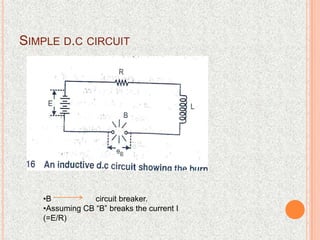
SIMPLE D.C CIRCUIT


   •B           circuit breaker.
   •Assuming CB ―B‖ breaks the current I
   (=E/R)
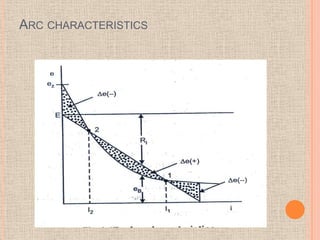
ARC CHARACTERISTICS
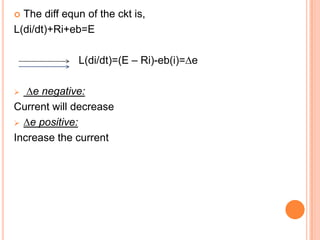
 The diff equn of the ckt is,
L(di/dt)+Ri+eb=E

              L(di/dt)=(E – Ri)-eb(i)=∆e

  ∆e negative:
Current will decrease
 ∆e positive:

Increase the current
Basic requirement
 Progressive lengthening of arc is a basic
  requirement of dc circuit breakers.
In designing an HVDC circuit breaker there are there
  main problems to be solved


 How to produce a current zero?
 How to prevent restriking?

 How to dissipate the stored energy?


Producing current zero
 This approach involves changing the form of arc current
  by commutation principle
 Quenching gear of well proven HVAC ckt breaker

 Principle of oscillatory circuit
Prevention of restrikes
 To produce a good ionizing arc the space between two
  walls of arc chute can be narrowed to restrict the arc
 At the same time it can be broken into number of arcs by
  inserting a grating of vertical metal plane
Dissipation of stored energy
 A protective spark gap can be used across the CB to
  reduce the size of the commuting capacitor.
 It will keep the abnormal voltage produced at the
  switching time below the undesired level
 By means of high frequency currents the spark gap acts
  as an energy dissipating device
Psps ppt

Psps ppt

  • 1.
     INTERRUPTION OF CAPACITIVE CURRENT  Dc circuit breaking by A.Janani EEE,SREC
  • 2.
    INTERRUPTION OF CAPACITIVECURRENT Effect:  The interruption of capacitive current produces high voltage transients across the gap of the circuit breaker. When?  This occurs when an unloaded long transmission line or a capacitor bank is switched off.
  • 4.
    •Considering a electricalcircuit of a simple power system •C stray capacitance of the circuit breaker •C L line capacitance
  • 5.
    TRANSIENT VOLTAGE ACROSSTHE GAP OF THE CIRCUIT BREAKER WHEN THE CAPACITIVE CURRENT IS INTERRUPTED
  • 6.
    At the instantM  The capacitive current is 0.  System voltage is maximum  If interruption occurs  Capacitor CL remains charged at the maximum value of system voltage. After the instant M  Voltage across the breaker gap is the difference of Vc and VcL.
  • 7.
    At the instantN  The voltage across the gap is twice the maximum  Value of Vc. If the breaker restrikes  The voltage across the gap become partially zero.  Voltage falls from 2Vcmax to zero.  A severe high frequency oscillation occurs (about the point S)  Interrupted again.( if restriking current=0)  The capacitor CL at the voltage -3emax.
  • 8.
    At the instantP  The system voltage reaches its positive maximum.(point T)  Voltage across the gap becomes 4emax.  The capacitive current reaches zero again and there may be an interruption.  The transient voltage oscillates between -3emax and +5emax. (point P—Q)  Thus voltage across the gap goes on increasing
  • 9.
  • 10.
    How is dcbreaking done? The contacts of the DC breaker separate and the arc is transferred from contacts to the runners where it rises upwards and extinguishes on its own.
  • 11.
    Drawbacks of HVDCcircuit breaking  The amount of energy to be dissipated during the short interval of breaking is very high as compared to the conventional a.c circuit breakers  The natural zero current does not occur as in the case of a.c cb, resistance switching and the efficient cooling by forcing the liquid or air blast are used to dissipate the high amount of energy.
  • 12.
    SIMPLE D.C CIRCUIT •B circuit breaker. •Assuming CB ―B‖ breaks the current I (=E/R)
  • 13.
  • 14.
     The diffequn of the ckt is, L(di/dt)+Ri+eb=E L(di/dt)=(E – Ri)-eb(i)=∆e  ∆e negative: Current will decrease  ∆e positive: Increase the current
  • 15.
    Basic requirement  Progressivelengthening of arc is a basic requirement of dc circuit breakers.
  • 16.
    In designing anHVDC circuit breaker there are there main problems to be solved  How to produce a current zero?  How to prevent restriking?  How to dissipate the stored energy? Producing current zero  This approach involves changing the form of arc current by commutation principle  Quenching gear of well proven HVAC ckt breaker  Principle of oscillatory circuit
  • 17.
    Prevention of restrikes To produce a good ionizing arc the space between two walls of arc chute can be narrowed to restrict the arc  At the same time it can be broken into number of arcs by inserting a grating of vertical metal plane Dissipation of stored energy  A protective spark gap can be used across the CB to reduce the size of the commuting capacitor.  It will keep the abnormal voltage produced at the switching time below the undesired level  By means of high frequency currents the spark gap acts as an energy dissipating device