AMRUTVAHINI SHETI AND SHIKSHAN VIKAS SANSTHA'S
AMRUTVAHINI COLLEGE OF
ENGINEERING
Seminar on
“MODERN ELECTRIC STORAGE
SYSTEMS”
Guided by:-
Prof.A.S.Varade
Department of electrical engg.
AVCOE,Sangamner
Presented by:-
Kapde moazzam
T.E.Electrical
AVCOE,Sangamner
CONTENTS:
 INTRODUCTON
 NEED:-why only choose this topic.
 TYPES OF STORGE TECHNOLOGIES.
 COMPARISON
 POPOULAR TECHNIQUES OF STORAGE.
 FUEL CELL.
 ADVANCED LEAD ACID BATTERY.
 SODIUM BASED BATTERIES.
 LION BATTERIES.
 FLOW BATTERIES.
 SUPER CAPACITORS.
 CONCLUSION…
Do you have a Smartphone? Digital camera or pc?
car or bike? Inverter at your home and HAVE u
seen an industrial electrical area?
WHAT DO ALL OF THESE HAVE COMMON IN?
?
WHY???
 Generation is easy but what about storage?
 Can't stop production process even in emergency!
 You pay for it and u have right to have interrupt free
service!
 BLACK-OUT :- July 2012
 What about modern electrical sensors of vehicles?
 Hybrid system can't survive.
 Soul of electronic devices are missing.
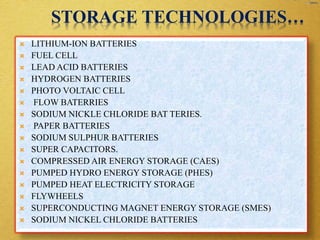
STORAGE TECHNOLOGIES…
 LITHIUM-ION BATTERIES
 FUEL CELL
 LEAD ACID BATTERIES
 HYDROGEN BATTERIES
 PHOTO VOLTAIC CELL
 FLOW BATERRIES
 SODIUM NICKLE CHLORIDE BAT TERIES.
 PAPER BATTERIES
 SODIUM SULPHUR BATTERIES
 SUPER CAPACITORS.
 COMPRESSED AIR ENERGY STORAGE (CAES)
 PUMPED HYDRO ENERGY STORAGE (PHES)
 PUMPED HEAT ELECTRICITY STORAGE
 FLYWHEELS
 SUPERCONDUCTING MAGNET ENERGY STORAGE (SMES)
 SODIUM NICKEL CHLORIDE BATTERIES
FUEL CELL
 Faradays 1st law of elctrolysis: Mass
of ions dispatched at electrode
propotional to electric power.
 “A score of nonutility companies are
well advanced toward developing a
powerful chemical fuel cell, which
could sit in some hidden closet of
every home silently ticking off electric
power.”
-Theodore Levitt, “Marketing Myopia,”
Harvard Business Review, 1960
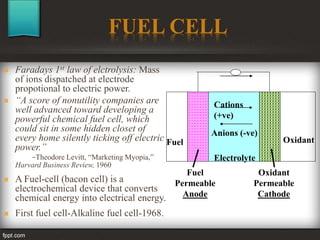
 A Fuel-cell (bacon cell) is a
electrochemical device that converts
chemical energy into electrical energy.
 First fuel cell-Alkaline fuel cell-1968.
Fuel
Permeable
Anode
Electrolyte
Oxidant
Permeable
Cathode
Fuel Oxidant
Cations
(+ve)
Anions (-ve)
 Principle:
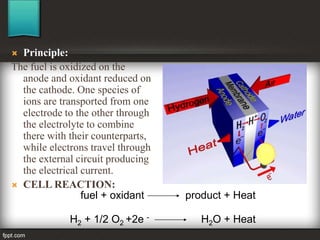
The fuel is oxidized on the
anode and oxidant reduced on
the cathode. One species of
ions are transported from one
electrode to the other through
the electrolyte to combine
there with their counterparts,
while electrons travel through
the external circuit producing
the electrical current.
 CELL REACTION:
H2 + 1/2 O2 +2e - H2O + Heat
fuel + oxidant product + Heat
TYPES OF FUEL CELL
 Alkaline fuel cells (AFC)
 Direct methanol fuel cells
(DMFC)
 Molten carbonate fuel cell
(MFFC)
 Phosphoric acid fuel cells (PAFC)
 Polymer electrolyte membrane
fuel cells (PEMFC)
 Solid oxide fuel cells (SOFC)
There are different types of fuel cells, differentiated
by the type of electrolyte separating the hydrogen
from the oxygen. The types of fuel cells are:
ADVANTAGES:
1.Zero Emission
2.Quite operation
3.High power density
4.No recharge.
AREAS OF IMPROVEMENTS:
1.It is difficult to manufacture and stores a high pure hydrogen
2.It is very expense as compared to battery.
3.It is sensitive to temperature variations.
APPLICATIONS:
1.Portable applications
2.Transportation applications
3.Power Distribution applications
4.Electric protection.
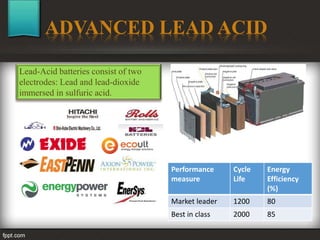
ADVANCED LEAD ACID
Lead-Acid batteries consist of two
electrodes: Lead and lead-dioxide
immersed in sulfuric acid.
Performance
measure
Cycle
Life
Energy
Efficiency
(%)
Market leader 1200 80
Best in class 2000 85
TYPES
 Automatic or SLI batteries:
lead-acid, nickel-cadmium
 Industrial or vehicle traction batteries
nickel-iron, silver-zinc
 Stationary batteries:
A. Stand by power system
B. Load leveling system
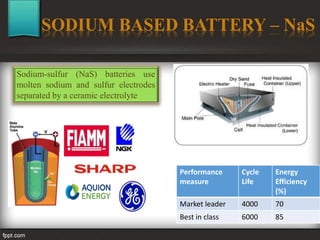
SODIUM BASED BATTERY – NaS
Sodium-sulfur (NaS) batteries use
molten sodium and sulfur electrodes
separated by a ceramic electrolyte
Performance
measure
Cycle
Life
Energy
Efficiency
(%)
Market leader 4000 70
Best in class 6000 85
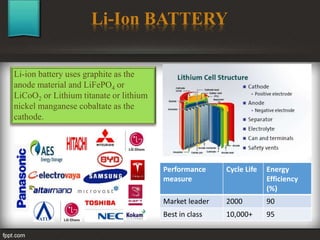
Li-Ion BATTERY
Li-ion battery uses graphite as the
anode material and LiFePO4 or
LiCoO2 or Lithium titanate or lithium
nickel manganese cobaltate as the
cathode.
Performance
measure
Cycle Life Energy
Efficiency
(%)
Market leader 2000 90
Best in class 10,000+ 95
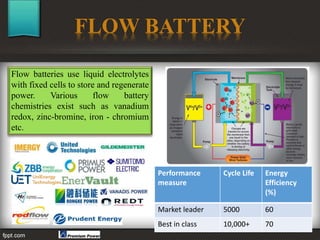
FLOW BATTERY
Flow batteries use liquid electrolytes
with fixed cells to store and regenerate
power. Various flow battery
chemistries exist such as vanadium
redox, zinc-bromine, iron - chromium
etc.
Performance
measure
Cycle Life Energy
Efficiency
(%)
Market leader 5000 60
Best in class 10,000+ 70
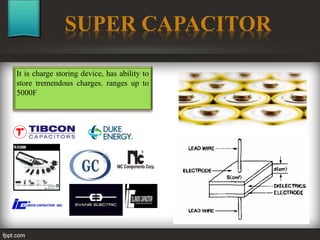
SUPER CAPACITOR
It is charge storing device, has ability to
store tremendous charges. ranges up to
5000F
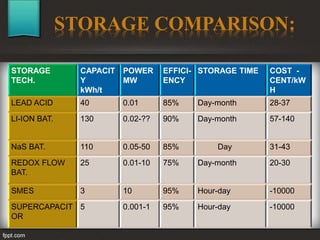
STORAGE
TECH.
CAPACIT
Y
kWh/t
POWER
MW
EFFICI-
ENCY
STORAGE TIME COST -
CENT/kW
H
LEAD ACID 40 0.01 85% Day-month 28-37
LI-ION BAT. 130 0.02-?? 90% Day-month 57-140
NaS BAT. 110 0.05-50 85% Day 31-43
REDOX FLOW
BAT.
25 0.01-10 75% Day-month 20-30
SMES 3 10 95% Hour-day -10000
SUPERCAPACIT
OR
5 0.001-1 95% Hour-day -10000
STORAGE COMPARISON:
FUTURE TRENDS:
 It is assumed that till 2020 all vehicles sold will be hybrid of one
kind or another(complete electric vehicle).For reduction of overall
price a lower cost longer lived batteries will required.
 Increase use of fuel cell.
 Within 10 years carbon electrode will replace by metal alloy
systems, perhaps tin or silicon based.
 Pure metals should be used in some liquid electrolyte cells.
 In 25 years, the storage systems are likely to be sealed black boxes
i.e: low cost sealed metal-oxygen batteries.
 Lower cost ion exchange membranes need to found.
CONCLUSION
 In order to maintain the system reliable and efficient we must have
to use the batteries and other storage system.
 Batteries are widely used for electrical back-up, in case of
emergency.
 We all are surrounded with various applications of batteries in
different field, different size and ratings.
 Wastage of energy can be avoided using these batteries; similarly
electric charge stored in batteries is helpful in reduction of peak
load demand on generation system.
Concept co-ordinated by:-
KAPDE MOAZZAM

Batteries (modern electric storage systems)

  • 1.
    AMRUTVAHINI SHETI ANDSHIKSHAN VIKAS SANSTHA'S AMRUTVAHINI COLLEGE OF ENGINEERING Seminar on “MODERN ELECTRIC STORAGE SYSTEMS” Guided by:- Prof.A.S.Varade Department of electrical engg. AVCOE,Sangamner Presented by:- Kapde moazzam T.E.Electrical AVCOE,Sangamner
  • 2.
    CONTENTS:  INTRODUCTON  NEED:-whyonly choose this topic.  TYPES OF STORGE TECHNOLOGIES.  COMPARISON  POPOULAR TECHNIQUES OF STORAGE.  FUEL CELL.  ADVANCED LEAD ACID BATTERY.  SODIUM BASED BATTERIES.  LION BATTERIES.  FLOW BATTERIES.  SUPER CAPACITORS.  CONCLUSION…
  • 3.
    Do you havea Smartphone? Digital camera or pc? car or bike? Inverter at your home and HAVE u seen an industrial electrical area? WHAT DO ALL OF THESE HAVE COMMON IN? ?
  • 5.
    WHY???  Generation iseasy but what about storage?  Can't stop production process even in emergency!  You pay for it and u have right to have interrupt free service!  BLACK-OUT :- July 2012  What about modern electrical sensors of vehicles?  Hybrid system can't survive.  Soul of electronic devices are missing.
  • 6.
    STORAGE TECHNOLOGIES…  LITHIUM-IONBATTERIES  FUEL CELL  LEAD ACID BATTERIES  HYDROGEN BATTERIES  PHOTO VOLTAIC CELL  FLOW BATERRIES  SODIUM NICKLE CHLORIDE BAT TERIES.  PAPER BATTERIES  SODIUM SULPHUR BATTERIES  SUPER CAPACITORS.  COMPRESSED AIR ENERGY STORAGE (CAES)  PUMPED HYDRO ENERGY STORAGE (PHES)  PUMPED HEAT ELECTRICITY STORAGE  FLYWHEELS  SUPERCONDUCTING MAGNET ENERGY STORAGE (SMES)  SODIUM NICKEL CHLORIDE BATTERIES
  • 7.
    FUEL CELL  Faradays1st law of elctrolysis: Mass of ions dispatched at electrode propotional to electric power.  “A score of nonutility companies are well advanced toward developing a powerful chemical fuel cell, which could sit in some hidden closet of every home silently ticking off electric power.” -Theodore Levitt, “Marketing Myopia,” Harvard Business Review, 1960  A Fuel-cell (bacon cell) is a electrochemical device that converts chemical energy into electrical energy.  First fuel cell-Alkaline fuel cell-1968. Fuel Permeable Anode Electrolyte Oxidant Permeable Cathode Fuel Oxidant Cations (+ve) Anions (-ve)
  • 8.
     Principle: The fuelis oxidized on the anode and oxidant reduced on the cathode. One species of ions are transported from one electrode to the other through the electrolyte to combine there with their counterparts, while electrons travel through the external circuit producing the electrical current.  CELL REACTION: H2 + 1/2 O2 +2e - H2O + Heat fuel + oxidant product + Heat
  • 9.
    TYPES OF FUELCELL  Alkaline fuel cells (AFC)  Direct methanol fuel cells (DMFC)  Molten carbonate fuel cell (MFFC)  Phosphoric acid fuel cells (PAFC)  Polymer electrolyte membrane fuel cells (PEMFC)  Solid oxide fuel cells (SOFC) There are different types of fuel cells, differentiated by the type of electrolyte separating the hydrogen from the oxygen. The types of fuel cells are:
  • 10.
    ADVANTAGES: 1.Zero Emission 2.Quite operation 3.Highpower density 4.No recharge. AREAS OF IMPROVEMENTS: 1.It is difficult to manufacture and stores a high pure hydrogen 2.It is very expense as compared to battery. 3.It is sensitive to temperature variations. APPLICATIONS: 1.Portable applications 2.Transportation applications 3.Power Distribution applications 4.Electric protection.
  • 11.
    ADVANCED LEAD ACID Lead-Acidbatteries consist of two electrodes: Lead and lead-dioxide immersed in sulfuric acid. Performance measure Cycle Life Energy Efficiency (%) Market leader 1200 80 Best in class 2000 85
  • 12.
    TYPES  Automatic orSLI batteries: lead-acid, nickel-cadmium  Industrial or vehicle traction batteries nickel-iron, silver-zinc  Stationary batteries: A. Stand by power system B. Load leveling system
  • 13.
    SODIUM BASED BATTERY– NaS Sodium-sulfur (NaS) batteries use molten sodium and sulfur electrodes separated by a ceramic electrolyte Performance measure Cycle Life Energy Efficiency (%) Market leader 4000 70 Best in class 6000 85
  • 14.
    Li-Ion BATTERY Li-ion batteryuses graphite as the anode material and LiFePO4 or LiCoO2 or Lithium titanate or lithium nickel manganese cobaltate as the cathode. Performance measure Cycle Life Energy Efficiency (%) Market leader 2000 90 Best in class 10,000+ 95
  • 15.
    FLOW BATTERY Flow batteriesuse liquid electrolytes with fixed cells to store and regenerate power. Various flow battery chemistries exist such as vanadium redox, zinc-bromine, iron - chromium etc. Performance measure Cycle Life Energy Efficiency (%) Market leader 5000 60 Best in class 10,000+ 70
  • 16.
    SUPER CAPACITOR It ischarge storing device, has ability to store tremendous charges. ranges up to 5000F
  • 17.
    STORAGE TECH. CAPACIT Y kWh/t POWER MW EFFICI- ENCY STORAGE TIME COST- CENT/kW H LEAD ACID 40 0.01 85% Day-month 28-37 LI-ION BAT. 130 0.02-?? 90% Day-month 57-140 NaS BAT. 110 0.05-50 85% Day 31-43 REDOX FLOW BAT. 25 0.01-10 75% Day-month 20-30 SMES 3 10 95% Hour-day -10000 SUPERCAPACIT OR 5 0.001-1 95% Hour-day -10000 STORAGE COMPARISON:
  • 18.
    FUTURE TRENDS:  Itis assumed that till 2020 all vehicles sold will be hybrid of one kind or another(complete electric vehicle).For reduction of overall price a lower cost longer lived batteries will required.  Increase use of fuel cell.  Within 10 years carbon electrode will replace by metal alloy systems, perhaps tin or silicon based.  Pure metals should be used in some liquid electrolyte cells.  In 25 years, the storage systems are likely to be sealed black boxes i.e: low cost sealed metal-oxygen batteries.  Lower cost ion exchange membranes need to found.
  • 19.
    CONCLUSION  In orderto maintain the system reliable and efficient we must have to use the batteries and other storage system.  Batteries are widely used for electrical back-up, in case of emergency.  We all are surrounded with various applications of batteries in different field, different size and ratings.  Wastage of energy can be avoided using these batteries; similarly electric charge stored in batteries is helpful in reduction of peak load demand on generation system.
  • 20.