DC Circuits The circuit Resistance in combinations Kirchhoff’s Rules RC transient circuits
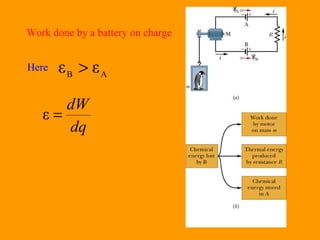
Work done by a battery on charge  Here
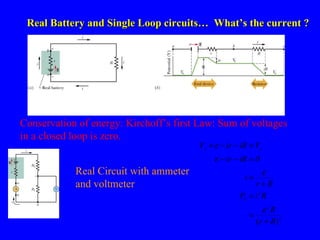
Real Battery and Single Loop circuits…  What’s the current ? Conservation of energy: Kirchoff’s first Law: Sum of voltages in a closed loop is zero. Real Circuit with ammeter and voltmeter
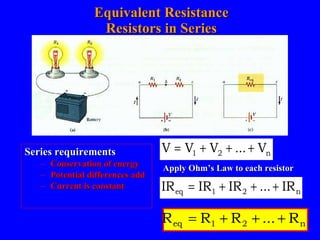
Equivalent Resistance Resistors in Series Series requirements Conservation of energy Potential differences add Current is constant Apply Ohm’s Law to each resistor
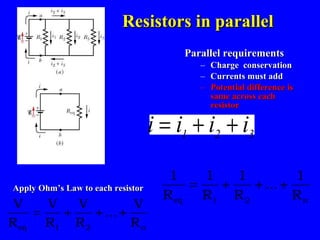
Resistors in parallel Parallel requirements Charge  conservation Currents must add Potential difference is same across each resistor Apply Ohm’s Law to each resistor
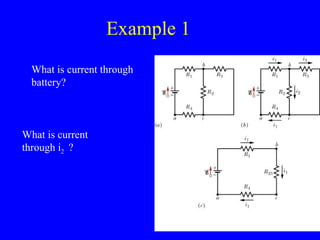
Example 1 What is current through battery? What is current through i 2  ?
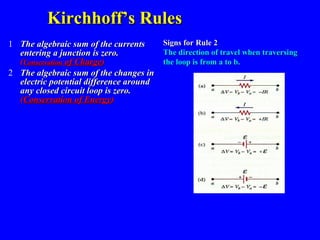
Kirchhoff’s Rules The algebraic sum of the currents entering a junction is zero.  ( Conservation  of Charge ) The algebraic sum of the changes in electric potential difference around any closed circuit loop is zero.   ( Conservation of Energy )   Signs for Rule 2 The direction of travel when traversing the loop is from a to b.
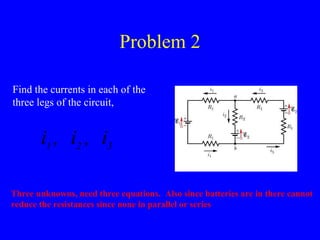
Problem 2 Find the currents in each of the three legs of the circuit,  Three unknowns, need three equations.  Also since batteries are in there cannot reduce the resistances since none in parallel or series
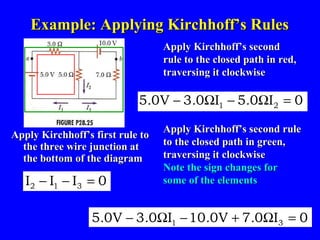
Example: Applying Kirchhoff’s Rules Apply Kirchhoff’s first rule to the three wire junction at the bottom of the diagram Apply Kirchhoff’s second rule to the closed path in red, traversing it clockwise Apply Kirchhoff’s second rule to the closed path in green, traversing it clockwise Note the sign changes for some of the elements
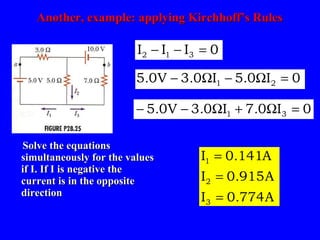
Another, example: applying Kirchhoff’s Rules Solve the equations simultaneously for the values if I. If I is negative the current is in the opposite direction
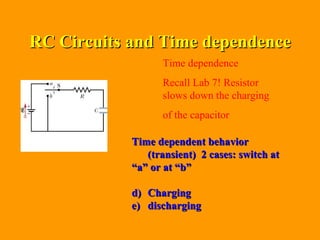
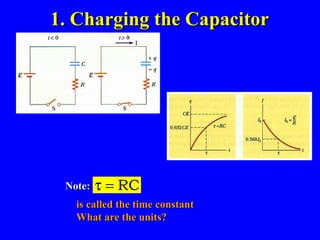
RC Circuits and Time dependence Time dependence  Recall Lab 7! Resistor slows down the charging of the capacitor  Time dependent behavior (transient)  2 cases: switch at  “ a” or at “b” Charging discharging
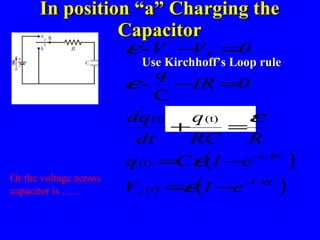
In position “a” Charging the Capacitor Use Kirchhoff’s Loop rule Or the voltage across capacitor is …..
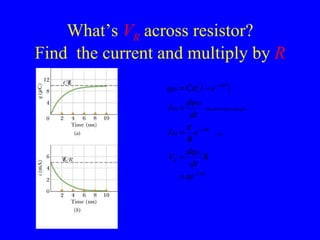
What’s  V R  across resistor? Find  the current and multiply by  R
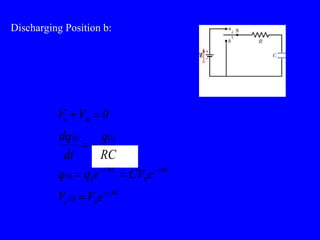
Discharging Position b:
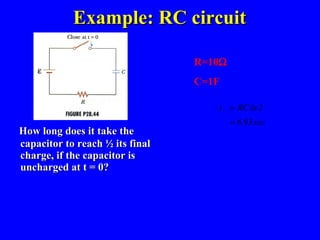
Example: RC circuit How long does it take the capacitor to reach ½ its final charge, if the capacitor is uncharged at t = 0? R=10  C=1F
1. Charging the Capacitor Note: is called the time constant What are the units?

Dc Circuit

  • 1.
    DC Circuits Thecircuit Resistance in combinations Kirchhoff’s Rules RC transient circuits
  • 2.
    Work done bya battery on charge Here
  • 3.
    Real Battery andSingle Loop circuits… What’s the current ? Conservation of energy: Kirchoff’s first Law: Sum of voltages in a closed loop is zero. Real Circuit with ammeter and voltmeter
  • 4.
    Equivalent Resistance Resistorsin Series Series requirements Conservation of energy Potential differences add Current is constant Apply Ohm’s Law to each resistor
  • 5.
    Resistors in parallelParallel requirements Charge conservation Currents must add Potential difference is same across each resistor Apply Ohm’s Law to each resistor
  • 6.
    Example 1 Whatis current through battery? What is current through i 2 ?
  • 7.
    Kirchhoff’s Rules Thealgebraic sum of the currents entering a junction is zero. ( Conservation of Charge ) The algebraic sum of the changes in electric potential difference around any closed circuit loop is zero. ( Conservation of Energy ) Signs for Rule 2 The direction of travel when traversing the loop is from a to b.
  • 8.
    Problem 2 Findthe currents in each of the three legs of the circuit, Three unknowns, need three equations. Also since batteries are in there cannot reduce the resistances since none in parallel or series
  • 9.
    Example: Applying Kirchhoff’sRules Apply Kirchhoff’s first rule to the three wire junction at the bottom of the diagram Apply Kirchhoff’s second rule to the closed path in red, traversing it clockwise Apply Kirchhoff’s second rule to the closed path in green, traversing it clockwise Note the sign changes for some of the elements
  • 10.
    Another, example: applyingKirchhoff’s Rules Solve the equations simultaneously for the values if I. If I is negative the current is in the opposite direction
  • 11.
    RC Circuits andTime dependence Time dependence Recall Lab 7! Resistor slows down the charging of the capacitor Time dependent behavior (transient) 2 cases: switch at “ a” or at “b” Charging discharging
  • 12.
    In position “a”Charging the Capacitor Use Kirchhoff’s Loop rule Or the voltage across capacitor is …..
  • 13.
    What’s VR across resistor? Find the current and multiply by R
  • 14.
  • 15.
    Example: RC circuitHow long does it take the capacitor to reach ½ its final charge, if the capacitor is uncharged at t = 0? R=10  C=1F
  • 16.
    1. Charging theCapacitor Note: is called the time constant What are the units?