Basic electronics Optical interfaces:  Detect and control
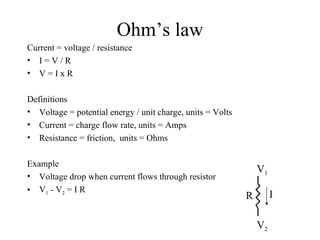
Ohm’s law Current = voltage / resistance I = V / R V = I x R Definitions  Voltage = potential energy / unit charge, units = Volts Current = charge flow rate, units = Amps Resistance = friction,  units = Ohms Example Voltage drop when current flows through resistor V 1  - V 2  = I R I R V 1 V 2
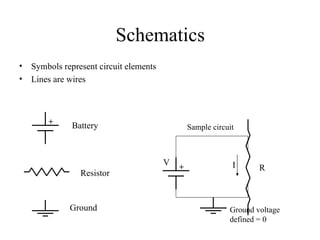
Schematics  Symbols represent circuit elements Lines are wires Battery  Resistor  Ground  V R I Sample circuit Ground voltage defined = 0 + +
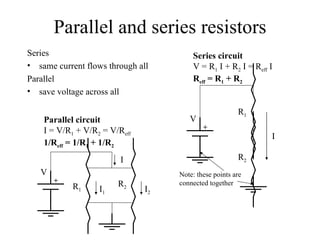
Parallel and series resistors Series same current flows through all Parallel save voltage across all Series circuit V = R 1  I + R 2  I = R eff  I R eff  = R 1  + R 2 Parallel circuit I = V/R 1  + V/R 2  = V/R eff   1/R eff  = 1/R 1  + 1/R 2 + Note: these points are  connected together I V R 1 R 2 + V R 1 R 2 I 1 I 2 I
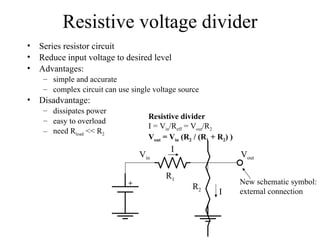
Resistive voltage divider Series resistor circuit Reduce input voltage to desired level Advantages:  simple and accurate complex circuit can use single voltage source Disadvantage:  dissipates power easy to overload need R load  << R 2 New schematic symbol: external connection Resistive divider I = V in /R eff  = V out /R 2 V out  = V in  (R 2  / (R 1  + R 2 ) ) + V in R 1 R 2 I I V out
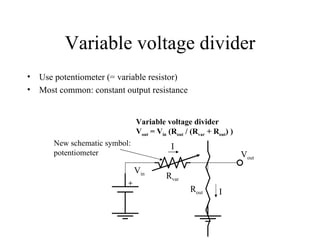
Variable voltage divider Use potentiometer (= variable resistor) Most common: constant output resistance V in R var R out I I V out Variable voltage divider V out  = V in  (R out  / (R var  + R out ) ) New schematic symbol: potentiometer +
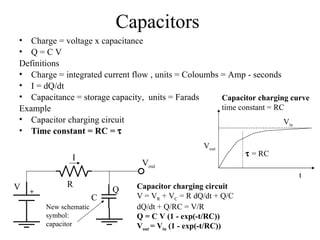
Capacitors  Charge = voltage x capacitance Q = C V Definitions  Charge = integrated current flow , units = Coloumbs = Amp - seconds I = dQ/dt Capacitance = storage capacity,  units = Farads Example  Capacitor charging circuit Time constant = RC =   Capacitor charging circuit V = V R  + V C  = R dQ/dt + Q/C dQ/dt + Q/RC = V/R Q = C V (1 - exp(-t/RC)) V out  = V in  (1 - exp(-t/RC)) New schematic  symbol: capacitor + V R C I V out Q V out t V in    = RC Capacitor charging curve time constant = RC
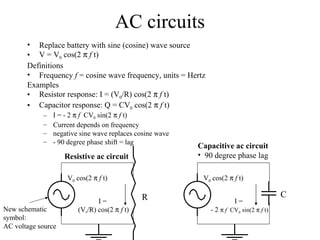
AC circuits Replace battery with sine (cosine) wave source V = V 0  cos(2     f  t) Definitions  Frequency  f  = cosine wave frequency, units = Hertz  Examples  Resistor response: I = (V 0 /R) cos(2     f  t) Capacitor response: Q = CV 0  cos(2     f  t) I = - 2     f   CV 0  sin(2     f  t) Current depends on frequency negative sine wave replaces cosine wave  - 90 degree phase shift = lag V 0  cos(2     f  t) C I =  - 2     f   CV 0  sin(2     f  t) Capacitive ac circuit 90 degree phase lag V 0  cos(2     f  t) R I =  (V 0 /R) cos(2     f  t) Resistive ac circuit New schematic  symbol: AC voltage source
Simplified notation: ac-circuits V = V 0  cos(2     f  t) = V 0  [exp(2   j  f  t) + c.c.]/2 Drop c.c. part and factor of 1/2 V = V 0  exp(2   j  f  t)   Revisit resistive and capacitive circuits Resistor response: I = (V 0 /R) exp(2   j  f  t) = V / R = V/ Z R   Capacitor response: I =  2   j  f   CV 0  exp(2   j  f  t) =  (2   j  f   C) V = V/ Z C   Definition:  Impedance, Z = effective resistance, units Ohms Capacitor impedance  Z C  = 1 / (2   j  f   C) Resistor impedance  Z R  = R Impedance makes it look like Ohms law applies to capacitive circuits also Capacitor response I = V / Z C
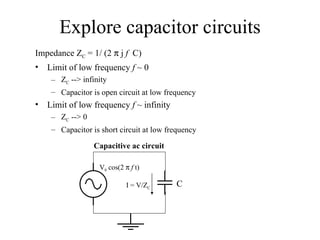
Explore capacitor circuits Impedance Z C  = 1/ (2   j  f   C)  Limit of low frequency  f  ~ 0 Z C  --> infinity Capacitor is open circuit at low frequency Limit of low frequency  f  ~ infinity Z C  --> 0 Capacitor is short circuit at low frequency V 0  cos(2     f  t) C I = V/Z C Capacitive ac circuit
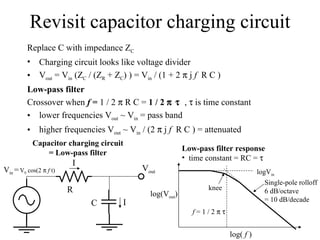
Revisit capacitor charging circuit Replace C with impedance Z C Charging circuit looks like voltage divider V out  = V in  (Z C  / (Z R  + Z C ) ) = V in  / (1 + 2   j  f   R C ) Low-pass filter Crossover when  f  =  1 / 2   R C =  1 / 2     ,    is time constant lower frequencies V out  ~ V in  = pass band higher frequencies V out  ~ V in  / (2   j  f   R C ) = attenuated log(V out ) log(  f  ) logV in f  = 1 / 2   Low-pass filter response time constant = RC =   Single-pole rolloff 6 dB/octave = 10 dB/decade knee Capacitor charging circuit = Low-pass filter V in  =   V 0  cos(2     f  t) R C I V out I
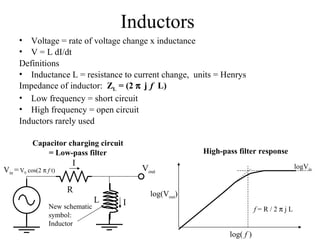
Inductors  Voltage = rate of voltage change x inductance V = L dI/dt Definitions  Inductance L = resistance to current change,  units = Henrys Impedance of inductor:  Z L  = (2   j  f   L) Low frequency = short circuit High frequency = open circuit Inductors rarely used Capacitor charging circuit = Low-pass filter V out log(V out ) log(  f  ) logV in f  = R / 2   j  L High-pass filter response V in  =   V 0  cos(2     f  t) R L I I New schematic  symbol: Inductor
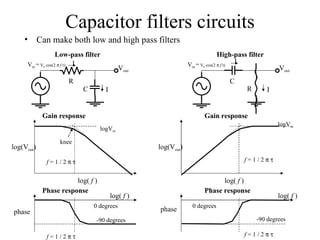
Capacitor filters circuits Can make both low and high pass filters 0 degrees 0 degrees Low-pass filter V in  =   V 0  cos(2     f  t) R C I V out I High-pass filter V in  =   V 0  cos(2     f  t) C R I V out I log(V out ) log(  f  ) logV in f  = 1 / 2   Gain response log(V out ) log(  f  ) logV in f  = 1 / 2   Gain response knee phase log(  f  ) f  = 1 / 2   Phase response -90 degrees phase log(  f  ) f  = 1 / 2   Phase response -90 degrees
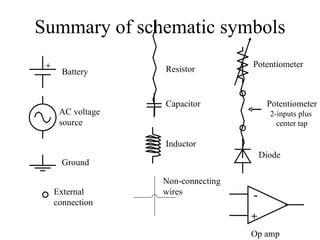
Summary of schematic symbols + Battery  Resistor  Ground  External connection Capacitor  AC voltage source Inductor  Non-connecting  wires - + Op amp Potentiometer Potentiometer 2-inputs plus  center tap Diode
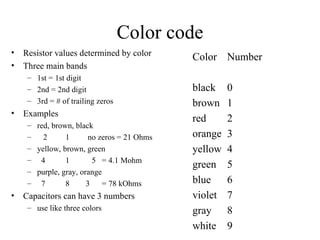
Color code Resistor values determined by color Three main bands 1st = 1st digit 2nd = 2nd digit 3rd = # of trailing zeros Examples red, brown, black 2  1  no zeros = 21 Ohms yellow, brown, green 4  1  5  = 4.1 Mohm purple, gray, orange 7  8  3  = 78 kOhms Capacitors can have 3 numbers use like three colors Color black brown red orange yellow green blue violet gray  white Number 0 1 2 3 4 5 6 7 8 9

07 basic-electronics

  • 1.
    Basic electronics Opticalinterfaces: Detect and control
  • 2.
    Ohm’s law Current= voltage / resistance I = V / R V = I x R Definitions Voltage = potential energy / unit charge, units = Volts Current = charge flow rate, units = Amps Resistance = friction, units = Ohms Example Voltage drop when current flows through resistor V 1 - V 2 = I R I R V 1 V 2
  • 3.
    Schematics Symbolsrepresent circuit elements Lines are wires Battery Resistor Ground V R I Sample circuit Ground voltage defined = 0 + +
  • 4.
    Parallel and seriesresistors Series same current flows through all Parallel save voltage across all Series circuit V = R 1 I + R 2 I = R eff I R eff = R 1 + R 2 Parallel circuit I = V/R 1 + V/R 2 = V/R eff 1/R eff = 1/R 1 + 1/R 2 + Note: these points are connected together I V R 1 R 2 + V R 1 R 2 I 1 I 2 I
  • 5.
    Resistive voltage dividerSeries resistor circuit Reduce input voltage to desired level Advantages: simple and accurate complex circuit can use single voltage source Disadvantage: dissipates power easy to overload need R load << R 2 New schematic symbol: external connection Resistive divider I = V in /R eff = V out /R 2 V out = V in (R 2 / (R 1 + R 2 ) ) + V in R 1 R 2 I I V out
  • 6.
    Variable voltage dividerUse potentiometer (= variable resistor) Most common: constant output resistance V in R var R out I I V out Variable voltage divider V out = V in (R out / (R var + R out ) ) New schematic symbol: potentiometer +
  • 7.
    Capacitors Charge= voltage x capacitance Q = C V Definitions Charge = integrated current flow , units = Coloumbs = Amp - seconds I = dQ/dt Capacitance = storage capacity, units = Farads Example Capacitor charging circuit Time constant = RC =  Capacitor charging circuit V = V R + V C = R dQ/dt + Q/C dQ/dt + Q/RC = V/R Q = C V (1 - exp(-t/RC)) V out = V in (1 - exp(-t/RC)) New schematic symbol: capacitor + V R C I V out Q V out t V in  = RC Capacitor charging curve time constant = RC
  • 8.
    AC circuits Replacebattery with sine (cosine) wave source V = V 0 cos(2  f t) Definitions Frequency f = cosine wave frequency, units = Hertz Examples Resistor response: I = (V 0 /R) cos(2  f t) Capacitor response: Q = CV 0 cos(2  f t) I = - 2  f CV 0 sin(2  f t) Current depends on frequency negative sine wave replaces cosine wave - 90 degree phase shift = lag V 0 cos(2  f t) C I = - 2  f CV 0 sin(2  f t) Capacitive ac circuit 90 degree phase lag V 0 cos(2  f t) R I = (V 0 /R) cos(2  f t) Resistive ac circuit New schematic symbol: AC voltage source
  • 9.
    Simplified notation: ac-circuitsV = V 0 cos(2  f t) = V 0 [exp(2  j f t) + c.c.]/2 Drop c.c. part and factor of 1/2 V = V 0 exp(2  j f t) Revisit resistive and capacitive circuits Resistor response: I = (V 0 /R) exp(2  j f t) = V / R = V/ Z R Capacitor response: I = 2  j f CV 0 exp(2  j f t) = (2  j f C) V = V/ Z C Definition: Impedance, Z = effective resistance, units Ohms Capacitor impedance Z C = 1 / (2  j  f C) Resistor impedance Z R = R Impedance makes it look like Ohms law applies to capacitive circuits also Capacitor response I = V / Z C
  • 10.
    Explore capacitor circuitsImpedance Z C = 1/ (2  j  f C) Limit of low frequency f ~ 0 Z C --> infinity Capacitor is open circuit at low frequency Limit of low frequency f ~ infinity Z C --> 0 Capacitor is short circuit at low frequency V 0 cos(2  f t) C I = V/Z C Capacitive ac circuit
  • 11.
    Revisit capacitor chargingcircuit Replace C with impedance Z C Charging circuit looks like voltage divider V out = V in (Z C / (Z R + Z C ) ) = V in / (1 + 2  j  f R C ) Low-pass filter Crossover when f = 1 / 2  R C = 1 / 2   ,  is time constant lower frequencies V out ~ V in = pass band higher frequencies V out ~ V in / (2  j  f R C ) = attenuated log(V out ) log(  f ) logV in f = 1 / 2  Low-pass filter response time constant = RC =  Single-pole rolloff 6 dB/octave = 10 dB/decade knee Capacitor charging circuit = Low-pass filter V in = V 0 cos(2  f t) R C I V out I
  • 12.
    Inductors Voltage= rate of voltage change x inductance V = L dI/dt Definitions Inductance L = resistance to current change, units = Henrys Impedance of inductor: Z L = (2  j  f L) Low frequency = short circuit High frequency = open circuit Inductors rarely used Capacitor charging circuit = Low-pass filter V out log(V out ) log(  f ) logV in f = R / 2  j  L High-pass filter response V in = V 0 cos(2  f t) R L I I New schematic symbol: Inductor
  • 13.
    Capacitor filters circuitsCan make both low and high pass filters 0 degrees 0 degrees Low-pass filter V in = V 0 cos(2  f t) R C I V out I High-pass filter V in = V 0 cos(2  f t) C R I V out I log(V out ) log(  f ) logV in f = 1 / 2  Gain response log(V out ) log(  f ) logV in f = 1 / 2  Gain response knee phase log(  f ) f = 1 / 2  Phase response -90 degrees phase log(  f ) f = 1 / 2  Phase response -90 degrees
  • 14.
    Summary of schematicsymbols + Battery Resistor Ground External connection Capacitor AC voltage source Inductor Non-connecting wires - + Op amp Potentiometer Potentiometer 2-inputs plus center tap Diode
  • 15.
    Color code Resistorvalues determined by color Three main bands 1st = 1st digit 2nd = 2nd digit 3rd = # of trailing zeros Examples red, brown, black 2 1 no zeros = 21 Ohms yellow, brown, green 4 1 5 = 4.1 Mohm purple, gray, orange 7 8 3 = 78 kOhms Capacitors can have 3 numbers use like three colors Color black brown red orange yellow green blue violet gray white Number 0 1 2 3 4 5 6 7 8 9