DATABASE MANAGEMENT
SYSTEMS
By: SURBHI SAROHA
SYLLABUS
•What is DBMS.
•Three-level architecture of DBMS.
WHAT IS DBMS
• What is Database
• The database is a collection of inter-related data which is used to retrieve, insert and
delete the data efficiently. It is also used to organize the data in the form of a table,
schema, views, and reports, etc.
• For example: The college Database organizes the data about the admin, staff,
students and faculty etc.
• Using the database, you can easily retrieve, insert, and delete the information.
CHARACTERISTICS OF DBMS
• It uses a digital repository established on a server to store and manage the information.
• It can provide a clear and logical view of the process that manipulates data.
• DBMS contains automatic backup and recovery procedures.
• It contains ACID properties which maintain data in a healthy state in case of failure.
• It can reduce the complex relationship between data.
• It is used to support manipulation and processing of data.
• It is used to provide security of data.
• It can view the database from different viewpoints according to the requirements of the
user.
ADVANTAGES OF DBMS
• Controls database redundancy: It can control data redundancy because it stores all the
data in one single database file and that recorded data is placed in the database.
• Data sharing: In DBMS, the authorized users of an organization can share the data among
multiple users.
• Easily Maintenance: It can be easily maintainable due to the centralized nature of the
database system.
• Reduce time: It reduces development time and maintenance need.
• Backup: It provides backup and recovery subsystems which create automatic backup of data
from hardware and software failures and restores the data if required.
• multiple user interface: It provides different types of user interfaces like graphical user
interfaces, application program interfaces
DISADVANTAGES OF DBMS
• Cost of Hardware and Software: It requires a high speed of data processor and
large memory size to run DBMS software.
• Size: It occupies a large space of disks and large memory to run them efficiently.
• Complexity: Database system creates additional complexity and requirements.
• Higher impact of failure: Failure is highly impacted the database because in most
of the organization, all the data stored in a single database and if the database is
damaged due to electric failure or database corruption then the data may be lost
forever.
THREE-LEVEL ARCHITECTURE OF
DBMS
• Three schema Architecture
• The three schema architecture is also called ANSI/SPARC architecture or three-level
architecture.
• This framework is used to describe the structure of a specific database system.
• The three schema architecture is also used to separate the user applications and
physical database.
• The three schema architecture contains three-levels. It breaks the database down
into three different categories.
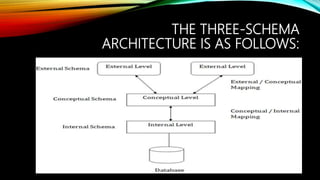
THE THREE-SCHEMA
ARCHITECTURE IS AS FOLLOWS:
IN THE ABOVE DIAGRAM:
• It shows the DBMS architecture.
• Mapping is used to transform the request and response between various database
levels of architecture.
• Mapping is not good for small DBMS because it takes more time.
• In External / Conceptual mapping, it is necessary to transform the request from
external level to conceptual schema.
• In Conceptual / Internal mapping, DBMS transform the request from the
conceptual to internal level.
1. INTERNAL LEVEL
• The internal level has an internal schema which describes the physical storage
structure of the database.
• The internal schema is also known as a physical schema.
• It uses the physical data model. It is used to define that how the data will be stored
in a block.
• The physical level is used to describe complex low-level data structures in detail.
2. CONCEPTUAL LEVEL
• The conceptual schema describes the design of a database at the conceptual level.
Conceptual level is also known as logical level.
• The conceptual schema describes the structure of the whole database.
• The conceptual level describes what data are to be stored in the database and also
describes what relationship exists among those data.
• In the conceptual level, internal details such as an implementation of the data
structure are hidden.
• Programmers and database administrators work at this level.
3. EXTERNAL LEVEL
• At the external level, a database contains several schemas that sometimes called as
subschema. The subschema is used to describe the different view of the database.
• An external schema is also known as view schema.
• Each view schema describes the database part that a particular user group is
interested and hides the remaining database from that user group.
• The view schema describes the end user interaction with database systems.
THANK YOU 

Database Management Systems

  • 1.
  • 2.
  • 3.
    WHAT IS DBMS •What is Database • The database is a collection of inter-related data which is used to retrieve, insert and delete the data efficiently. It is also used to organize the data in the form of a table, schema, views, and reports, etc. • For example: The college Database organizes the data about the admin, staff, students and faculty etc. • Using the database, you can easily retrieve, insert, and delete the information.
  • 4.
    CHARACTERISTICS OF DBMS •It uses a digital repository established on a server to store and manage the information. • It can provide a clear and logical view of the process that manipulates data. • DBMS contains automatic backup and recovery procedures. • It contains ACID properties which maintain data in a healthy state in case of failure. • It can reduce the complex relationship between data. • It is used to support manipulation and processing of data. • It is used to provide security of data. • It can view the database from different viewpoints according to the requirements of the user.
  • 5.
    ADVANTAGES OF DBMS •Controls database redundancy: It can control data redundancy because it stores all the data in one single database file and that recorded data is placed in the database. • Data sharing: In DBMS, the authorized users of an organization can share the data among multiple users. • Easily Maintenance: It can be easily maintainable due to the centralized nature of the database system. • Reduce time: It reduces development time and maintenance need. • Backup: It provides backup and recovery subsystems which create automatic backup of data from hardware and software failures and restores the data if required. • multiple user interface: It provides different types of user interfaces like graphical user interfaces, application program interfaces
  • 6.
    DISADVANTAGES OF DBMS •Cost of Hardware and Software: It requires a high speed of data processor and large memory size to run DBMS software. • Size: It occupies a large space of disks and large memory to run them efficiently. • Complexity: Database system creates additional complexity and requirements. • Higher impact of failure: Failure is highly impacted the database because in most of the organization, all the data stored in a single database and if the database is damaged due to electric failure or database corruption then the data may be lost forever.
  • 7.
    THREE-LEVEL ARCHITECTURE OF DBMS •Three schema Architecture • The three schema architecture is also called ANSI/SPARC architecture or three-level architecture. • This framework is used to describe the structure of a specific database system. • The three schema architecture is also used to separate the user applications and physical database. • The three schema architecture contains three-levels. It breaks the database down into three different categories.
  • 8.
  • 9.
    IN THE ABOVEDIAGRAM: • It shows the DBMS architecture. • Mapping is used to transform the request and response between various database levels of architecture. • Mapping is not good for small DBMS because it takes more time. • In External / Conceptual mapping, it is necessary to transform the request from external level to conceptual schema. • In Conceptual / Internal mapping, DBMS transform the request from the conceptual to internal level.
  • 10.
    1. INTERNAL LEVEL •The internal level has an internal schema which describes the physical storage structure of the database. • The internal schema is also known as a physical schema. • It uses the physical data model. It is used to define that how the data will be stored in a block. • The physical level is used to describe complex low-level data structures in detail.
  • 11.
    2. CONCEPTUAL LEVEL •The conceptual schema describes the design of a database at the conceptual level. Conceptual level is also known as logical level. • The conceptual schema describes the structure of the whole database. • The conceptual level describes what data are to be stored in the database and also describes what relationship exists among those data. • In the conceptual level, internal details such as an implementation of the data structure are hidden. • Programmers and database administrators work at this level.
  • 12.
    3. EXTERNAL LEVEL •At the external level, a database contains several schemas that sometimes called as subschema. The subschema is used to describe the different view of the database. • An external schema is also known as view schema. • Each view schema describes the database part that a particular user group is interested and hides the remaining database from that user group. • The view schema describes the end user interaction with database systems.
  • 13.