APPLICATIONS OF TISSUE CULTURE
1. Studies on intracellular activity eg. cell cycle and
differentiation, metabolism
2. Elucidation of intracellular flux eg. hormonal receptors,
signal transduction
3. Studies related to cell to cell interaction eg. cell adhesion
and motility, metabolic cooperation
4. Evaluation of environmental interactions eg. cytotoxicity,
mutagenesis
5. Studies dealing with genetics eg. Genetic analysis,
immortalization, senescence
6. Laboratory production of medical/ pharmaceutical
compounds for wide range of applications eg. Vaccines,
interferon, hormones
2
 Animal cell culture are useful for the production of
many pharmaceutically/ medically important proteins
which are as follows:
1. Plasminogen
2. Interferon
3. Blood clotting factors
4. Hormones
5. Monoclonal antibodies
6. Erythropoietin
3
Major development’s in cell culture
technology
 First development was the use of antibiotics which
inhibits the growth of contaminants.
 Second was the use of trypsin to remove adherent cells
to subculture further from the culture vessel
 Third was the use of chemically defined culture
medium.
4
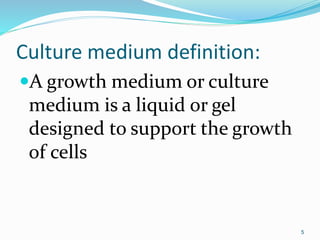
Culture medium definition:
A growth medium or culture
medium is a liquid or gel
designed to support the growth
of cells
5
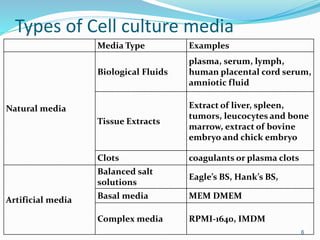
Media Type Examples
Natural media
Biological Fluids
plasma, serum, lymph,
human placental cord serum,
amniotic fluid
Tissue Extracts
Extract of liver, spleen,
tumors, leucocytes and bone
marrow, extract of bovine
embryo and chick embryo
Clots coagulants or plasma clots
Artificial media
Balanced salt
solutions
Eagle’s BS, Hank’s BS,
Basal media MEM DMEM
Complex media RPMI-1640, IMDM
6
Types of Cell culture media
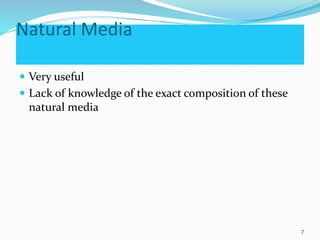
Natural Media
 Very useful
 Lack of knowledge of the exact composition of these
natural media
7
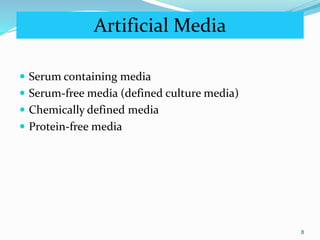
Artificial Media
 Serum containing media
 Serum-free media (defined culture media)
 Chemically defined media
 Protein-free media
8
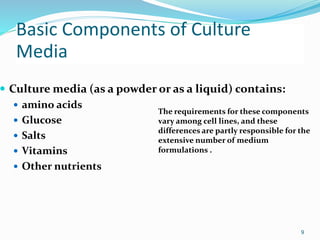
Basic Components of Culture
Media
 Culture media (as a powder or as a liquid) contains:
 amino acids
 Glucose
 Salts
 Vitamins
 Other nutrients
The requirements for these components
vary among cell lines, and these
differences are partly responsible for the
extensive number of medium
formulations .
9
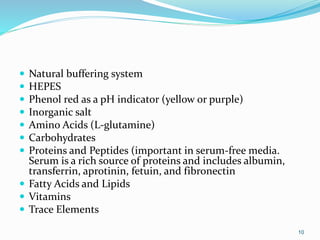
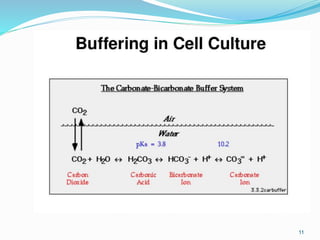
 Natural buffering system
 HEPES
 Phenol red as a pH indicator (yellow or purple)
 Inorganic salt
 Amino Acids (L-glutamine)
 Carbohydrates
 Proteins and Peptides (important in serum-free media.
Serum is a rich source of proteins and includes albumin,
transferrin, aprotinin, fetuin, and fibronectin
 Fatty Acids and Lipids
 Vitamins
 Trace Elements
10
11
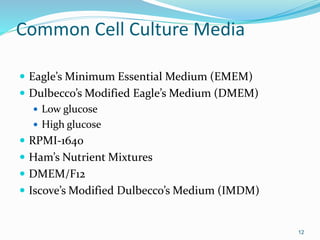
Common Cell Culture Media
 Eagle’s Minimum Essential Medium (EMEM)
 Dulbecco’s Modified Eagle’s Medium (DMEM)
 Low glucose
 High glucose
 RPMI-1640
 Ham’s Nutrient Mixtures
 DMEM/F12
 Iscove’s Modified Dulbecco’s Medium (IMDM)
12
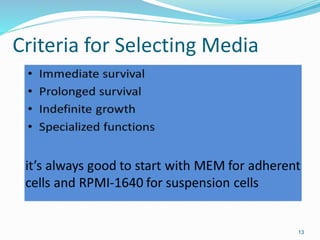
Criteria for Selecting Media
13
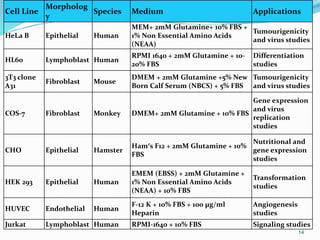
Cell Line
Morpholog
y
Species Medium Applications
HeLa B Epithelial Human
MEM+ 2mM Glutamine+ 10% FBS +
1% Non Essential Amino Acids
(NEAA)
Tumourigenicity
and virus studies
HL60 Lymphoblast Human
RPMI 1640 + 2mM Glutamine + 10-
20% FBS
Differentiation
studies
3T3 clone
A31
Fibroblast Mouse
DMEM + 2mM Glutamine +5% New
Born Calf Serum (NBCS) + 5% FBS
Tumourigenicity
and virus studies
COS-7 Fibroblast Monkey DMEM+ 2mM Glutamine + 10% FBS
Gene expression
and virus
replication
studies
CHO Epithelial Hamster
Ham′s F12 + 2mM Glutamine + 10%
FBS
Nutritional and
gene expression
studies
HEK 293 Epithelial Human
EMEM (EBSS) + 2mM Glutamine +
1% Non Essential Amino Acids
(NEAA) + 10% FBS
Transformation
studies
HUVEC Endothelial Human
F-12 K + 10% FBS + 100 µg/ml
Heparin
Angiogenesis
studies
Jurkat Lymphoblast Human RPMI-1640 + 10% FBS Signaling studies
14
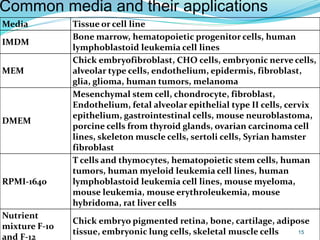
Common media and their applications
Media Tissue or cell line
IMDM
Bone marrow, hematopoietic progenitor cells, human
lymphoblastoid leukemia cell lines
MEM
Chick embryofibroblast, CHO cells, embryonic nerve cells,
alveolar type cells, endothelium, epidermis, fibroblast,
glia, glioma, human tumors, melanoma
DMEM
Mesenchymal stem cell, chondrocyte, fibroblast,
Endothelium, fetal alveolar epithelial type II cells, cervix
epithelium, gastrointestinal cells, mouse neuroblastoma,
porcine cells from thyroid glands, ovarian carcinoma cell
lines, skeleton muscle cells, sertoli cells, Syrian hamster
fibroblast
RPMI-1640
T cells and thymocytes, hematopoietic stem cells, human
tumors, human myeloid leukemia cell lines, human
lymphoblastoid leukemia cell lines, mouse myeloma,
mouse leukemia, mouse erythroleukemia, mouse
hybridoma, rat liver cells
Nutrient
mixture F-10
and F-12
Chick embryo pigmented retina, bone, cartilage, adipose
tissue, embryonic lung cells, skeletal muscle cells 15
Media Supplements
 Serum in Media
 Basic nutrients
 Growth factors and hormones
 Binding proteins
 Promote attachment of cells to the substrate
 Protease inhibitors
 Provides minerals, like Na+, K+, Zn2+, Fe2+, etc
 Protects cells from mechanical damages during agitation of
suspension cultures
 Acts a buffer
 Antibiotics
16
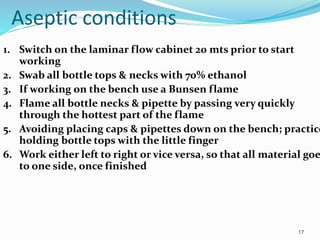
Aseptic conditions
1. Switch on the laminar flow cabinet 20 mts prior to start
working
2. Swab all bottle tops & necks with 70% ethanol
3. If working on the bench use a Bunsen flame
4. Flame all bottle necks & pipette by passing very quickly
through the hottest part of the flame
5. Avoiding placing caps & pipettes down on the bench; practice
holding bottle tops with the little finger
6. Work either left to right or vice versa, so that all material goe
to one side, once finished
17
7. Clean up spills immediately & always leave
the work place neat & tidy
8. Never use the same media bottle for different
cell lines.
9. If caps are dropped or bottles touched
unconditionally touched, replace them with
new ones
10. Necks of glass bottles prefer heat at least for
60 secs at a temperature of 200 C
11. Never use stock of materials during handling
of cells.
18
Contaminant’s of cell culture
Cell culture contaminants of two types
 Chemical-difficult to detect caused by
endotoxins, plasticizers, metal ions or traces
of disinfectants that are invisible
 Biological-cause visible effects on the culture
they are mycoplasma, yeast, bacteria or fungus
or also from cross-contamination of cells from
other cell lines
19
Effects of Biological Contamination’s
 They competes for nutrients with host cells
 Secreted acidic or alkaline by-products ceases the
growth of the host cells
 Degraded arginine & purine inhibits the synthesis of
histone and nucleic acid
 They also produces H2O2 which is directly toxic to cells
20
Detection of contaminants
 In general: turbid culture media, change in growth rates,
abnormally high pH, poor attachment, multi-nucleated cells,
graining cellular appearance, vacuolization, inclusion bodies
and cell lysis
 Yeast, bacteria & fungi usually shows visible effect on the culture
(changes in medium turbidity or pH)
 Mycoplasma detected by direct DNA staining with intercalating
fluorescent substances e.g. Hoechst 33258
 Mycoplasma also detected by enzyme immunoassay by specific
antisera or monoclonal abs or by PCR amplification of
mycoplasmal RNA
 The best and the oldest way to eliminate contamination is to
discard the infected cell lines directly
21
22

Day2 tissue culture

  • 2.
    APPLICATIONS OF TISSUECULTURE 1. Studies on intracellular activity eg. cell cycle and differentiation, metabolism 2. Elucidation of intracellular flux eg. hormonal receptors, signal transduction 3. Studies related to cell to cell interaction eg. cell adhesion and motility, metabolic cooperation 4. Evaluation of environmental interactions eg. cytotoxicity, mutagenesis 5. Studies dealing with genetics eg. Genetic analysis, immortalization, senescence 6. Laboratory production of medical/ pharmaceutical compounds for wide range of applications eg. Vaccines, interferon, hormones 2
  • 3.
     Animal cellculture are useful for the production of many pharmaceutically/ medically important proteins which are as follows: 1. Plasminogen 2. Interferon 3. Blood clotting factors 4. Hormones 5. Monoclonal antibodies 6. Erythropoietin 3
  • 4.
    Major development’s incell culture technology  First development was the use of antibiotics which inhibits the growth of contaminants.  Second was the use of trypsin to remove adherent cells to subculture further from the culture vessel  Third was the use of chemically defined culture medium. 4
  • 5.
    Culture medium definition: Agrowth medium or culture medium is a liquid or gel designed to support the growth of cells 5
  • 6.
    Media Type Examples Naturalmedia Biological Fluids plasma, serum, lymph, human placental cord serum, amniotic fluid Tissue Extracts Extract of liver, spleen, tumors, leucocytes and bone marrow, extract of bovine embryo and chick embryo Clots coagulants or plasma clots Artificial media Balanced salt solutions Eagle’s BS, Hank’s BS, Basal media MEM DMEM Complex media RPMI-1640, IMDM 6 Types of Cell culture media
  • 7.
    Natural Media  Veryuseful  Lack of knowledge of the exact composition of these natural media 7
  • 8.
    Artificial Media  Serumcontaining media  Serum-free media (defined culture media)  Chemically defined media  Protein-free media 8
  • 9.
    Basic Components ofCulture Media  Culture media (as a powder or as a liquid) contains:  amino acids  Glucose  Salts  Vitamins  Other nutrients The requirements for these components vary among cell lines, and these differences are partly responsible for the extensive number of medium formulations . 9
  • 10.
     Natural bufferingsystem  HEPES  Phenol red as a pH indicator (yellow or purple)  Inorganic salt  Amino Acids (L-glutamine)  Carbohydrates  Proteins and Peptides (important in serum-free media. Serum is a rich source of proteins and includes albumin, transferrin, aprotinin, fetuin, and fibronectin  Fatty Acids and Lipids  Vitamins  Trace Elements 10
  • 11.
  • 12.
    Common Cell CultureMedia  Eagle’s Minimum Essential Medium (EMEM)  Dulbecco’s Modified Eagle’s Medium (DMEM)  Low glucose  High glucose  RPMI-1640  Ham’s Nutrient Mixtures  DMEM/F12  Iscove’s Modified Dulbecco’s Medium (IMDM) 12
  • 13.
  • 14.
    Cell Line Morpholog y Species MediumApplications HeLa B Epithelial Human MEM+ 2mM Glutamine+ 10% FBS + 1% Non Essential Amino Acids (NEAA) Tumourigenicity and virus studies HL60 Lymphoblast Human RPMI 1640 + 2mM Glutamine + 10- 20% FBS Differentiation studies 3T3 clone A31 Fibroblast Mouse DMEM + 2mM Glutamine +5% New Born Calf Serum (NBCS) + 5% FBS Tumourigenicity and virus studies COS-7 Fibroblast Monkey DMEM+ 2mM Glutamine + 10% FBS Gene expression and virus replication studies CHO Epithelial Hamster Ham′s F12 + 2mM Glutamine + 10% FBS Nutritional and gene expression studies HEK 293 Epithelial Human EMEM (EBSS) + 2mM Glutamine + 1% Non Essential Amino Acids (NEAA) + 10% FBS Transformation studies HUVEC Endothelial Human F-12 K + 10% FBS + 100 µg/ml Heparin Angiogenesis studies Jurkat Lymphoblast Human RPMI-1640 + 10% FBS Signaling studies 14
  • 15.
    Common media andtheir applications Media Tissue or cell line IMDM Bone marrow, hematopoietic progenitor cells, human lymphoblastoid leukemia cell lines MEM Chick embryofibroblast, CHO cells, embryonic nerve cells, alveolar type cells, endothelium, epidermis, fibroblast, glia, glioma, human tumors, melanoma DMEM Mesenchymal stem cell, chondrocyte, fibroblast, Endothelium, fetal alveolar epithelial type II cells, cervix epithelium, gastrointestinal cells, mouse neuroblastoma, porcine cells from thyroid glands, ovarian carcinoma cell lines, skeleton muscle cells, sertoli cells, Syrian hamster fibroblast RPMI-1640 T cells and thymocytes, hematopoietic stem cells, human tumors, human myeloid leukemia cell lines, human lymphoblastoid leukemia cell lines, mouse myeloma, mouse leukemia, mouse erythroleukemia, mouse hybridoma, rat liver cells Nutrient mixture F-10 and F-12 Chick embryo pigmented retina, bone, cartilage, adipose tissue, embryonic lung cells, skeletal muscle cells 15
  • 16.
    Media Supplements  Serumin Media  Basic nutrients  Growth factors and hormones  Binding proteins  Promote attachment of cells to the substrate  Protease inhibitors  Provides minerals, like Na+, K+, Zn2+, Fe2+, etc  Protects cells from mechanical damages during agitation of suspension cultures  Acts a buffer  Antibiotics 16
  • 17.
    Aseptic conditions 1. Switchon the laminar flow cabinet 20 mts prior to start working 2. Swab all bottle tops & necks with 70% ethanol 3. If working on the bench use a Bunsen flame 4. Flame all bottle necks & pipette by passing very quickly through the hottest part of the flame 5. Avoiding placing caps & pipettes down on the bench; practice holding bottle tops with the little finger 6. Work either left to right or vice versa, so that all material goe to one side, once finished 17
  • 18.
    7. Clean upspills immediately & always leave the work place neat & tidy 8. Never use the same media bottle for different cell lines. 9. If caps are dropped or bottles touched unconditionally touched, replace them with new ones 10. Necks of glass bottles prefer heat at least for 60 secs at a temperature of 200 C 11. Never use stock of materials during handling of cells. 18
  • 19.
    Contaminant’s of cellculture Cell culture contaminants of two types  Chemical-difficult to detect caused by endotoxins, plasticizers, metal ions or traces of disinfectants that are invisible  Biological-cause visible effects on the culture they are mycoplasma, yeast, bacteria or fungus or also from cross-contamination of cells from other cell lines 19
  • 20.
    Effects of BiologicalContamination’s  They competes for nutrients with host cells  Secreted acidic or alkaline by-products ceases the growth of the host cells  Degraded arginine & purine inhibits the synthesis of histone and nucleic acid  They also produces H2O2 which is directly toxic to cells 20
  • 21.
    Detection of contaminants In general: turbid culture media, change in growth rates, abnormally high pH, poor attachment, multi-nucleated cells, graining cellular appearance, vacuolization, inclusion bodies and cell lysis  Yeast, bacteria & fungi usually shows visible effect on the culture (changes in medium turbidity or pH)  Mycoplasma detected by direct DNA staining with intercalating fluorescent substances e.g. Hoechst 33258  Mycoplasma also detected by enzyme immunoassay by specific antisera or monoclonal abs or by PCR amplification of mycoplasmal RNA  The best and the oldest way to eliminate contamination is to discard the infected cell lines directly 21
  • 22.