welcome
SYNOPSIS PRESENTATION
ON
Molecular approaches of heat tolerance
in wheat
Major advisor Presentedby
Dr Shambhoo prasad Ashish kumar
Asstt proff A- 10046/17
Deptt of PMB and GE MSc.(Ag)Biotech
Introduction
• Wheat (Triticum aestivum L.) is the main staple food crop for a large number of
world populations.
• It is the second main winter cereal in India after rice.
• The area under wheat cultivation in the world 222 m ha, while a production of
714.74 million tons and productivity 2.99 Mt/ha (CIMMYT, 2016).
• India had a remarkable success during green revolution in wheat production and
could increase productivity to the extent through it could bring itself out from
insufficiency to a self-sufficient status. This is certainly a significant and
comforting outcome.
• The area under wheat in India is 28.42 mha, with a production of 84.20 million
tons and productivity of 2.6 Mt/ha. However at Uttar Pradesh level, it occupy an
area of 10.42 mha, with production of 29.32 million tons and productivity of 2.8
Mt/ha (DWR, 2016).
•Yield increases are essential to meet this demand, as expanding the wheat area is
not possible (Rajaram and Braun, 2008). (Gill et al., 2004) stated that in order to
meet growing human needs; wheat grain production must increase at an annual
rate of 2%.
•Unfortunately, heat stress is a major environmental factor that substantially
reduces wheat grain yield globally especially in arid, semi-arid, tropical, and sub-
tropical regions that are associated with higher temperature. (Wahid et al., 2007).
•Wheat is highly sensitive heat stress and even slight variation in temperature
during critical stages like pollination and milky ripe reduces the quality and
quantity of wheat grains. Increase in temperature of 1ºC reduce the yield of wheat
by 4% (kumar et al., 2014).
•Heat stress as the rise in temperature beyond a threshold level for a period of
time sufficient to cause irreversible damage to plant growth and development.
Global warming as a result of climate change negatively affects wheat grain yield,
which potentially increases food insecurity and poverty (Ortiz et al., 2008).
• Heat stress tolerance is complex phenomenon and controlled by multiple
genes imparting a number of physiological and biochemical changes.
•High temperature shorten the grain filling period significantly in all the
bread and durum wheat genotype because of significant interaction of each
genotype with temperature (Panday et al.,2013).
•Expression of heat shock proteins (HSPs) is the most studied molecular
response under heat stress.
•Expression of HSP genes is a fundamental response to heat stress when
exposed to high temperature (>35ºC), normal protein synthesis in wheat is
reduced but HSPs are produced (Farooq et al., 2011).
•Heat stress adversely affects the wheat crop starting from the early stage of
emergence in wheat. Exposure of wheat seedling to heat stress for a short period
can also cause significant decrease of the root and shoot length, dry mass,
chlorophyll content as well as membrane stability index which is a measure of
tolerance of cell membrane to sustain in high temperature (Gupta et al., 2013)
•. Molecular marker-assisted breeding is defined as use of genetic and
genomic analysis to identify DNA regions that linked to quantitative traits in
crops. It can facilitate breeding programs for wheat improvement.
•Molecular markers are very important materials for the evaluation of genetic
diversity. These markers can show types of high and low polymorphism in
wheat. The new methods with molecular markers has been developed in many
recent studies that most of these were based on PCR amplification of genomic
DNA.
•Polymerase chain reactions (PCR) have been started as the most modern
technique in molecular biology in 1980s. This tool was introduced as decreased
data method to identify of relationships with together. Several molecular markers
like random amplified polymorphic DNAs (RAPD) and simple sequence repeats
(SSRs) are presently available to identify the variability, diversity and similarity
in molecular levels
•
Objectives
Screening parent and F2 population for heat tolerance by physio-
molecular approaches,
Selecting best heat tolerant and heat susceptible plant for BSA work,
Yield and yield component of parent and F2 population
Review of Literature
• Sapi et al., (2017), studied that an experiment was conducted on 108 bread wheat genotypes to
evaluate the genetic diversity for yield and yield contributing parameters under heat stress
conditions. The genotypes congregated into eleven clusters, and distribution pattern designates that
maximum number of genotypes were grouped into the cluster VI (25) followed by cluster I (16) and IX
(12). The inter cluster distances were higher than the intra-cluster distance, indicating broader genetic
diversity among the genotypes of different groupsThis suggested that genotypes like SHIATS BW-
1606, SHIATS BW- 1630, and SHIATS BW- 1698 from cluster VIII and SHIATS BW- 1695 from cluster I
could be used as potential donors for hybridization program to develop recombinant genotypes with
high grain yield adapted to heat stress conditions
• Jena et al., (2017), suggested that Climate change is a reality and agriculture is highly vulnerable..
Among various factors affecting wheat productivity high temperature has a significant effect. The
terminal heat stress is prevalent in the major wheat growing regions of Indo-Gangetic Plains. The
increasing temperature shortens the duration of both vegetative and reproductive phases. Late sown
wheat crop makes the ripening stage of the crop coinciding with high temperature stress. Also
provision of additional irrigation water at critical stages and skipping during the dough and ripening
stages increases the yield of wheat under high temperature. Application of certain chemicals can help
in mitigating the adverse impact of high temperature stress.
• Prasad et al., (2016), studied with 8 wheat varieties to see the genetic variability in wheat for heat
stress tolerance at grain filling stage during rabi season 2013-14. Heat stress treatment was given by
delayed sowing of 60 days from normal date of sowing (15 November) so that reproductive stage of
wheat varieties could experience severs heat stress. The wheat varieties K 911, AAI 11, HUW 658 and
NW 4035 had high membrane stability index (MSI), canopy temperature depression (CTD) and total
chlorophyll content (SPAD) at grain filling stage and less percent reduction in grain number per spike,
grain yield and test weight over control.
Kumar et al., (2016), proposed that A field study was conducted with seven wheat lines NDL-10-2, NDL-9-
4, NDL-12-1, NDL-12-3, KO-307, NDL-12-2 and NDL-12-4 to assess heat stress effects on yield and yield
related traits of wheat. Heat stress was induced by delayed sowing of 60 days from normal date of sowing so
that grain filling stage of wheat could experience severe heat stress. Data related to no. of tillers, plant height,
spike length, no. of grain per spike, grain yield per plant and test weight of wheat lines were taken in control
and heat stress condition. On the basis of yield and yield attributing traits, three wheat lines NDL-10-2, NDL-
9-4 and NDL-12-4 showed heat tolerant while NDL-121, NDL-12-3, KO-307 and NDL-12-2 appeared as
susceptible under heat stress conditions.
Ray et al., (2015), studied that to compare adaptation of wheat genotypes in warmer environment by means
of canopy temperature depression (CTD). In 30 December sowing BARI gom 26 showed higher mean value
of CTD (2.32oC) whereas Pavon 76 showed lower value (0.88oC) at different stages indicating that BARI
gom 26 maintained cooler canopies even at post anthesis heat stress condition compared to Pavon 76. On 30
December sowing BARI gom 25 and BARI gom 26 continued to increase grain dry matter upto 32 DAA
which stopped 8 days earlier in Pavon 76, reflecting higher relative 1000-grain weight (96%) and grain yield
(89%) in BARI gom 26 compared to Pavon 76. BARI gom 26 that maintained higher CTD was found to be
better in grain growth and yield under warmer environment.
Kumar et al., (2015), studied that molecular characterization of 18 wheat cultivars and the amplification was
successfully carried out 23 SSR primer pairs. A total of 341 allelic variants were detected with an average of
9.2 alleles per locus in which 226 unique alleles were observed at 37 SSR loci, with an average of 6.10 unique
alleles per locus. Polymorphism information content (PIC) value ranged from 0.347 for the primer Xgwm369
to 0.858 for Xgwm251 & Xgwm282 with an average of 0.691. A maximum similarity coefficient was found
between AKAW 4189-3 and Kauz/AA/ Kauz (0.93) while minimum similarity was found between PBW343
and Kauz-dwarf (0.63). The results of this experiment suggest that hybridization between AKAW4008 with
C306 and Raj3765 with C306 will not produce high yielding heat tolerant hybrid of wheat, because these
parental lines shows the narrow genetic base.
Khavarinejad M.S. et al., (2013), evaluated that the molecular analysis of 10 bread wheat genotypes using
RAPD and SSR markers. In RAPD with 6 primers and in SSR with 5 primers were detected 33 and 17
polymorphism allels for genotypes the most polymorphic information content (PIC) value and polymorphism
percentage was detected by UBC 350 and 109 markers with value 0.53 and 0.50 respectively in RAPDs. In
SSRs,Xgwm 469-6D marker detected 14 bands with 5 polymorphic alleles but Xgwm 120 -2Bhad the most
PIC with 57%.for both markers UPGMA was the the best method of clustering. In final resuls RAPDs could
detect more polymorphism alleles than SSRs.
Barakat et al., (2012), reported that the grain-filling rate (GFR) plays an important role in determining grain
yield. An F2 population of wheat was developed from a cross between the 2 wheat cultivars, Ksu106 (heat-
tolerant) and Yecora Rojo (heat-sensitive The results reveal that 12 SSR markers: Wmc24, Wmc168,
Wmc326, Xgwm30, Xgwm456, Wmc25, Wmc44, Wmc94, Wmc161, Wmc273, Wmc327 and Xgwm566
were linked to GFR by QTLs analysis of the F2 population. The results show that regression analysis for the
relationship between the 12 markers and the phenotypes of F2 individuals were highly significant. The results
demonstrate that SSR markers combined with bulked segregant analysis could be used to identify molecular
markers linked to the grain filling rate as an indicator for heat tolerance in wheat.
Kumar et al., (2012), studied that terminal heat stress causes an array of physiological, biochemical and
morphological changes in plants, which affect plant growth and development. In present investigation, real
time quantitative expression analysis of HSP90 gene in root showed a maximum of 2.5 fold increase in the
transcript level during seed hardening stage. Under differential heat shock, the highest activity of SOD and
CAT were observed in response to heat shock of 40° and 35°C for 2 h. The results from this study suggest a
potential role for antioxidant enzymes in the reduction of elevated levels of H2O2 in wheat plants grown
under heat stress condition.
Barakat et al., (2011), proposed that to estimate inheritance of the grain filling rate as indicator for heat
tolerant genes. The minimum number of genes for the trait in bread wheat was also assessed by combining
quantitative genetic estimates and SSR marker analyses. Two cultivars, Debra (heat-tolerant) and Yecora Rojo
(heat-sensitive) crossed and F1 and F2 populations generated.
Barakat et al., (2011), proposed that to estimate inheritance of the grain filling rate as indicator
for heat tolerant genes. The minimum number of genes for the trait in bread wheat was also
assessed by combining quantitative genetic estimates and SSR marker analyses. Two cultivars,
Debra (heat-tolerant) and Yecora Rojo (heat-sensitive) crossed and F1 and F2 populations
generated. The parents, F1 and 162 F2 plants were planted in winter season 2009 to evaluate heat
tolerance during the grain-filling period. The results demonstrated that SSR markers, combined
with bulked segregant analysis, could be used to identify molecular markers linked to the grain
filling rate as indicator for heat tolerance in wheat.
Ciuca et al., (2009), studied that Membrane stability has been suggested as a useful measure of
drought tolerance in wheat breeding programs. We studied the association between membrane
stability, as estimated by conductivity test after exposing plants to water stress in the field, and
several SSR markers located on chromosome 7A. SSR markers wmc9, wmc596, wmc603 and
barc108 were weakly but significantly associated with cell membrane stability after water stress
and can be used for increasing the frequency of progenies with better performance under drought
in a wheat breeding program
Technical Programme:-
Treatment
Heat stress will be given to wheat genotype by delayed sowing in field condition
•Normal sowing (15 November to 25 november )
•Very late sowing (15 January to 25 january )
Design: Factorial RBD
No. of varieties 11
Replication 3
Treatment 2
Observation to be recorded:-
•For objective 1:
Phenotyping
•Membrane stability index (%)
•Chlorophyll stability index (%)
•Canopy temperature depression (0
C)
•Protein profiling of parents and its F1s at gain growth stage at 12% under control and
stress condition by SDS-PAGE methods (lamellae et al ,1970)
•For objective 2:
•Isolation of DNA by CTAB methods from the taken genotypes.
•Checking the diversity of the parent and mapping population by molecular markers
Selecting a set of donor and recipient parent having diverged background
•Selecting a set of donor and recipient parent having diverged background
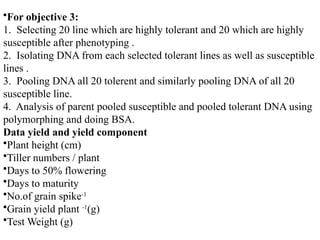
•For objective 3:
1. Selecting 20 line which are highly tolerant and 20 which are highly
susceptible after phenotyping .
2. Isolating DNA from each selected tolerant lines as well as susceptible
lines .
3. Pooling DNA all 20 tolerent and similarly pooling DNA of all 20
susceptible line.
4. Analysis of parent pooled susceptible and pooled tolerant DNA using
polymorphing and doing BSA.
Data yield and yield component
•Plant height (cm)
•Tiller numbers / plant
•Days to 50% flowering
•Days to maturity
•No.of grain spike-1
•Grain yield plant -1
(g)
•Test Weight (g)
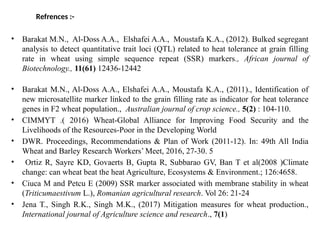
Refrences :-
• Barakat M.N., Al-Doss A.A., Elshafei A.A., Moustafa K.A., (2012). Bulked segregant
analysis to detect quantitative trait loci (QTL) related to heat tolerance at grain filling
rate in wheat using simple sequence repeat (SSR) markers., African journal of
Biotechnology., 11(61) 12436-12442
• Barakat M.N., Al-Doss A.A., Elshafei A.A., Moustafa K.A., (2011)., Identification of
new microsatellite marker linked to the grain filling rate as indicator for heat tolerance
genes in F2 wheat population., Australian journal of crop science., 5(2) : 104-110.
• CIMMYT .( 2016) Wheat-Global Alliance for Improving Food Security and the
Livelihoods of the Resources-Poor in the Developing World
• DWR. Proceedings, Recommendations & Plan of Work (2011-12). In: 49th All India
Wheat and Barley Research Workers’ Meet, 2016, 27-30. 5
• Ortiz R, Sayre KD, Govaerts B, Gupta R, Subbarao GV, Ban T et al(2008 )Climate
change: can wheat beat the heat Agriculture, Ecosystems & Environment.; 126:4658.
• Ciuca M and Petcu E (2009) SSR marker associated with membrane stability in wheat
(Triticumaestivum L.), Romanian agricultural research. Vol 26: 21-24
• Jena T., Singh R.K., Singh M.K., (2017) Mitigation measures for wheat production.,
International journal of Agriculture science and research., 7(1)
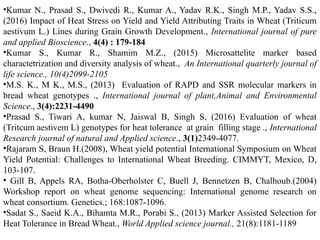
•Kumar N., Prasad S., Dwivedi R., Kumar A., Yadav R.K., Singh M.P., Yadav S.S.,
(2016) Impact of Heat Stress on Yield and Yield Attributing Traits in Wheat (Triticum
aestivum L.) Lines during Grain Growth Development., International journal of pure
and applied Bioscience., 4(4) : 179-184
•Kumar S., Kumar R., Shamim M.Z., (2015) Microsattelite marker based
charactetrization and diversity analysis of wheat., An International quarterly journal of
life science., 10(4)2099-2105
•M.S. K., M K., M.S., (2013) Evaluation of RAPD and SSR molecular markers in
bread wheat genotypes ., International journal of plant,Animal and Environmental
Science., 3(4):2231-4490
•Prasad S., Tiwari A, kumar N, Jaiswal B, Singh S, (2016) Evaluation of wheat
(Tritcum aestivem L) genotypes for heat tolerance at grain filling stage ., International
Research journal of natural and Applied science., 3(1)2349-4077.
•Rajaram S, Braun H.(2008), Wheat yield potential International Symposium on Wheat
Yield Potential: Challenges to International Wheat Breeding. CIMMYT, Mexico, D,
103-107.
• Gill B, Appels RA, Botha-Oberholster C, Buell J, Bennetzen B, Chalhoub.(2004)
Workshop report on wheat genome sequencing: International genome research on
wheat consortium. Genetics.; 168:1087-1096.
•Sadat S., Saeid K.A., Bihamta M.R., Porabi S., (2013) Marker Assisted Selection for
Heat Tolerance in Bread Wheat., World Applied science journal., 21(8):1181-1189
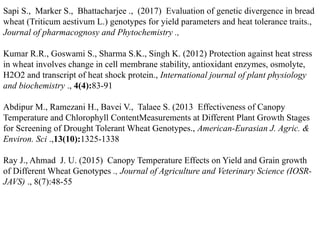
Sapi S., Marker S., Bhattacharjee ., (2017) Evaluation of genetic divergence in bread
wheat (Triticum aestivum L.) genotypes for yield parameters and heat tolerance traits.,
Journal of pharmacognosy and Phytochemistry .,
Kumar R.R., Goswami S., Sharma S.K., Singh K. (2012) Protection against heat stress
in wheat involves change in cell membrane stability, antioxidant enzymes, osmolyte,
H2O2 and transcript of heat shock protein., International journal of plant physiology
and biochemistry ., 4(4):83-91
Abdipur M., Ramezani H., Bavei V., Talaee S. (2013 Effectiveness of Canopy
Temperature and Chlorophyll ContentMeasurements at Different Plant Growth Stages
for Screening of Drought Tolerant Wheat Genotypes., American-Eurasian J. Agric. &
Environ. Sci .,13(10):1325-1338
Ray J., Ahmad J. U. (2015) Canopy Temperature Effects on Yield and Grain growth
of Different Wheat Genotypes ., Journal of Agriculture and Veterinary Science (IOSR-
JAVS) ., 8(7):48-55
Thank you

Ashish yadav seminor.pptx assocition mapping

  • 1.
  • 2.
    SYNOPSIS PRESENTATION ON Molecular approachesof heat tolerance in wheat Major advisor Presentedby Dr Shambhoo prasad Ashish kumar Asstt proff A- 10046/17 Deptt of PMB and GE MSc.(Ag)Biotech
  • 3.
    Introduction • Wheat (Triticumaestivum L.) is the main staple food crop for a large number of world populations. • It is the second main winter cereal in India after rice. • The area under wheat cultivation in the world 222 m ha, while a production of 714.74 million tons and productivity 2.99 Mt/ha (CIMMYT, 2016). • India had a remarkable success during green revolution in wheat production and could increase productivity to the extent through it could bring itself out from insufficiency to a self-sufficient status. This is certainly a significant and comforting outcome. • The area under wheat in India is 28.42 mha, with a production of 84.20 million tons and productivity of 2.6 Mt/ha. However at Uttar Pradesh level, it occupy an area of 10.42 mha, with production of 29.32 million tons and productivity of 2.8 Mt/ha (DWR, 2016).
  • 4.
    •Yield increases areessential to meet this demand, as expanding the wheat area is not possible (Rajaram and Braun, 2008). (Gill et al., 2004) stated that in order to meet growing human needs; wheat grain production must increase at an annual rate of 2%. •Unfortunately, heat stress is a major environmental factor that substantially reduces wheat grain yield globally especially in arid, semi-arid, tropical, and sub- tropical regions that are associated with higher temperature. (Wahid et al., 2007). •Wheat is highly sensitive heat stress and even slight variation in temperature during critical stages like pollination and milky ripe reduces the quality and quantity of wheat grains. Increase in temperature of 1ºC reduce the yield of wheat by 4% (kumar et al., 2014). •Heat stress as the rise in temperature beyond a threshold level for a period of time sufficient to cause irreversible damage to plant growth and development. Global warming as a result of climate change negatively affects wheat grain yield, which potentially increases food insecurity and poverty (Ortiz et al., 2008).
  • 5.
    • Heat stresstolerance is complex phenomenon and controlled by multiple genes imparting a number of physiological and biochemical changes. •High temperature shorten the grain filling period significantly in all the bread and durum wheat genotype because of significant interaction of each genotype with temperature (Panday et al.,2013). •Expression of heat shock proteins (HSPs) is the most studied molecular response under heat stress. •Expression of HSP genes is a fundamental response to heat stress when exposed to high temperature (>35ºC), normal protein synthesis in wheat is reduced but HSPs are produced (Farooq et al., 2011). •Heat stress adversely affects the wheat crop starting from the early stage of emergence in wheat. Exposure of wheat seedling to heat stress for a short period can also cause significant decrease of the root and shoot length, dry mass, chlorophyll content as well as membrane stability index which is a measure of tolerance of cell membrane to sustain in high temperature (Gupta et al., 2013) •. Molecular marker-assisted breeding is defined as use of genetic and genomic analysis to identify DNA regions that linked to quantitative traits in crops. It can facilitate breeding programs for wheat improvement.
  • 6.
    •Molecular markers arevery important materials for the evaluation of genetic diversity. These markers can show types of high and low polymorphism in wheat. The new methods with molecular markers has been developed in many recent studies that most of these were based on PCR amplification of genomic DNA. •Polymerase chain reactions (PCR) have been started as the most modern technique in molecular biology in 1980s. This tool was introduced as decreased data method to identify of relationships with together. Several molecular markers like random amplified polymorphic DNAs (RAPD) and simple sequence repeats (SSRs) are presently available to identify the variability, diversity and similarity in molecular levels •
  • 7.
    Objectives Screening parent andF2 population for heat tolerance by physio- molecular approaches, Selecting best heat tolerant and heat susceptible plant for BSA work, Yield and yield component of parent and F2 population
  • 8.
    Review of Literature •Sapi et al., (2017), studied that an experiment was conducted on 108 bread wheat genotypes to evaluate the genetic diversity for yield and yield contributing parameters under heat stress conditions. The genotypes congregated into eleven clusters, and distribution pattern designates that maximum number of genotypes were grouped into the cluster VI (25) followed by cluster I (16) and IX (12). The inter cluster distances were higher than the intra-cluster distance, indicating broader genetic diversity among the genotypes of different groupsThis suggested that genotypes like SHIATS BW- 1606, SHIATS BW- 1630, and SHIATS BW- 1698 from cluster VIII and SHIATS BW- 1695 from cluster I could be used as potential donors for hybridization program to develop recombinant genotypes with high grain yield adapted to heat stress conditions • Jena et al., (2017), suggested that Climate change is a reality and agriculture is highly vulnerable.. Among various factors affecting wheat productivity high temperature has a significant effect. The terminal heat stress is prevalent in the major wheat growing regions of Indo-Gangetic Plains. The increasing temperature shortens the duration of both vegetative and reproductive phases. Late sown wheat crop makes the ripening stage of the crop coinciding with high temperature stress. Also provision of additional irrigation water at critical stages and skipping during the dough and ripening stages increases the yield of wheat under high temperature. Application of certain chemicals can help in mitigating the adverse impact of high temperature stress. • Prasad et al., (2016), studied with 8 wheat varieties to see the genetic variability in wheat for heat stress tolerance at grain filling stage during rabi season 2013-14. Heat stress treatment was given by delayed sowing of 60 days from normal date of sowing (15 November) so that reproductive stage of wheat varieties could experience severs heat stress. The wheat varieties K 911, AAI 11, HUW 658 and NW 4035 had high membrane stability index (MSI), canopy temperature depression (CTD) and total chlorophyll content (SPAD) at grain filling stage and less percent reduction in grain number per spike, grain yield and test weight over control.
  • 9.
    Kumar et al.,(2016), proposed that A field study was conducted with seven wheat lines NDL-10-2, NDL-9- 4, NDL-12-1, NDL-12-3, KO-307, NDL-12-2 and NDL-12-4 to assess heat stress effects on yield and yield related traits of wheat. Heat stress was induced by delayed sowing of 60 days from normal date of sowing so that grain filling stage of wheat could experience severe heat stress. Data related to no. of tillers, plant height, spike length, no. of grain per spike, grain yield per plant and test weight of wheat lines were taken in control and heat stress condition. On the basis of yield and yield attributing traits, three wheat lines NDL-10-2, NDL- 9-4 and NDL-12-4 showed heat tolerant while NDL-121, NDL-12-3, KO-307 and NDL-12-2 appeared as susceptible under heat stress conditions. Ray et al., (2015), studied that to compare adaptation of wheat genotypes in warmer environment by means of canopy temperature depression (CTD). In 30 December sowing BARI gom 26 showed higher mean value of CTD (2.32oC) whereas Pavon 76 showed lower value (0.88oC) at different stages indicating that BARI gom 26 maintained cooler canopies even at post anthesis heat stress condition compared to Pavon 76. On 30 December sowing BARI gom 25 and BARI gom 26 continued to increase grain dry matter upto 32 DAA which stopped 8 days earlier in Pavon 76, reflecting higher relative 1000-grain weight (96%) and grain yield (89%) in BARI gom 26 compared to Pavon 76. BARI gom 26 that maintained higher CTD was found to be better in grain growth and yield under warmer environment. Kumar et al., (2015), studied that molecular characterization of 18 wheat cultivars and the amplification was successfully carried out 23 SSR primer pairs. A total of 341 allelic variants were detected with an average of 9.2 alleles per locus in which 226 unique alleles were observed at 37 SSR loci, with an average of 6.10 unique alleles per locus. Polymorphism information content (PIC) value ranged from 0.347 for the primer Xgwm369 to 0.858 for Xgwm251 & Xgwm282 with an average of 0.691. A maximum similarity coefficient was found between AKAW 4189-3 and Kauz/AA/ Kauz (0.93) while minimum similarity was found between PBW343 and Kauz-dwarf (0.63). The results of this experiment suggest that hybridization between AKAW4008 with C306 and Raj3765 with C306 will not produce high yielding heat tolerant hybrid of wheat, because these parental lines shows the narrow genetic base.
  • 10.
    Khavarinejad M.S. etal., (2013), evaluated that the molecular analysis of 10 bread wheat genotypes using RAPD and SSR markers. In RAPD with 6 primers and in SSR with 5 primers were detected 33 and 17 polymorphism allels for genotypes the most polymorphic information content (PIC) value and polymorphism percentage was detected by UBC 350 and 109 markers with value 0.53 and 0.50 respectively in RAPDs. In SSRs,Xgwm 469-6D marker detected 14 bands with 5 polymorphic alleles but Xgwm 120 -2Bhad the most PIC with 57%.for both markers UPGMA was the the best method of clustering. In final resuls RAPDs could detect more polymorphism alleles than SSRs. Barakat et al., (2012), reported that the grain-filling rate (GFR) plays an important role in determining grain yield. An F2 population of wheat was developed from a cross between the 2 wheat cultivars, Ksu106 (heat- tolerant) and Yecora Rojo (heat-sensitive The results reveal that 12 SSR markers: Wmc24, Wmc168, Wmc326, Xgwm30, Xgwm456, Wmc25, Wmc44, Wmc94, Wmc161, Wmc273, Wmc327 and Xgwm566 were linked to GFR by QTLs analysis of the F2 population. The results show that regression analysis for the relationship between the 12 markers and the phenotypes of F2 individuals were highly significant. The results demonstrate that SSR markers combined with bulked segregant analysis could be used to identify molecular markers linked to the grain filling rate as an indicator for heat tolerance in wheat. Kumar et al., (2012), studied that terminal heat stress causes an array of physiological, biochemical and morphological changes in plants, which affect plant growth and development. In present investigation, real time quantitative expression analysis of HSP90 gene in root showed a maximum of 2.5 fold increase in the transcript level during seed hardening stage. Under differential heat shock, the highest activity of SOD and CAT were observed in response to heat shock of 40° and 35°C for 2 h. The results from this study suggest a potential role for antioxidant enzymes in the reduction of elevated levels of H2O2 in wheat plants grown under heat stress condition. Barakat et al., (2011), proposed that to estimate inheritance of the grain filling rate as indicator for heat tolerant genes. The minimum number of genes for the trait in bread wheat was also assessed by combining quantitative genetic estimates and SSR marker analyses. Two cultivars, Debra (heat-tolerant) and Yecora Rojo (heat-sensitive) crossed and F1 and F2 populations generated.
  • 11.
    Barakat et al.,(2011), proposed that to estimate inheritance of the grain filling rate as indicator for heat tolerant genes. The minimum number of genes for the trait in bread wheat was also assessed by combining quantitative genetic estimates and SSR marker analyses. Two cultivars, Debra (heat-tolerant) and Yecora Rojo (heat-sensitive) crossed and F1 and F2 populations generated. The parents, F1 and 162 F2 plants were planted in winter season 2009 to evaluate heat tolerance during the grain-filling period. The results demonstrated that SSR markers, combined with bulked segregant analysis, could be used to identify molecular markers linked to the grain filling rate as indicator for heat tolerance in wheat. Ciuca et al., (2009), studied that Membrane stability has been suggested as a useful measure of drought tolerance in wheat breeding programs. We studied the association between membrane stability, as estimated by conductivity test after exposing plants to water stress in the field, and several SSR markers located on chromosome 7A. SSR markers wmc9, wmc596, wmc603 and barc108 were weakly but significantly associated with cell membrane stability after water stress and can be used for increasing the frequency of progenies with better performance under drought in a wheat breeding program
  • 12.
    Technical Programme:- Treatment Heat stresswill be given to wheat genotype by delayed sowing in field condition •Normal sowing (15 November to 25 november ) •Very late sowing (15 January to 25 january ) Design: Factorial RBD No. of varieties 11 Replication 3 Treatment 2 Observation to be recorded:- •For objective 1: Phenotyping •Membrane stability index (%) •Chlorophyll stability index (%) •Canopy temperature depression (0 C) •Protein profiling of parents and its F1s at gain growth stage at 12% under control and stress condition by SDS-PAGE methods (lamellae et al ,1970) •For objective 2: •Isolation of DNA by CTAB methods from the taken genotypes. •Checking the diversity of the parent and mapping population by molecular markers Selecting a set of donor and recipient parent having diverged background •Selecting a set of donor and recipient parent having diverged background
  • 13.
    •For objective 3: 1.Selecting 20 line which are highly tolerant and 20 which are highly susceptible after phenotyping . 2. Isolating DNA from each selected tolerant lines as well as susceptible lines . 3. Pooling DNA all 20 tolerent and similarly pooling DNA of all 20 susceptible line. 4. Analysis of parent pooled susceptible and pooled tolerant DNA using polymorphing and doing BSA. Data yield and yield component •Plant height (cm) •Tiller numbers / plant •Days to 50% flowering •Days to maturity •No.of grain spike-1 •Grain yield plant -1 (g) •Test Weight (g)
  • 14.
    Refrences :- • BarakatM.N., Al-Doss A.A., Elshafei A.A., Moustafa K.A., (2012). Bulked segregant analysis to detect quantitative trait loci (QTL) related to heat tolerance at grain filling rate in wheat using simple sequence repeat (SSR) markers., African journal of Biotechnology., 11(61) 12436-12442 • Barakat M.N., Al-Doss A.A., Elshafei A.A., Moustafa K.A., (2011)., Identification of new microsatellite marker linked to the grain filling rate as indicator for heat tolerance genes in F2 wheat population., Australian journal of crop science., 5(2) : 104-110. • CIMMYT .( 2016) Wheat-Global Alliance for Improving Food Security and the Livelihoods of the Resources-Poor in the Developing World • DWR. Proceedings, Recommendations & Plan of Work (2011-12). In: 49th All India Wheat and Barley Research Workers’ Meet, 2016, 27-30. 5 • Ortiz R, Sayre KD, Govaerts B, Gupta R, Subbarao GV, Ban T et al(2008 )Climate change: can wheat beat the heat Agriculture, Ecosystems & Environment.; 126:4658. • Ciuca M and Petcu E (2009) SSR marker associated with membrane stability in wheat (Triticumaestivum L.), Romanian agricultural research. Vol 26: 21-24 • Jena T., Singh R.K., Singh M.K., (2017) Mitigation measures for wheat production., International journal of Agriculture science and research., 7(1)
  • 15.
    •Kumar N., PrasadS., Dwivedi R., Kumar A., Yadav R.K., Singh M.P., Yadav S.S., (2016) Impact of Heat Stress on Yield and Yield Attributing Traits in Wheat (Triticum aestivum L.) Lines during Grain Growth Development., International journal of pure and applied Bioscience., 4(4) : 179-184 •Kumar S., Kumar R., Shamim M.Z., (2015) Microsattelite marker based charactetrization and diversity analysis of wheat., An International quarterly journal of life science., 10(4)2099-2105 •M.S. K., M K., M.S., (2013) Evaluation of RAPD and SSR molecular markers in bread wheat genotypes ., International journal of plant,Animal and Environmental Science., 3(4):2231-4490 •Prasad S., Tiwari A, kumar N, Jaiswal B, Singh S, (2016) Evaluation of wheat (Tritcum aestivem L) genotypes for heat tolerance at grain filling stage ., International Research journal of natural and Applied science., 3(1)2349-4077. •Rajaram S, Braun H.(2008), Wheat yield potential International Symposium on Wheat Yield Potential: Challenges to International Wheat Breeding. CIMMYT, Mexico, D, 103-107. • Gill B, Appels RA, Botha-Oberholster C, Buell J, Bennetzen B, Chalhoub.(2004) Workshop report on wheat genome sequencing: International genome research on wheat consortium. Genetics.; 168:1087-1096. •Sadat S., Saeid K.A., Bihamta M.R., Porabi S., (2013) Marker Assisted Selection for Heat Tolerance in Bread Wheat., World Applied science journal., 21(8):1181-1189
  • 16.
    Sapi S., MarkerS., Bhattacharjee ., (2017) Evaluation of genetic divergence in bread wheat (Triticum aestivum L.) genotypes for yield parameters and heat tolerance traits., Journal of pharmacognosy and Phytochemistry ., Kumar R.R., Goswami S., Sharma S.K., Singh K. (2012) Protection against heat stress in wheat involves change in cell membrane stability, antioxidant enzymes, osmolyte, H2O2 and transcript of heat shock protein., International journal of plant physiology and biochemistry ., 4(4):83-91 Abdipur M., Ramezani H., Bavei V., Talaee S. (2013 Effectiveness of Canopy Temperature and Chlorophyll ContentMeasurements at Different Plant Growth Stages for Screening of Drought Tolerant Wheat Genotypes., American-Eurasian J. Agric. & Environ. Sci .,13(10):1325-1338 Ray J., Ahmad J. U. (2015) Canopy Temperature Effects on Yield and Grain growth of Different Wheat Genotypes ., Journal of Agriculture and Veterinary Science (IOSR- JAVS) ., 8(7):48-55
  • 17.