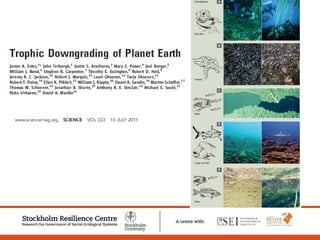
CPWF  3rd International Forum South Africa 14th November 2011 Prof. Johan Rockström Stockholm Resilience Centre Stockholm Environment Institute The grand challenge for humanity:  Water and Food in the Anthropocene
Growing  Human Pressure [20/80 dilemma] Climate change [560/450/400 dilemma] Surprise [99/1 dilemma] Ecosystem decline [60 % loss dilemma]
 
 
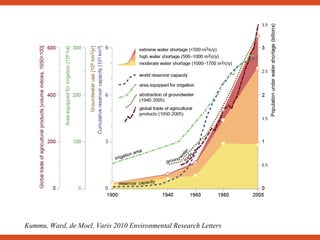
Kummu, Ward, de Moel, Varis  2010 Environmental Research Letters
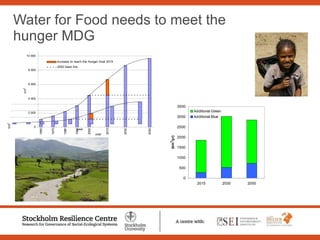
Water for Food needs to meet the hunger MDG
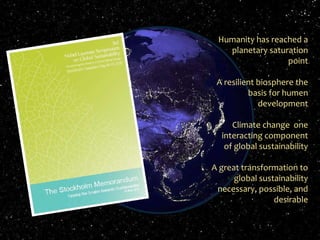
11-11-18 Johan Rockström and Carl Folke, Stockholm Resilience Centre Humanity has reached a planetary saturation point A resilient biosphere the basis for humen development Climate change  one interacting component of global sustainability A great transformation to global sustainability necessary, possible, and desirable
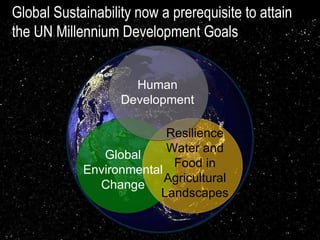
Resilience Water and Food in Agricultural Landscapes Global Environmental Change Global Sustainability now a prerequisite to attain the UN Millennium Development Goals   Human Development
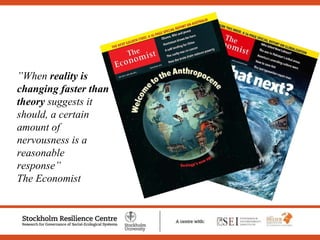
” When  reality is changing faster than theory  suggests it should, a certain amount of nervousness is a reasonable response ” The Economist
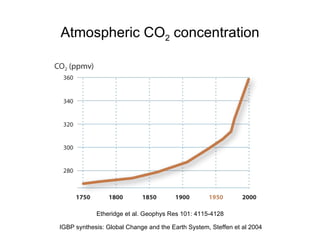
Atmospheric CO 2  concentration Etheridge et al. Geophys Res 101: 4115-4128 IGBP synthesis: Global Change and the Earth System, Steffen et al 2004
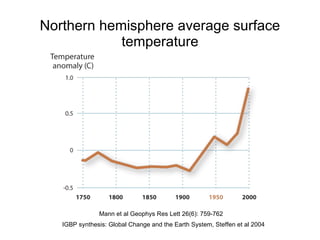
Northern hemisphere average surface temperature IGBP synthesis: Global Change and the Earth System, Steffen et al 2004 Mann et al Geophys Res Lett 26(6): 759-762
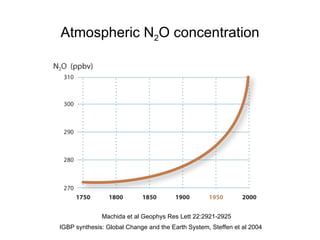
Atmospheric N 2 O concentration IGBP synthesis: Global Change and the Earth System, Steffen et al 2004 Machida et al Geophys Res Lett 22:2921-2925
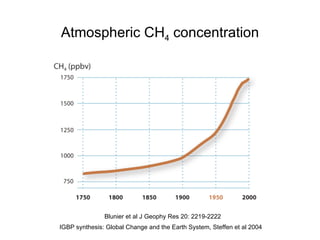
Atmospheric CH 4  concentration IGBP synthesis: Global Change and the Earth System, Steffen et al 2004 Blunier et al J Geophy Res 20: 2219-2222
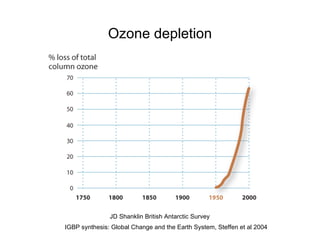
Ozone depletion IGBP synthesis: Global Change and the Earth System, Steffen et al 2004 JD Shanklin British Antarctic Survey
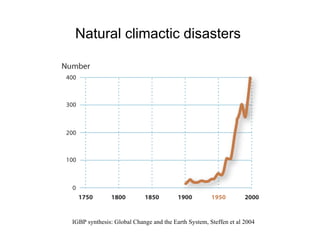
Natural climactic disasters  IGBP synthesis: Global Change and the Earth System, Steffen et al 2004
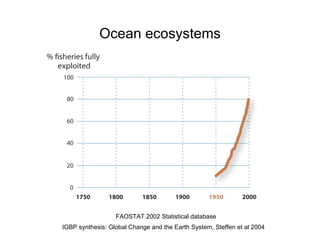
Ocean ecosystems IGBP synthesis: Global Change and the Earth System, Steffen et al 2004 FAOSTAT 2002 Statistical database
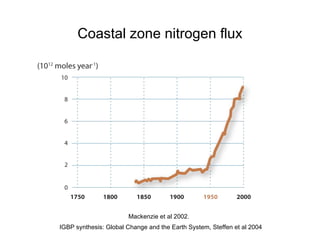
Coastal zone nitrogen flux IGBP synthesis: Global Change and the Earth System, Steffen et al 2004 Mackenzie et al 2002.
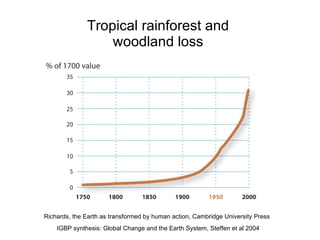
Tropical rainforest and  woodland loss  IGBP synthesis: Global Change and the Earth System, Steffen et al 2004 Richards, the Earth as transformed by human action, Cambridge University Press
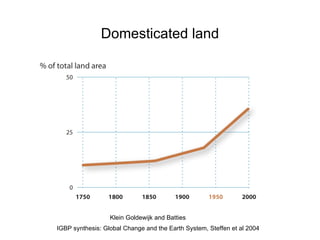
Domesticated land IGBP synthesis: Global Change and the Earth System, Steffen et al 2004 Klein Goldewijk and Batties
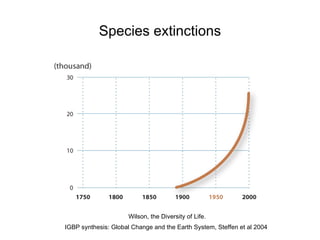
Species extinctions IGBP synthesis: Global Change and the Earth System, Steffen et al 2004 Wilson, the Diversity of Life.
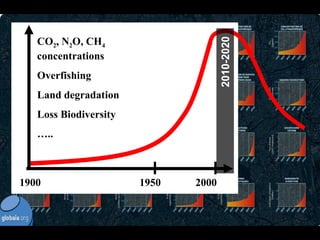
The Planetary Response to the drivers of the Anthropocene  ” the great acceleration of the human entreprise ” , Professor Will Steffen 1900   1950  2000 CO 2 , N 2 O, CH 4  concentrations Overfishing Land degradation Loss Biodiversity … .. 2010-2020
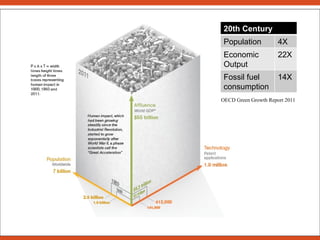
OECD Green Growth Report 2011 20th Century Population 4X Economic Output 22X Fossil fuel consumption 14X
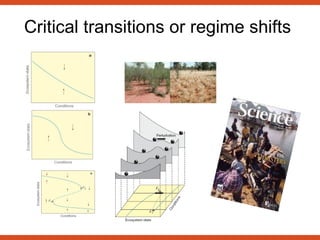
Critical transitions or regime shifts
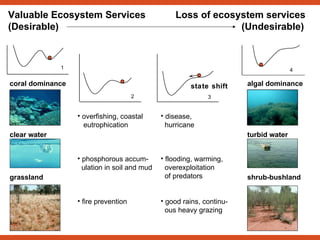
1 2 overfishing,  coastal  e utrophication phosphorous accum- ulation in soil and mud fire prevention 3 state shift disease, h urricane f looding, warming, overexploitation of predators   good rains, continu- ous heavy grazing coral dominance clear water grassland 4 algal dominance turbid water shrub-bushland Valuable Ecosystem Services  Loss of ecosystem services (Desirable)   (Undesirable)
 
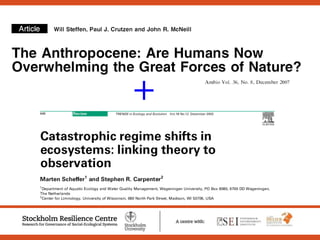
+
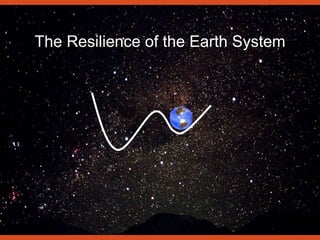
The Resilience of the Earth System
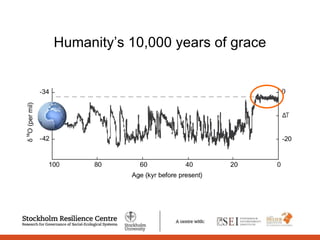
Humanity ’ s 10,000 years of grace
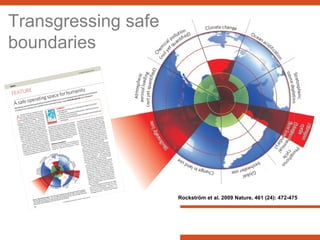
… Rockström et al. 2009   Nature, 461 (24): 472-475 Global fresh- water use Transgressing safe boundaries
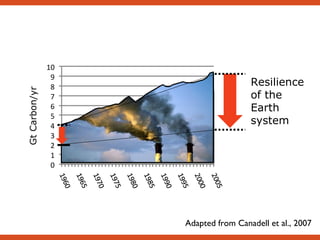
Adapted from Canadell et al., 2007 0 1 2 3 4 5 6 7 8 9 10 Gt Carbon/yr land ocean atmosphere Resilience of the Earth system
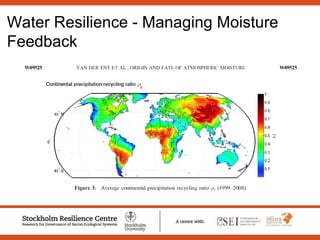
Water Resilience - Managing Moisture Feedback
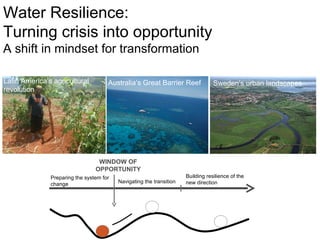
Australia ’ s Great Barrier Reef Sweden ’ s urban landscapes Latin America ’ s agricultural revolution Water Resilience: Turning crisis into opportunity A shift in mindset for transformation WINDOW OF OPPORTUNITY Preparing the system for change Navigating the transition Building resilience of the new direction
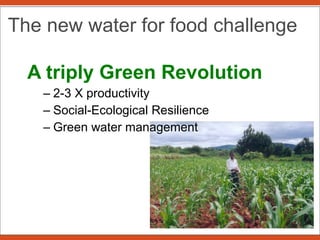
A triply Green Revolution 2-3 X productivity Social-Ecological Resilience Green water management The new water for food challenge
 

Day Presentation by Johan Rockstrom

  • 1.
    CPWF 3rdInternational Forum South Africa 14th November 2011 Prof. Johan Rockström Stockholm Resilience Centre Stockholm Environment Institute The grand challenge for humanity: Water and Food in the Anthropocene
  • 2.
    Growing HumanPressure [20/80 dilemma] Climate change [560/450/400 dilemma] Surprise [99/1 dilemma] Ecosystem decline [60 % loss dilemma]
  • 3.
  • 4.
  • 5.
    Kummu, Ward, deMoel, Varis 2010 Environmental Research Letters
  • 6.
    Water for Foodneeds to meet the hunger MDG
  • 7.
    11-11-18 Johan Rockströmand Carl Folke, Stockholm Resilience Centre Humanity has reached a planetary saturation point A resilient biosphere the basis for humen development Climate change one interacting component of global sustainability A great transformation to global sustainability necessary, possible, and desirable
  • 8.
    Resilience Water andFood in Agricultural Landscapes Global Environmental Change Global Sustainability now a prerequisite to attain the UN Millennium Development Goals Human Development
  • 9.
    ” When reality is changing faster than theory suggests it should, a certain amount of nervousness is a reasonable response ” The Economist
  • 10.
    Atmospheric CO 2 concentration Etheridge et al. Geophys Res 101: 4115-4128 IGBP synthesis: Global Change and the Earth System, Steffen et al 2004
  • 11.
    Northern hemisphere averagesurface temperature IGBP synthesis: Global Change and the Earth System, Steffen et al 2004 Mann et al Geophys Res Lett 26(6): 759-762
  • 12.
    Atmospheric N 2O concentration IGBP synthesis: Global Change and the Earth System, Steffen et al 2004 Machida et al Geophys Res Lett 22:2921-2925
  • 13.
    Atmospheric CH 4 concentration IGBP synthesis: Global Change and the Earth System, Steffen et al 2004 Blunier et al J Geophy Res 20: 2219-2222
  • 14.
    Ozone depletion IGBPsynthesis: Global Change and the Earth System, Steffen et al 2004 JD Shanklin British Antarctic Survey
  • 15.
    Natural climactic disasters IGBP synthesis: Global Change and the Earth System, Steffen et al 2004
  • 16.
    Ocean ecosystems IGBPsynthesis: Global Change and the Earth System, Steffen et al 2004 FAOSTAT 2002 Statistical database
  • 17.
    Coastal zone nitrogenflux IGBP synthesis: Global Change and the Earth System, Steffen et al 2004 Mackenzie et al 2002.
  • 18.
    Tropical rainforest and woodland loss IGBP synthesis: Global Change and the Earth System, Steffen et al 2004 Richards, the Earth as transformed by human action, Cambridge University Press
  • 19.
    Domesticated land IGBPsynthesis: Global Change and the Earth System, Steffen et al 2004 Klein Goldewijk and Batties
  • 20.
    Species extinctions IGBPsynthesis: Global Change and the Earth System, Steffen et al 2004 Wilson, the Diversity of Life.
  • 21.
    The Planetary Responseto the drivers of the Anthropocene ” the great acceleration of the human entreprise ” , Professor Will Steffen 1900 1950 2000 CO 2 , N 2 O, CH 4 concentrations Overfishing Land degradation Loss Biodiversity … .. 2010-2020
  • 22.
    OECD Green GrowthReport 2011 20th Century Population 4X Economic Output 22X Fossil fuel consumption 14X
  • 23.
  • 24.
    1 2 overfishing, coastal e utrophication phosphorous accum- ulation in soil and mud fire prevention 3 state shift disease, h urricane f looding, warming, overexploitation of predators good rains, continu- ous heavy grazing coral dominance clear water grassland 4 algal dominance turbid water shrub-bushland Valuable Ecosystem Services Loss of ecosystem services (Desirable) (Undesirable)
  • 25.
  • 26.
  • 27.
    The Resilience ofthe Earth System
  • 28.
    Humanity ’ s10,000 years of grace
  • 29.
    … Rockström etal. 2009 Nature, 461 (24): 472-475 Global fresh- water use Transgressing safe boundaries
  • 30.
    Adapted from Canadellet al., 2007 0 1 2 3 4 5 6 7 8 9 10 Gt Carbon/yr land ocean atmosphere Resilience of the Earth system
  • 31.
    Water Resilience -Managing Moisture Feedback
  • 32.
    Australia ’ sGreat Barrier Reef Sweden ’ s urban landscapes Latin America ’ s agricultural revolution Water Resilience: Turning crisis into opportunity A shift in mindset for transformation WINDOW OF OPPORTUNITY Preparing the system for change Navigating the transition Building resilience of the new direction
  • 33.
    A triply GreenRevolution 2-3 X productivity Social-Ecological Resilience Green water management The new water for food challenge
  • 34.

Editor's Notes

  • #11 The biophysical responses of the Earth System show many of the same features as the Great Acceleration in the human enterprise. The hockeystick pattern applies all key indicators that form the basis for human well being and environmental health.
  • #13 Nitrous oxide makes up an extremely small amount of the atmosphere - it is less than one-thousandth as abundant as carbon dioxide. However, it is 200 to 300 times more effective in trapping heat than carbon dioxide. Nitrogen is removed from the atmosphere by plants and converted into forms such as ammonia, which can then be used by the plants. This is called nitrogen fixation. At the same time, micro-organisms remove nitrogen from the soil and put it back into the atmosphere - denitrification - and this process produces nitrous oxide. Nitrous oxide also enters the atmosphere from the ocean. Nitrous oxide has one of the longest atmosphere lifetimes of the greenhouse gases, lasting for up to 150 years. Burning fossil fuels and wood is one source of the increase in atmospheric nitrous oxide, however the main contributor is believed to be the widespread use of nitrogen-base fertilisers. Sewage treatment plants may also be a major source of this gas. Since the Industrial Revolution, the level of nitrous oxide in the atmosphere has increased by 16%.