Present By-Nikita Sahoo, Department –WLBC, Roll No.-
16201N233012,GuidedBy-DR.DebasishNayak(AssistantProfessor)
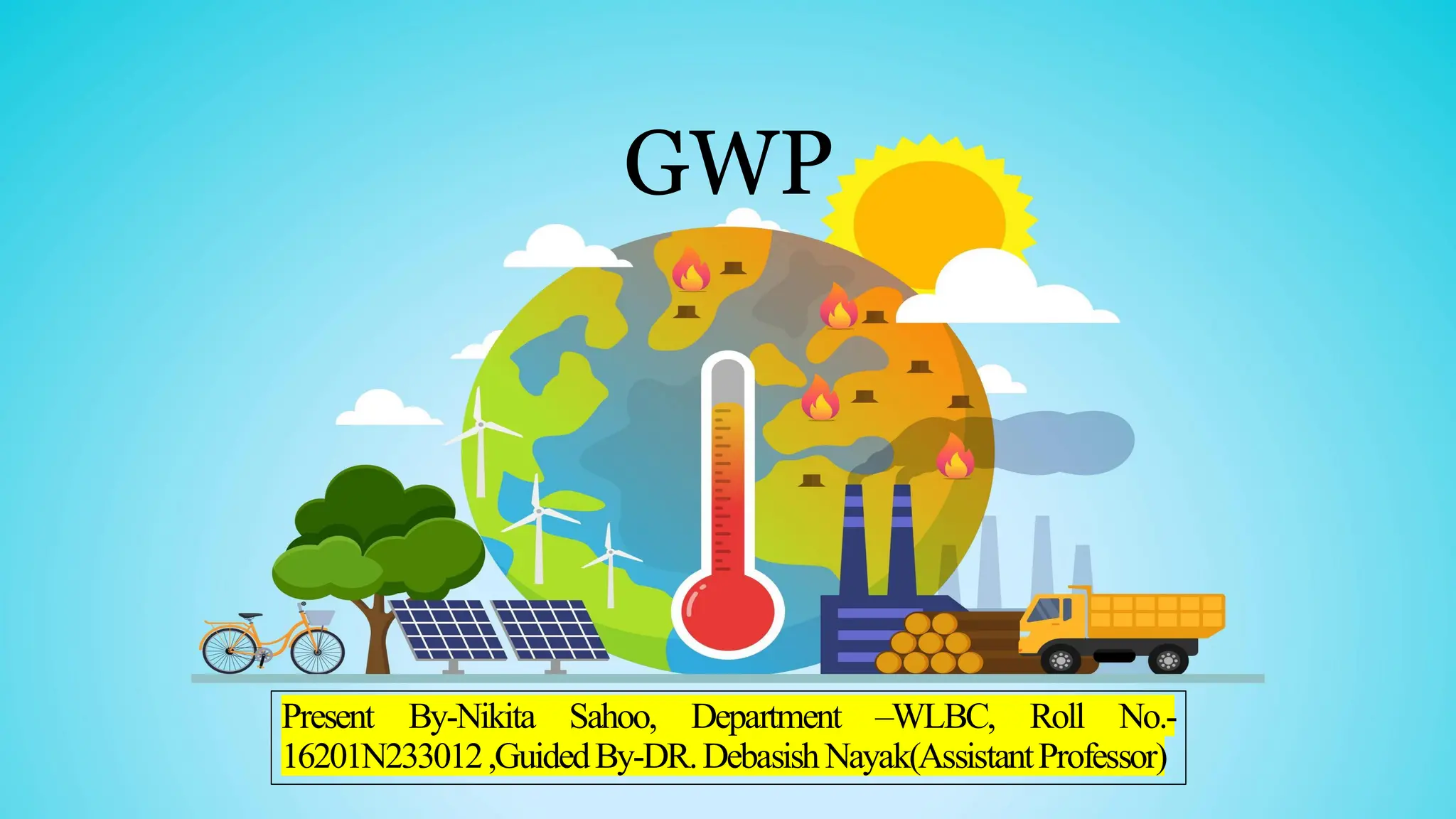
GWP
CONTENT
INTRODUCTION
KEY CONCEPT
FACTOR INFLUENCING GWP
GWP OF MAJOR GREENHOUSE GASES
IMPACT OF HIGH-GWP GASES
IMPACT OF LOW-GWP GASES
INTERNATIONAL POLICIES
CASE STUDIES
CONCLUSION
REFERENCES
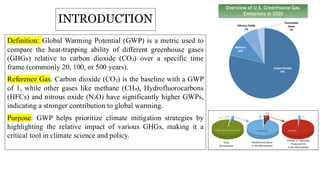
Definition: Global Warming Potential (GWP) is a metric used to
compare the heat-trapping ability of different greenhouse gases
(GHGs) relative to carbon dioxide (CO₂) over a specific time
frame (commonly 20, 100, or 500 years).
Reference Gas: Carbon dioxide (CO₂) is the baseline with a GWP
of 1, while other gases like methane (CH₄), Hydrofluorocarbons
(HFCs) and nitrous oxide (N₂O) have significantly higher GWPs,
indicating a stronger contribution to global warming.
Purpose: GWP helps prioritize climate mitigation strategies by
highlighting the relative impact of various GHGs, making it a
critical tool in climate science and policy.
INTRODUCTION
KEY CONCEPT
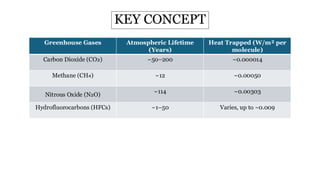
Greenhouse Gases Atmospheric Lifetime
(Years)
Heat Trapped (W/m² per
molecule)
Carbon Dioxide (CO₂) ~50–200 ~0.000014
Methane (CH₄) ~12 ~0.00050
Nitrous Oxide (N₂O)
~114 ~0.00303
Hydrofluorocarbons (HFCs) ~1–50 Varies, up to ~0.009
FACTOR INFLUENCING GWP
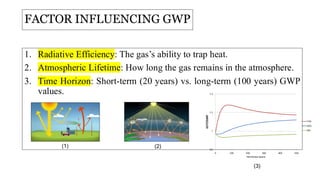
1. Radiative Efficiency: The gas’s ability to trap heat.
2. Atmospheric Lifetime: How long the gas remains in the atmosphere.
3. Time Horizon: Short-term (20 years) vs. long-term (100 years) GWP
values.
(1) (2)
(3)
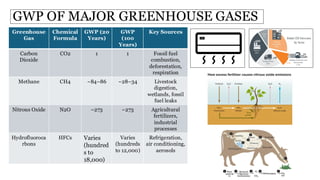
GWP OF MAJOR GREENHOUSE GASES
Greenhouse
Gas
Chemical
Formula
GWP (20
Years)
GWP
(100
Years)
Key Sources
Carbon
Dioxide
CO2 1 1 Fossil fuel
combustion,
deforestation,
respiration
Methane CH4 ~84–86 ~28–34 Livestock
digestion,
wetlands, fossil
fuel leaks
Nitrous Oxide N2O ~273 ~273 Agricultural
fertilizers,
industrial
processes
Hydrofluoroca
rbons
HFCs Varies
(hundred
s to
18,000)
Varies
(hundreds
to 12,000)
Refrigeration,
air conditioning,
aerosols
IMPACT OF HIGH-GWP GASES
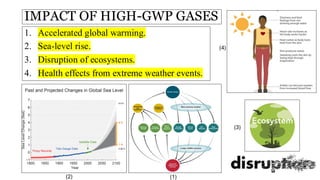
1. Accelerated global warming.
2. Sea-level rise.
3. Disruption of ecosystems.
4. Health effects from extreme weather events.
(1)
(2)
(3)
(4)
IMPACT OF LOW-GWP GASES
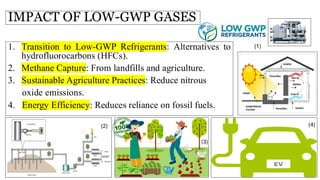
1. Transition to Low-GWP Refrigerants: Alternatives to
hydrofluorocarbons (HFCs).
2. Methane Capture: From landfills and agriculture.
3. Sustainable Agriculture Practices: Reduce nitrous
oxide emissions.
4. Energy Efficiency: Reduces reliance on fossil fuels.
(2)
(3)
(4)
(1)
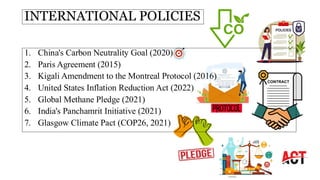
INTERNATIONAL POLICIES
1. China's Carbon Neutrality Goal (2020)
2. Paris Agreement (2015)
3. Kigali Amendment to the Montreal Protocol (2016)
4. United States Inflation Reduction Act (2022)
5. Global Methane Pledge (2021)
6. India's Panchamrit Initiative (2021)
7. Glasgow Climate Pact (COP26, 2021)
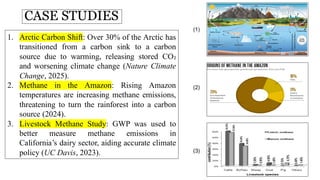
CASE STUDIES
1. Arctic Carbon Shift: Over 30% of the Arctic has
transitioned from a carbon sink to a carbon
source due to warming, releasing stored CO₂
and worsening climate change (Nature Climate
Change, 2025).
2. Methane in the Amazon: Rising Amazon
temperatures are increasing methane emissions,
threatening to turn the rainforest into a carbon
source (2024).
3. Livestock Methane Study: GWP was used to
better measure methane emissions in
California’s dairy sector, aiding accurate climate
policy (UC Davis, 2023).
(1)
(2)
(3)
CONCLUSION
• GWP is crucial for comparing greenhouse gases and tackling climate
change.
• Recent case studies show that targeted interventions and policies can
reduce high-GWP emissions.
• Global collaboration is essential to mitigate the effects of global warming.
REFERENCES
• IPCC 6th Assessment Report (2023)
• UNEP’s 2023 Update on Kigali Amendment
• Scientific American – Methane Emissions Studies (2023)
• European Union Reports on ETS (2024)

GLOBAL WARMING POTENTIAL PRESENTATION BY NIKITA SAHOO

  • 1.
    Present By-Nikita Sahoo,Department –WLBC, Roll No.- 16201N233012,GuidedBy-DR.DebasishNayak(AssistantProfessor) GWP
  • 2.
    CONTENT INTRODUCTION KEY CONCEPT FACTOR INFLUENCINGGWP GWP OF MAJOR GREENHOUSE GASES IMPACT OF HIGH-GWP GASES IMPACT OF LOW-GWP GASES INTERNATIONAL POLICIES CASE STUDIES CONCLUSION REFERENCES
  • 3.
    Definition: Global WarmingPotential (GWP) is a metric used to compare the heat-trapping ability of different greenhouse gases (GHGs) relative to carbon dioxide (CO₂) over a specific time frame (commonly 20, 100, or 500 years). Reference Gas: Carbon dioxide (CO₂) is the baseline with a GWP of 1, while other gases like methane (CH₄), Hydrofluorocarbons (HFCs) and nitrous oxide (N₂O) have significantly higher GWPs, indicating a stronger contribution to global warming. Purpose: GWP helps prioritize climate mitigation strategies by highlighting the relative impact of various GHGs, making it a critical tool in climate science and policy. INTRODUCTION
  • 4.
    KEY CONCEPT Greenhouse GasesAtmospheric Lifetime (Years) Heat Trapped (W/m² per molecule) Carbon Dioxide (CO₂) ~50–200 ~0.000014 Methane (CH₄) ~12 ~0.00050 Nitrous Oxide (N₂O) ~114 ~0.00303 Hydrofluorocarbons (HFCs) ~1–50 Varies, up to ~0.009
  • 5.
    FACTOR INFLUENCING GWP 1.Radiative Efficiency: The gas’s ability to trap heat. 2. Atmospheric Lifetime: How long the gas remains in the atmosphere. 3. Time Horizon: Short-term (20 years) vs. long-term (100 years) GWP values. (1) (2) (3)
  • 6.
    GWP OF MAJORGREENHOUSE GASES Greenhouse Gas Chemical Formula GWP (20 Years) GWP (100 Years) Key Sources Carbon Dioxide CO2 1 1 Fossil fuel combustion, deforestation, respiration Methane CH4 ~84–86 ~28–34 Livestock digestion, wetlands, fossil fuel leaks Nitrous Oxide N2O ~273 ~273 Agricultural fertilizers, industrial processes Hydrofluoroca rbons HFCs Varies (hundred s to 18,000) Varies (hundreds to 12,000) Refrigeration, air conditioning, aerosols
  • 7.
    IMPACT OF HIGH-GWPGASES 1. Accelerated global warming. 2. Sea-level rise. 3. Disruption of ecosystems. 4. Health effects from extreme weather events. (1) (2) (3) (4)
  • 8.
    IMPACT OF LOW-GWPGASES 1. Transition to Low-GWP Refrigerants: Alternatives to hydrofluorocarbons (HFCs). 2. Methane Capture: From landfills and agriculture. 3. Sustainable Agriculture Practices: Reduce nitrous oxide emissions. 4. Energy Efficiency: Reduces reliance on fossil fuels. (2) (3) (4) (1)
  • 9.
    INTERNATIONAL POLICIES 1. China'sCarbon Neutrality Goal (2020) 2. Paris Agreement (2015) 3. Kigali Amendment to the Montreal Protocol (2016) 4. United States Inflation Reduction Act (2022) 5. Global Methane Pledge (2021) 6. India's Panchamrit Initiative (2021) 7. Glasgow Climate Pact (COP26, 2021)
  • 10.
    CASE STUDIES 1. ArcticCarbon Shift: Over 30% of the Arctic has transitioned from a carbon sink to a carbon source due to warming, releasing stored CO₂ and worsening climate change (Nature Climate Change, 2025). 2. Methane in the Amazon: Rising Amazon temperatures are increasing methane emissions, threatening to turn the rainforest into a carbon source (2024). 3. Livestock Methane Study: GWP was used to better measure methane emissions in California’s dairy sector, aiding accurate climate policy (UC Davis, 2023). (1) (2) (3)
  • 11.
    CONCLUSION • GWP iscrucial for comparing greenhouse gases and tackling climate change. • Recent case studies show that targeted interventions and policies can reduce high-GWP emissions. • Global collaboration is essential to mitigate the effects of global warming. REFERENCES • IPCC 6th Assessment Report (2023) • UNEP’s 2023 Update on Kigali Amendment • Scientific American – Methane Emissions Studies (2023) • European Union Reports on ETS (2024)