Climate Change Science &  Role of Youth Dhiraj Pradhananga The Small Earth Nepal
?????? WHY our EARTH is small? What are the major pressures to the EARTH? Causes for climate change? Global, Regional, National, Local Climate Change? What are its impacts? What can we do?  Adaptation to Climate Change? OUR Role ?
????? Aim of the Presentation To enable us to understand the climate change science and its consequences Objectives of the Presentation Human Pressure on the Earth Review on Climate Change Science Review - climate change impacts Adaptation to climate change Observed & Projected climate change in Nepal GCM & RCM (Climate scenario & climate change scenario) All Nepal & Local – Climate Change
Major causes of pressure to the Earth??
 
09/27/11 SEN-DP
 
Human Impacts
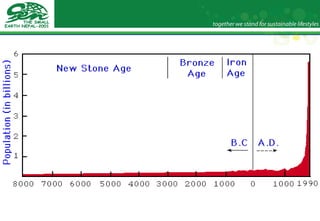
Human Activities and Environment During 100 yrs (1900 – 2000) Population 4*, Economic 20*, fossil fuels 30*, industry 50* Dynamic development provides explosive global environmental impact Disappearance of species 0.17% per year Desertification 6*10 6  Km 2  per year Deforestation 17*10 6  Km 2  per year Soil oxidation & erosion 26*10 9  Km 2  per year Increase in CO 2  since 1850 30%
Environmental Problems The pressure on the environment is high and can be observed worldwide Local disturbance to climate change Polluted ground/water to acidification Dispersion of chemical in nature to waste disposal Melting of ice-caps/glaciers to deforestation and desertification Road accident to natural disasters
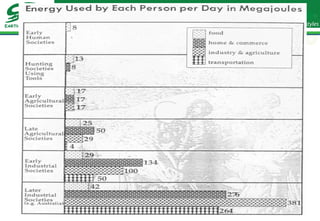
Ecological Significance energy and material consumption for the last 4 decades is faster than population growth an irresistible economy seems to be on a collision course on within immovable ecosphere
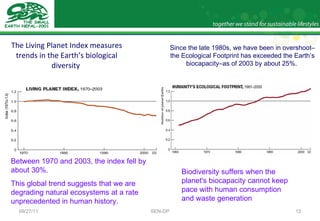
The Living Planet Index measures trends in the Earth’s biological diversity   09/27/11 SEN-DP Between 1970 and 2003, the index fell by about 30%.  This global trend suggests that we are degrading natural ecosystems at a rate unprecedented in human history.  Biodiversity suffers when the planet's biocapacity cannot keep pace with human consumption and waste generation Since the late 1980s, we have been in overshoot–the Ecological Footprint has exceeded the Earth’s biocapacity–as of 2003 by about 25%.
Living Planet Report 2000   (30 years from 1970 to 1997) Earth’s natural ecosystems has declined by 33% Ecological pressure of humanity on the Earth has increased by 50%   09/27/11 SEN-DP Ecological pressure of an average consumer in the industrialized countries is FOUR times that of an average consumer in the lower income countries
Living in Capital not Interest Effectively, the Earth’s regenerative capacity can no longer keep up with demand – people are turning resources into waste faster than nature can turn waste back into resources.  Humanity is no longer living off nature’s interest, but drawing down its capital.  This growing pressure on ecosystems is causing habitat destruction or degradation and permanent loss of productivity, threatening both biodiversity and human well-being. 09/27/11 SEN-DP
The Global Aspects Taught by Gandhi “ If every inhabitant of this earth were to consume as much as the inhabitants of the wealthy countries, we would need  a  second Earth .” But the present data tells us we already need a  third Earth  if everyone consumed the same amount of fossil fuel.
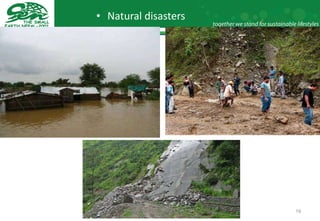
Natural disasters
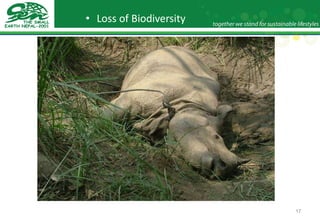
Loss of Biodiversity
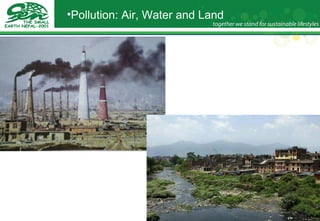
Pollution: Air, Water and Land
Climate Change  and Its Consequences The Greatest Challenge Basics of Climate Change What is it meant for us?
What is giving cause for concern? Weather has been more chaotic and extreme (hurricanes, droughts, floods) Glaciers are shrinking Animals moving to cooler places Global temperature has increased by 0.74 o C
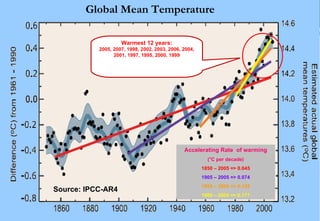
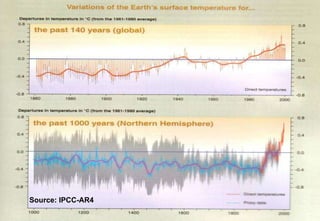
Source: IPCC-AR4 Global Mean Temperature   Accelerating Rate  of warming (°C per decade) 1850 – 2005 => 0.045 1905 – 2005 => 0.074 1955 – 2005 => 0.128 1980 – 2005 => 0.177 Warmest 12 years: 2005, 2007, 1998, 2002, 2003, 2006, 2004, 2001, 1997, 1995, 2000, 1999
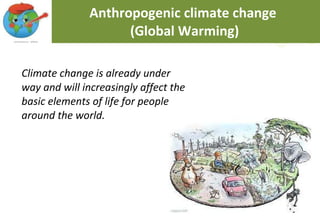
Anthropogenic climate change  (Global Warming) Climate change is already under way and will increasingly affect the basic elements of life for people around the world.
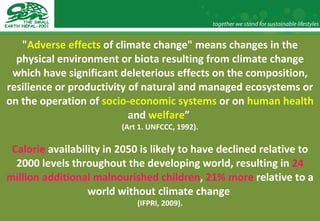
" Adverse effects  of climate change" means changes in the physical environment or biota resulting from climate change which have significant deleterious effects on the composition, resilience or productivity of natural and managed ecosystems or on the operation of  socio-economic systems  or on  human health  and  welfare ”  (Art 1. UNFCCC, 1992). Calorie  availability in 2050 is likely to have declined relative to 2000 levels throughout the developing world, resulting in  24 million additional malnourished children ,  21% more  relative to a world without climate change  (IFPRI, 2009).
Vulnerability of developing world to  climate change Rely on climate-sensitive sectors, such as agriculture and fisheries Low GDP, high levels of poverty Low levels of education  Limited human, institutional, economic, technical and financial capacity Key sectors hardest hit by climate change Water resources Food production Human health Ecosystem and natural resources
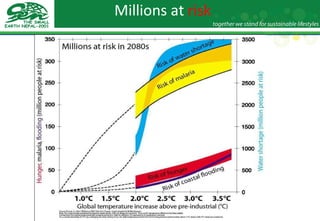
Millions at  risk
Climate Change Science What is the major cause of CHANGE?
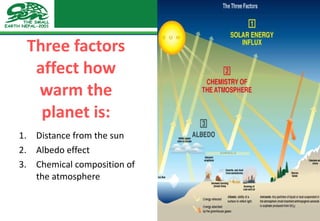
Three factors affect how warm the planet is: Distance from the sun Albedo effect Chemical composition of the atmosphere
It is the chemical composition which has changed the most significantly in the last 200 years
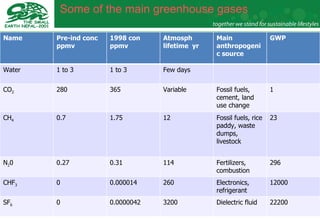
Some of the main greenhouse gases Name Pre-ind conc ppmv 1998 con ppmv Atmosph lifetime  yr Main anthropogenic source GWP Water  1 to 3 1 to 3 Few days CO 2 280 365 Variable Fossil fuels, cement, land use change 1 CH 4 0.7 1.75 12 Fossil fuels, rice paddy, waste dumps, livestock 23 N 2 0 0.27 0.31 114 Fertilizers, combustion 296 CHF 3 0 0.000014 260 Electronics, refrigerant 12000 SF 6 0 0.0000042 3200 Dielectric fluid 22200
Two important points Greenhouse effect is needed for life! If no GH effect, temp the earth would be -18 deg. C It is not only CO 2  which is responsible
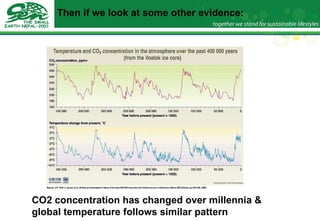
CO2 concentration has changed over millennia & global temperature follows similar pattern Then if we look at some other evidence:
There are other natural causes of climate change Amount of energy coming from the sun Volcano's Ocean currents Meteor strikes (very rare!) Tectonic plate movement  (very, very slow!)
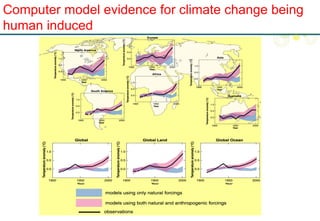
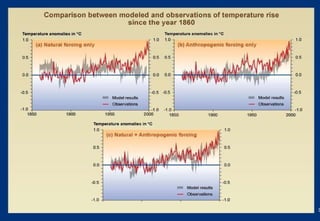
Computer model evidence for climate change being human induced
Climate Change  Definition   Any change in climate over time, whether due to natural variability or as a result of human activity (IPCC) Change of climate that is attributed directly or indirectly to human activity that alters the composition of the global atmosphere and that is in addition to natural variability observed over comparable time periods (UNFCCC) A statistically significant variation in either the mean state of the climate or in its variability, persisting for an extended period (typically decades or longer)   EARTHSCAN 2007
Source: IPCC-AR4
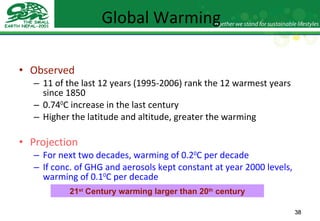
Global Warming Observed 11 of the last 12 years (1995-2006) rank the 12 warmest years since 1850 0.74 0 C increase in the last century Higher the latitude and altitude, greater the warming Projection For next two decades, warming of 0.2 0 C per decade If conc. of GHG and aerosols kept constant at year 2000 levels, warming of 0.1 0 C per decade 21 st  Century warming larger than 20 th  century
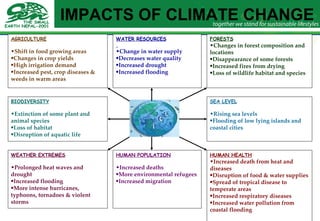
IMPACTS OF CLIMATE CHANGE BIODIVERSITY Extinction of some plant and animal species Loss of habitat Disruption of aquatic life AGRICULTURE Shift in food growing areas Changes in crop yields High irrigation demand Increased pest, crop diseases & weeds in warm areas WATER RESOURCES Change in water supply Decreases water quality Increased drought Increased flooding FORESTS Changes in forest composition and locations Disappearance of some forests Increased fires from drying Loss of wildlife habitat and species SEA LEVEL Rising sea levels Flooding of low lying islands and coastal cities WEATHER EXTREMES Prolonged heat waves and drought Increased flooding More intense hurricanes, typhoons, tornadoes & violent storms HUMAN POPULATION Increased deaths More environmental refugees Increased migration HUMAN HEALTH Increased death from heat and diseases Disruption of food & water supplies Spread of tropical disease to temperate areas Increased respiratory diseases Increased water pollution from coastal flooding
Some projected impacts   IPCC   Fourth Assessment Report Glacier melt in the Himalayas is projected to increase flooding, and rock avalanches from destabilized slopes, and to affect water resources within the next two to three decades.  This will be followed by decreased river flows as the glaciers recede. Freshwater availability in central, south, east and southeast Asia is projected to decrease due to climate change
Some projected impacts   IPCC   Fourth Assessment Report Crop yield could decrease up to 30% in central and south Asia by the mid-21 st  century However, yield could increase in colder environments Insect outbreaks could increase
Some projected impacts   IPCC   Fourth Assessment Report Endemic morbidity and mortality due to diarrhea disease primarily associated with floods and droughts are expected to rise Increased risk of heat-related mortality Reduced human mortality from decreased cold exposure
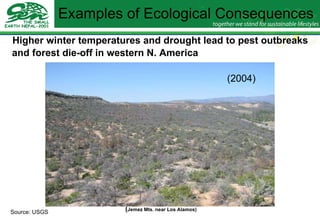
Examples of Ecological Consequences Higher winter temperatures and drought lead to pest outbreaks and forest die-off in western N. America   In summer 2002, pinyon ( Pinus edulis ) began dying  en masse   from drought stress and an associated  bark beetle outbreak   ( Jemez Mts. near Los Alamos) (2004) Source: USGS
Climate Change Scenario: Nepal Observed and Projected Climate - what we expect Weather - what we get
????? Climate scenario  &  climate change scenario Observed  &  Projected  climate change in Nepal GCM  &  RCM All Nepal  &  Local  – Climate Change
Climate Scenario Plausible representations of the future that are consistent with assumptions about future emissions of GHG and with our understanding of the effect of increased atmospheric concentrations of these gases on global climate.
Climate Change Scenario difference between  “ climate scenario”  & “ present climate”
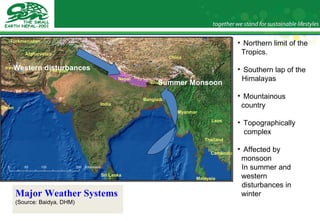
Major Weather Systems  (Source: Baidya, DHM) Northern limit of the  Tropics. Southern lap of the  Himalayas Mountainous  country Topographically  complex Affected by monsoon In summer and western disturbances in winter Summer Monsoon Western disturbances 26º 22' N - 30º 27' N Lat. 80º 4'E - 88º 12'E Long. 0 200 400 100 Kilometers India China Iran Pakistan Myanmar Thailand Afghanistan Laos Nepal Cambodia Bangladesh Oman Bhutan Sri Lanka Turkmenistan Malaysia 0 130 260 65 Kilometers
Climate Change: Nepal Temperature Precipitation Himalayan Glaciers
Temperature
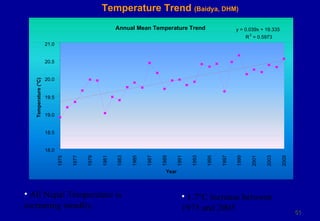
Annual Mean Temperature Trend 2 18.0 18.5 19.0 19.5 20.0 20.5 21.0 1975 1977 1979 1981 1983 1985 1987 1989 1991 1993 1995 1997 1999 2001 2003 2005 Year Temperature (°C) All Nepal Temperature is  increasing steadily.  1.7°C increase between  1975 and 2005 Temperature Trend  (Baidya, DHM) y = 0.039x + 19.335 R = 0.5973
Precipitation
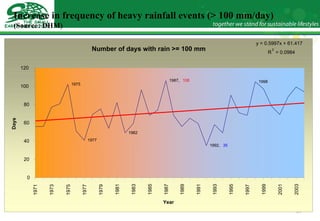
Increase in frequency of heavy rainfall events (> 100 mm/day) (Source: DHM) Number of days with rain >= 100 mm 1977 1992,  35 1987,  106 1998 1975 1982 y = 0.5997x + 61.417 R 2 = 0.0984 0 20 40 60 80 100 120 1971 1973 1975 1977 1979 1981 1983 1985 1987 1989 1991 1993 1995 1997 1999 2001 2003 Year Days
Glaciers
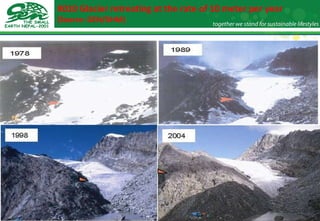
X010 Glacier retreating at the rate of 10 meter per year  (Source: GEN/DHM)
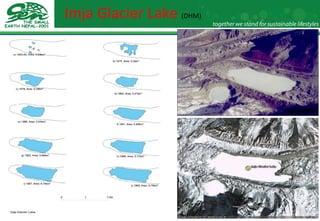
Imja Glacier Lake  (DHM)
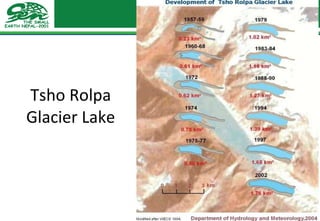
Tsho Rolpa Glacier Lake
How Fast They Are Shrinking? Faster than the other glaciers Faster than the previous estimate Dyurgerov  [2002];  Fujita et al.  [1997, JG; 1998; BGR; 2001, BGR]
Observed Climate Change Impact   Cryosphore studies in Nepal Glaciers of Nepal Himalayas are retreating  Glacier lakes are forming and expanding Higher chances of GLOF There are changes in monsoon and winter climate under global warming.  Hydro-climate process of high Himalayas are largely different from those of lowland.
Climate Change and Himalayas Vulnerable Himalayan Glaciers Rapid Shrinkage & high climatic sensitivity of Himalayan Glaciers Himalayan Glaciers  Not enough data, not integrated A Blank Spot in IPCC AR4 (2007) 3 billion people are associated  shrinking more rapidly than elsewhere Need to reduce scientific uncertainty Most of the glaciers are retreating!
Observed Climate Change  Rainfall Total rainfall and heavy rainfall events are increasing Maximum 24 hour rainfall is also increasing   Temperature Days and nights are both becoming warmer.  Warm spell duration (long hot days) is increasing Cool nights and cool days are becoming less frequent Most glaciers are retreating at faster rate Extreme hydro-climatic events are increasing
PROJECTIONS
 
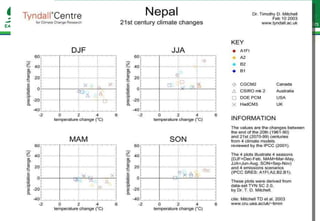
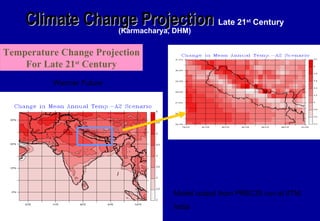
Warmer Future  Model output from PRECIS run at IITM, India Temperature Change Projection For Late 21 st  Century Climate Change Projection  Late 21 st  Century (Karmacharya, DHM)
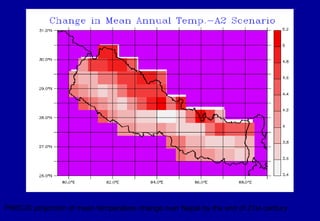
PRECIS projection of mean temperature change over Nepal by the end of 21st century
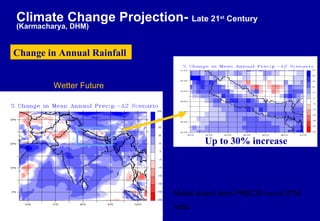
Wetter Future   Model output from PRECIS run at IITM, India Change in Annual Rainfall  Up to 30% increase  Climate Change Projection-  Late 21 st  Century (Karmacharya, DHM)
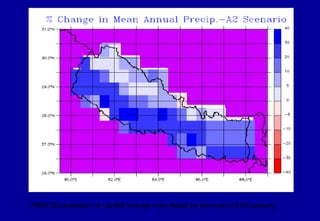
PRECIS projection of rainfall change over Nepal by the end of 21st century
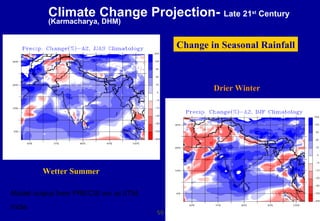
Wetter Summer Drier Winter Change in Seasonal Rainfall Climate Change Projection-  Late 21 st  Century (Karmacharya, DHM) Model output from PRECIS run at IITM, India
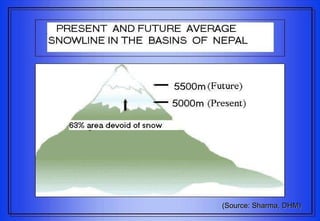
(Source: Sharma, DHM)
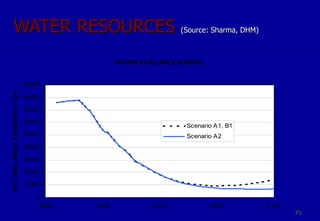
WATER RESOURCES  (Source: Sharma, DHM)
Khumbu, Rasuwa and Jumla LOCAL Observations from
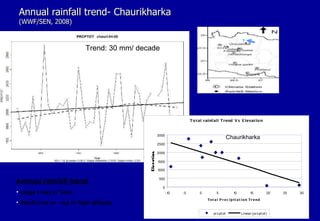
Annual rainfall trend- Chaurikharka  (WWF/SEN, 2008) Trend: 30 mm/ decade Annual rainfall trend Large (+ve) in Terai Small (+ve or –ve) in high altitude Chaurikharka
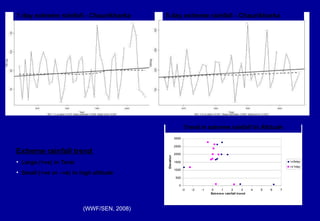
Extreme rainfall trend  Large (+ve) in Terai Small (+ve or –ve) in high altitude 1 day extreme rainfall - Chaurikharka 5 day extreme rainfall - Chaurikharka Trend in extreme rainfall Vs Altitude (WWF/SEN, 2008)
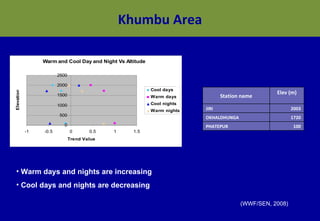
Khumbu Area Warm days and nights are increasing  Cool days and nights are decreasing (WWF/SEN, 2008) Khumbu Area Station name Elev (m) JIRI 2003 OKHALDHUNGA 1720 PHATEPUR 100
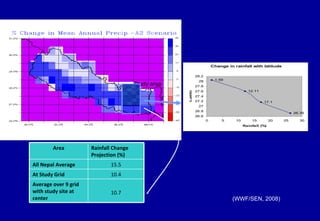
Study area (WWF/SEN, 2008) Area Rainfall Change Projection (%) All Nepal Average 15.5 At Study Grid 10.4 Average over 9 grid with study site at center 10.7
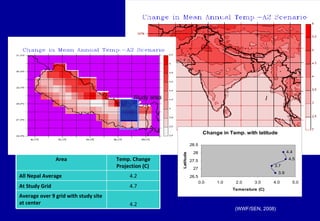
(WWF/SEN, 2008) Area Temp. Change Projection (C)  All Nepal Average 4.2 At Study Grid 4.7 Average over 9 grid with study site at center 4.2 Study area
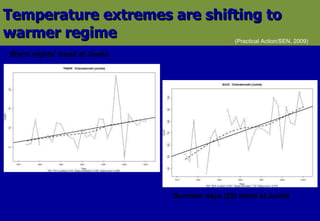
Temperature extremes are shifting to warmer regime  (Practical Action/SEN, 2009) Summer days (25) trend at Jumla   Warm nights' trend at Jumla
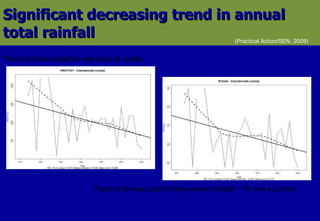
Significant decreasing trend in annual total rainfall  (Practical Action/SEN, 2009) Trend of total rainfall on wet days at Jumla  Trend of annual count of days when rainfall > 10 mm at Jumla
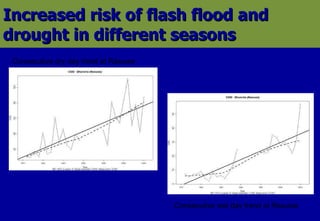
Increased risk of flash flood and drought in different seasons Consecutive dry day trend at Rasuwa  Consecutive wet day trend at Rasuwa
Changing Climate in Jumla Annual rainfall is in decline Temperature extremes are shifting to warmer regime Likely to cause significant decrease in water availability, specially decrease in snowfall amount in winter  This will seriously deplete the moister available for the winter crop.  Thus, rapidly altering (warming) climatic condition might have negative impact on productivity of local crop varieties and might also damage habitat of important medicinal plants.  The combined effect of increased temperature and decrease snowfall will also reduce the snow mass available for melting in dry period (pre-monsoon) when snowmelt is the major component of river flow and thus affect the livelihood condition on downstreams as well.  (Practical Action/SEN, 2009)
Rasuwa (Jibjibe at border of Bhorle and Dhaibung, between two big landslides) Impact severity in ranking: Landslide, Hail storm and lighting, Drought, Flood, Snowfall Heavy rain during short period - increased  Village is at very high risk due to landslides; transportation got hit most significantly; local labor got impacted due to the road destruction but getting more jobs as no transportation. Due to risk of landslide, all the settlement was in situation of replacement.  Temperature increase significantly since 6-7 years; Mango is seen (growing well) and other plants from low land is now growing here, and is considered positive impact of climate change.  Less snowfall and decreased water resource.
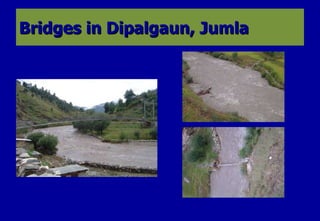
Bridges in Dipalgaun, Jumla
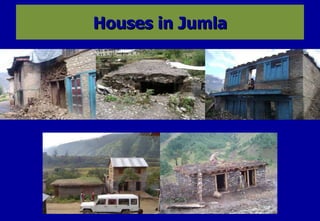
Houses in Jumla
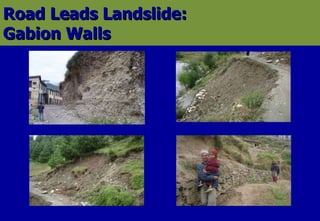
Road Leads Landslide:  Gabion Walls
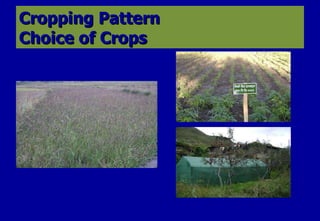
Cropping Pattern Choice of Crops
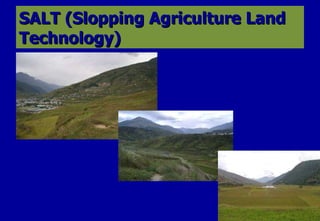
SALT (Slopping Agriculture Land Technology)
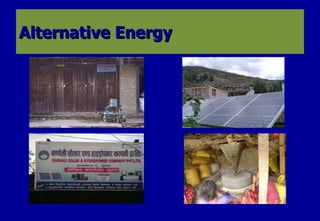
Alternative Energy
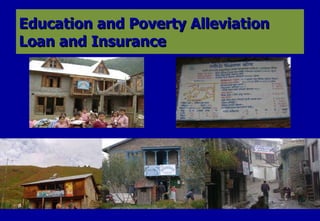
Education and Poverty Alleviation Loan and Insurance
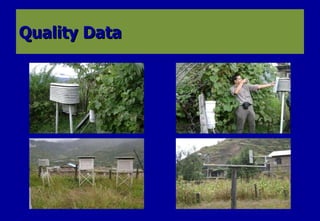
Quality Data
 
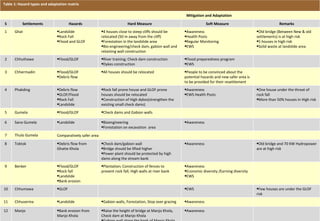
Table 1: Hazard types and adaptation matrix Mitigation and Adaptation S Settlements Hazards  Hard Measure Soft Measure Remarks 1 Ghat Landslide Rock Fall Flood and GLOF 4 houses close to steep cliffs should be relocated (50 m away from the cliff) Forestation in the landslide area Bio-engineering/check dam, gabion wall and retaining wall construction Awareness  Health Posts Regular Monitoring EWS Old bridge (Between New & old settlements) is at high risk 5 houses in high risk  Solid waste at landslide area 2 Chhuthawa Flood/GLOF River training; Check dam construction Dykes construction Flood preparedness program  EWS 3 Chhermadin Flood/GLOF Debris flow All houses should be relocated People to be convinced about the potential hazards and new safer area is to be provided for their resettlement 4 Phakding Debris flow GLOF/Flood Rock Fall Landslide Rock fall prone house and GLOF prone houses should be relocated Construction of High dykes(strengthen the existing small check dams) Awareness EWS Health Posts One house under the threat of rock fall More than 50% houses in High risk 5 Gumela Flood/GLOF Check dams and Gabion walls 6 Sano Gumela Landslide Bioengineering Forestation on excavation  area Awareness 7 Thulo Gumela Comparatively safer area 8 Toktok Debris flow from Ghatte Khola Check dam/gabion wall Bridge should be lifted higher Power plant should be protected by high dams along the stream bank Awareness Old bridge and 70 KW Hydropower are at high risk 9 Benker Flood/GLOF Rock fall Landslide Bank erosion Plantation; Construction of fences to prevent rock fall; High walls at river bank Awareness Economic diversity /Earning diversity  EWS 10 Chhumawa GLOF EWS Few houses are under the GLOF risk 11 Chhuserma Landslide Gabion walls, Forestation, Stop over grazing  Awareness 12 Manjo Bank erosion from Manjo Khola Raise the height of bridge at Manjo Khola, Check dam at Manjo Khola Gabion wall along the bank of Manjo Khola Awareness
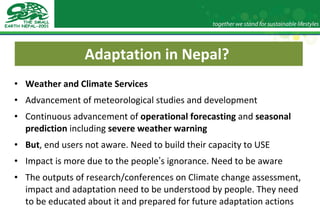
Adaptation in Nepal?  Weather and Climate Services Advancement of meteorological studies and development  Continuous advancement of  operational forecasting  and  seasonal prediction  including  severe weather warning But , end users not aware. Need to build their capacity to USE Impact is more due to the people ’ s ignorance. Need to be aware The outputs of research/conferences on Climate change assessment, impact and adaptation need to be understood by people. They need to be educated about it and prepared for future adaptation actions
What Should be Done? the best strategy to cope with the adverse impacts - and opportunities - of CC tomorrow is to help developing countries adapt to climate variability today it is necessary to involve the community in the process there is a need of greater integration between approaches to CC adaptation and sustainable development Therefore , CC adaptation needs collaboration and participation efforts from local to national and international level Similarly , the threats and challenges of climate variability and change need to be embedded into community development planning and community based capacity building programs.
Our  Respond? International Action: UNFCC and Kyoto Carbon trading: CDM, Footprint tax Local Commitment  (USA, EU, East Asia, India, Bhutan, Australia)  highest is north America Sustainable economic growth: Renewable energy; Adapting to change Personal Commitment and public action
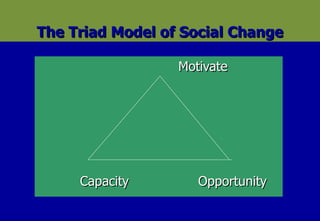
The Triad Model of Social Change Motivate Capacity Opportunity
Discussion!!! The Small Earth Nepal 626 Bhakti Thapa Sadak Naya Baneshwor   Tel: +977-1-4782738 Email:  [email_address] URL:  http://www.smallearth.org.np
Climate Change Impact in Nepal Message take HOME developing countries are, in particular, disproportionately vulnerable to climate change most affected by climate variability and extreme events are the poor and vulnerable estimated impact of weather-related disasters in developing countries 20-30 times larger than in industrialized countries  (Jovel, 1989) Climate change will most likely exacerbate these problems   (McCarthy, 2001)
“ I am no longer skeptical  …climate change is the major challenge facing the world” Sir David Attenborough “ Climate change is the most severe problem that we are facing today, more serious even than the threat of terrorism” Sir David King The Atlas of  Climate Change Mapping the world’s greatest  challenge

Climate Science- Dhiraj Pradhananga

  • 1.
    Climate Change Science& Role of Youth Dhiraj Pradhananga The Small Earth Nepal
  • 2.
    ?????? WHY ourEARTH is small? What are the major pressures to the EARTH? Causes for climate change? Global, Regional, National, Local Climate Change? What are its impacts? What can we do? Adaptation to Climate Change? OUR Role ?
  • 3.
    ????? Aim ofthe Presentation To enable us to understand the climate change science and its consequences Objectives of the Presentation Human Pressure on the Earth Review on Climate Change Science Review - climate change impacts Adaptation to climate change Observed & Projected climate change in Nepal GCM & RCM (Climate scenario & climate change scenario) All Nepal & Local – Climate Change
  • 4.
    Major causes ofpressure to the Earth??
  • 5.
  • 6.
  • 7.
  • 8.
  • 9.
    Human Activities andEnvironment During 100 yrs (1900 – 2000) Population 4*, Economic 20*, fossil fuels 30*, industry 50* Dynamic development provides explosive global environmental impact Disappearance of species 0.17% per year Desertification 6*10 6 Km 2 per year Deforestation 17*10 6 Km 2 per year Soil oxidation & erosion 26*10 9 Km 2 per year Increase in CO 2 since 1850 30%
  • 10.
    Environmental Problems Thepressure on the environment is high and can be observed worldwide Local disturbance to climate change Polluted ground/water to acidification Dispersion of chemical in nature to waste disposal Melting of ice-caps/glaciers to deforestation and desertification Road accident to natural disasters
  • 11.
    Ecological Significance energyand material consumption for the last 4 decades is faster than population growth an irresistible economy seems to be on a collision course on within immovable ecosphere
  • 12.
    The Living PlanetIndex measures trends in the Earth’s biological diversity 09/27/11 SEN-DP Between 1970 and 2003, the index fell by about 30%. This global trend suggests that we are degrading natural ecosystems at a rate unprecedented in human history. Biodiversity suffers when the planet's biocapacity cannot keep pace with human consumption and waste generation Since the late 1980s, we have been in overshoot–the Ecological Footprint has exceeded the Earth’s biocapacity–as of 2003 by about 25%.
  • 13.
    Living Planet Report2000 (30 years from 1970 to 1997) Earth’s natural ecosystems has declined by 33% Ecological pressure of humanity on the Earth has increased by 50% 09/27/11 SEN-DP Ecological pressure of an average consumer in the industrialized countries is FOUR times that of an average consumer in the lower income countries
  • 14.
    Living in Capitalnot Interest Effectively, the Earth’s regenerative capacity can no longer keep up with demand – people are turning resources into waste faster than nature can turn waste back into resources. Humanity is no longer living off nature’s interest, but drawing down its capital. This growing pressure on ecosystems is causing habitat destruction or degradation and permanent loss of productivity, threatening both biodiversity and human well-being. 09/27/11 SEN-DP
  • 15.
    The Global AspectsTaught by Gandhi “ If every inhabitant of this earth were to consume as much as the inhabitants of the wealthy countries, we would need a second Earth .” But the present data tells us we already need a third Earth if everyone consumed the same amount of fossil fuel.
  • 16.
  • 17.
  • 18.
  • 19.
    Climate Change and Its Consequences The Greatest Challenge Basics of Climate Change What is it meant for us?
  • 20.
    What is givingcause for concern? Weather has been more chaotic and extreme (hurricanes, droughts, floods) Glaciers are shrinking Animals moving to cooler places Global temperature has increased by 0.74 o C
  • 22.
    Source: IPCC-AR4 GlobalMean Temperature Accelerating Rate of warming (°C per decade) 1850 – 2005 => 0.045 1905 – 2005 => 0.074 1955 – 2005 => 0.128 1980 – 2005 => 0.177 Warmest 12 years: 2005, 2007, 1998, 2002, 2003, 2006, 2004, 2001, 1997, 1995, 2000, 1999
  • 23.
    Anthropogenic climate change (Global Warming) Climate change is already under way and will increasingly affect the basic elements of life for people around the world.
  • 24.
    " Adverse effects of climate change" means changes in the physical environment or biota resulting from climate change which have significant deleterious effects on the composition, resilience or productivity of natural and managed ecosystems or on the operation of socio-economic systems or on human health and welfare ” (Art 1. UNFCCC, 1992). Calorie availability in 2050 is likely to have declined relative to 2000 levels throughout the developing world, resulting in 24 million additional malnourished children , 21% more relative to a world without climate change (IFPRI, 2009).
  • 25.
    Vulnerability of developingworld to climate change Rely on climate-sensitive sectors, such as agriculture and fisheries Low GDP, high levels of poverty Low levels of education Limited human, institutional, economic, technical and financial capacity Key sectors hardest hit by climate change Water resources Food production Human health Ecosystem and natural resources
  • 26.
  • 27.
    Climate Change ScienceWhat is the major cause of CHANGE?
  • 28.
    Three factors affecthow warm the planet is: Distance from the sun Albedo effect Chemical composition of the atmosphere
  • 29.
    It is thechemical composition which has changed the most significantly in the last 200 years
  • 30.
    Some of themain greenhouse gases Name Pre-ind conc ppmv 1998 con ppmv Atmosph lifetime yr Main anthropogenic source GWP Water 1 to 3 1 to 3 Few days CO 2 280 365 Variable Fossil fuels, cement, land use change 1 CH 4 0.7 1.75 12 Fossil fuels, rice paddy, waste dumps, livestock 23 N 2 0 0.27 0.31 114 Fertilizers, combustion 296 CHF 3 0 0.000014 260 Electronics, refrigerant 12000 SF 6 0 0.0000042 3200 Dielectric fluid 22200
  • 31.
    Two important pointsGreenhouse effect is needed for life! If no GH effect, temp the earth would be -18 deg. C It is not only CO 2 which is responsible
  • 32.
    CO2 concentration haschanged over millennia & global temperature follows similar pattern Then if we look at some other evidence:
  • 33.
    There are othernatural causes of climate change Amount of energy coming from the sun Volcano's Ocean currents Meteor strikes (very rare!) Tectonic plate movement (very, very slow!)
  • 34.
    Computer model evidencefor climate change being human induced
  • 36.
    Climate Change Definition Any change in climate over time, whether due to natural variability or as a result of human activity (IPCC) Change of climate that is attributed directly or indirectly to human activity that alters the composition of the global atmosphere and that is in addition to natural variability observed over comparable time periods (UNFCCC) A statistically significant variation in either the mean state of the climate or in its variability, persisting for an extended period (typically decades or longer) EARTHSCAN 2007
  • 37.
  • 38.
    Global Warming Observed11 of the last 12 years (1995-2006) rank the 12 warmest years since 1850 0.74 0 C increase in the last century Higher the latitude and altitude, greater the warming Projection For next two decades, warming of 0.2 0 C per decade If conc. of GHG and aerosols kept constant at year 2000 levels, warming of 0.1 0 C per decade 21 st Century warming larger than 20 th century
  • 39.
    IMPACTS OF CLIMATECHANGE BIODIVERSITY Extinction of some plant and animal species Loss of habitat Disruption of aquatic life AGRICULTURE Shift in food growing areas Changes in crop yields High irrigation demand Increased pest, crop diseases & weeds in warm areas WATER RESOURCES Change in water supply Decreases water quality Increased drought Increased flooding FORESTS Changes in forest composition and locations Disappearance of some forests Increased fires from drying Loss of wildlife habitat and species SEA LEVEL Rising sea levels Flooding of low lying islands and coastal cities WEATHER EXTREMES Prolonged heat waves and drought Increased flooding More intense hurricanes, typhoons, tornadoes & violent storms HUMAN POPULATION Increased deaths More environmental refugees Increased migration HUMAN HEALTH Increased death from heat and diseases Disruption of food & water supplies Spread of tropical disease to temperate areas Increased respiratory diseases Increased water pollution from coastal flooding
  • 40.
    Some projected impacts IPCC Fourth Assessment Report Glacier melt in the Himalayas is projected to increase flooding, and rock avalanches from destabilized slopes, and to affect water resources within the next two to three decades. This will be followed by decreased river flows as the glaciers recede. Freshwater availability in central, south, east and southeast Asia is projected to decrease due to climate change
  • 41.
    Some projected impacts IPCC Fourth Assessment Report Crop yield could decrease up to 30% in central and south Asia by the mid-21 st century However, yield could increase in colder environments Insect outbreaks could increase
  • 42.
    Some projected impacts IPCC Fourth Assessment Report Endemic morbidity and mortality due to diarrhea disease primarily associated with floods and droughts are expected to rise Increased risk of heat-related mortality Reduced human mortality from decreased cold exposure
  • 43.
    Examples of EcologicalConsequences Higher winter temperatures and drought lead to pest outbreaks and forest die-off in western N. America In summer 2002, pinyon ( Pinus edulis ) began dying en masse from drought stress and an associated bark beetle outbreak ( Jemez Mts. near Los Alamos) (2004) Source: USGS
  • 44.
    Climate Change Scenario:Nepal Observed and Projected Climate - what we expect Weather - what we get
  • 45.
    ????? Climate scenario & climate change scenario Observed & Projected climate change in Nepal GCM & RCM All Nepal & Local – Climate Change
  • 46.
    Climate Scenario Plausiblerepresentations of the future that are consistent with assumptions about future emissions of GHG and with our understanding of the effect of increased atmospheric concentrations of these gases on global climate.
  • 47.
    Climate Change Scenariodifference between “ climate scenario” & “ present climate”
  • 48.
    Major Weather Systems (Source: Baidya, DHM) Northern limit of the Tropics. Southern lap of the Himalayas Mountainous country Topographically complex Affected by monsoon In summer and western disturbances in winter Summer Monsoon Western disturbances 26º 22' N - 30º 27' N Lat. 80º 4'E - 88º 12'E Long. 0 200 400 100 Kilometers India China Iran Pakistan Myanmar Thailand Afghanistan Laos Nepal Cambodia Bangladesh Oman Bhutan Sri Lanka Turkmenistan Malaysia 0 130 260 65 Kilometers
  • 49.
    Climate Change: NepalTemperature Precipitation Himalayan Glaciers
  • 50.
  • 51.
    Annual Mean TemperatureTrend 2 18.0 18.5 19.0 19.5 20.0 20.5 21.0 1975 1977 1979 1981 1983 1985 1987 1989 1991 1993 1995 1997 1999 2001 2003 2005 Year Temperature (°C) All Nepal Temperature is increasing steadily. 1.7°C increase between 1975 and 2005 Temperature Trend (Baidya, DHM) y = 0.039x + 19.335 R = 0.5973
  • 52.
  • 53.
    Increase in frequencyof heavy rainfall events (> 100 mm/day) (Source: DHM) Number of days with rain >= 100 mm 1977 1992, 35 1987, 106 1998 1975 1982 y = 0.5997x + 61.417 R 2 = 0.0984 0 20 40 60 80 100 120 1971 1973 1975 1977 1979 1981 1983 1985 1987 1989 1991 1993 1995 1997 1999 2001 2003 Year Days
  • 54.
  • 55.
    X010 Glacier retreatingat the rate of 10 meter per year (Source: GEN/DHM)
  • 56.
  • 57.
  • 58.
    How Fast TheyAre Shrinking? Faster than the other glaciers Faster than the previous estimate Dyurgerov [2002]; Fujita et al. [1997, JG; 1998; BGR; 2001, BGR]
  • 59.
    Observed Climate ChangeImpact Cryosphore studies in Nepal Glaciers of Nepal Himalayas are retreating Glacier lakes are forming and expanding Higher chances of GLOF There are changes in monsoon and winter climate under global warming. Hydro-climate process of high Himalayas are largely different from those of lowland.
  • 60.
    Climate Change andHimalayas Vulnerable Himalayan Glaciers Rapid Shrinkage & high climatic sensitivity of Himalayan Glaciers Himalayan Glaciers Not enough data, not integrated A Blank Spot in IPCC AR4 (2007) 3 billion people are associated shrinking more rapidly than elsewhere Need to reduce scientific uncertainty Most of the glaciers are retreating!
  • 61.
    Observed Climate Change Rainfall Total rainfall and heavy rainfall events are increasing Maximum 24 hour rainfall is also increasing Temperature Days and nights are both becoming warmer. Warm spell duration (long hot days) is increasing Cool nights and cool days are becoming less frequent Most glaciers are retreating at faster rate Extreme hydro-climatic events are increasing
  • 62.
  • 63.
  • 64.
    Warmer Future Model output from PRECIS run at IITM, India Temperature Change Projection For Late 21 st Century Climate Change Projection Late 21 st Century (Karmacharya, DHM)
  • 65.
    PRECIS projection ofmean temperature change over Nepal by the end of 21st century
  • 66.
    Wetter Future Model output from PRECIS run at IITM, India Change in Annual Rainfall Up to 30% increase Climate Change Projection- Late 21 st Century (Karmacharya, DHM)
  • 67.
    PRECIS projection ofrainfall change over Nepal by the end of 21st century
  • 68.
    Wetter Summer DrierWinter Change in Seasonal Rainfall Climate Change Projection- Late 21 st Century (Karmacharya, DHM) Model output from PRECIS run at IITM, India
  • 69.
  • 70.
    WATER RESOURCES (Source: Sharma, DHM)
  • 71.
    Khumbu, Rasuwa andJumla LOCAL Observations from
  • 72.
    Annual rainfall trend-Chaurikharka (WWF/SEN, 2008) Trend: 30 mm/ decade Annual rainfall trend Large (+ve) in Terai Small (+ve or –ve) in high altitude Chaurikharka
  • 73.
    Extreme rainfall trend Large (+ve) in Terai Small (+ve or –ve) in high altitude 1 day extreme rainfall - Chaurikharka 5 day extreme rainfall - Chaurikharka Trend in extreme rainfall Vs Altitude (WWF/SEN, 2008)
  • 74.
    Khumbu Area Warmdays and nights are increasing Cool days and nights are decreasing (WWF/SEN, 2008) Khumbu Area Station name Elev (m) JIRI 2003 OKHALDHUNGA 1720 PHATEPUR 100
  • 75.
    Study area (WWF/SEN,2008) Area Rainfall Change Projection (%) All Nepal Average 15.5 At Study Grid 10.4 Average over 9 grid with study site at center 10.7
  • 76.
    (WWF/SEN, 2008) AreaTemp. Change Projection (C) All Nepal Average 4.2 At Study Grid 4.7 Average over 9 grid with study site at center 4.2 Study area
  • 77.
    Temperature extremes areshifting to warmer regime (Practical Action/SEN, 2009) Summer days (25) trend at Jumla Warm nights' trend at Jumla
  • 78.
    Significant decreasing trendin annual total rainfall (Practical Action/SEN, 2009) Trend of total rainfall on wet days at Jumla Trend of annual count of days when rainfall > 10 mm at Jumla
  • 79.
    Increased risk offlash flood and drought in different seasons Consecutive dry day trend at Rasuwa Consecutive wet day trend at Rasuwa
  • 80.
    Changing Climate inJumla Annual rainfall is in decline Temperature extremes are shifting to warmer regime Likely to cause significant decrease in water availability, specially decrease in snowfall amount in winter This will seriously deplete the moister available for the winter crop. Thus, rapidly altering (warming) climatic condition might have negative impact on productivity of local crop varieties and might also damage habitat of important medicinal plants. The combined effect of increased temperature and decrease snowfall will also reduce the snow mass available for melting in dry period (pre-monsoon) when snowmelt is the major component of river flow and thus affect the livelihood condition on downstreams as well. (Practical Action/SEN, 2009)
  • 81.
    Rasuwa (Jibjibe atborder of Bhorle and Dhaibung, between two big landslides) Impact severity in ranking: Landslide, Hail storm and lighting, Drought, Flood, Snowfall Heavy rain during short period - increased Village is at very high risk due to landslides; transportation got hit most significantly; local labor got impacted due to the road destruction but getting more jobs as no transportation. Due to risk of landslide, all the settlement was in situation of replacement. Temperature increase significantly since 6-7 years; Mango is seen (growing well) and other plants from low land is now growing here, and is considered positive impact of climate change. Less snowfall and decreased water resource.
  • 82.
  • 83.
  • 84.
    Road Leads Landslide: Gabion Walls
  • 85.
  • 86.
  • 87.
  • 88.
    Education and PovertyAlleviation Loan and Insurance
  • 89.
  • 90.
  • 91.
    Table 1: Hazardtypes and adaptation matrix Mitigation and Adaptation S Settlements Hazards Hard Measure Soft Measure Remarks 1 Ghat Landslide Rock Fall Flood and GLOF 4 houses close to steep cliffs should be relocated (50 m away from the cliff) Forestation in the landslide area Bio-engineering/check dam, gabion wall and retaining wall construction Awareness Health Posts Regular Monitoring EWS Old bridge (Between New & old settlements) is at high risk 5 houses in high risk Solid waste at landslide area 2 Chhuthawa Flood/GLOF River training; Check dam construction Dykes construction Flood preparedness program EWS 3 Chhermadin Flood/GLOF Debris flow All houses should be relocated People to be convinced about the potential hazards and new safer area is to be provided for their resettlement 4 Phakding Debris flow GLOF/Flood Rock Fall Landslide Rock fall prone house and GLOF prone houses should be relocated Construction of High dykes(strengthen the existing small check dams) Awareness EWS Health Posts One house under the threat of rock fall More than 50% houses in High risk 5 Gumela Flood/GLOF Check dams and Gabion walls 6 Sano Gumela Landslide Bioengineering Forestation on excavation area Awareness 7 Thulo Gumela Comparatively safer area 8 Toktok Debris flow from Ghatte Khola Check dam/gabion wall Bridge should be lifted higher Power plant should be protected by high dams along the stream bank Awareness Old bridge and 70 KW Hydropower are at high risk 9 Benker Flood/GLOF Rock fall Landslide Bank erosion Plantation; Construction of fences to prevent rock fall; High walls at river bank Awareness Economic diversity /Earning diversity EWS 10 Chhumawa GLOF EWS Few houses are under the GLOF risk 11 Chhuserma Landslide Gabion walls, Forestation, Stop over grazing Awareness 12 Manjo Bank erosion from Manjo Khola Raise the height of bridge at Manjo Khola, Check dam at Manjo Khola Gabion wall along the bank of Manjo Khola Awareness
  • 92.
    Adaptation in Nepal? Weather and Climate Services Advancement of meteorological studies and development Continuous advancement of operational forecasting and seasonal prediction including severe weather warning But , end users not aware. Need to build their capacity to USE Impact is more due to the people ’ s ignorance. Need to be aware The outputs of research/conferences on Climate change assessment, impact and adaptation need to be understood by people. They need to be educated about it and prepared for future adaptation actions
  • 93.
    What Should beDone? the best strategy to cope with the adverse impacts - and opportunities - of CC tomorrow is to help developing countries adapt to climate variability today it is necessary to involve the community in the process there is a need of greater integration between approaches to CC adaptation and sustainable development Therefore , CC adaptation needs collaboration and participation efforts from local to national and international level Similarly , the threats and challenges of climate variability and change need to be embedded into community development planning and community based capacity building programs.
  • 94.
    Our Respond?International Action: UNFCC and Kyoto Carbon trading: CDM, Footprint tax Local Commitment (USA, EU, East Asia, India, Bhutan, Australia) highest is north America Sustainable economic growth: Renewable energy; Adapting to change Personal Commitment and public action
  • 95.
    The Triad Modelof Social Change Motivate Capacity Opportunity
  • 96.
    Discussion!!! The SmallEarth Nepal 626 Bhakti Thapa Sadak Naya Baneshwor   Tel: +977-1-4782738 Email: [email_address] URL: http://www.smallearth.org.np
  • 97.
    Climate Change Impactin Nepal Message take HOME developing countries are, in particular, disproportionately vulnerable to climate change most affected by climate variability and extreme events are the poor and vulnerable estimated impact of weather-related disasters in developing countries 20-30 times larger than in industrialized countries (Jovel, 1989) Climate change will most likely exacerbate these problems (McCarthy, 2001)
  • 98.
    “ I amno longer skeptical …climate change is the major challenge facing the world” Sir David Attenborough “ Climate change is the most severe problem that we are facing today, more serious even than the threat of terrorism” Sir David King The Atlas of Climate Change Mapping the world’s greatest challenge

Editor's Notes

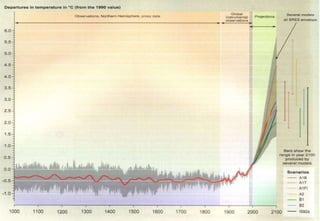
  • #22 The red line (1000-1860) shows the 50-year average, and the gray region the 95% confidence limit in the annual data. The red line (1860-2000) shows the decadal average. Over the period 2000 to 2100, projections are shown of globally averaged surface temp for the six illustrative SRES scenarios and IS92a as estimated by a model with average climate sensitivity. The grey region – ‘several models all SRES envelope”
  • #26 Nearly one in three Asians today lives on less than one US dollar per day. The climate models project a warming of at least 2.5°C over Asia by the end of the century. According to the Global Human Development Report 2007/08, Nepal’s Human Development Index (HDI) of 0.534 is the lowest for South Asia and less than the average for the developing countries. The incidence of poverty is 31 percent
  • #31 Water vapour is the most abundant greenhouse gas. However, human activities have little direct impact on its concentration in the atmosphere. In contrast, we have a large impact on the concentrations of carbon dioxide, methane and nitrous oxide. In order to be able to compare how different gases contribute to the greenhouse effect, a method has been developed to estimate their global warming potentials (GWP). GWPs depend on the capacity of greenhouse gas molecules to absorb or trap heat and the time the molecules remain in the atmosphere before being removed or broken down. The GWP of carbon dioxide is 1 (constant for all time periods) and the GWPs of other greenhouse gases are measured relative to it. Even though methane and nitrous oxide have much higher GWPs than carbon dioxide, because their concentration in the atmosphere is much lower, carbon dioxide remains the most important greenhouse gas, contributing about 60% to the enhancement of the greenhouse effect.
  • #47 A range of scenarios can be used to identify the sensitivity of an exposure unit to climate change and to help policy makers decide on appropriate policy responses. It is important to emphasize that climate scenarios are not predictions, like weather forecasts. Weather forecasts make use of enormous quantities of information on the observed state of the atmosphere and calculate, using the laws of physics, how this state will evolve during the next few days, producing a prediction of the future - a forecast. In contrast, a climate scenario is a plausible indication of what the future could be like over decades or centuries, given a specific set of assumptions. These assumptions include future trends in energy demand, emissions of greenhouse gases, land use change as well as assumptions about the behavior of the climate system over long time scales. It is largely the uncertainty surrounding these assumptions which determines the range of possible scenarios. The Intergovernmental Panel on Climate Change (IPCC) Special Report on Emission Scenarios (SRES) provides 40 different scenarios. The choice of climate scenarios and related non-climatic scenarios is important because it can determine the outcome of a climate impact assessment. Extreme scenarios can produce extreme impacts; moderate scenarios may produce more modest effects. It follows that the selection of scenarios can also be controversial, unless the fundamental uncertainties inherent in future projections are properly addressed in the impact analysis.
  • #48 A plausible and often simplified representation of the future climate, based on an internally consistent set of climatological relationships, that has been constructed for explicit use in investigating the potential consequences of anthropogenic climate change, often serving as input to impact models. Climate projections often serve as the raw material for constructing climate scenarios, but climate scenarios usually require additional information such as about the observed current climate. A “climate change scenario” is the difference between a climate scenario and the current climate.
  • #65 Substantial Warming (3.5 o C – 5 o C )
  • #70 Source: Sharma, DHM
  • #73 The National Communication indicates that overall precipitation in Nepal is decreasing at the rate of 9.8mm/decade, using data from 1981-1999, and that monsoon precipitation increased at 8.4mm/decade over the same period (National Communication 2004). The IPCC however, cite studies indicating that there has been no long term trend in precipitation in Nepal for the period 1948-1994 (IPCC 2007b). This highlights the fact that even for current trends, it is much harder to accurately assess precipitation. Positive trend (~30 mm/decade) at Chaurikharka- closest met stn from site. But trend is much higher in teria and apparently annual rf trend decrease with elevation with much smaller trend (+ve or –ve) at high altitude
  • #75 TN10p Cool nights Percentage of days when TN<10th percentile Days TX10p Cool days Percentage of days when TX<10th percentile Days TN90p Warm nights Percentage of days when TN>90th percentile Days TX90pWarm days Percentage of days when TX>90th percentile Days