Gamechanging education 1Co-evolving TLA with industryD.W. NicollDirector of Entrepreneurship, Student placement and IndusityLimkokwing Lesotho
The objective of this presentation is to:Provide some foundation to why we must link with industry;Argue why each of us must all aim at  employability as the endgame for our students, not just graduation;Consider the skills necessary for our students to competefor jobs or clients at the local, regional and global levels;Consider offering a broader range of skills beyond domain-specific or technical academic skills;All in all, accommodate to what is special or unique about Lesotho – or any other particular operating environment - and how best to orientate our programmes and TLA to best suit economy and society;
‘Industry’ refers here to organisations operating in the private as well as public and not-for-profit sectors
What do we do?
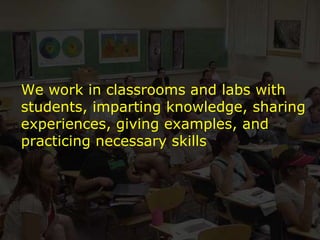
We work in classrooms and labs with students, imparting knowledge, sharing experiences, giving examples, and practicing necessary skills
WHY?
If the classroom is uncomfortable and the imparting of knowledge is impeded due to our lack of it. If the practicing of necessary skills is prevented by non-functioning or non-existent equipment, and the sharing of examples hampered due to us not having any, then the only experiences shared will surely be negative ones…
We work in classrooms and labs with students, imparting knowledge, sharing experiences, giving examples, and practicing necessary skills
WHY?
Why don’t students just go and learn what they must in the factory, workshop, office, and lab?Why don’t students just go out to the communities in which they live and learn or just simplydowhat needs to be done?
We work in classrooms and labs with students, imparting knowledge, sharing experiences, giving examples, and practicing necessary skills
WHY?
All in the hope of when they graduate, they are employed or are able to self-employ themselves… doing what they want, or doing what they can…
With high unemployment underscoring the skills market in Lesotho, there is more of an imperative for us to enable them to sell themselves and their talents, and to develop within them, commercial and entrepreneurial outlooks – we need them to be…gamechangers…
People often says the ‘mindset’ has to change in Lesotho if it wants to progress, so what is this mindset and whymust it change? How can it change?
Gamechangers don’t accept things only on face value, they will break the rules if necessary, interrogate the rulebook, steal, assimilate, incorporate, mash-up, unlearn, reverse engineer, and dismantle, use the old as new, and mask the new as old, all in the name of creativity and innovation. They are flexible and they make the problem malleable...
We want them to be restless, to look at how things could be improved, and how to improve upon things...
Is this a picture of Lesotho’s economy?
45% unemployment, HIV, garment factories, remittances from mine workers declining...or
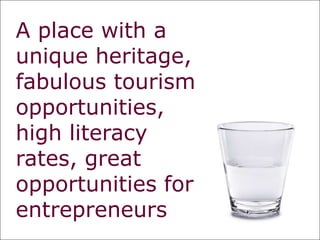
A place with a unique heritage, fabulous tourism opportunities, high literacy rates, great opportunities for entrepreneurs
Which is it to be, half-full or half-empty?
IS IT?
Or more
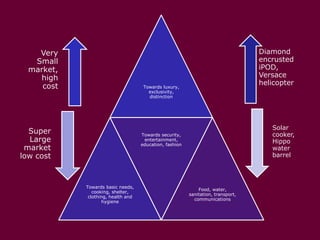
"the Bottom of the Pyramid (BoP)-almost four billionpeople, or nearly two-thirds of humanity, who live at the bottom of the economic pyramid, with a vast majority of them struggling to survive on less than two dollars a day.""a pressing business responsibility that is a significant new business opportunity."
"the Bottom of the Pyramid (BoP)-almost four billion people, or nearly two-thirds of humanity, who live at the bottom of the economic pyramid, with a vast majority of them struggling to survive on less than two dollars a day.""a pressing business responsibility that is a significant new business opportunity."
Is the BoP best served and understood by local designers and design and social researchers, or by people from far away? There is a debate just now about the imperialism of humanitarian design? It join wider debates regarding economic aid, and land rights...
Its not just about building products for the poor, it is at the same time about sustainable design, humanitarian design, social entrepreneurship… being ‘ecofreindly’ and ‘green’ from necessity and not luxury
The old style of university has its roots in Northern, western religious study and has traditionally stood aloof or ‘outside’ of society, at best it has observed society from its ivory tower, and reported to industry and government.
The modern university and design school is very much in the midstof societal problem solving, whether that is working out how patient care could be improved in local hospitals, to better supply networks for local farmers, through to improvements in shop design, through to designing a new range of signature outfits which could define and even brand the country.
Where are our graduates going?
Existing businesses in Lesotho. Resurrecting, revitalising and otherwise augmenting existing business processes. The biggest challenge is to persuade local businesses that good design is good for business, that they can improve the propensity of business through design to compete on local, regional or global markets.
Existing businesses in neighbouring South Africa. Our graduates must be of a calibre sufficient to compete in the S.A. Skills market, against local candidates. They must have the presentation skills and portfolios that help them win.
Createnew businesses in Lesotho. The significant challenge lies in the imperative to create a strong creative industries cluster in Lesotho. The pioneers of this should be our best students working in new start-ups with seed capital, serving the local public, private and not-for-profit sectors. They will also vie for regional and global business by undercutting cost and delivering high quality output – a.k.a. Nollywood, Philippines animation, IT in Bangalore...
“Our sons and daughters will not hew, forge, mine, plough or weld. They will serve, design, advise, create, compose, analyse, judge and write.’” Charles Leadbeater
They need to have skills and knowledge recognised by industry to deliver value at the local, regional, and global levels
Technical and cognitive academic skills – programming, developing a brochure or website, producing a documentary, writing a magazine article, doing a report on a company, designing a new skirt, developing a plan for new hotel interiors and so on… They need more than this…
Employability skills are also sometimes referred to as ‘generic skills’, ‘capabilities’, ‘enabling skills’ or ‘key competencies’.
*Communication skills*Teamwork skills*Problem-solving skills*Initiative and enterprise skills*Planning and organising skills*Self-management skills*Learning skills*Technology skills
*Academic ability (27%)*Seeing problems from different angles (50%)*Grasping complex information (68%)
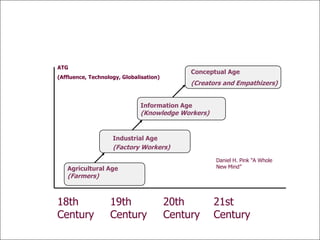
Daniel H. Pink refers to ‘the conceptual age’ – as a new age in economic history which will elevate those who are nimble and creative
From the Agricultural Ag to the Conceptual AgeATG(Affluence, Technology, Globalisation)Conceptual Age(Creators and Empathizers)Information Age (Knowledge Workers)Industrial Age(Factory Workers)Daniel H. Pink “A Whole New Mind”Agricultural Age (Farmers)18th Century19th Century20th Century21st Century
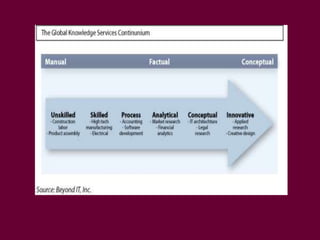
Pink’s three questions for creative individuals and businessesCan someone overseas do it cheaper?Can a computer do it fasterIs what I am offering in demand in an age of abundance?
Link technical and cognitive skills and employability skills to industry
i.e. What team working skills are involved in TV production? Which self-management skills are involved in producing a new logo design?
What are your students aiming at when they finish their studies?Ask them repeatedly?Can they sell fish in a unique way in the market? place?
What are your students aiming at when they finish their studies?Then where should we be aiming our teaching at? What should and how should they learn? How should assessments be carried out? What are out benchmarks?
Do they need a portfolio?Do they need strong presentation skills, to package and sell themselves and what they can do?
If they want to work locally – what is the current state of the industry? Who are the players? How developed is the sector/local economy? What are the present challenges? How much room is there for improvement?When an industry is new or incumbant, students will have to know how to package and sell unfamiliar skills to those who may need persuading –they, and we, must educate business to the relevance of the creative industries
If they want to work regionally – what is the state of the industry? Who are the main players? What are they looking for in new staff?When an industry is established, students will have to have regionally comparable skills levels  and know how to compete for jobs or clients
So what’s the difference between the workplace and the lab or classroom? Should there be a difference? If so, what? If not, why are we doing what we do? How do we add value to a society, to an economy?
We work in classrooms and labs with students, imparting knowledge, sharing experiences, giving examples, and practicing necessary skills
Classes and labs are spaces where we can trial and error in safety, ask questions without having to be accountable financially, criticise the way things are depicted and done without the criticism of a fussy boss or client – through this students can orientate towards a discipline or field or careers
As lecturers we are all leaders. We have in our everyday working lives a fairly high degree of autonomy in deciding upon the way in which we work with students.
As an instructor, you make decisions about:what topics to include and which to leave out; the order in which those topics will be presented; which pedagogical methods to use (e.g., lecture, discussion, hands-on experiments); appropriate means of assessing the students; materials and technology to employ; how to get feedback; etc.
Worst case scenario
We could make a pact with students, tell them not to turn up, nor will we, they in turn will give us good feedback, we in turn will give good attendance reports and provide exam answers, and mark them all as ‘A’s
The net result
The net result
Students which have learned nothing, can do nothing, nothing more than what they came to us with – we then foster students which are not in anyway prepared for subsequent, more advanced classes.
Nor are they being prepared in any respect for work, locally or regionally, they are students who are not, in any meaningful way, able or equipped with the skills, know-how or attitudes to start their own business.
At best they only benefited for a while from a government sponsored loan of money which they will never pay back… University is only a place to hang out  with other young people, and in some cases make them pregnant
We as an institution will have a short shelf life
better case scenario
The university provides teaching kits – module outlines, sometimes student hand-outs, lecturer notes, assessment examples, PowerPoint slides.
Lecturers use them verbatim – that is, how they come, regardless if they are good or bad, localised or not, and with very little personal input. They switch the slides on automatic and they leave the room…
MANAGEMENTChain ofCommandLine versusStaff AuthorityDelegationof AuthorityDegree ofCentralisationOrganisational AuthorityThe vertical line of authority in an organisationClarifies who reports to whom
Unity of command
workers report to only one boss
matrix organisations violate this principleLine authority: the right to command immediate subordinates in the chain of commandStaff authority: the right to advise but not command othersDelegation of Authority: The assignment of direct authority and responsibility to a subordinate to complete tasks for which the manager is normally responsible.[R.A.A]Centralisation of authority: primary authority is held by upper managementDecentralisation: significant authority is found in lower levels of the organisationStandardisation: solving problems by applying rules, procedures, and processes77
MANAGEMENTWhy study job design?Every manager must know the relationship between how organisation being structured, the job within and the linkages to organisational processes78
MANAGEMENTJob designSpecialisedJobsA job that is a small part of a larger task or process
Jobs are simple, easy to learn, and economical
Can lead to low satisfaction, high absenteeism, & employee turnover
Job Rotation: periodically moving workers from one specialised job to another
Job Enlargement: increasing the number of tasks performed by a worker
Job Enrichment: adding more tasks and authority to an employee’s jobJob Rotation, Enlargement, EnrichmentJobCharacteristicsModelA job redesign approach: that seeks to increase employee motivation
Emphasizes internal motivation: experience work as meaningful, experience responsibility for work outcomes, knowledge of results79
MANAGEMENTJob Characteristics Model80
MANAGEMENTIntra-organisational ProcessesReengineeringEmpowermentBehaviouralInformality81
The net result
Lecturers read off the slides or notes, or direct from the book and get the students to copy whiteboard after whiteboard of dead material…
This is tantamount to the infamous rote learning – very little thought is required by students, just good memory. In response, they want and need notes, they write cheat scripts, they need to remember… boring, poor experiences
Best case scenario
In teaching lecturers vet the teaching materials in terms of both being up-to-date and for local relevance, they aim to ask more questions than provide answers
They draw upon their depth knowledge of the subject derived from experience of working in a directly related industry, or from research projects in the subject area – this would certainly enliven or animate any presentation and discussion of the theories or their applications…
Students are happy to work their six hours a week self-directed study, they use it to research the questions posed in the lecture, to discover examples to share in the next class, interview or otherwise get data for business plans from real world sources, do design research by photographing local examples and contrasting these with found examples on the internet …
But then some of us have little direct knowledge of the subject itself, as we have come straight from being taught ourselves, or we have no or little teaching experience, or we have taught at only secondary school level, or we are teaching out of subject…
Compromise scenario
We can still let the students do the finding out, what is it they need to know, why they need to know it, where or from whom they can find it out…
The time to take ownership of a set of modules is now
As we approach one full academic cycle, we will repeat modules, as we do our knowledge will consolidate and increase

Gamechanging education 1

  • 1.
    Gamechanging education 1Co-evolvingTLA with industryD.W. NicollDirector of Entrepreneurship, Student placement and IndusityLimkokwing Lesotho
  • 2.
    The objective ofthis presentation is to:Provide some foundation to why we must link with industry;Argue why each of us must all aim at employability as the endgame for our students, not just graduation;Consider the skills necessary for our students to competefor jobs or clients at the local, regional and global levels;Consider offering a broader range of skills beyond domain-specific or technical academic skills;All in all, accommodate to what is special or unique about Lesotho – or any other particular operating environment - and how best to orientate our programmes and TLA to best suit economy and society;
  • 3.
    ‘Industry’ refers hereto organisations operating in the private as well as public and not-for-profit sectors
  • 4.
  • 5.
    We work inclassrooms and labs with students, imparting knowledge, sharing experiences, giving examples, and practicing necessary skills
  • 6.
  • 7.
    If the classroomis uncomfortable and the imparting of knowledge is impeded due to our lack of it. If the practicing of necessary skills is prevented by non-functioning or non-existent equipment, and the sharing of examples hampered due to us not having any, then the only experiences shared will surely be negative ones…
  • 8.
    We work inclassrooms and labs with students, imparting knowledge, sharing experiences, giving examples, and practicing necessary skills
  • 9.
  • 10.
    Why don’t studentsjust go and learn what they must in the factory, workshop, office, and lab?Why don’t students just go out to the communities in which they live and learn or just simplydowhat needs to be done?
  • 11.
    We work inclassrooms and labs with students, imparting knowledge, sharing experiences, giving examples, and practicing necessary skills
  • 12.
  • 13.
    All in thehope of when they graduate, they are employed or are able to self-employ themselves… doing what they want, or doing what they can…
  • 14.
    With high unemploymentunderscoring the skills market in Lesotho, there is more of an imperative for us to enable them to sell themselves and their talents, and to develop within them, commercial and entrepreneurial outlooks – we need them to be…gamechangers…
  • 15.
    People often saysthe ‘mindset’ has to change in Lesotho if it wants to progress, so what is this mindset and whymust it change? How can it change?
  • 16.
    Gamechangers don’t acceptthings only on face value, they will break the rules if necessary, interrogate the rulebook, steal, assimilate, incorporate, mash-up, unlearn, reverse engineer, and dismantle, use the old as new, and mask the new as old, all in the name of creativity and innovation. They are flexible and they make the problem malleable...
  • 17.
    We want themto be restless, to look at how things could be improved, and how to improve upon things...
  • 19.
    Is this apicture of Lesotho’s economy?
  • 20.
    45% unemployment, HIV,garment factories, remittances from mine workers declining...or
  • 21.
    A place witha unique heritage, fabulous tourism opportunities, high literacy rates, great opportunities for entrepreneurs
  • 22.
    Which is itto be, half-full or half-empty?
  • 23.
  • 25.
  • 29.
    "the Bottom ofthe Pyramid (BoP)-almost four billionpeople, or nearly two-thirds of humanity, who live at the bottom of the economic pyramid, with a vast majority of them struggling to survive on less than two dollars a day.""a pressing business responsibility that is a significant new business opportunity."
  • 30.
    "the Bottom ofthe Pyramid (BoP)-almost four billion people, or nearly two-thirds of humanity, who live at the bottom of the economic pyramid, with a vast majority of them struggling to survive on less than two dollars a day.""a pressing business responsibility that is a significant new business opportunity."
  • 31.
    Is the BoPbest served and understood by local designers and design and social researchers, or by people from far away? There is a debate just now about the imperialism of humanitarian design? It join wider debates regarding economic aid, and land rights...
  • 32.
    Its not justabout building products for the poor, it is at the same time about sustainable design, humanitarian design, social entrepreneurship… being ‘ecofreindly’ and ‘green’ from necessity and not luxury
  • 33.
    The old styleof university has its roots in Northern, western religious study and has traditionally stood aloof or ‘outside’ of society, at best it has observed society from its ivory tower, and reported to industry and government.
  • 34.
    The modern universityand design school is very much in the midstof societal problem solving, whether that is working out how patient care could be improved in local hospitals, to better supply networks for local farmers, through to improvements in shop design, through to designing a new range of signature outfits which could define and even brand the country.
  • 35.
    Where are ourgraduates going?
  • 36.
    Existing businesses inLesotho. Resurrecting, revitalising and otherwise augmenting existing business processes. The biggest challenge is to persuade local businesses that good design is good for business, that they can improve the propensity of business through design to compete on local, regional or global markets.
  • 37.
    Existing businesses inneighbouring South Africa. Our graduates must be of a calibre sufficient to compete in the S.A. Skills market, against local candidates. They must have the presentation skills and portfolios that help them win.
  • 38.
    Createnew businesses inLesotho. The significant challenge lies in the imperative to create a strong creative industries cluster in Lesotho. The pioneers of this should be our best students working in new start-ups with seed capital, serving the local public, private and not-for-profit sectors. They will also vie for regional and global business by undercutting cost and delivering high quality output – a.k.a. Nollywood, Philippines animation, IT in Bangalore...
  • 39.
    “Our sons anddaughters will not hew, forge, mine, plough or weld. They will serve, design, advise, create, compose, analyse, judge and write.’” Charles Leadbeater
  • 40.
    They need tohave skills and knowledge recognised by industry to deliver value at the local, regional, and global levels
  • 41.
    Technical and cognitiveacademic skills – programming, developing a brochure or website, producing a documentary, writing a magazine article, doing a report on a company, designing a new skirt, developing a plan for new hotel interiors and so on… They need more than this…
  • 42.
    Employability skills arealso sometimes referred to as ‘generic skills’, ‘capabilities’, ‘enabling skills’ or ‘key competencies’.
  • 43.
    *Communication skills*Teamwork skills*Problem-solvingskills*Initiative and enterprise skills*Planning and organising skills*Self-management skills*Learning skills*Technology skills
  • 44.
    *Academic ability (27%)*Seeingproblems from different angles (50%)*Grasping complex information (68%)
  • 45.
    Daniel H. Pinkrefers to ‘the conceptual age’ – as a new age in economic history which will elevate those who are nimble and creative
  • 47.
    From the AgriculturalAg to the Conceptual AgeATG(Affluence, Technology, Globalisation)Conceptual Age(Creators and Empathizers)Information Age (Knowledge Workers)Industrial Age(Factory Workers)Daniel H. Pink “A Whole New Mind”Agricultural Age (Farmers)18th Century19th Century20th Century21st Century
  • 48.
    Pink’s three questionsfor creative individuals and businessesCan someone overseas do it cheaper?Can a computer do it fasterIs what I am offering in demand in an age of abundance?
  • 49.
    Link technical andcognitive skills and employability skills to industry
  • 50.
    i.e. What teamworking skills are involved in TV production? Which self-management skills are involved in producing a new logo design?
  • 51.
    What are yourstudents aiming at when they finish their studies?Ask them repeatedly?Can they sell fish in a unique way in the market? place?
  • 52.
    What are yourstudents aiming at when they finish their studies?Then where should we be aiming our teaching at? What should and how should they learn? How should assessments be carried out? What are out benchmarks?
  • 53.
    Do they needa portfolio?Do they need strong presentation skills, to package and sell themselves and what they can do?
  • 54.
    If they wantto work locally – what is the current state of the industry? Who are the players? How developed is the sector/local economy? What are the present challenges? How much room is there for improvement?When an industry is new or incumbant, students will have to know how to package and sell unfamiliar skills to those who may need persuading –they, and we, must educate business to the relevance of the creative industries
  • 55.
    If they wantto work regionally – what is the state of the industry? Who are the main players? What are they looking for in new staff?When an industry is established, students will have to have regionally comparable skills levels and know how to compete for jobs or clients
  • 56.
    So what’s thedifference between the workplace and the lab or classroom? Should there be a difference? If so, what? If not, why are we doing what we do? How do we add value to a society, to an economy?
  • 57.
    We work inclassrooms and labs with students, imparting knowledge, sharing experiences, giving examples, and practicing necessary skills
  • 58.
    Classes and labsare spaces where we can trial and error in safety, ask questions without having to be accountable financially, criticise the way things are depicted and done without the criticism of a fussy boss or client – through this students can orientate towards a discipline or field or careers
  • 59.
    As lecturers weare all leaders. We have in our everyday working lives a fairly high degree of autonomy in deciding upon the way in which we work with students.
  • 60.
    As an instructor,you make decisions about:what topics to include and which to leave out; the order in which those topics will be presented; which pedagogical methods to use (e.g., lecture, discussion, hands-on experiments); appropriate means of assessing the students; materials and technology to employ; how to get feedback; etc.
  • 61.
    As an instructor,you make decisions about:what topics to include and which to leave out; the order in which those topics will be presented; which pedagogical methods to use (e.g., lecture, discussion, hands-on experiments); appropriate means of assessing the students; materials and technology to employ; how to get feedback; etc.
  • 62.
    As an instructor,you make decisions about:what topics to include and which to leave out; the order in which those topics will be presented; which pedagogical methods to use (e.g., lecture, discussion, hands-on experiments); appropriate means of assessing the students; materials and technology to employ; how to get feedback; etc.
  • 63.
    As an instructor,you make decisions about:what topics to include and which to leave out; the order in which those topics will be presented; which pedagogical methods to use (e.g., lecture, discussion, hands-on experiments); appropriate means of assessing the students; materials and technology to employ; how to get feedback; etc.
  • 64.
    As an instructor,you make decisions about:what topics to include and which to leave out; the order in which those topics will be presented; which pedagogical methods to use (e.g., lecture, discussion, hands-on experiments); appropriate means of assessing the students; materials and technology to employ; how to get feedback; etc.
  • 65.
    As an instructor,you make decisions about:what topics to include and which to leave out; the order in which those topics will be presented; which pedagogical methods to use (e.g., lecture, discussion, hands-on experiments); appropriate means of assessing the students; materials and technology to employ; how to get feedback; etc.
  • 66.
  • 67.
    We could makea pact with students, tell them not to turn up, nor will we, they in turn will give us good feedback, we in turn will give good attendance reports and provide exam answers, and mark them all as ‘A’s
  • 68.
  • 69.
  • 70.
    Students which havelearned nothing, can do nothing, nothing more than what they came to us with – we then foster students which are not in anyway prepared for subsequent, more advanced classes.
  • 71.
    Nor are theybeing prepared in any respect for work, locally or regionally, they are students who are not, in any meaningful way, able or equipped with the skills, know-how or attitudes to start their own business.
  • 72.
    At best theyonly benefited for a while from a government sponsored loan of money which they will never pay back… University is only a place to hang out with other young people, and in some cases make them pregnant
  • 73.
    We as aninstitution will have a short shelf life
  • 74.
  • 75.
    The university providesteaching kits – module outlines, sometimes student hand-outs, lecturer notes, assessment examples, PowerPoint slides.
  • 76.
    Lecturers use themverbatim – that is, how they come, regardless if they are good or bad, localised or not, and with very little personal input. They switch the slides on automatic and they leave the room…
  • 77.
    MANAGEMENTChain ofCommandLine versusStaffAuthorityDelegationof AuthorityDegree ofCentralisationOrganisational AuthorityThe vertical line of authority in an organisationClarifies who reports to whom
  • 78.
  • 79.
    workers report toonly one boss
  • 80.
    matrix organisations violatethis principleLine authority: the right to command immediate subordinates in the chain of commandStaff authority: the right to advise but not command othersDelegation of Authority: The assignment of direct authority and responsibility to a subordinate to complete tasks for which the manager is normally responsible.[R.A.A]Centralisation of authority: primary authority is held by upper managementDecentralisation: significant authority is found in lower levels of the organisationStandardisation: solving problems by applying rules, procedures, and processes77
  • 81.
    MANAGEMENTWhy study jobdesign?Every manager must know the relationship between how organisation being structured, the job within and the linkages to organisational processes78
  • 82.
    MANAGEMENTJob designSpecialisedJobsA jobthat is a small part of a larger task or process
  • 83.
    Jobs are simple,easy to learn, and economical
  • 84.
    Can lead tolow satisfaction, high absenteeism, & employee turnover
  • 85.
    Job Rotation: periodicallymoving workers from one specialised job to another
  • 86.
    Job Enlargement: increasingthe number of tasks performed by a worker
  • 87.
    Job Enrichment: addingmore tasks and authority to an employee’s jobJob Rotation, Enlargement, EnrichmentJobCharacteristicsModelA job redesign approach: that seeks to increase employee motivation
  • 88.
    Emphasizes internal motivation:experience work as meaningful, experience responsibility for work outcomes, knowledge of results79
  • 89.
  • 90.
  • 91.
  • 92.
    Lecturers read offthe slides or notes, or direct from the book and get the students to copy whiteboard after whiteboard of dead material…
  • 93.
    This is tantamountto the infamous rote learning – very little thought is required by students, just good memory. In response, they want and need notes, they write cheat scripts, they need to remember… boring, poor experiences
  • 94.
  • 95.
    In teaching lecturersvet the teaching materials in terms of both being up-to-date and for local relevance, they aim to ask more questions than provide answers
  • 96.
    They draw upontheir depth knowledge of the subject derived from experience of working in a directly related industry, or from research projects in the subject area – this would certainly enliven or animate any presentation and discussion of the theories or their applications…
  • 97.
    Students are happyto work their six hours a week self-directed study, they use it to research the questions posed in the lecture, to discover examples to share in the next class, interview or otherwise get data for business plans from real world sources, do design research by photographing local examples and contrasting these with found examples on the internet …
  • 98.
    But then someof us have little direct knowledge of the subject itself, as we have come straight from being taught ourselves, or we have no or little teaching experience, or we have taught at only secondary school level, or we are teaching out of subject…
  • 99.
  • 100.
    We can stilllet the students do the finding out, what is it they need to know, why they need to know it, where or from whom they can find it out…
  • 101.
    The time totake ownership of a set of modules is now
  • 102.
    As we approachone full academic cycle, we will repeat modules, as we do our knowledge will consolidate and increase