

A Presentation on
“Database Management System”
Presented by:
Haris BB133082
Muzammil BB133100
Junaid BB133037
Mujtaba BB133019
Jabar BB133038
M.A.J.U
What is Database
• collection of programs that enables you to
store and extract information from a
database
• created to operate large quantities of
information by inputting, storing, retrieving,
and managing
M.A.J.U
Examples of Database
Applications
• computerized library systems
• automated teller machines
• flight reservation systems
• computerized parts inventory systems
M.A.J.U
STEPS IN DATABASE DESIGN
• Requirement analysis
− What does the user want?
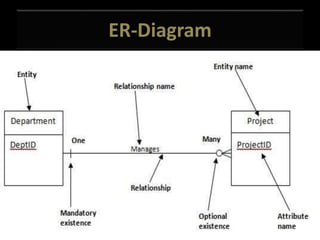
• Conceptual database design
− Defining the entities and attributes, and
the relationships between these --> The
ER model
M.A.J.U
ER-Diagram
Functions of a Database Management
System
• several functions that a DBMS performs to
ensure data integrity and consistency of
data in the database
• Ten functions in the DBMS are:
− Data Dictionary Management
− Data Storage ManagementM.A.J.U
Functions of a Database Management
System
− Data Transformation and Presentation
− Security Management
− Multiuser Access Control
− Backup and Recovery Management
M.A.J.U
Functions of a Database Management
System
− Data Integrity Management
− Database Access Languages and
Application Interface
− Database Communication Interfaces
− Transaction ManagementM.A.J.U
Role of Database Management
System
• interaction between end-user and the
database
• create an environment in which end users
have better access to more data
• Database is stored as a collection of files
M.A.J.U
DBMS benefits
• Occupies minimum storage space
• No unnecessary data
• Easy to update
M.A.J.U
Data Management Task
• Data management task fall into one or four
general options
− Storage space
− Backup strategy
− Speed
Database Tables
• Creating database tables
− Name the field
− Specify the field type
− Specify the field size
M.A.J.U
Database Tables
• Entering data in tables
− After the tables has been set up, data
can be entered by
• Viewing records
• Sorting records
M.A.J.U
Querying a Database
• Allow the DBMS to locate records
• Establish relationship
• List a subset of records
• Perform calculations
M.A.J.U
Querying a Database
• Delete obsolete records
• Perform other data management task
Field Types of DBMS
• Text field
• Numeric field
• Time field
• Logical field
M.A.J.U
Field Types of DBMS
• Binary field
• Counter field
M.A.J.U
ORDBMS
• object-relational database management
systems.
• How DBMS accessed languages:
− directly using programming languages
M.A.J.U
RDBMS VS ORDBMS
• Stands for
–Relational database management
system
–Object-relational database management
systems
• Difference between RDBMS and
ORDBMS
–They are both database management
systems M.A.J.U
DB2 database management
• DB2 database management : that was
introduced by IBM in 1983.
• Editions of DB2 :
– DB2Workgroup
– DB2 Workgroup Unlimited
M.A.J.U
DB2 database management
–DB2 Enterprise Server Edition
–DB2 UDB Data Warehouse
Enterprise Edition (DWE)
• DB2 has APIs for many languages
including the following.
–Java
–C
M.A.J.U
Database Management System

Database Management System

  • 2.
    A Presentation on “DatabaseManagement System” Presented by: Haris BB133082 Muzammil BB133100 Junaid BB133037 Mujtaba BB133019 Jabar BB133038 M.A.J.U
  • 3.
    What is Database •collection of programs that enables you to store and extract information from a database • created to operate large quantities of information by inputting, storing, retrieving, and managing M.A.J.U
  • 4.
    Examples of Database Applications •computerized library systems • automated teller machines • flight reservation systems • computerized parts inventory systems M.A.J.U
  • 5.
    STEPS IN DATABASEDESIGN • Requirement analysis − What does the user want? • Conceptual database design − Defining the entities and attributes, and the relationships between these --> The ER model M.A.J.U
  • 6.
  • 7.
    Functions of aDatabase Management System • several functions that a DBMS performs to ensure data integrity and consistency of data in the database • Ten functions in the DBMS are: − Data Dictionary Management − Data Storage ManagementM.A.J.U
  • 8.
    Functions of aDatabase Management System − Data Transformation and Presentation − Security Management − Multiuser Access Control − Backup and Recovery Management M.A.J.U
  • 9.
    Functions of aDatabase Management System − Data Integrity Management − Database Access Languages and Application Interface − Database Communication Interfaces − Transaction ManagementM.A.J.U
  • 10.
    Role of DatabaseManagement System • interaction between end-user and the database • create an environment in which end users have better access to more data • Database is stored as a collection of files M.A.J.U
  • 11.
    DBMS benefits • Occupiesminimum storage space • No unnecessary data • Easy to update M.A.J.U
  • 12.
    Data Management Task •Data management task fall into one or four general options − Storage space − Backup strategy − Speed
  • 13.
    Database Tables • Creatingdatabase tables − Name the field − Specify the field type − Specify the field size M.A.J.U
  • 14.
    Database Tables • Enteringdata in tables − After the tables has been set up, data can be entered by • Viewing records • Sorting records M.A.J.U
  • 15.
    Querying a Database •Allow the DBMS to locate records • Establish relationship • List a subset of records • Perform calculations M.A.J.U
  • 16.
    Querying a Database •Delete obsolete records • Perform other data management task
  • 17.
    Field Types ofDBMS • Text field • Numeric field • Time field • Logical field M.A.J.U
  • 18.
    Field Types ofDBMS • Binary field • Counter field M.A.J.U
  • 19.
    ORDBMS • object-relational databasemanagement systems. • How DBMS accessed languages: − directly using programming languages M.A.J.U
  • 20.
    RDBMS VS ORDBMS •Stands for –Relational database management system –Object-relational database management systems • Difference between RDBMS and ORDBMS –They are both database management systems M.A.J.U
  • 21.
    DB2 database management •DB2 database management : that was introduced by IBM in 1983. • Editions of DB2 : – DB2Workgroup – DB2 Workgroup Unlimited M.A.J.U
  • 22.
    DB2 database management –DB2Enterprise Server Edition –DB2 UDB Data Warehouse Enterprise Edition (DWE) • DB2 has APIs for many languages including the following. –Java –C M.A.J.U