Sanjivani Rural EducationSociety’s
Sanjivani College of Engineering, Kopargaon-423 603
(An Autonomous Institute, Affiliated to Savitribai Phule Pune University, Pune)
NACC ‘A’ Grade Accredited, ISO 9001:2015 Certified
Department of Computer Engineering
(NBA Accredited)
Prof. Monika Agrawal
Assistant Professor
E-mail : agrawalmonikacomp@sanjivani.org.in
Contact No: 8103645710
Course:PCCO208
Database Management System
UNIT-01 Introduction to DBMS
2.
DBMS Architecture 1-level,2-Level, 3-Level
We choose database architecture depending on several factors like the size of the
database, number of users, and relationships between the users.
• Types of DBMS Architecture
1-Tier Architecture
2-Tier Architecture
3-Tier Architecture
3.
1-Tier Architecture
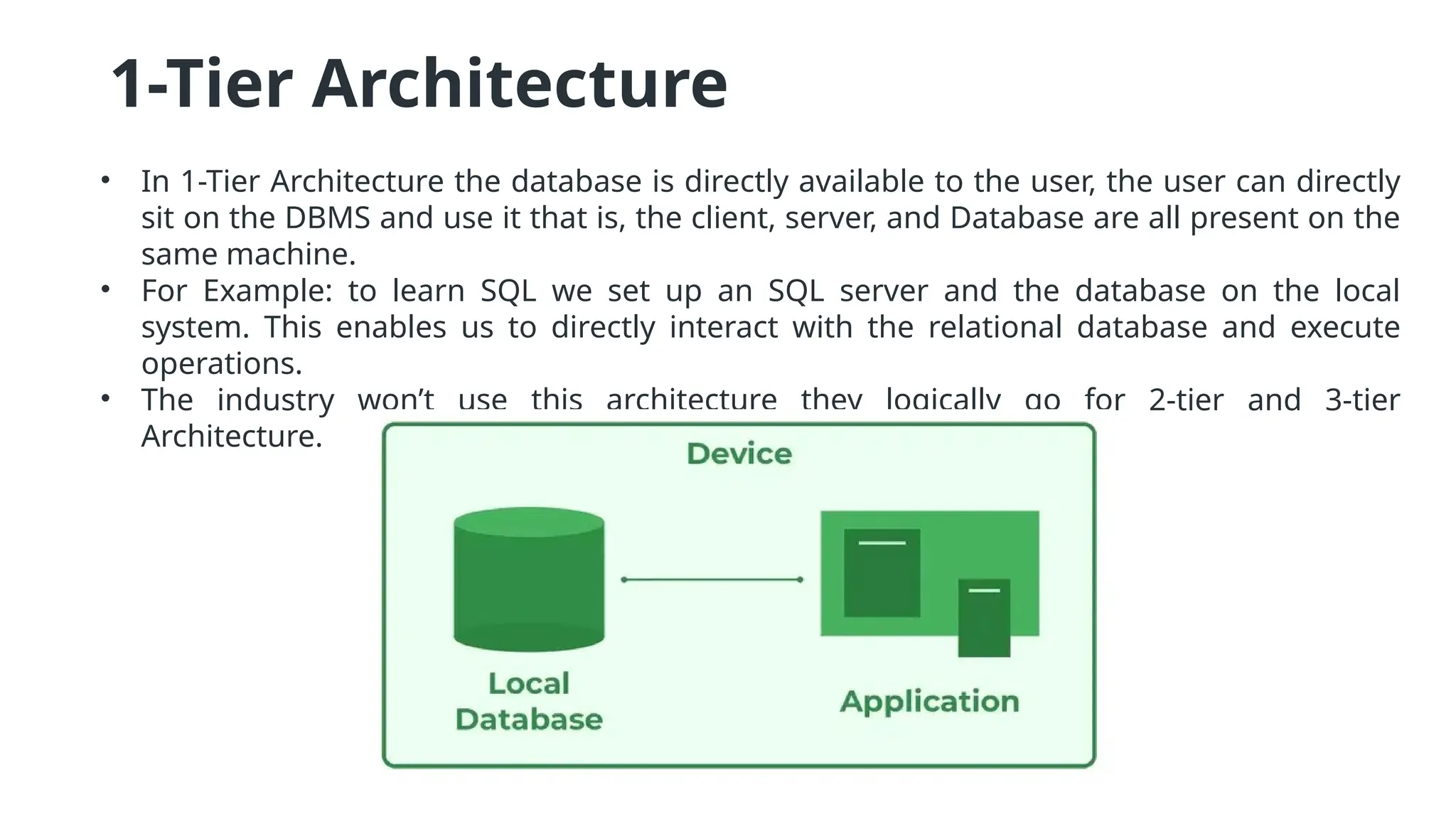
• In1-Tier Architecture the database is directly available to the user, the user can directly
sit on the DBMS and use it that is, the client, server, and Database are all present on the
same machine.
• For Example: to learn SQL we set up an SQL server and the database on the local
system. This enables us to directly interact with the relational database and execute
operations.
• The industry won’t use this architecture they logically go for 2-tier and 3-tier
Architecture.
4.
2-Tier Architecture
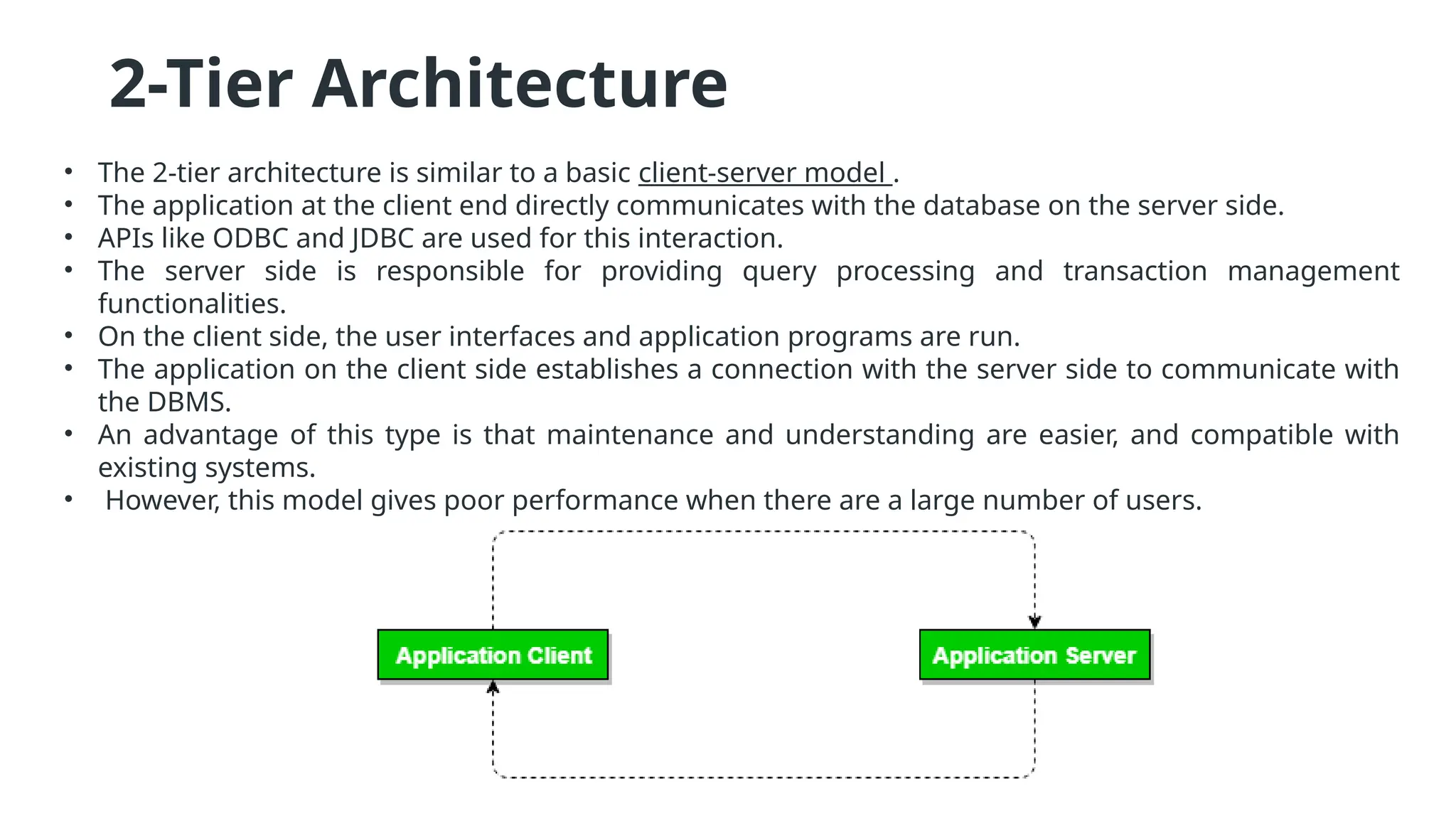
• The2-tier architecture is similar to a basic client-server model .
• The application at the client end directly communicates with the database on the server side.
• APIs like ODBC and JDBC are used for this interaction.
• The server side is responsible for providing query processing and transaction management
functionalities.
• On the client side, the user interfaces and application programs are run.
• The application on the client side establishes a connection with the server side to communicate with
the DBMS.
• An advantage of this type is that maintenance and understanding are easier, and compatible with
existing systems.
• However, this model gives poor performance when there are a large number of users.
5.
3-Tier Architecture
• In3-Tier Architecture , there is another layer between the client and the server.
• The client does not directly communicate with the server.
• Instead, it interacts with an application server which further communicates with the database system
and then the query processing and transaction management takes place.
• It is Internet based architecture.
6.
DBMS 3-Tier architecturedivides the complete system into three inter-related but independent modules as shown below:
7.
Physical Level: Atthe physical level, the information about the location of database objects in the
data store is kept. Various users of DBMS are unaware of the locations of these objects. In simple terms,
physical level of a database describes how the data is being stored in secondary storage devices like disks
and tapes and also gives insights on additional storage details.
Conceptual Level: At conceptual level, data is represented in the form of various database tables.
For Example, STUDENT database may contain STUDENT and COURSE tables which will be visible to users
but users are unaware of their storage. Also referred as logical schema,it describes what kind of data is to
be stored in the database.
External Level: An external level specifies a view of the data in terms of conceptual level
tables. Each external level view is used to cater to the needs of a particular category of users. For Example,
FACULTY of a university is interested in looking course details of students, STUDENTS are interested in
looking at all details related to academics, accounts, courses and hostel details as well. So, different views
can be generated for different users. The main focus of external level is data abstraction.