Sanjivani Rural EducationSociety’s
Sanjivani College of Engineering, Kopargaon-423 603
(An Autonomous Institute, Affiliated to Savitribai Phule Pune University, Pune)
NACC ‘A’ Grade Accredited, ISO 9001:2015 Certified
Department of Computer Engineering
(NBA Accredited)
Prof. Monika Agrawal
Assistant Professor
E-mail : agrawalmonikacomp@sanjivani.org.in
Contact No: 8770361037
Course:CO210
Database Management System
Unit 6 - NoSQL Databases
Lecture -2: Introduction to Mongo DB
2.
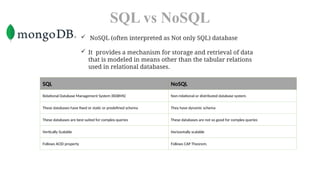
SQL vs NoSQL
NoSQL (often interpreted as Not only SQL) database
It provides a mechanism for storage and retrieval of data
that is modeled in means other than the tabular relations
used in relational databases.
SQL NoSQL
Relational Database Management System (RDBMS) Non-relational or distributed database system.
These databases have fixed or static or predefined schema They have dynamic schema
These databases are best suited for complex queries These databases are not so good for complex queries
Vertically Scalable Horizontally scalable
Follows ACID property Follows CAP Theorem.
What is MongoDB?
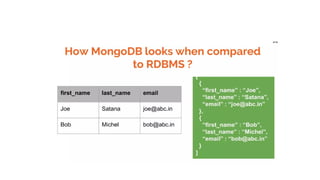
MongoDB is an open source, document-oriented database designed with both
scalability and developer agility in mind.
Instead of storing your data in tables and rows as you would with a relational
database, in MongoDB you store JSON-like documents with dynamic
schemas(schema-free, schema less).
{
"_id" : ObjectId("5114e0bd42…"),
“FirstName" : "John",
“LastName" : "Doe",
“Age" : 39,
“Interests" : [ "Reading", "Mountain Biking ]
“Favorites": {
"color": "Blue",
"sport": "Soccer“
}
}
10.
RDBMS MongoDB
Database Database
TableCollection
Row Document (JSON, BSON)
Column Field
Index Index
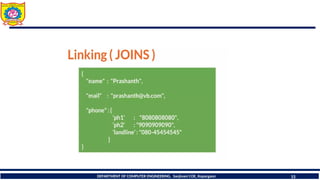
Join Embedded Document
Partition Shard
RDBMS vs MongoDB
MongoDB does not need any pre-defined data schema
Every document could have different data!
{name: “brendan”,
boss: “will”}
{name: “matt”,
weight:60,
height: 72,
loc: [44.6, 71.3]}
{name: “will”,
eyes: “blue”,
birthplace: “NY”,
aliases: [“bill”, “ben”],
loc: [32.7, 63.4],
boss: ”ben”}
Schema Free
![What is MongoDB?
MongoDB is an open source, document-oriented database designed with both
scalability and developer agility in mind.
Instead of storing your data in tables and rows as you would with a relational
database, in MongoDB you store JSON-like documents with dynamic
schemas(schema-free, schema less).
{
"_id" : ObjectId("5114e0bd42…"),
“FirstName" : "John",
“LastName" : "Doe",
“Age" : 39,
“Interests" : [ "Reading", "Mountain Biking ]
“Favorites": {
"color": "Blue",
"sport": "Soccer“
}
}](https://image.slidesharecdn.com/lecture2-250508114112-05bd29f1/85/Lecture-2-Difference-between-NoSQL-and-SQL-ppt-8-320.jpg)
![RDBMS MongoDB
Database Database
Table Collection
Row Document (JSON, BSON)
Column Field
Index Index
Join Embedded Document
Partition Shard
RDBMS vs MongoDB
MongoDB does not need any pre-defined data schema
Every document could have different data!
{name: “brendan”,
boss: “will”}
{name: “matt”,
weight:60,
height: 72,
loc: [44.6, 71.3]}
{name: “will”,
eyes: “blue”,
birthplace: “NY”,
aliases: [“bill”, “ben”],
loc: [32.7, 63.4],
boss: ”ben”}
Schema Free](https://image.slidesharecdn.com/lecture2-250508114112-05bd29f1/85/Lecture-2-Difference-between-NoSQL-and-SQL-ppt-10-320.jpg)


![nosql [Autosaved].pptx](https://cdn.slidesharecdn.com/ss_thumbnails/nosqlautosaved-230721181148-0ee7f758-thumbnail.jpg?width=640&height=640&fit=bounds)


