Lecture 1-Introduction to Database Transactions.ppt
1.
Sanjivani Rural EducationSociety’s
Sanjivani College of Engineering, Kopargaon-423 603
(An Autonomous Institute, Affiliated to Savitribai Phule Pune University, Pune)
NACC ‘A’ Grade Accredited, ISO 9001:2015 Certified
Department of Computer Engineering
(NBA Accredited)
Prof. Monika Agrawal
Assistant Professor
E-mail : agrawalmonikacomp@sanjivani.org.in
Contact No: 8770361037
Course:CO210
Database Management System
Lecture-01 Introduction
2.
DEPARTMENT OF COMPUTERENGINEERING, Sanjivani COE, Kopargaon 2
Unit – IV
Database Transactions and Query Processing
3.
Syllabus
•Basic concept ofa Transaction, Transaction Management,
•Properties of Transactions,
•Concept of Schedule, Serial Schedule,
•Serializability: Conflict and View,
•Cascaded Aborts,
•Recoverable and Non-recoverable Schedules,
•Concurrency Control: Need, Locking Methods,
•Deadlocks, Time-stamping Methods,
•Recovery methods: Shadow-Paging and Log-Based Recovery
DEPARTMENT OF COMPUTER ENGINEERING, Sanjivani COE, Kopargaon 3
4.
Transaction Concept
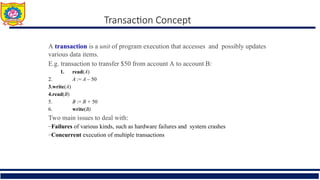
A transactionis a unit of program execution that accesses and possibly updates
various data items.
E.g. transaction to transfer $50 from account A to account B:
1. read(A)
2. A := A – 50
3.write(A)
4.read(B)
5. B := B + 50
6. write(B)
Two main issues to deal with:
–Failures of various kinds, such as hardware failures and system crashes
–Concurrent execution of multiple transactions
5.
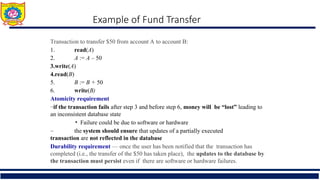
Example of FundTransfer
Transaction to transfer $50 from account A to account B:
1. read(A)
2. A := A – 50
3.write(A)
4.read(B)
5. B := B + 50
6. write(B)
Atomicity requirement
–if the transaction fails after step 3 and before step 6, money will be “lost” leading to
an inconsistent database state
• Failure could be due to software or hardware
– the system should ensure that updates of a partially executed
transaction are not reflected in the database
Durability requirement — once the user has been notified that the transaction has
completed (i.e., the transfer of the $50 has taken place), the updates to the database by
the transaction must persist even if there are software or hardware failures.
6.
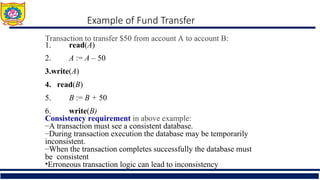
Example of FundTransfer
Transaction to transfer $50 from account A to account B:
1. read(A)
2. A := A – 50
3.write(A)
4. read(B)
5. B := B + 50
6. write(B)
Consistency requirement in above example:
–A transaction must see a consistent database.
–During transaction execution the database may be temporarily
inconsistent.
–When the transaction completes successfully the database must
be consistent
•Erroneous transaction logic can lead to inconsistency
7.
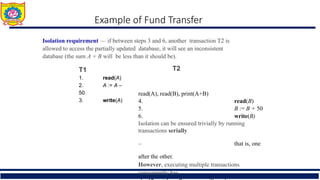
Example of FundTransfer
Isolation requirement — if between steps 3 and 6, another transaction T2 is
allowed to access the partially updated database, it will see an inconsistent
database (the sum A + B will be less than it should be).
T2
T1
1. read(A)
2. A := A –
50
3. write(A)
read(A), read(B), print(A+B)
4. read(B)
5. B := B + 50
6. write(B)
Isolation can be ensured trivially by running
transactions serially
– that is, one
after the other.
However, executing multiple transactions
concurrently has
8.
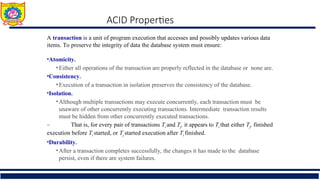
ACID Properties
A transactionis a unit of program execution that accesses and possibly updates various data
items. To preserve the integrity of data the database system must ensure:
•Atomicity.
• Either all operations of the transaction are properly reflected in the database or none are.
•Consistency.
• Execution of a transaction in isolation preserves the consistency of the database.
•Isolation.
• Although multiple transactions may execute concurrently, each transaction must be
unaware of other concurrently executing transactions. Intermediate transaction results
must be hidden from other concurrently executed transactions.
– That is, for every pair of transactions Ti and Tj, it appears to Ti that either Tj, finished
execution before Ti started, or Tj started execution after Ti finished.
•Durability.
• After a transaction completes successfully, the changes it has made to the database
persist, even if there are system failures.
9.
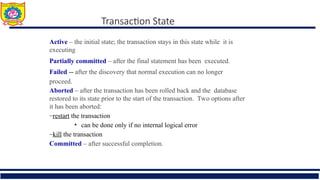
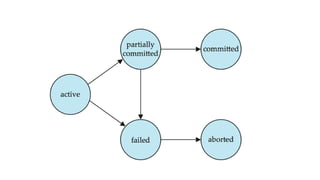
Transaction State
Active –the initial state; the transaction stays in this state while it is
executing
Partially committed – after the final statement has been executed.
Failed -- after the discovery that normal execution can no longer
proceed.
Aborted – after the transaction has been rolled back and the database
restored to its state prior to the start of the transaction. Two options after
it has been aborted:
–restart the transaction
• can be done only if no internal logical error
–kill the transaction
Committed – after successful completion.
11.
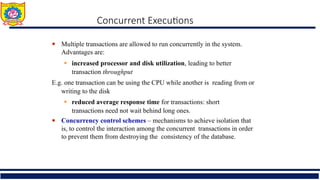
Concurrent Executions
● Multipletransactions are allowed to run concurrently in the system.
Advantages are:
● increased processor and disk utilization, leading to better
transaction throughput
E.g. one transaction can be using the CPU while another is reading from or
writing to the disk
● reduced average response time for transactions: short
transactions need not wait behind long ones.
● Concurrency control schemes – mechanisms to achieve isolation that
is, to control the interaction among the concurrent transactions in order
to prevent them from destroying the consistency of the database.