Multicast
&
Indirect
Communication
M.Jagadeesh, Assistant Professor, Information Technology.
MNM Jain Engineering College, Chennai
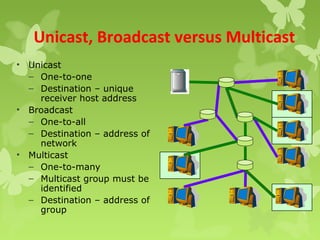
Unicast, Broadcast versus Multicast
• Unicast
– One-to-one
– Destination – unique
receiver host address
• Broadcast
– One-to-all
– Destination – address of
network
• Multicast
– One-to-many
– Multicast group must be
identified
– Destination – address of
group
Multicast Communication
02/10/19
 Multicast is Communication of One-to-Group of devices, where group
is created based on some criteria .
 Each process in a group can send and receive message. A message
sent by any process in the group can be received by each participating
process in the group.
 Multicast operation is an operation that sends a single message from
one process to each of the members of a group of processes.
 In an application or network service which makes use of multicasting,
a set of processes form a group, called a multicast group.
 Provides no guarantees about message delivery or ordering.
Characteristics of Multicast
 Fault tolerance based on replicated services
 A replicated service consists of a group of members.
 Client requests are multicast to all the members of the group, each of
which performs an identical operation.
 Even if one fails the clients can be still served
 Finding the discovery servers in spontaneous networking
 Multicast messages can be used by servers and clients to locate available
discovery services in order to register their interfaces or to look up the
interfaces of other services in the distributed system.
 Better performance through replicated data
 Data are replicated to increase the performance of a service.
 Propagation of event notifications
 Multicast to a group may be used to notify processes when something
happens.
Multicast application examples
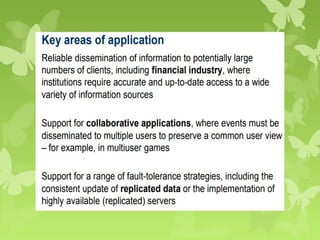
 Financial services
Delivery of news, stock quotes, financial indices, etc
 Remote conferencing/e-learning
Streaming audio and video to many participants (clients,
students)
Interactive communication between participants
 Data distribution
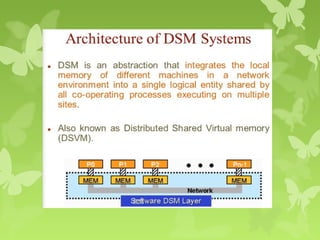
Indirect communication
Indirect Communication
1.group communication
2.publish-subscribe
3.message queues
4.shared memory
Direct Communication
 Client Server Communication
 Space Coupling-Examples
 Message Passing
 Remote invocation
Group Communication
02/10/19
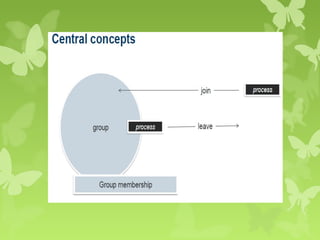
 Group communication offers a service whereby a message is
sent to a group and then this message is delivered to all
members of the group.
 Sender is not aware of the identities of the receivers.
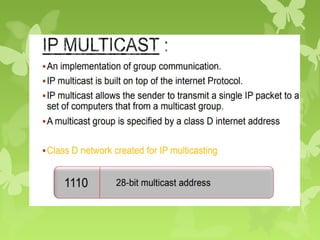
 Possible implementation over IP multicast (or an equivalent
overlay network), adding value in terms of
• Managing group membership
• Detecting failures and providing reliability and ordering
guarantees
Distributed event-based
programming model
 allow objects to subscribe to event occurring at
remote objects of interest & in turn to receive
notifications when such event occur.
 events and notification provide a way for
heterogeneous objects to communicate with
one another asynchronously.
What is a Publish/Subscribe System?
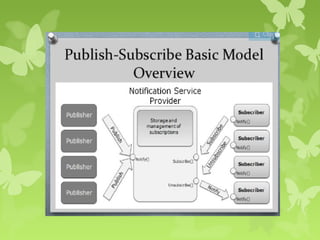
Publishers generate event data and publishes
them.
Subscribers : Subscribers submit their
subscriptions and process the events received.
P/S service: It’s the mediator/broker that
filters and routes events from publishers to
interested subscribers.
Information has been referred to as
Notifications.
Notification management system that maintains
a database with all publishers and subscribers.
Introduction
 Traditional system-centric approach
 Request/Response query of data.
 Data volume and response time.
 Data-centric approach
 Publishers
 Subscribers
 Notification system
Publish-Subscribe model
advantages
 Enhanced response time.
 Enhanced results.
 Database resources utilization and increased capacity.
 Loosely coupled relationship between publishers and
subscribers.
 Scalability.
Classification of Pub/Sub
Architectures
Centralized Broker model
Consists of multiple publishers and multiple subscribers
and centralized broker/brokers (an overlay network of
brokers interacting with each other).
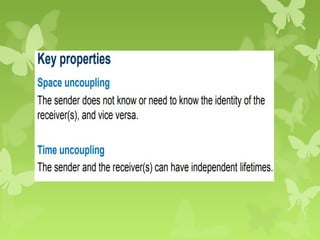
 Space decoupling: Subscribers/Publishers will contact
broker, and does not need to have knowledge about
others.
Time decoupling: in which publishers and subscribers
do not need to be running at the same time.
E.g. CORBA event services, JMS, JEDI etc…
Peer-to-Peer model
 Each node can be publisher, subscriber or broker.
 Subscribers subscribe to publishers directly and
publishers notify subscribers directly.
 Therefore they must maintain knowledge of each
other.
 Complex in nature, mechanisms such as DHT and
CHORD are employed to locate nodes in the
network.
 E.g. Java distributed event service
Key functions implemented by
P/S middleware service
 Event filtering (event selection)
The process which selects the set of subscribers that have
shown interest in a given event. Subscriptions are stored
in memory and searched when a publisher publishes a
new event.
 Event routing (event delivery)
The process of routing the published events from the
publisher to all interested subscribers
Event Routing
After filtering the events, the broker/brokers must route
the events to the corresponding subscribers.
Can be done in the following ways:
 Unicast
 Multicast
 Server push/ client pull
The broker makes the decision: how to route the message
to the subscriber.
 Several optimization schemes are available.
 Profile forwarding scheme
Subscription models
Topic-based subscription model
Also referred to as Subject-based models, group
based or channel based event filtering
subscriber shows interest in a particular topic and
receives notifications filtered based on that.
Each event is published to one of these channels by
its publisher.
Subscribers subscribes to a particular channel and
will receive ALL events published to the subscribed
channel.
Content based Content based
Bound to the content of events themselves rather than
external criteria.
More flexibility and power to subscribers, by allowing
more expression in arbitrary/customized query over the
contents of the event.
Event publication by a key/value attribute pair, and
subscriptions specify filters using a explicit subscription
language.
Car Brand =“Mercedes and Price <= 20,000‟
More advanced and complex notification system to be
able to filter each event and extract subscriptions
Type-based subscription model
 Built using concepts from Object-Oriented.
 Events are objects that can hold attributes and
methods and notifications are objects of specific type.
 Subscribers of specific object types will only receive
instances of that type or its sub-types.
Performance issues when a large amount of events
that need to be processed all at runtime.
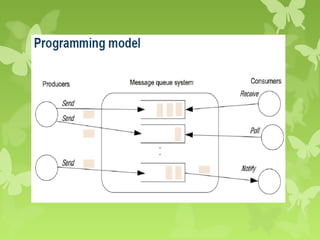
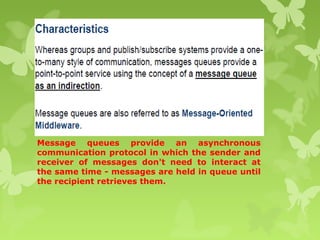
Message queues provide an asynchronous
communication protocol in which the sender and
receiver of messages don't need to interact at
the same time - messages are held in queue until
the recipient retrieves them.
 The basic architecture of a message queue is simple,
there are client applications called producers that
create messages and deliver them to the message
queue. An other application, called consumer, connect
to the queue and get the messages to be processed.
Messages placed onto the queue are stored until the
consumer retrieves them.
 Email is probably the best example of asynchronous
messaging. When an email is sent can the sender
continue processing other things without an immediate
response from the receiver. This way of handling
messages decouple the producer from the
consumer. The producer and the consumer of the
message do not need to interact with the message
queue at the same time.
Distributed System-Multicast & Indirect communication

Distributed System-Multicast & Indirect communication

  • 1.
    Multicast & Indirect Communication M.Jagadeesh, Assistant Professor,Information Technology. MNM Jain Engineering College, Chennai
  • 2.
    Unicast, Broadcast versusMulticast • Unicast – One-to-one – Destination – unique receiver host address • Broadcast – One-to-all – Destination – address of network • Multicast – One-to-many – Multicast group must be identified – Destination – address of group
  • 3.
    Multicast Communication 02/10/19  Multicastis Communication of One-to-Group of devices, where group is created based on some criteria .  Each process in a group can send and receive message. A message sent by any process in the group can be received by each participating process in the group.  Multicast operation is an operation that sends a single message from one process to each of the members of a group of processes.  In an application or network service which makes use of multicasting, a set of processes form a group, called a multicast group.  Provides no guarantees about message delivery or ordering.
  • 4.
    Characteristics of Multicast Fault tolerance based on replicated services  A replicated service consists of a group of members.  Client requests are multicast to all the members of the group, each of which performs an identical operation.  Even if one fails the clients can be still served  Finding the discovery servers in spontaneous networking  Multicast messages can be used by servers and clients to locate available discovery services in order to register their interfaces or to look up the interfaces of other services in the distributed system.  Better performance through replicated data  Data are replicated to increase the performance of a service.  Propagation of event notifications  Multicast to a group may be used to notify processes when something happens.
  • 5.
    Multicast application examples Financial services Delivery of news, stock quotes, financial indices, etc  Remote conferencing/e-learning Streaming audio and video to many participants (clients, students) Interactive communication between participants  Data distribution
  • 7.
  • 10.
  • 11.
    Direct Communication  ClientServer Communication  Space Coupling-Examples  Message Passing  Remote invocation
  • 12.
    Group Communication 02/10/19  Groupcommunication offers a service whereby a message is sent to a group and then this message is delivered to all members of the group.  Sender is not aware of the identities of the receivers.  Possible implementation over IP multicast (or an equivalent overlay network), adding value in terms of • Managing group membership • Detecting failures and providing reliability and ordering guarantees
  • 17.
    Distributed event-based programming model allow objects to subscribe to event occurring at remote objects of interest & in turn to receive notifications when such event occur.  events and notification provide a way for heterogeneous objects to communicate with one another asynchronously.
  • 18.
    What is aPublish/Subscribe System? Publishers generate event data and publishes them. Subscribers : Subscribers submit their subscriptions and process the events received. P/S service: It’s the mediator/broker that filters and routes events from publishers to interested subscribers. Information has been referred to as Notifications. Notification management system that maintains a database with all publishers and subscribers.
  • 19.
    Introduction  Traditional system-centricapproach  Request/Response query of data.  Data volume and response time.  Data-centric approach  Publishers  Subscribers  Notification system
  • 20.
    Publish-Subscribe model advantages  Enhancedresponse time.  Enhanced results.  Database resources utilization and increased capacity.  Loosely coupled relationship between publishers and subscribers.  Scalability.
  • 23.
    Classification of Pub/Sub Architectures CentralizedBroker model Consists of multiple publishers and multiple subscribers and centralized broker/brokers (an overlay network of brokers interacting with each other).  Space decoupling: Subscribers/Publishers will contact broker, and does not need to have knowledge about others. Time decoupling: in which publishers and subscribers do not need to be running at the same time. E.g. CORBA event services, JMS, JEDI etc…
  • 24.
    Peer-to-Peer model  Eachnode can be publisher, subscriber or broker.  Subscribers subscribe to publishers directly and publishers notify subscribers directly.  Therefore they must maintain knowledge of each other.  Complex in nature, mechanisms such as DHT and CHORD are employed to locate nodes in the network.  E.g. Java distributed event service
  • 25.
    Key functions implementedby P/S middleware service  Event filtering (event selection) The process which selects the set of subscribers that have shown interest in a given event. Subscriptions are stored in memory and searched when a publisher publishes a new event.  Event routing (event delivery) The process of routing the published events from the publisher to all interested subscribers
  • 26.
    Event Routing After filteringthe events, the broker/brokers must route the events to the corresponding subscribers. Can be done in the following ways:  Unicast  Multicast  Server push/ client pull The broker makes the decision: how to route the message to the subscriber.  Several optimization schemes are available.  Profile forwarding scheme
  • 28.
    Subscription models Topic-based subscriptionmodel Also referred to as Subject-based models, group based or channel based event filtering subscriber shows interest in a particular topic and receives notifications filtered based on that. Each event is published to one of these channels by its publisher. Subscribers subscribes to a particular channel and will receive ALL events published to the subscribed channel.
  • 29.
    Content based Contentbased Bound to the content of events themselves rather than external criteria. More flexibility and power to subscribers, by allowing more expression in arbitrary/customized query over the contents of the event. Event publication by a key/value attribute pair, and subscriptions specify filters using a explicit subscription language. Car Brand =“Mercedes and Price <= 20,000‟ More advanced and complex notification system to be able to filter each event and extract subscriptions
  • 30.
    Type-based subscription model Built using concepts from Object-Oriented.  Events are objects that can hold attributes and methods and notifications are objects of specific type.  Subscribers of specific object types will only receive instances of that type or its sub-types. Performance issues when a large amount of events that need to be processed all at runtime.
  • 34.
    Message queues providean asynchronous communication protocol in which the sender and receiver of messages don't need to interact at the same time - messages are held in queue until the recipient retrieves them.
  • 35.
     The basicarchitecture of a message queue is simple, there are client applications called producers that create messages and deliver them to the message queue. An other application, called consumer, connect to the queue and get the messages to be processed. Messages placed onto the queue are stored until the consumer retrieves them.  Email is probably the best example of asynchronous messaging. When an email is sent can the sender continue processing other things without an immediate response from the receiver. This way of handling messages decouple the producer from the consumer. The producer and the consumer of the message do not need to interact with the message queue at the same time.