Advance Database Management Systems : 1
Three-Schema Database Architecture
Prof Neeraj Bhargava
Vaibhav Khanna
Department of Computer Science
School of Engineering and Systems Sciences
Maharshi Dayanand Saraswati University Ajmer
Slide 2- 2
Three-Schema Architecture
• Proposed to support DBMS characteristics of:
– Program-data independence.
– Support of multiple views of the data.
• Not explicitly used in commercial DBMS
products, but has been useful in explaining
database system organization
Slide 2- 3
Three-Schema Architecture
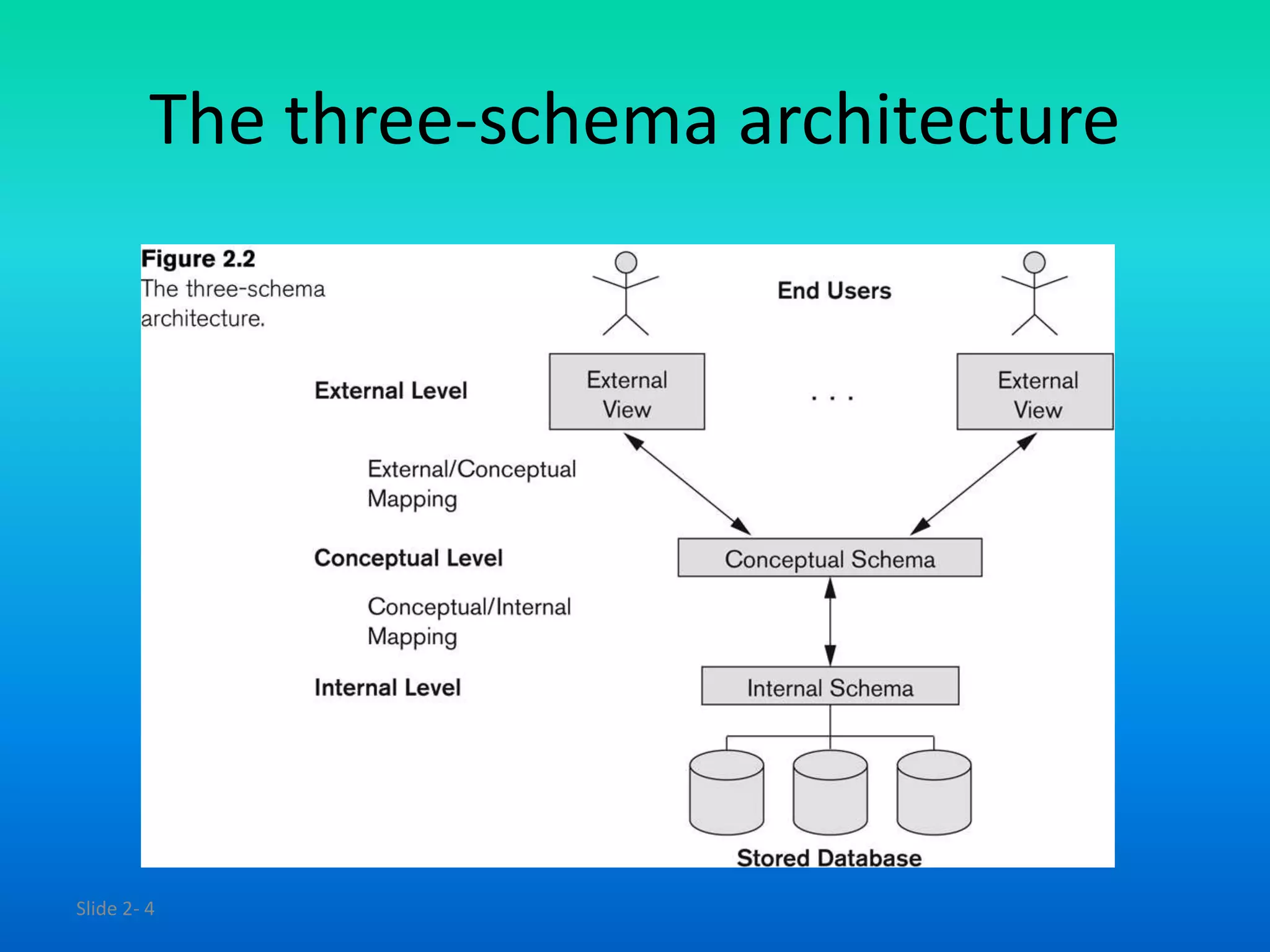
• Defines DBMS schemas at three levels:
– Internal schema at the internal level to describe physical
storage structures and access paths (e.g indexes).
• Typically uses a physical data model.
– Conceptual schema at the conceptual level to describe the
structure and constraints for the whole database for a
community of users.
• Uses a conceptual or an implementation data model.
– External schemas at the external level to describe the various
user views.
• Usually uses the same data model as the conceptual schema.
Slide 2- 4
The three-schema architecture
Slide 2- 5
Three-Schema Architecture
• Mappings among schema levels are needed to
transform requests and data.
– Programs refer to an external schema, and are
mapped by the DBMS to the internal schema for
execution.
– Data extracted from the internal DBMS level is
reformatted to match the user’s external view
(e.g. formatting the results of an SQL query for
display in a Web page)
Slide 2- 6
Data Independence
• Logical Data Independence:
– The capacity to change the conceptual schema
without having to change the external schemas
and their associated application programs.
• Physical Data Independence:
– The capacity to change the internal schema
without having to change the conceptual schema.
– For example, the internal schema may be changed
when certain file structures are reorganized or
new indexes are created to improve database
performance
Slide 2- 7
Data Independence (continued)
• When a schema at a lower level is changed,
only the mappings between this schema and
higher-level schemas need to be changed in a
DBMS that fully supports data independence.
• The higher-level schemas themselves are
unchanged.
– Hence, the application programs need not be
changed since they refer to the external schemas.
Assignment
• Draw and describe the Three-Schema
Architecture

Adbms 6 three schema database architecture

  • 1.
    Advance Database ManagementSystems : 1 Three-Schema Database Architecture Prof Neeraj Bhargava Vaibhav Khanna Department of Computer Science School of Engineering and Systems Sciences Maharshi Dayanand Saraswati University Ajmer
  • 2.
    Slide 2- 2 Three-SchemaArchitecture • Proposed to support DBMS characteristics of: – Program-data independence. – Support of multiple views of the data. • Not explicitly used in commercial DBMS products, but has been useful in explaining database system organization
  • 3.
    Slide 2- 3 Three-SchemaArchitecture • Defines DBMS schemas at three levels: – Internal schema at the internal level to describe physical storage structures and access paths (e.g indexes). • Typically uses a physical data model. – Conceptual schema at the conceptual level to describe the structure and constraints for the whole database for a community of users. • Uses a conceptual or an implementation data model. – External schemas at the external level to describe the various user views. • Usually uses the same data model as the conceptual schema.
  • 4.
    Slide 2- 4 Thethree-schema architecture
  • 5.
    Slide 2- 5 Three-SchemaArchitecture • Mappings among schema levels are needed to transform requests and data. – Programs refer to an external schema, and are mapped by the DBMS to the internal schema for execution. – Data extracted from the internal DBMS level is reformatted to match the user’s external view (e.g. formatting the results of an SQL query for display in a Web page)
  • 6.
    Slide 2- 6 DataIndependence • Logical Data Independence: – The capacity to change the conceptual schema without having to change the external schemas and their associated application programs. • Physical Data Independence: – The capacity to change the internal schema without having to change the conceptual schema. – For example, the internal schema may be changed when certain file structures are reorganized or new indexes are created to improve database performance
  • 7.
    Slide 2- 7 DataIndependence (continued) • When a schema at a lower level is changed, only the mappings between this schema and higher-level schemas need to be changed in a DBMS that fully supports data independence. • The higher-level schemas themselves are unchanged. – Hence, the application programs need not be changed since they refer to the external schemas.
  • 8.
    Assignment • Draw anddescribe the Three-Schema Architecture