www.oeclib.in
Submitted By:
Odisha Electronics Control Library
Data Warehouse Introduction
 History
 Types of Data Warehouse
 Security in Data Warehouse
 Complete Decision Support System
 Applications
 Components
 Architecture
 Benefits
 Problems
 Conclusion
Introduction
 Data warehouse is defined as "A subject-oriented,
integrated, time-variant, and nonvolatile collection of data
in support of management's decision-making process."
 Subject-oriented as the warehouse is organized around the
major subjects of the enterprise (such as customers,
products, and sales) rather than major application areas
(such as customer invoicing, stock control, and product
sales).
 Time-variant because data in the warehouse is only
accurate and valid at some point in time or over some time
interval.
History
• In the 1990's as organizations of scale began to need more
timely data about their business, they found that traditional
information systems technology was simply too cumbersome to
provide relevant data efficiently and quickly.
• Completing reporting requests could take days or weeks using
antiquated reporting tools that were designed more or less to
'execute' the business rather than 'run' the business.
Types of Data Warehouse
1. Enterprise Data Warehouse provides a control Data Base for
decision support throughout the enterprise.
2. Operational data store has a broad enterprise under scope
but unlike a real enterprise DW. Data is refreshed in rare real
time and used for routine business activity.
3. Data Mart is a sub part of Data Warehouse. It support a
particular reason or it is design for particular lines of business
such as sells, marketing or finance, or in any organization
documents of a particular department will be data mart.
SECURITY IN DATA WAREHOU
SING
 Data warehouse is an integrated repository derived from multiple
source (operational and legacy) databases.
 Replication control
 Aggregation and Generalization
 Exaggeration and Misleading
 Anonymity
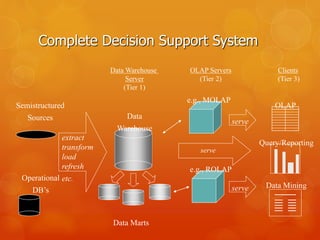
Complete Decision Support System
Data Warehouse
Server
(Tier 1)
OLAP Servers
(Tier 2)
Clients
(Tier 3)
Operational
DB’s
Semistructured
Sources
extract
transform
load
refresh
etc.
Data Marts
Data
Warehouse
e.g., MOLAP
e.g., ROLAP
serve
OLAP
Query/Reporting
Data Mining
serve
serve
The Application of Data Warehouses
 The proliferation of data warehouses is highlighted by the
“customer loyalty” schemes that are now run by many leading
retailers and airlines. These schemes illustrate the potential of the
data warehouse for “micromarketing” and profitability calculations,
but there are other applications of equal value, such as:
 Stock control
 Product category management
 Basket analysis
 Fraud analysis
 All of these applications offer a direct payback to the customer by
facilitating the identification of areas that require attention.
Components
 Operational data sources
 Operational data store
 Load manager
 Warehouse manager
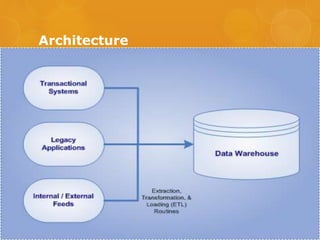
Architecture
Benefits
 Potential high returns on investment
:Implementation of data warehousing by an organization
requires a huge investment typically from Rs 10 lack to
50 lacks
 Competitive advantage :The huge returns on
investment for those companies that have successfully
implemented a data warehouse is evidence of the
enormous competitive advantage that accompanies this
technology.
Benefits …
 Increased productivity of corporate decision-
makers :Data warehousing improves the productivity of
corporate decision-makers by creating an integrated
database of consistent, subject-oriented, historical data.
 More cost-effective decision-making :Data
warehousing helps to reduce the overall cost of the·
product· by reducing the number of channels.
Problems
Underestimation of resources of data
loading
Hidden problems with source systems
Required data not captured
Increased end-user demands
Data homogenization
High demand for resources
Data ownership
High maintenance
Long-duration projects
CONCLUSION
Since the primary task of management
is effective decision making, the
primary task of research, and
subsequently data warehouses, is to
generate accurate information for use
in that decision making.
It is imperative that an organization’s
data warehousing strategies reflect
changes in the internal and external
business environment in addition to
the direction in which the business is
traveling.
References
 www.oeclib.in
 www.google.com
 www.wikipedia.com
Thanks…!!!

Data Warehousing ppt

  • 1.
  • 2.
    Data Warehouse Introduction History  Types of Data Warehouse  Security in Data Warehouse  Complete Decision Support System  Applications  Components  Architecture  Benefits  Problems  Conclusion
  • 3.
    Introduction  Data warehouseis defined as "A subject-oriented, integrated, time-variant, and nonvolatile collection of data in support of management's decision-making process."  Subject-oriented as the warehouse is organized around the major subjects of the enterprise (such as customers, products, and sales) rather than major application areas (such as customer invoicing, stock control, and product sales).  Time-variant because data in the warehouse is only accurate and valid at some point in time or over some time interval.
  • 4.
    History • In the1990's as organizations of scale began to need more timely data about their business, they found that traditional information systems technology was simply too cumbersome to provide relevant data efficiently and quickly. • Completing reporting requests could take days or weeks using antiquated reporting tools that were designed more or less to 'execute' the business rather than 'run' the business.
  • 5.
    Types of DataWarehouse 1. Enterprise Data Warehouse provides a control Data Base for decision support throughout the enterprise. 2. Operational data store has a broad enterprise under scope but unlike a real enterprise DW. Data is refreshed in rare real time and used for routine business activity. 3. Data Mart is a sub part of Data Warehouse. It support a particular reason or it is design for particular lines of business such as sells, marketing or finance, or in any organization documents of a particular department will be data mart.
  • 6.
    SECURITY IN DATAWAREHOU SING  Data warehouse is an integrated repository derived from multiple source (operational and legacy) databases.  Replication control  Aggregation and Generalization  Exaggeration and Misleading  Anonymity
  • 7.
    Complete Decision SupportSystem Data Warehouse Server (Tier 1) OLAP Servers (Tier 2) Clients (Tier 3) Operational DB’s Semistructured Sources extract transform load refresh etc. Data Marts Data Warehouse e.g., MOLAP e.g., ROLAP serve OLAP Query/Reporting Data Mining serve serve
  • 8.
    The Application ofData Warehouses  The proliferation of data warehouses is highlighted by the “customer loyalty” schemes that are now run by many leading retailers and airlines. These schemes illustrate the potential of the data warehouse for “micromarketing” and profitability calculations, but there are other applications of equal value, such as:  Stock control  Product category management  Basket analysis  Fraud analysis  All of these applications offer a direct payback to the customer by facilitating the identification of areas that require attention.
  • 9.
    Components  Operational datasources  Operational data store  Load manager  Warehouse manager
  • 10.
  • 11.
    Benefits  Potential highreturns on investment :Implementation of data warehousing by an organization requires a huge investment typically from Rs 10 lack to 50 lacks  Competitive advantage :The huge returns on investment for those companies that have successfully implemented a data warehouse is evidence of the enormous competitive advantage that accompanies this technology.
  • 12.
    Benefits …  Increasedproductivity of corporate decision- makers :Data warehousing improves the productivity of corporate decision-makers by creating an integrated database of consistent, subject-oriented, historical data.  More cost-effective decision-making :Data warehousing helps to reduce the overall cost of the· product· by reducing the number of channels.
  • 13.
    Problems Underestimation of resourcesof data loading Hidden problems with source systems Required data not captured Increased end-user demands Data homogenization High demand for resources Data ownership High maintenance Long-duration projects
  • 14.
    CONCLUSION Since the primarytask of management is effective decision making, the primary task of research, and subsequently data warehouses, is to generate accurate information for use in that decision making. It is imperative that an organization’s data warehousing strategies reflect changes in the internal and external business environment in addition to the direction in which the business is traveling.
  • 15.
  • 16.

Editor's Notes