11
Data WarehousingData Warehousing
Lecture-13Lecture-13
Dimensional Modeling (DM)Dimensional Modeling (DM)
Virtual University of PakistanVirtual University of Pakistan
Ahsan Abdullah
Assoc. Prof. & Head
Center for Agro-Informatics Research
www.nu.edu.pk/cairindex.asp
National University of Computers & Emerging Sciences, Islamabad
Email: ahsan@cluxing.com
2
Dimensional Modeling (DM)Dimensional Modeling (DM)
3
The need for ER modeling?The need for ER modeling?
 Problems with early COBOLian dataProblems with early COBOLian data
processing systems.processing systems.
 Data redundanciesData redundancies
 From flat file toFrom flat file to TableTable, each entity ultimately, each entity ultimately
becomes abecomes a TableTable in the physical schema.in the physical schema.
 Simple O(nSimple O(n22
) Join to work with T) Join to work with Tablesables
4
Why ER Modeling has been so successful?Why ER Modeling has been so successful?
 Coupled with normalization drives out allCoupled with normalization drives out all
the redundancy out of the database.the redundancy out of the database.
 Change (or add or delete) the data at justChange (or add or delete) the data at just
one point.one point.
 Can be used with indexing for very fastCan be used with indexing for very fast
access.access.
 Resulted in success of OLTP systems.Resulted in success of OLTP systems.
5
Need for DM: Un-answered QsNeed for DM: Un-answered Qs
 Lets have a look at aLets have a look at a typical ER data modeltypical ER data model first.first.
 Some Observations:Some Observations:
 All tables look-alike, as a consequence it is difficult toAll tables look-alike, as a consequence it is difficult to
identify:identify:
 Which table is more important ?Which table is more important ?
 Which is the largest?Which is the largest?
 Which tables contain numerical measurements of theWhich tables contain numerical measurements of the
business?business?
 Which table contain nearly static descriptive attributes?Which table contain nearly static descriptive attributes?
6
Need for DM: Complexity of RepresentationNeed for DM: Complexity of Representation
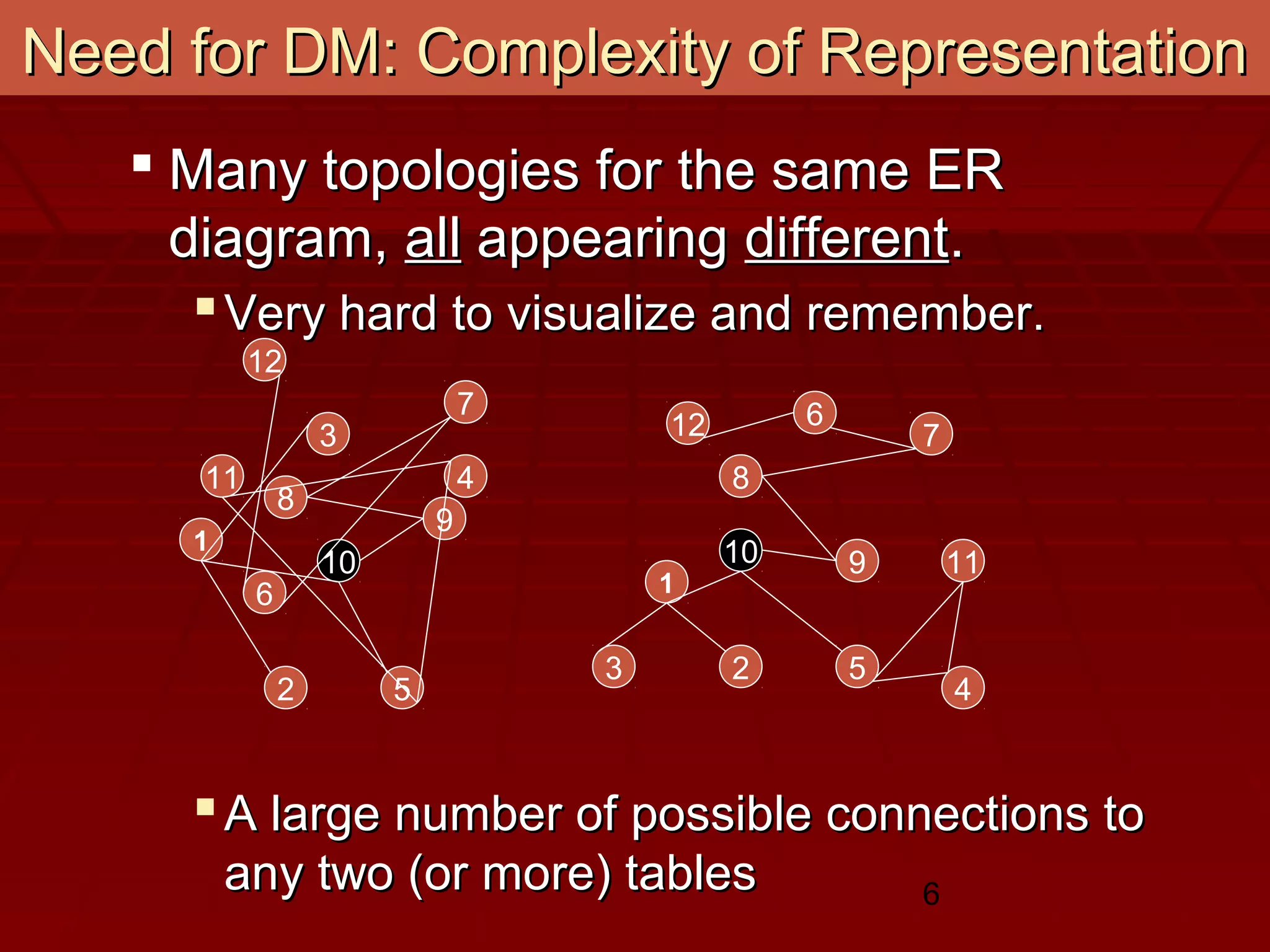
 Many topologies for the same ERMany topologies for the same ER
diagram,diagram, allall appearingappearing differentdifferent..
Very hard to visualize and remember.Very hard to visualize and remember.
A large number of possible connections toA large number of possible connections to
any two (or more) tablesany two (or more) tables
1
10
3
12
2
6
5
11 4
7
8
9
1
10
3
12
2
6
5
11
4
7
8
9
7
Need for DM: The ParadoxNeed for DM: The Paradox
 The Paradox:The Paradox: Trying to make information accessible usingTrying to make information accessible using
tables resulted in an inability to query them!tables resulted in an inability to query them!
 ER and Normalization result in large number of tables whichER and Normalization result in large number of tables which
are:are:
 Hard to understand by the users (DB programmers)Hard to understand by the users (DB programmers)
 Hard to navigate optimally by DBMS softwareHard to navigate optimally by DBMS software
 Real value of ER is in using tables individually or in pairsReal value of ER is in using tables individually or in pairs
 Too complex for queries that span multiple tables with aToo complex for queries that span multiple tables with a
large number of recordslarge number of records
8
ER vs. DMER vs. DM
ER DM
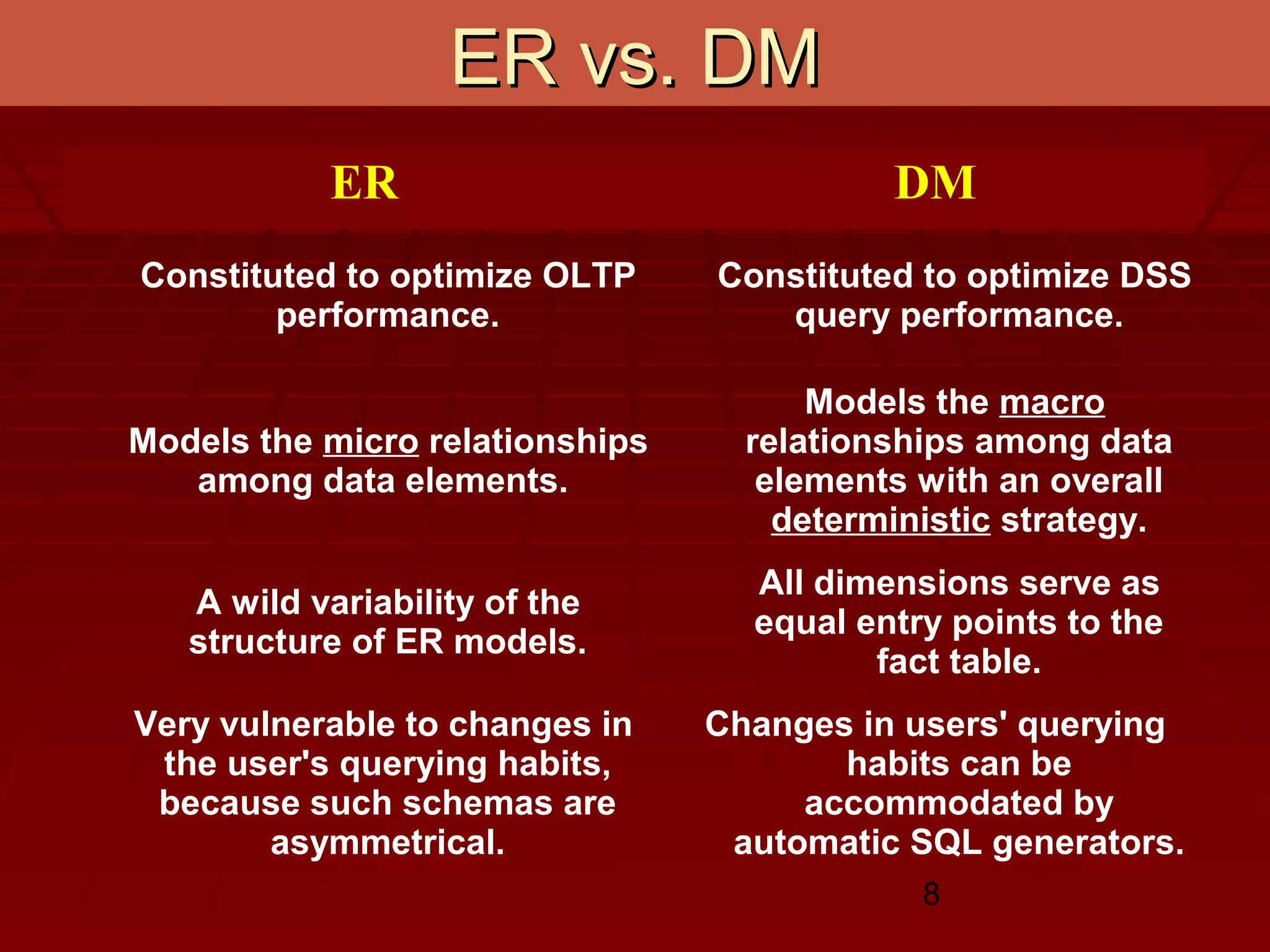
Constituted to optimize OLTP
performance.
Constituted to optimize DSS
query performance.
Models the micro relationships
among data elements.
Models the macro
relationships among data
elements with an overall
deterministic strategy.
A wild variability of the
structure of ER models.
All dimensions serve as
equal entry points to the
fact table.
Very vulnerable to changes in
the user's querying habits,
because such schemas are
asymmetrical.
Changes in users' querying
habits can be
accommodated by
automatic SQL generators.
9
How to simplify a ER data model?How to simplify a ER data model?
 Two general methods:Two general methods:
 De-NormalizationDe-Normalization
 Dimensional Modeling (DM)Dimensional Modeling (DM)
10
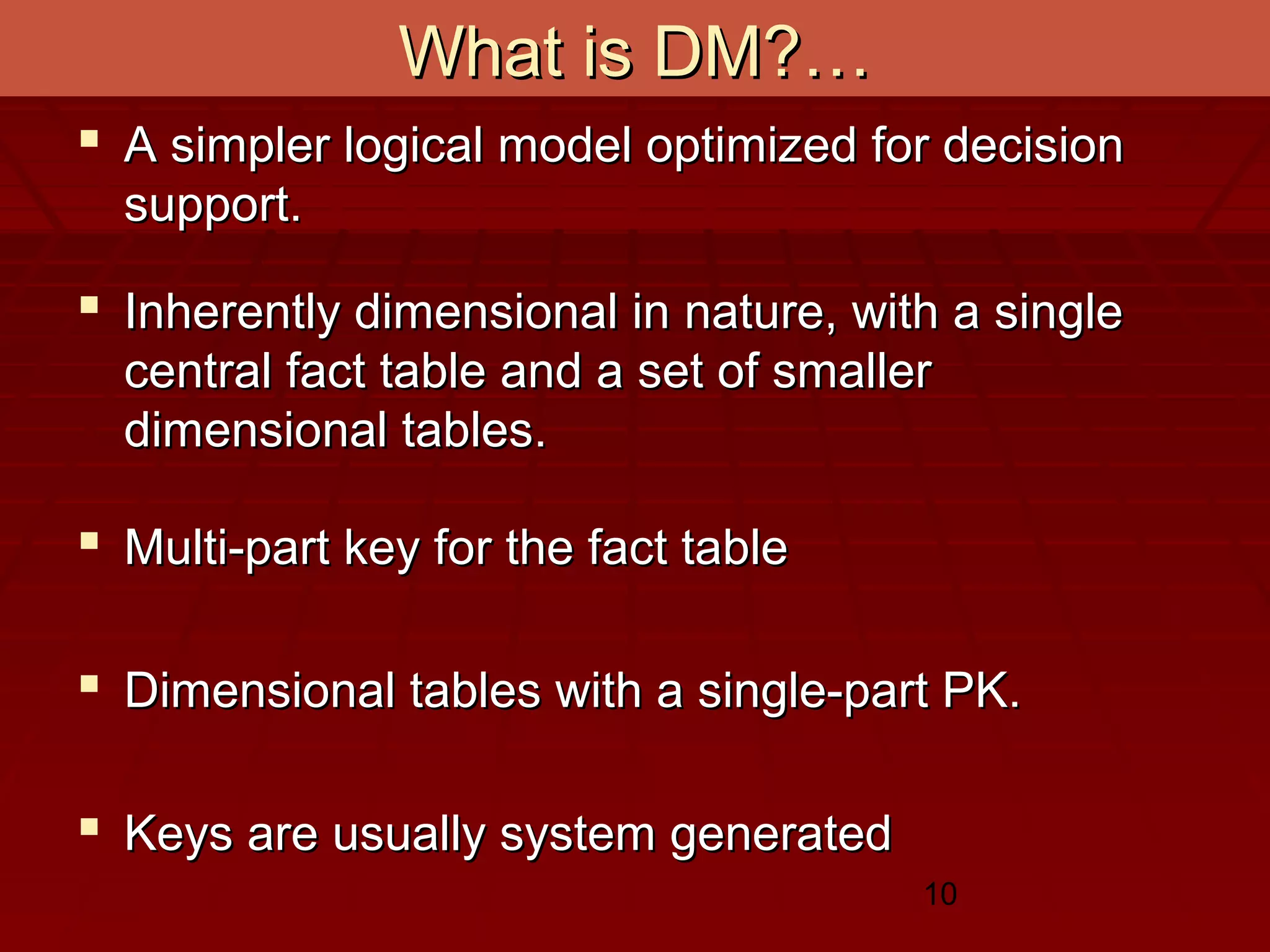
What is DM?…What is DM?…
 A simpler logical model optimized for decisionA simpler logical model optimized for decision
support.support.
 Inherently dimensional in nature, with a singleInherently dimensional in nature, with a single
central fact table and a set of smallercentral fact table and a set of smaller
dimensional tables.dimensional tables.
 Multi-part key for the fact tableMulti-part key for the fact table
 Dimensional tables with a single-part PK.Dimensional tables with a single-part PK.
 Keys are usually system generatedKeys are usually system generated
11
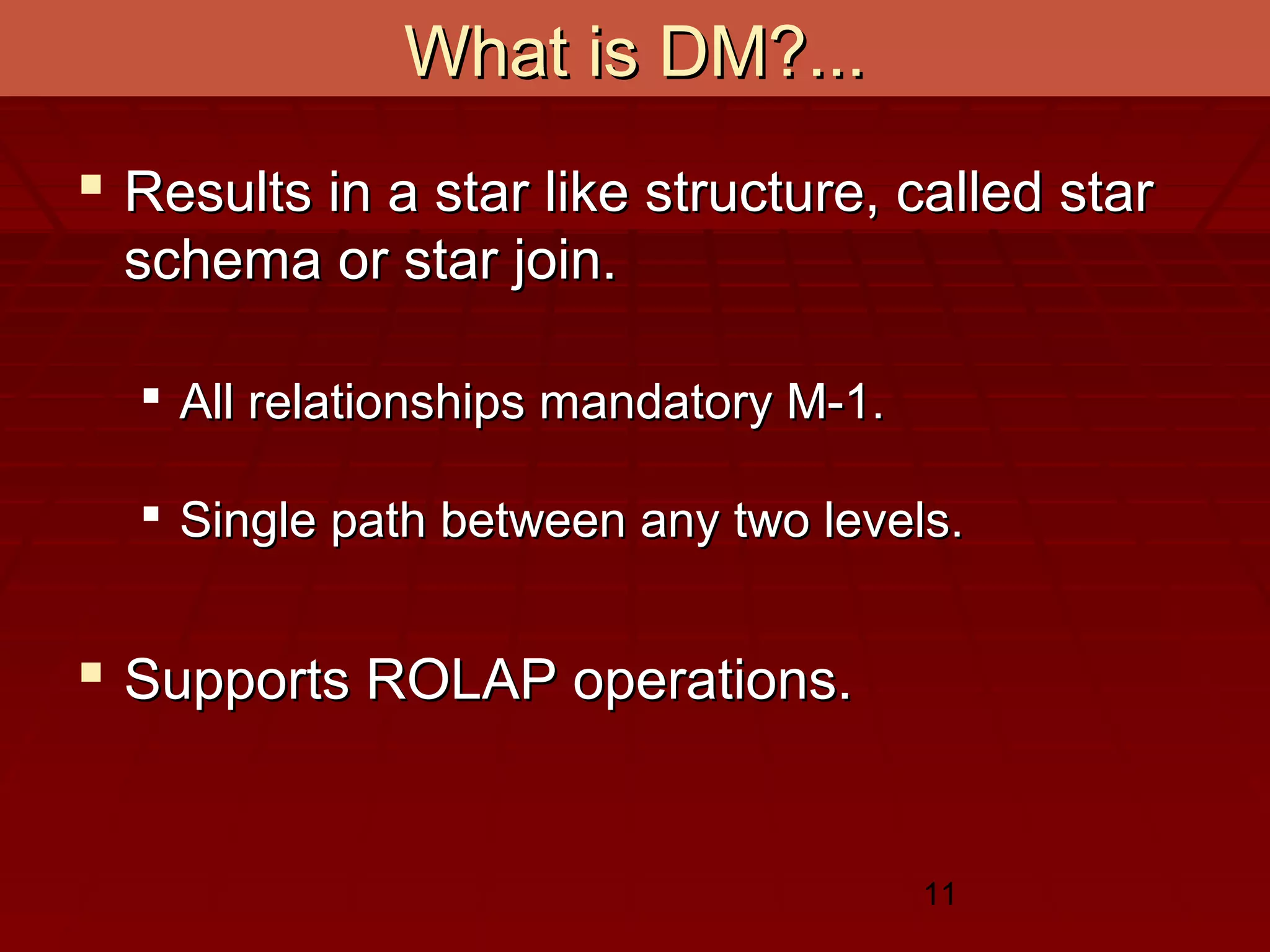
What is DM?...What is DM?...
 Results in a star like structure, called starResults in a star like structure, called star
schema or star join.schema or star join.
 All relationships mandatory M-1.All relationships mandatory M-1.
 Single path between any two levels.Single path between any two levels.
 Supports ROLAP operations.Supports ROLAP operations.
12
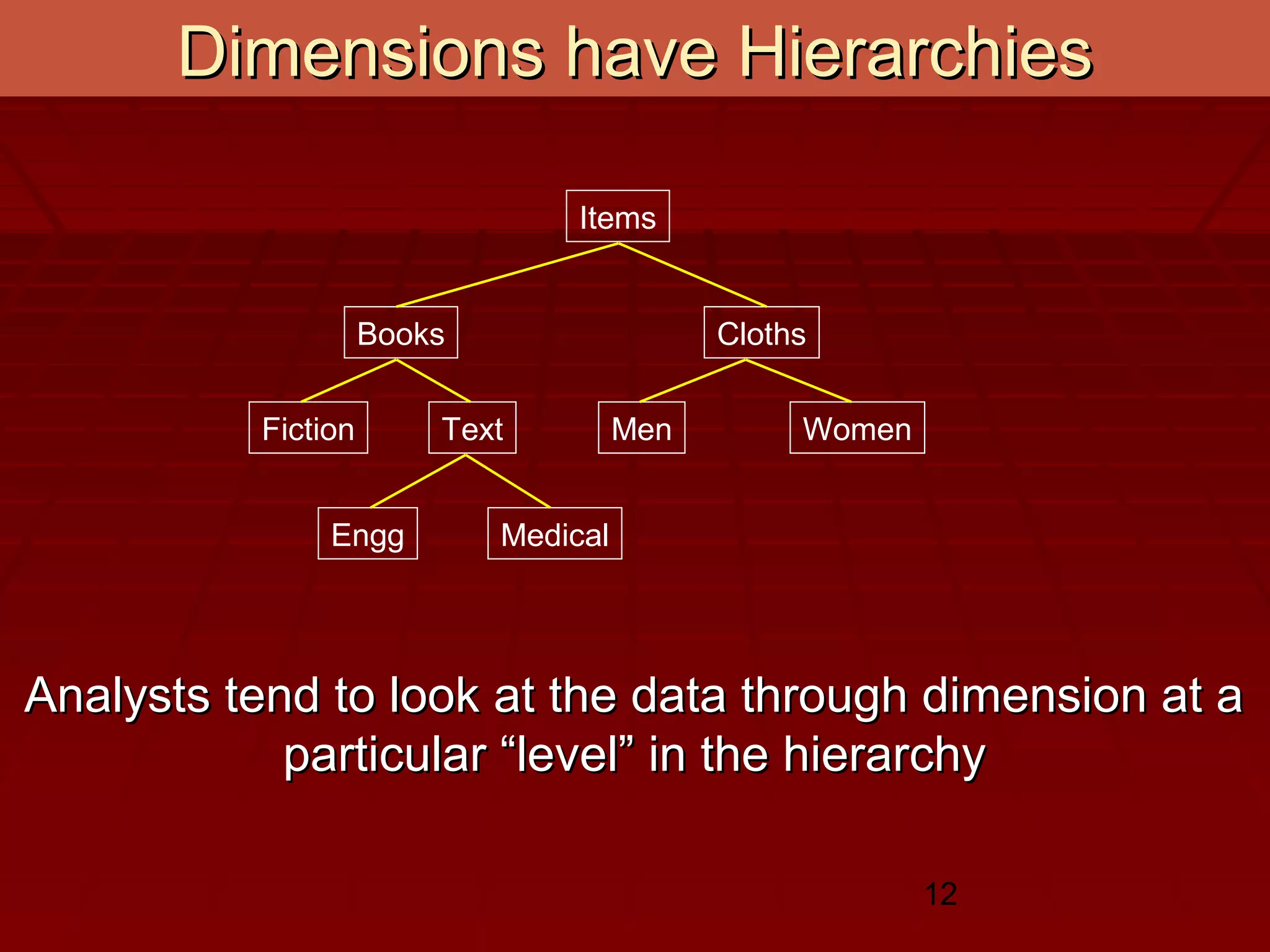
Dimensions have HierarchiesDimensions have Hierarchies
Items
Books Cloths
Fiction Text Men Women
MedicalEngg
Analysts tend to look at the data through dimension at aAnalysts tend to look at the data through dimension at a
particular “level” in the hierarchyparticular “level” in the hierarchy
13
The two SchemasThe two Schemas
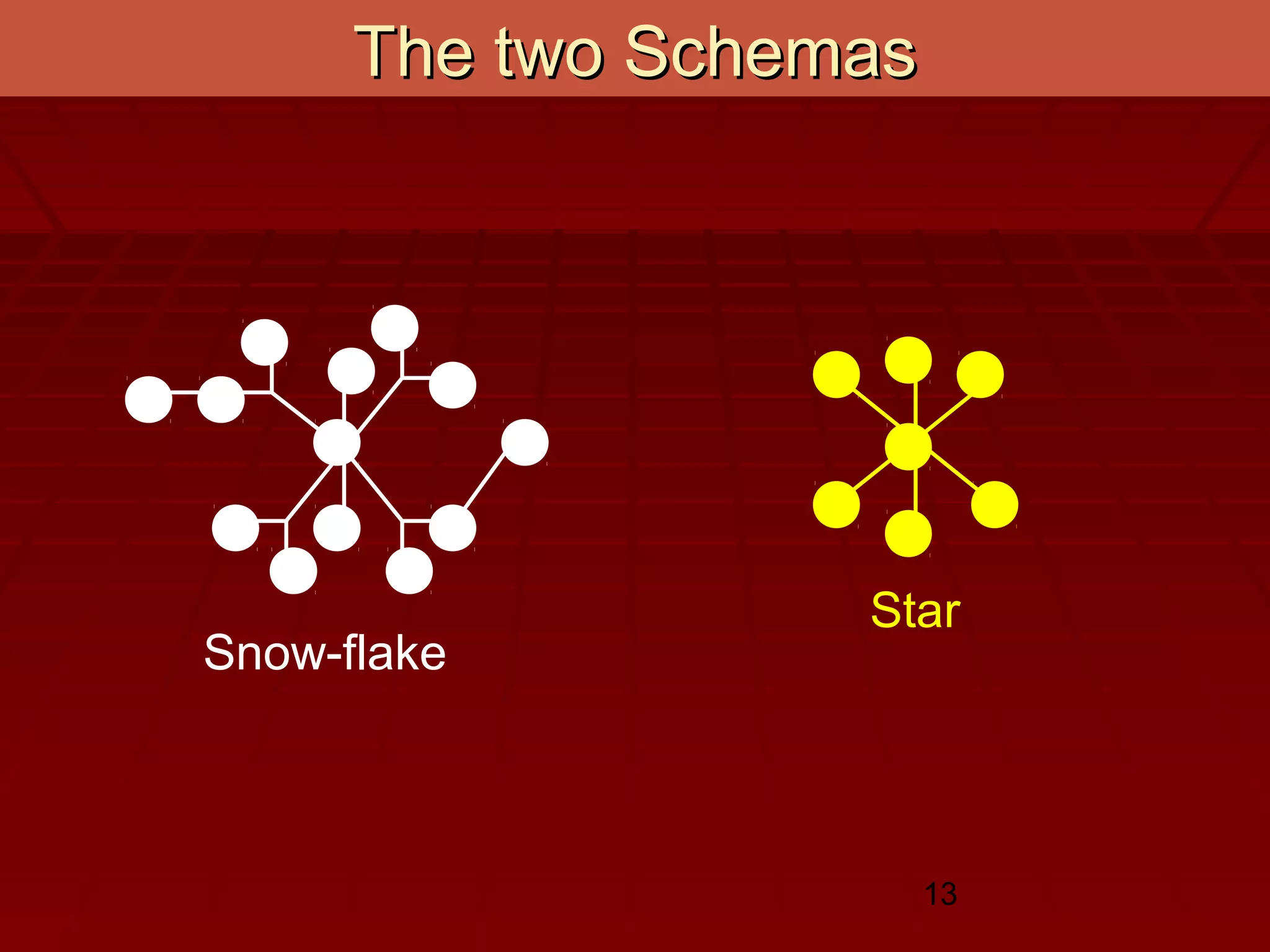
Star
Snow-flake
14
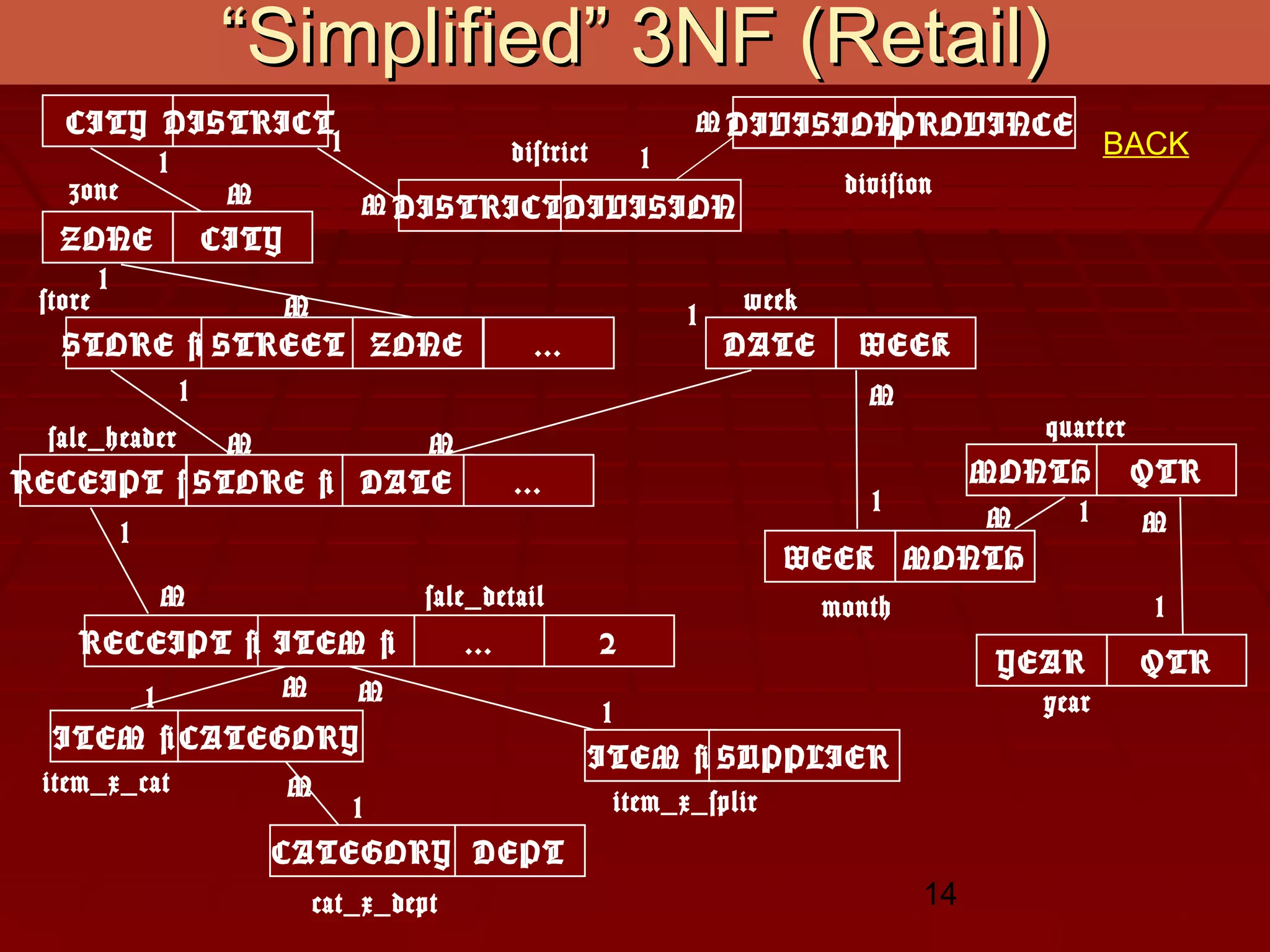
““Simplified” 3NF (Retail)Simplified” 3NF (Retail)
CITY DISTRICT
1
ZONE CITY
DISTRICTDIVISION
MONTH QTR
STORE # STREET ZONE ...
WEEK MONTH
DATE WEEK
RECEIPT #STORE # DATE ...
ITEM #RECEIPT # ... $
ITEM # CATEGORY
ITEM #
DEPTCATEGORY
year
month
week
sale_header
store
sale_detail
item_x_cat
item_x_splir
cat_x_dept
M
1
M
1M
1
M
1
1
M M
1
M
M M1
1
M
1
1
M
YEAR QTR
1
M
quarter
SUPPLIER
DIVISIONPROVINCEM
1 BACK
division
district
zone
15
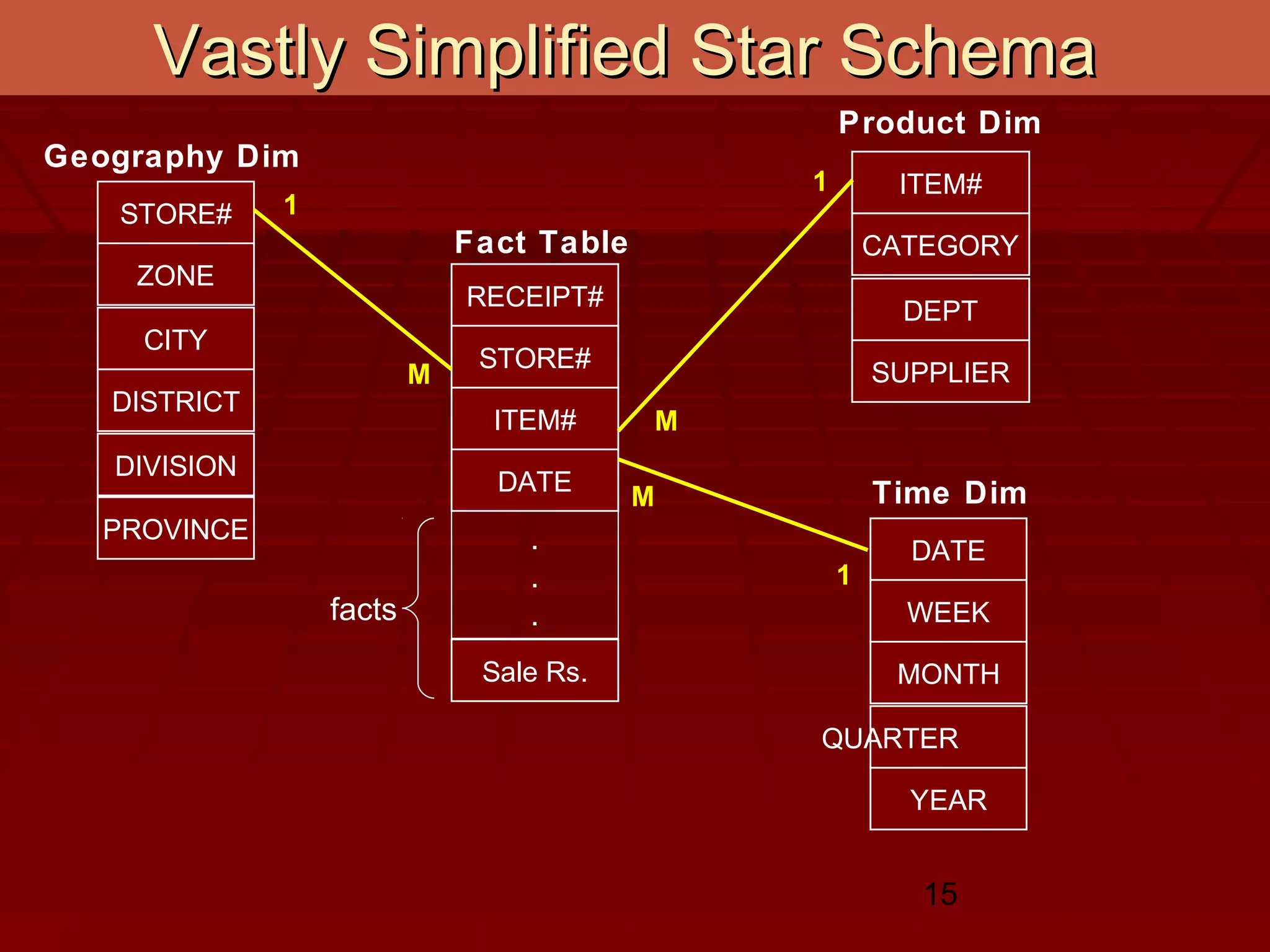
Vastly Simplified Star SchemaVastly Simplified Star Schema
RECEIPT#
STORE#
DATE
ITEM# M
Fact Table
ITEM#
CATEGORY
DEPT
SUPPLIER
Product Dim
M
Sale Rs.
M
STORE#
ZONE
CITY
PROVINCE
Geography Dim
DISTRICT
DATE
WEEK
QUARTER
YEAR
Time Dim
MONTH
.
.
.
1
1
1
facts
DIVISION
16
The Benefit of SimplicityThe Benefit of Simplicity
Beauty lies in close correspondence
with the business, evident even to
business users.
17
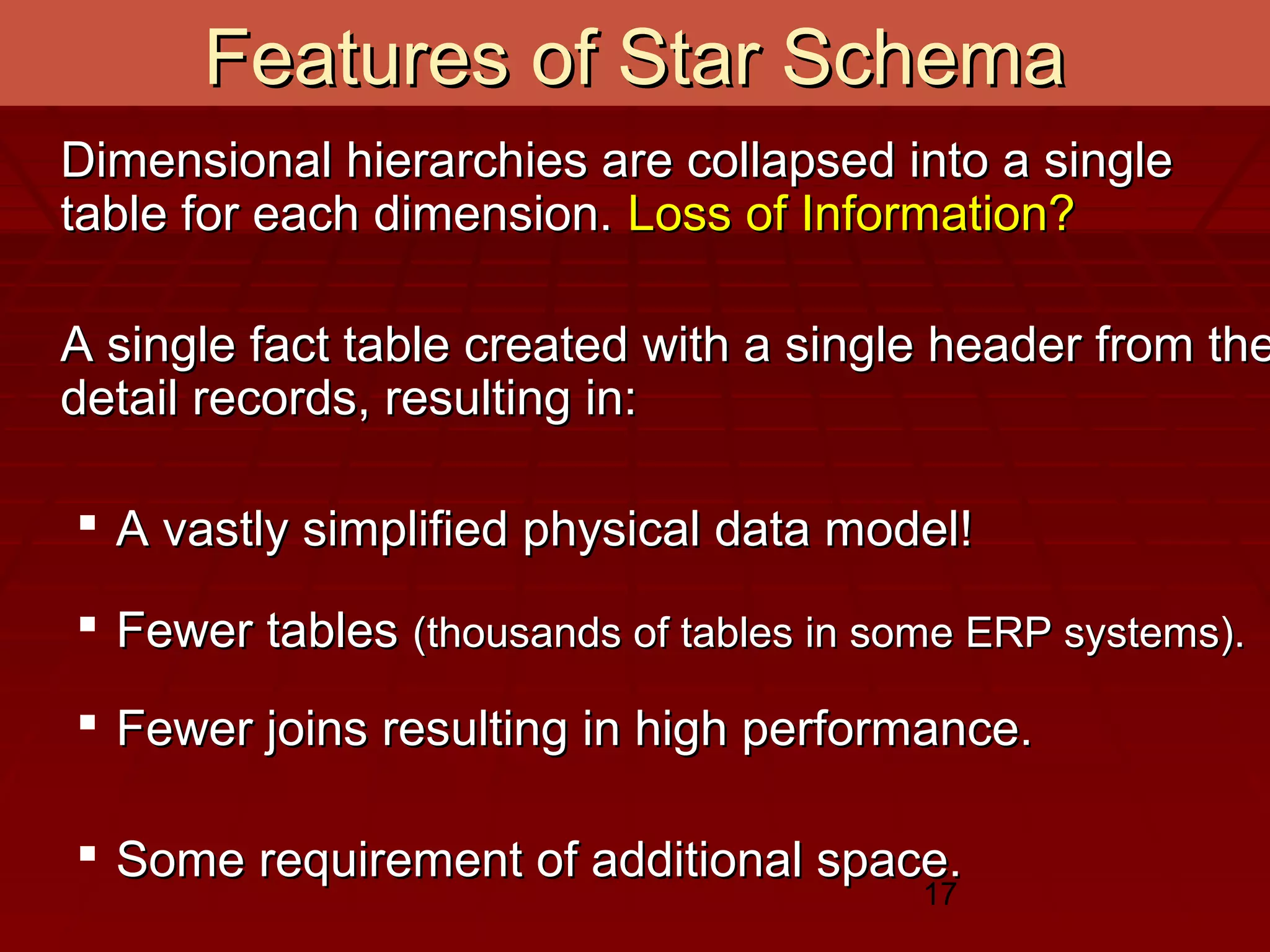
Features of Star SchemaFeatures of Star Schema
Dimensional hierarchies are collapsed into a singleDimensional hierarchies are collapsed into a single
table for each dimension.table for each dimension. Loss of Information?Loss of Information?
A single fact table created with a single header from theA single fact table created with a single header from the
detail records, resulting in:detail records, resulting in:
 A vastly simplified physical data model!A vastly simplified physical data model!
 Fewer tablesFewer tables (thousands of tables in some ERP systems).(thousands of tables in some ERP systems).
 Fewer joins resulting in high performance.Fewer joins resulting in high performance.
 Some requirement of additional space.Some requirement of additional space.
18
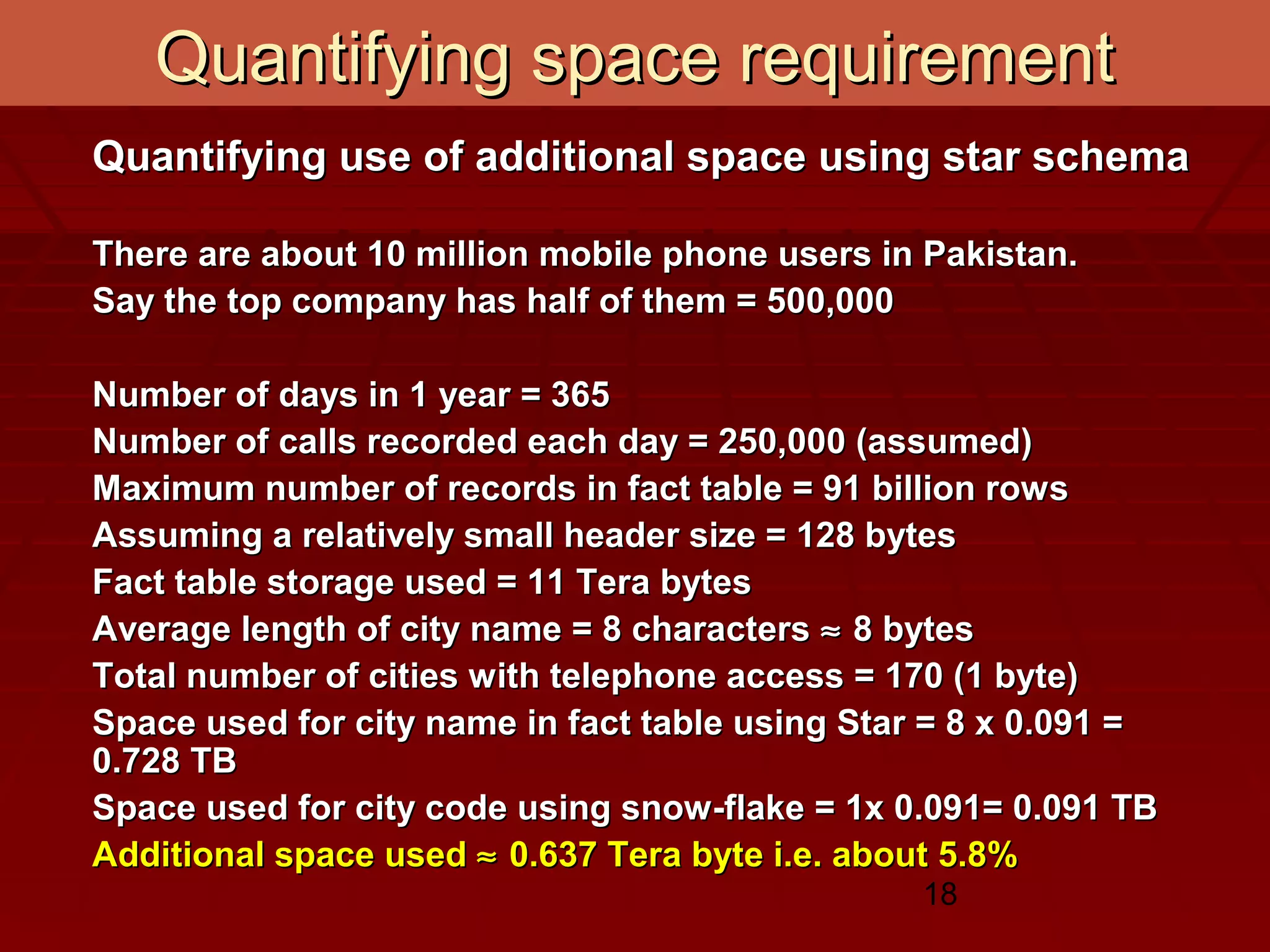
Quantifying space requirementQuantifying space requirement
Quantifying use of additional space using star schemaQuantifying use of additional space using star schema
There are about 10 million mobile phone users in Pakistan.There are about 10 million mobile phone users in Pakistan.
Say the top company has half of them = 500,000Say the top company has half of them = 500,000
Number of days in 1 year = 365Number of days in 1 year = 365
Number of calls recorded each day = 250,000 (assumed)Number of calls recorded each day = 250,000 (assumed)
Maximum number of records in fact table = 91 billion rowsMaximum number of records in fact table = 91 billion rows
Assuming a relatively small header size = 128 bytesAssuming a relatively small header size = 128 bytes
Fact table storage used = 11 Tera bytesFact table storage used = 11 Tera bytes
Average length of city name = 8 charactersAverage length of city name = 8 characters ≈≈ 8 bytes8 bytes
Total number of cities with telephone access = 170 (1 byte)Total number of cities with telephone access = 170 (1 byte)
Space used for city name in fact table using Star = 8 x 0.091 =Space used for city name in fact table using Star = 8 x 0.091 =
0.728 TB0.728 TB
Space used for city code using snow-flake = 1x 0.091= 0.091 TBSpace used for city code using snow-flake = 1x 0.091= 0.091 TB
Additional space usedAdditional space used ≈≈ 0.637 Tera byte i.e. about 5.8%0.637 Tera byte i.e. about 5.8%

Lecture 13

  • 1.
    11 Data WarehousingData Warehousing Lecture-13Lecture-13 DimensionalModeling (DM)Dimensional Modeling (DM) Virtual University of PakistanVirtual University of Pakistan Ahsan Abdullah Assoc. Prof. & Head Center for Agro-Informatics Research www.nu.edu.pk/cairindex.asp National University of Computers & Emerging Sciences, Islamabad Email: ahsan@cluxing.com
  • 2.
  • 3.
    3 The need forER modeling?The need for ER modeling?  Problems with early COBOLian dataProblems with early COBOLian data processing systems.processing systems.  Data redundanciesData redundancies  From flat file toFrom flat file to TableTable, each entity ultimately, each entity ultimately becomes abecomes a TableTable in the physical schema.in the physical schema.  Simple O(nSimple O(n22 ) Join to work with T) Join to work with Tablesables
  • 4.
    4 Why ER Modelinghas been so successful?Why ER Modeling has been so successful?  Coupled with normalization drives out allCoupled with normalization drives out all the redundancy out of the database.the redundancy out of the database.  Change (or add or delete) the data at justChange (or add or delete) the data at just one point.one point.  Can be used with indexing for very fastCan be used with indexing for very fast access.access.  Resulted in success of OLTP systems.Resulted in success of OLTP systems.
  • 5.
    5 Need for DM:Un-answered QsNeed for DM: Un-answered Qs  Lets have a look at aLets have a look at a typical ER data modeltypical ER data model first.first.  Some Observations:Some Observations:  All tables look-alike, as a consequence it is difficult toAll tables look-alike, as a consequence it is difficult to identify:identify:  Which table is more important ?Which table is more important ?  Which is the largest?Which is the largest?  Which tables contain numerical measurements of theWhich tables contain numerical measurements of the business?business?  Which table contain nearly static descriptive attributes?Which table contain nearly static descriptive attributes?
  • 6.
    6 Need for DM:Complexity of RepresentationNeed for DM: Complexity of Representation  Many topologies for the same ERMany topologies for the same ER diagram,diagram, allall appearingappearing differentdifferent.. Very hard to visualize and remember.Very hard to visualize and remember. A large number of possible connections toA large number of possible connections to any two (or more) tablesany two (or more) tables 1 10 3 12 2 6 5 11 4 7 8 9 1 10 3 12 2 6 5 11 4 7 8 9
  • 7.
    7 Need for DM:The ParadoxNeed for DM: The Paradox  The Paradox:The Paradox: Trying to make information accessible usingTrying to make information accessible using tables resulted in an inability to query them!tables resulted in an inability to query them!  ER and Normalization result in large number of tables whichER and Normalization result in large number of tables which are:are:  Hard to understand by the users (DB programmers)Hard to understand by the users (DB programmers)  Hard to navigate optimally by DBMS softwareHard to navigate optimally by DBMS software  Real value of ER is in using tables individually or in pairsReal value of ER is in using tables individually or in pairs  Too complex for queries that span multiple tables with aToo complex for queries that span multiple tables with a large number of recordslarge number of records
  • 8.
    8 ER vs. DMERvs. DM ER DM Constituted to optimize OLTP performance. Constituted to optimize DSS query performance. Models the micro relationships among data elements. Models the macro relationships among data elements with an overall deterministic strategy. A wild variability of the structure of ER models. All dimensions serve as equal entry points to the fact table. Very vulnerable to changes in the user's querying habits, because such schemas are asymmetrical. Changes in users' querying habits can be accommodated by automatic SQL generators.
  • 9.
    9 How to simplifya ER data model?How to simplify a ER data model?  Two general methods:Two general methods:  De-NormalizationDe-Normalization  Dimensional Modeling (DM)Dimensional Modeling (DM)
  • 10.
    10 What is DM?…Whatis DM?…  A simpler logical model optimized for decisionA simpler logical model optimized for decision support.support.  Inherently dimensional in nature, with a singleInherently dimensional in nature, with a single central fact table and a set of smallercentral fact table and a set of smaller dimensional tables.dimensional tables.  Multi-part key for the fact tableMulti-part key for the fact table  Dimensional tables with a single-part PK.Dimensional tables with a single-part PK.  Keys are usually system generatedKeys are usually system generated
  • 11.
    11 What is DM?...Whatis DM?...  Results in a star like structure, called starResults in a star like structure, called star schema or star join.schema or star join.  All relationships mandatory M-1.All relationships mandatory M-1.  Single path between any two levels.Single path between any two levels.  Supports ROLAP operations.Supports ROLAP operations.
  • 12.
    12 Dimensions have HierarchiesDimensionshave Hierarchies Items Books Cloths Fiction Text Men Women MedicalEngg Analysts tend to look at the data through dimension at aAnalysts tend to look at the data through dimension at a particular “level” in the hierarchyparticular “level” in the hierarchy
  • 13.
    13 The two SchemasThetwo Schemas Star Snow-flake
  • 14.
    14 ““Simplified” 3NF (Retail)Simplified”3NF (Retail) CITY DISTRICT 1 ZONE CITY DISTRICTDIVISION MONTH QTR STORE # STREET ZONE ... WEEK MONTH DATE WEEK RECEIPT #STORE # DATE ... ITEM #RECEIPT # ... $ ITEM # CATEGORY ITEM # DEPTCATEGORY year month week sale_header store sale_detail item_x_cat item_x_splir cat_x_dept M 1 M 1M 1 M 1 1 M M 1 M M M1 1 M 1 1 M YEAR QTR 1 M quarter SUPPLIER DIVISIONPROVINCEM 1 BACK division district zone
  • 15.
    15 Vastly Simplified StarSchemaVastly Simplified Star Schema RECEIPT# STORE# DATE ITEM# M Fact Table ITEM# CATEGORY DEPT SUPPLIER Product Dim M Sale Rs. M STORE# ZONE CITY PROVINCE Geography Dim DISTRICT DATE WEEK QUARTER YEAR Time Dim MONTH . . . 1 1 1 facts DIVISION
  • 16.
    16 The Benefit ofSimplicityThe Benefit of Simplicity Beauty lies in close correspondence with the business, evident even to business users.
  • 17.
    17 Features of StarSchemaFeatures of Star Schema Dimensional hierarchies are collapsed into a singleDimensional hierarchies are collapsed into a single table for each dimension.table for each dimension. Loss of Information?Loss of Information? A single fact table created with a single header from theA single fact table created with a single header from the detail records, resulting in:detail records, resulting in:  A vastly simplified physical data model!A vastly simplified physical data model!  Fewer tablesFewer tables (thousands of tables in some ERP systems).(thousands of tables in some ERP systems).  Fewer joins resulting in high performance.Fewer joins resulting in high performance.  Some requirement of additional space.Some requirement of additional space.
  • 18.
    18 Quantifying space requirementQuantifyingspace requirement Quantifying use of additional space using star schemaQuantifying use of additional space using star schema There are about 10 million mobile phone users in Pakistan.There are about 10 million mobile phone users in Pakistan. Say the top company has half of them = 500,000Say the top company has half of them = 500,000 Number of days in 1 year = 365Number of days in 1 year = 365 Number of calls recorded each day = 250,000 (assumed)Number of calls recorded each day = 250,000 (assumed) Maximum number of records in fact table = 91 billion rowsMaximum number of records in fact table = 91 billion rows Assuming a relatively small header size = 128 bytesAssuming a relatively small header size = 128 bytes Fact table storage used = 11 Tera bytesFact table storage used = 11 Tera bytes Average length of city name = 8 charactersAverage length of city name = 8 characters ≈≈ 8 bytes8 bytes Total number of cities with telephone access = 170 (1 byte)Total number of cities with telephone access = 170 (1 byte) Space used for city name in fact table using Star = 8 x 0.091 =Space used for city name in fact table using Star = 8 x 0.091 = 0.728 TB0.728 TB Space used for city code using snow-flake = 1x 0.091= 0.091 TBSpace used for city code using snow-flake = 1x 0.091= 0.091 TB Additional space usedAdditional space used ≈≈ 0.637 Tera byte i.e. about 5.8%0.637 Tera byte i.e. about 5.8%

Editor's Notes

  • #11 <number>
  • #12 <number>
  • #13 <number>
  • #15 <number>
  • #16 <number>
  • #17 <number>
  • #18 <number>
  • #19 <number>