Data Warehouse: 15
Data Modeling
Prof Neeraj Bhargava
Vaibhav Khanna
Department of Computer Science
School of Engineering and Systems Sciences
Maharshi Dayanand Saraswati University Ajmer
Database Life Cycle
• The database life cycle incorporates the basic
steps involved in designing a global schema of
the logical database, allocating data across a
computer network, and defining local DBMS-
specific schemas.
• Once the design is completed, the life cycle
continues with database implementation and
maintenance.
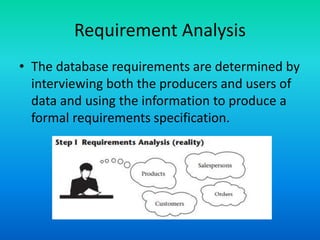
Requirement Analysis
• The database requirements are determined by
interviewing both the producers and users of
data and using the information to produce a
formal requirements specification.
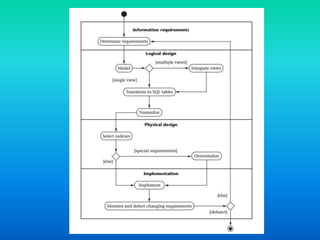
Logical design
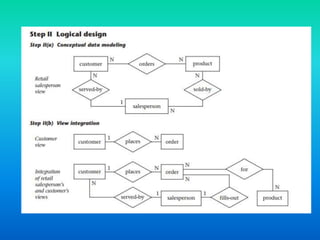
• The global schema, a conceptual data model
diagram that shows all the data and their
relationships, is developed using techniques
such as entity – relationship (ER) or UML.
• The data model constructs must ultimately be
transformed into normalized (global)
relations, or tables.
Conceptual data modeling
• . The data requirements are analyzed and
modeled using an ER or UML diagram that
includes, for example, semantics for optional
relationships, ternary relationships, super
types, and subtypes (categories).
• Processing requirements are typically specifi
ed using natural language expressions or SQL
commands, along with the frequency of
occurrence.
View integration
• Usually, when the design is large and more than
one person is involved in requirements analysis,
multiple views of data and relationships result.
• To eliminate redundancy and inconsistency from
the model, these views eventually must be “
rationalized ”
• Multiple views are consolidated into a single
global view.
• View integration requires the use of ER semantic
tools such as identification of synonyms,
aggregation, and generalization.
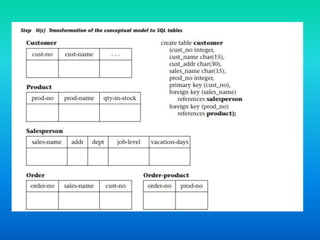
• Transformation of the conceptual data model to
SQL tables. Based on a categorization of data
modeling constructs and a set of mapping rules,
each relationship and its associated entities are
transformed into a set of DBMS specific candidate
relational tables.
• Generally database tool vendors
– use the term logical model to refer to the conceptual
data model,
– and use the term physical model to refer to the
DBMS-specific implementation model (e.g., SQL
tables).
Physical design
• The physical design step involves the selection
of indexes (access methods), partitioning, and
clustering of data.
• The logical design methodology in step II
simplifi es the approach to designing large
relational databases by reducing the number
of data dependencies that need to be
analyzed.
Database implementation, monitoring,
and modification
• Once the design is completed, the database
can be created through implementation of the
formal schema using the data definition
language (DDL) of a DBMS.
• Then the data manipulation language (DML)
can be used to query and update the
database, as well as to set up indexes and
establish constraints, such as referential
integrity.
Assignment
• Describe the concept and process of data
modeling for an Enterprise DBMS
• Thank You

Data warehouse 15 data modeling

  • 1.
    Data Warehouse: 15 DataModeling Prof Neeraj Bhargava Vaibhav Khanna Department of Computer Science School of Engineering and Systems Sciences Maharshi Dayanand Saraswati University Ajmer
  • 2.
    Database Life Cycle •The database life cycle incorporates the basic steps involved in designing a global schema of the logical database, allocating data across a computer network, and defining local DBMS- specific schemas. • Once the design is completed, the life cycle continues with database implementation and maintenance.
  • 4.
    Requirement Analysis • Thedatabase requirements are determined by interviewing both the producers and users of data and using the information to produce a formal requirements specification.
  • 5.
    Logical design • Theglobal schema, a conceptual data model diagram that shows all the data and their relationships, is developed using techniques such as entity – relationship (ER) or UML. • The data model constructs must ultimately be transformed into normalized (global) relations, or tables.
  • 7.
    Conceptual data modeling •. The data requirements are analyzed and modeled using an ER or UML diagram that includes, for example, semantics for optional relationships, ternary relationships, super types, and subtypes (categories). • Processing requirements are typically specifi ed using natural language expressions or SQL commands, along with the frequency of occurrence.
  • 8.
    View integration • Usually,when the design is large and more than one person is involved in requirements analysis, multiple views of data and relationships result. • To eliminate redundancy and inconsistency from the model, these views eventually must be “ rationalized ” • Multiple views are consolidated into a single global view. • View integration requires the use of ER semantic tools such as identification of synonyms, aggregation, and generalization.
  • 9.
    • Transformation ofthe conceptual data model to SQL tables. Based on a categorization of data modeling constructs and a set of mapping rules, each relationship and its associated entities are transformed into a set of DBMS specific candidate relational tables. • Generally database tool vendors – use the term logical model to refer to the conceptual data model, – and use the term physical model to refer to the DBMS-specific implementation model (e.g., SQL tables).
  • 11.
    Physical design • Thephysical design step involves the selection of indexes (access methods), partitioning, and clustering of data. • The logical design methodology in step II simplifi es the approach to designing large relational databases by reducing the number of data dependencies that need to be analyzed.
  • 12.
    Database implementation, monitoring, andmodification • Once the design is completed, the database can be created through implementation of the formal schema using the data definition language (DDL) of a DBMS. • Then the data manipulation language (DML) can be used to query and update the database, as well as to set up indexes and establish constraints, such as referential integrity.
  • 13.
    Assignment • Describe theconcept and process of data modeling for an Enterprise DBMS • Thank You