
All Data models
in DBMS
Overview
• Data
• Information
• Database
• Data Model
Types of Data Model
1. Record Base model
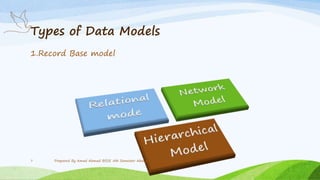
• Relationship model
• Network Model
• Hierarchical Model
2.Entity Relationship
Model
3.Object-Oriented Model
Prepared By Amad Ahmad BSSE 5th Semester Abasyn University Peshawar2
A data is known as the row fact which is stored in
computers memory and used by the user as the
output.
Example-21.
Data
Information
Collection of data its called information.
Example-House no 21C-S-1,Sch No 78 Indore
Database
A collection of inter related data its called
database.
Data Model
A data model is a collection of concepts that
can be used to describe the structure of a
database.
Types of Data Models
1.Record Base model
Prepared By Amad Ahmad BSSE 5th Semester Abasyn University Peshawar7
Types of Data Models
1.Record Base model • A record based data model
is used to specify the overall
logical structure of the
database.
• Each record type defines a
fixed no. of fields having a
fixed length.
Prepared By Amad Ahmad BSSE 5th Semester Abasyn University Peshawar8
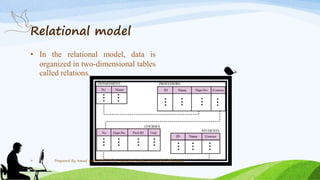
Relational model
• In the relational model, data is
organized in two-dimensional tables
called relations.
Prepared By Amad Ahmad BSSE 5th Semester Abasyn University Peshawar9
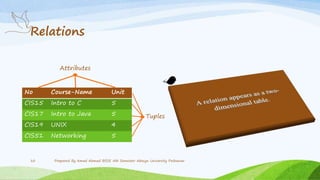
Relations
No Course-Name Unit
CIS15 Intro to C 5
CIS17 Intro to Java 5
CIS19 UNIX 4
CIS51 Networking 5
Attributes
Tuples
Prepared By Amad Ahmad BSSE 5th Semester Abasyn University Peshawar10
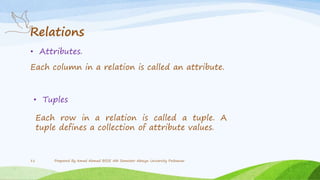
• Attributes.
Each column in a relation is called an attribute.
Relations
• Tuples
Each row in a relation is called a tuple. A
tuple defines a collection of attribute values.
Prepared By Amad Ahmad BSSE 5th Semester Abasyn University Peshawar11
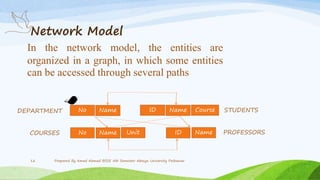
Network Model
In the network model, the entities are
organized in a graph, in which some entities
can be accessed through several paths
No Name ID Name Course
No Name Unit ID Name
DEPARTMENT
COURSES
STUDENTS
PROFESSORS
Prepared By Amad Ahmad BSSE 5th Semester Abasyn University Peshawar12
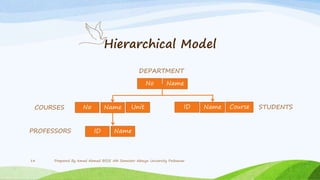
Hierarchical Model
The hierarchical data model organizes
data in a tree structure
PROFESSORS
No Name
ID Name CourseNo Name Unit
ID Name
DEPARTMENT
COURSES STUDENTS
Hierarchical Model
Prepared By Amad Ahmad BSSE 5th Semester Abasyn University Peshawar14
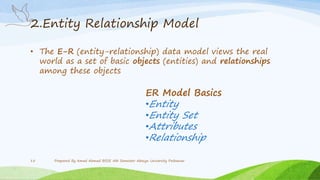
2.Entity Relationship Model
• The E-R (entity-relationship) data model views the real
world as a set of basic objects (entities) and relationships
among these objects
ER Model Basics
•Entity
•Entity Set
•Attributes
•Relationship
Prepared By Amad Ahmad BSSE 5th Semester Abasyn University Peshawar15
Entity
• entity is a thing in the real world with an independent
existance. and entity set is collection or set all entities of a
particular entity type at any point of time.
Prepared By Amad Ahmad BSSE 5th Semester Abasyn University Peshawar16

Data Models In Database Management System

  • 1.
  • 2.
    Overview • Data • Information •Database • Data Model Types of Data Model 1. Record Base model • Relationship model • Network Model • Hierarchical Model 2.Entity Relationship Model 3.Object-Oriented Model Prepared By Amad Ahmad BSSE 5th Semester Abasyn University Peshawar2
  • 3.
    A data isknown as the row fact which is stored in computers memory and used by the user as the output. Example-21. Data
  • 4.
    Information Collection of dataits called information. Example-House no 21C-S-1,Sch No 78 Indore
  • 5.
    Database A collection ofinter related data its called database.
  • 6.
    Data Model A datamodel is a collection of concepts that can be used to describe the structure of a database.
  • 7.
    Types of DataModels 1.Record Base model Prepared By Amad Ahmad BSSE 5th Semester Abasyn University Peshawar7
  • 8.
    Types of DataModels 1.Record Base model • A record based data model is used to specify the overall logical structure of the database. • Each record type defines a fixed no. of fields having a fixed length. Prepared By Amad Ahmad BSSE 5th Semester Abasyn University Peshawar8
  • 9.
    Relational model • Inthe relational model, data is organized in two-dimensional tables called relations. Prepared By Amad Ahmad BSSE 5th Semester Abasyn University Peshawar9
  • 10.
    Relations No Course-Name Unit CIS15Intro to C 5 CIS17 Intro to Java 5 CIS19 UNIX 4 CIS51 Networking 5 Attributes Tuples Prepared By Amad Ahmad BSSE 5th Semester Abasyn University Peshawar10
  • 11.
    • Attributes. Each columnin a relation is called an attribute. Relations • Tuples Each row in a relation is called a tuple. A tuple defines a collection of attribute values. Prepared By Amad Ahmad BSSE 5th Semester Abasyn University Peshawar11
  • 12.
    Network Model In thenetwork model, the entities are organized in a graph, in which some entities can be accessed through several paths No Name ID Name Course No Name Unit ID Name DEPARTMENT COURSES STUDENTS PROFESSORS Prepared By Amad Ahmad BSSE 5th Semester Abasyn University Peshawar12
  • 13.
    Hierarchical Model The hierarchicaldata model organizes data in a tree structure
  • 14.
    PROFESSORS No Name ID NameCourseNo Name Unit ID Name DEPARTMENT COURSES STUDENTS Hierarchical Model Prepared By Amad Ahmad BSSE 5th Semester Abasyn University Peshawar14
  • 15.
    2.Entity Relationship Model •The E-R (entity-relationship) data model views the real world as a set of basic objects (entities) and relationships among these objects ER Model Basics •Entity •Entity Set •Attributes •Relationship Prepared By Amad Ahmad BSSE 5th Semester Abasyn University Peshawar15
  • 16.
    Entity • entity isa thing in the real world with an independent existance. and entity set is collection or set all entities of a particular entity type at any point of time. Prepared By Amad Ahmad BSSE 5th Semester Abasyn University Peshawar16