Introduction to
Databases, Database Design and SQL
Zornitsa Zaharieva
CERN
Accelerators and Beams Department
Controls Group, Data Management Section
/AB-CO-DM/
08-SEP-2005
Zornitsa Zaharieva – CERN /AB-CO-DM/
2/47
Introduction to Databases, Database Design and SQL
: Introduction to Databases
: Main Database Concepts
: Conceptual Design - Entity-Relationship Model
: Logical Design - Relational Model
: Normalization and Denormalization
: Introduction to SQL
: Implementing the Relational Model through DDL
: DML Statements – SELECT, INSERT, DELETE, UPDATE, MERGE
: Transactions
: Best Practices in Database Design
Contents
Zornitsa Zaharieva – CERN /AB-CO-DM/
Introduction to Databases, Database Design and SQL
3/47
Zornitsa Zaharieva – CERN /AB-CO-DM/
Introduction to Databases, Database Design and SQL
4/47
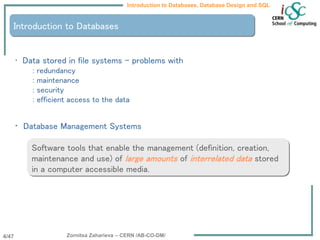
Introduction to Databases
• Data stored in file systems – problems with
: redundancy
: maintenance
: security
: efficient access to the data
• Database Management Systems
Software tools that enable the management (definition, creation,
maintenance and use) of large amounts of interrelated data stored
in a computer accessible media.
Zornitsa Zaharieva – CERN /AB-CO-DM/
Introduction to Databases, Database Design and SQL
5/47
Capabilities of a Database Management System
• Manage persistent data
• Access large amounts of data efficiently
• Support for at least one data model
• Support for certain high-level language that allow the user to
define the structure of the data, access data, and manipulate data
• Transaction management – the capability to provide correct,
concurrent access to the database by many users at once
• Access control – the ability to limit access to data by unauthorized
users, and the ability to check the validity of data
• Resiliency – the ability to recover from system failures without
losing data
Zornitsa Zaharieva – CERN /AB-CO-DM/
Introduction to Databases, Database Design and SQL
6/47
Data Model
• A mathematical abstraction (formalism) through which the user
can view the data
• Has two parts
1. A notation for describing data
2. A set of operations used to manipulate that data
• Examples of data models
: relational model
: network model
: hierarchical model
: object model
Zornitsa Zaharieva – CERN /AB-CO-DM/
Introduction to Databases, Database Design and SQL
7/47
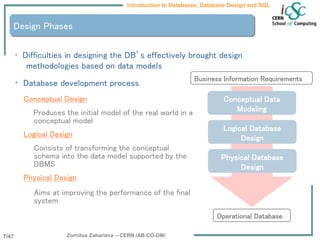
Design Phases
• Difficulties in designing the DB’s effectively brought design
methodologies based on data models
• Database development process
Conceptual Design
Produces the initial model of the real world in a
conceptual model
Logical Design
Consists of transforming the conceptual
schema into the data model supported by the
DBMS
Physical Design
Aims at improving the performance of the final
system
Business Information Requirements
Conceptual Data
Modeling
Logical Database
Design
Physical Database
Design
Operational Database
Zornitsa Zaharieva – CERN /AB-CO-DM/
Introduction to Databases, Database Design and SQL
8/47
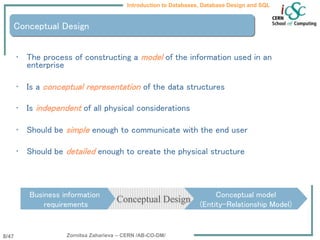
Conceptual Design
• The process of constructing a model of the information used in an
enterprise
• Is a conceptual representation of the data structures
• Is independent of all physical considerations
• Should be simple enough to communicate with the end user
• Should be detailed enough to create the physical structure
Conceptual Design
Business information
requirements
Conceptual model
(Entity-Relationship Model)
Zornitsa Zaharieva – CERN /AB-CO-DM/
Introduction to Databases, Database Design and SQL
9/47
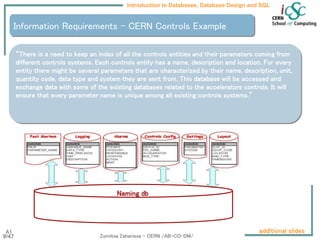
Information Requirements – CERN Controls Example
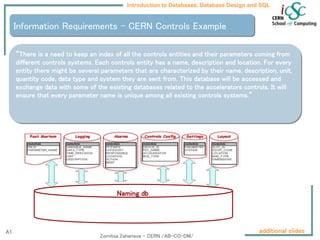
“There is a need to keep an index of all the controls entities and their parameters coming from
different controls systems. Each controls entity has a name, description and location. For every
entity there might be several parameters that are characterized by their name, description, unit,
quantity code, data type and system they are sent from. This database will be accessed and
exchange data with some of the existing databases related to the accelerators controls. It will
ensure that every parameter name is unique among all existing controls systems.”
Naming db
Zornitsa Zaharieva – CERN /AB-CO-DM/
additional slides
A1
Zornitsa Zaharieva – CERN /AB-CO-DM/
Introduction to Databases, Database Design and SQL
10/47
Entity-Relationship Model
• The Entity-Relationship model (ER) is the most common conceptual
model for database design nowadays
• No attention to efficiency or physical database design
• Describes data as entities, attributes, and relationships
• It is assumed that the Entity-Relationship diagram will be turned into
one of the other available models during the logical design
Entity-relationship model
Hierarchical model Network model
Relational model
Zornitsa Zaharieva – CERN /AB-CO-DM/
Introduction to Databases, Database Design and SQL
11/47
Entity
Remote Database
/edmsdb/
Local Database
/cerndb1/
• A thing of significance about which the business needs to store
information
trivial example: employee, department
CERN controls example: controls_entity, location, entity_parameter,
system, quantity_code, data_type
• Entity instance – an individual occurrence of a given entity
trivial example: a single employee
CERN controls example: a given system (e.g. SPS Vacuum)
Note: Be careful when establishing the ‘boundaries’ for the entity, e.g.
entity employee – all employees in the company or all employees in
a given department – depends on the requirements
“a thing that exists and is distinguishable” J. Ullman
Zornitsa Zaharieva – CERN /AB-CO-DM/
Introduction to Databases, Database Design and SQL
12/47
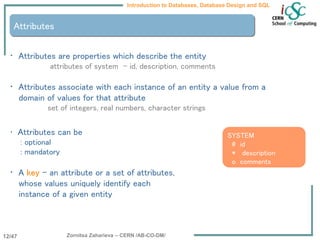
Attributes
• Attributes are properties which describe the entity
attributes of system - id, description, comments
• Attributes associate with each instance of an entity a value from a
domain of values for that attribute
set of integers, real numbers, character strings
• Attributes can be
: optional
: mandatory
• A key - an attribute or a set of attributes,
whose values uniquely identify each
instance of a given entity
SYSTEM
# id
* description
o comments
Zornitsa Zaharieva – CERN /AB-CO-DM/
Introduction to Databases, Database Design and SQL
13/47
Relationships
• Associations between entities
examples: employees are assigned to departments
entity_parameters are generated by systems
• Degree - number of entities associated with a relationship (most
common case - binary)
• Cardinality - indicates the maximum possible number of entity
occurrences
• Existence - indicates the minimum number of entity occurrences
set of integers, real numbers, character strings
: mandatory
: optional
SYSTEM
# id
* description
ENTITY_PARAMETER
# id
* description
o expert_name
……
produces
is generated by
Zornitsa Zaharieva – CERN /AB-CO-DM/
Introduction to Databases, Database Design and SQL
14/47
Relationship Cardinality
• One-to-One (1:1)
one manager is a head of one department
Note: Usually this is an assumption about the real world that the
database designer could choose to make or not to.
• One-to-Many (1:N)
one system could generate many parameters
one parameter is generated by only one system
• Many-to-Many (N:M)
many employees are assigned to one project
one employee is assigned to many projects
Zornitsa Zaharieva – CERN /AB-CO-DM/
Introduction to Databases, Database Design and SQL
15/47
CERN Controls Example
• Entity-Relationship diagram example – LHC Naming Database
Zornitsa Zaharieva – CERN /AB-CO-DM/
Introduction to Databases, Database Design and SQL
16/47
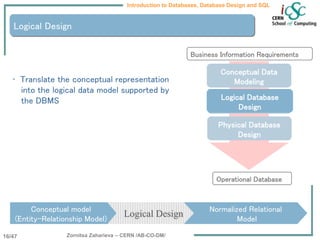
Logical Design
Logical Design
Conceptual model
(Entity-Relationship Model)
Normalized Relational
Model
Business Information Requirements
Conceptual Data
Modeling
Logical Database
Design
Physical Database
Design
Operational Database
Logical Database
Design
• Translate the conceptual representation
into the logical data model supported by
the DBMS
Zornitsa Zaharieva – CERN /AB-CO-DM/
Introduction to Databases, Database Design and SQL
17/47
Relational Model
• The most popular model for database implementation nowadays
• Supports powerful, yet simple and declarative languages with which
operations on data are expressed
• Value-oriented model
• Represents data in the form of relations
• Data structures – relational tables
• Data integrity – tables have to satisfy integrity constraints
• Relational database – a collection of relations or two-dimensional tables
Zornitsa Zaharieva – CERN /AB-CO-DM/
Introduction to Databases, Database Design and SQL
18/47
• Composed by named columns and unnamed rows
• The rows represent occurrences of the entity
• Every table has a unique name
• Columns within a table have unique names
• Order of columns is irrelevant
• Every row is unique
• Order of rows is irrelevant
• Every field value is atomic (contains a single value)
Relational Table
Zornitsa Zaharieva – CERN /AB-CO-DM/
Introduction to Databases, Database Design and SQL
19/47
Primary Key (PK) and Foreign Key (FK)
• Primary Key - a column or a set of columns that uniquely identify
each row in a table
• Composite (compound) key
• Role is to enforce integrity - every table must have a primary key
• For every row the PK
: must have a non-null value
: the value must be unique
: the value must not change or become ‘null’ during the table lifetime
: columns with the above mentioned characteristics are candidate keys
• Foreign Key - column(s) in a table that serves as a PK of another
table
• Enforces referential integrity by completing an association
between two tables
Zornitsa Zaharieva – CERN /AB-CO-DM/
Introduction to Databases, Database Design and SQL
20/47
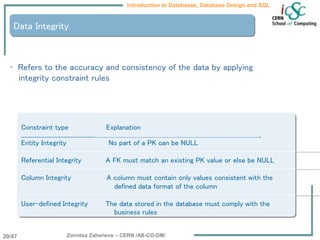
Data Integrity
• Refers to the accuracy and consistency of the data by applying
integrity constraint rules
Constraint type Explanation
_________________________________________________________________________ _
Entity Integrity No part of a PK can be NULL
-----------------------------------------------------------------------------------
Referential Integrity A FK must match an existing PK value or else be NULL
-----------------------------------------------------------------------------------
Column Integrity A column must contain only values consistent with the
defined data format of the column
-----------------------------------------------------------------------------------
User-defined Integrity The data stored in the database must comply with the
business rules
Zornitsa Zaharieva – CERN /AB-CO-DM/
Introduction to Databases, Database Design and SQL
21/47
From Entity-Relationship Model to Relational Model
Entity-Relationship model
Entity
Attribute
Key
Relationship
Relational model
Relational table
Column (attribute)
Primary Key (candidate keys)
Foreign Key
SYSTEMS
PK SYS_ID
SYS_DESCRIPTION
SYSTEM
# id
* description
Zornitsa Zaharieva – CERN /AB-CO-DM/
Introduction to Databases, Database Design and SQL
22/47
Relationships Transformations
• Binary 1:1 relationships
Solution : introduce a foreign key in the table on the optional side
• Binary 1:N relationship
Solution : introduce a foreign key in the table on the ‘many’ side
• M:N relationships
Solution : create a new table;
: introduce as a composite Primary Key of the new table,
the set of PKs of the original two tables
Zornitsa Zaharieva – CERN /AB-CO-DM/
Introduction to Databases, Database Design and SQL
23/47
CERN Controls Example
• Relational Model diagram example – before normalization
Zornitsa Zaharieva – CERN /AB-CO-DM/
Introduction to Databases, Database Design and SQL
24/47
Normalization
1st Normal Form
2nd Normal Form
3rd Normal Form
Boyce/Codd Normal Form
4th Normal Form
5th Normal Form
Normalized relational db
model
Relational db model
• A series of steps followed to obtain a database
design that allows for consistent storage and
avoiding duplication of data
• A process of decomposing relationships with
‘anomalies’
• The normalization process passes through
fulfilling different Normal Forms
• A table is said to be in a certain normal form if
it satisfies certain constraints
• Originally Dr. Codd defined 3 Normal Forms,
later on several more were added
• For most practical purposes databases are
considered normalized if they adhere to
3rd Normal Form
Zornitsa Zaharieva – CERN /AB-CO-DM/
Introduction to Databases, Database Design and SQL
25/47
Denormalization
• Queries against a fully normalized database often perform poorly
Explanation: Current RDBMSs implement the relational model poorly.
A true relational DBMS would allow for a fully normalized database at
the logical level, whilst providing physical storage of data that is tuned
for high performance.
• Two approaches are used
Approach 1: Keep the logical design normalized, but allow the DBMS
to store additional redundant information on disk to optimize
query response (indexes, materialized views, etc.).
In this case it is the DBMS software's responsibility to ensure
that any redundant copies are kept consistent.
Approach 2: Use denormalization to improve performance,
at the cost of reduced consistency
Zornitsa Zaharieva – CERN /AB-CO-DM/
Introduction to Databases, Database Design and SQL
26/47
Denormalization
• Denormalization is the process of attempting to optimize the
performance of a database by adding redundant data
• This may achieve (may not!) an improvement in query response, but
at a cost
• There should be a new set of constraints added that specify how the
redundant copies of information must be kept synchronized
• Denormalization can be hazardous
: increase in logical complexity of the database design
: complexity of the additional constraints
• It is the database designer's responsibility to ensure that the denormalized
database does not become inconsistent
Zornitsa Zaharieva – CERN /AB-CO-DM/
Introduction to Databases, Database Design and SQL
27/47
CERN Controls Example
•Relational Model diagram example – after normalization
Zornitsa Zaharieva – CERN /AB-CO-DM/
Introduction to Databases, Database Design and SQL
28/47
Structured Query Language
• Most commonly implemented relational query language
• SQL
: originally developed by IBM
: official ANSI standard
• Used to create, manipulate and maintain a relational database by using
 Data Definition Language (DDL)
: defines the database schema by creating, replacing, altering and dropping
objects – e.g. CREATE, DROP, ALTER, RENAME, TRUNCATE table
 Data Manipulation Language (DML)
: manipulates the data in the tables by inserting, updating, deleting and
querying data – e.g. SELECT, INSERT, UPDATE, DELETE
 Data Control Language (DCL)
: controls access to the database schema and its objects – e.g.
GRANT, REVOKE privileges
: guarantees database consistency and integrity
Zornitsa Zaharieva – CERN /AB-CO-DM/
Introduction to Databases, Database Design and SQL
29/47
Database Schema Implementation
Definition: Database schema is a collection of logical structures of data
• The implementation of the database schema is realized through
the DDL part of SQL
• Although there is a standard for SQL, there might be some features
when writing the SQL scripts that are vendor specific
• Some commercially available RDBMS
: Oracle
: DB2 – IBM
: Microsoft SQL Server
: Microsoft Access
: mySQL
Zornitsa Zaharieva – CERN /AB-CO-DM/
Introduction to Databases, Database Design and SQL
30/47
Create Table
• Create table - describes the layout of the table by providing
: table name
: column names
: datatype for each column
: integrity constraints – PK, FK, column constraints, default values, not null
CREATE TABLE systems (
sys_id VARCHAR2(20)
,sys_description VARCHAR2(100)
);
• Each attribute of a relation (column in a table) in a RDBMS has a
datatype that defines the domain of values this attribute can have
• The datatype for each column has to be specified when creating a table
: ANSI standard
: Oracle specific implementation
Zornitsa Zaharieva – CERN /AB-CO-DM/
Introduction to Databases, Database Design and SQL
31/47
Constraints
• Primary Key
ALTER TABLE systems ADD
(CONSTRAINT SYSTEM_PK PRIMARY KEY (sys_id));
• Foreign Key
ALTER TABLE entity_parameters ADD
(CONSTRAINT EP_SYS_FK FOREIGN KEY (system_id) REFERENCES systems(sys_id))
• Unique Key
ALTER TABLE entity_parameters ADD
(CONSTRAINT EP_UNQ UNIQUE (ep_name));
Zornitsa Zaharieva – CERN /AB-CO-DM/
Introduction to Databases, Database Design and SQL
32/47
Sequences
• A db object that generates in in/de-creasing order a unique
integer number
• Can be used as PK for a table
(in the absence of a more ‘natural’ choice)
• Better than generating ID in application
code
: very efficient thanks to caching
: uniqueness over multiple sessions, transaction safe
• Get sequence values
: current value
: next value
SELECT ep_seq.NEXTVAL FROM
DUAL;
SELECT ep_seq.CURRVAL FROM
DUAL;
CREATE SEQUENCE ep_seq
START WITH 1
NOMAXVALUE
NOMINVALUE
NOCYCLE
NOCACHE
Zornitsa Zaharieva – CERN /AB-CO-DM/
Introduction to Databases, Database Design and SQL
33/47
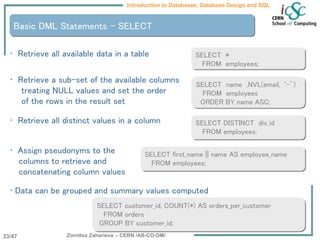
Basic DML Statements - SELECT
• Retrieve all available data in a table
• Retrieve a sub-set of the available columns
treating NULL values and set the order
of the rows in the result set
• Retrieve all distinct values in a column
• Assign pseudonyms to the
columns to retrieve and
concatenating column values
• Data can be grouped and summary values computed
SELECT *
FROM employees;
SELECT DISTINCT div_id
FROM employees;
SELECT name ,NVL(email, ‘-’)
FROM employees
ORDER BY name ASC;
SELECT first_name || name AS employee_name
FROM employees;
SELECT customer_id, COUNT(*) AS orders_per_customer
FROM orders
GROUP BY customer_id;
Zornitsa Zaharieva – CERN /AB-CO-DM/
Introduction to Databases, Database Design and SQL
34/47
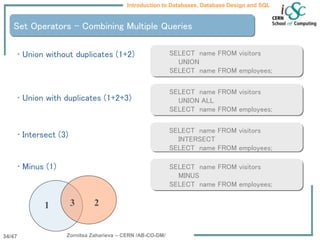
Set Operators – Combining Multiple Queries
• Union without duplicates (1+2)
• Union with duplicates (1+2+3)
• Intersect (3)
• Minus (1)
SELECT name FROM visitors
UNION
SELECT name FROM employees;
SELECT name FROM visitors
INTERSECT
SELECT name FROM employees;
SELECT name FROM visitors
MINUS
SELECT name FROM employees;
SELECT name FROM visitors
UNION ALL
SELECT name FROM employees;
1 2
3
Zornitsa Zaharieva – CERN /AB-CO-DM/
Introduction to Databases, Database Design and SQL
35/47
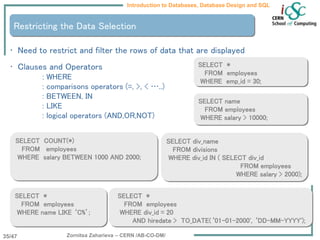
Restricting the Data Selection
• Need to restrict and filter the rows of data that are displayed
• Clauses and Operators
: WHERE
: comparisons operators (=, >, < …..)
: BETWEEN, IN
: LIKE
: logical operators (AND,OR,NOT)
SELECT name
FROM employees
WHERE salary > 10000;
SELECT *
FROM employees
WHERE emp_id = 30;
SELECT *
FROM employees
WHERE div_id = 20
AND hiredate > TO_DATE(‘01-01-2000', ‘DD-MM-YYYY');
SELECT *
FROM employees
WHERE name LIKE ‘C%’;
SELECT COUNT(*)
FROM employees
WHERE salary BETWEEN 1000 AND 2000;
SELECT div_name
FROM divisions
WHERE div_id IN ( SELECT div_id
FROM employees
WHERE salary > 2000);
Zornitsa Zaharieva – CERN /AB-CO-DM/
Introduction to Databases, Database Design and SQL
36/47
NATURAL Join
• Relates rows of two different tables sharing common values in one or more
columns of each table
• Typical case: a foreign key referring to a primary key
SELECT e.ename ,d.dname
FROM emp e ,dept d
WHERE e.deptno = d.deptno;
What are the names of the employees and their departments?
DEPT
PK DEPTNO
DNAME
LOC
EMP
PK EMPNO
ENAME
JOB
FK2 MGR
HIREDATE
SAL
COMM
FK1 DEPTNO
DEPTNO=DEPTNO
EMPNO=MGR
Zornitsa Zaharieva – CERN /AB-CO-DM/
Introduction to Databases, Database Design and SQL
37/47
Subqueries
• Logically, think of sub-queries in the following way:
Sub-queries (inner queries) execute once before the main query
The sub-query results are used by the main query (outer query)
SELECT ename
FROM emp
WHERE deptno = (SELECT deptno
FROM emp
WHERE ename = 'CLARK');
Who works in the same department as Clark?
DEPT
PK DEPTNO
DNAME
LOC
EMP
PK EMPNO
ENAME
JOB
FK2 MGR
HIREDATE
SAL
COMM
FK1 DEPTNO
DEPTNO=DEPTNO
EMPNO=MGR
Zornitsa Zaharieva – CERN /AB-CO-DM/
Introduction to Databases, Database Design and SQL
38/47
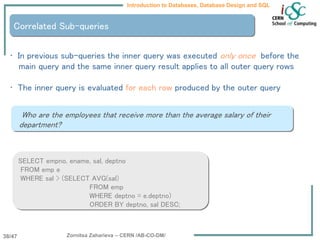
Correlated Sub-queries
• In previous sub-queries the inner query was executed only once before the
main query and the same inner query result applies to all outer query rows
• The inner query is evaluated for each row produced by the outer query
SELECT empno, ename, sal, deptno
FROM emp e
WHERE sal > (SELECT AVG(sal)
FROM emp
WHERE deptno = e.deptno)
ORDER BY deptno, sal DESC;
Who are the employees that receive more than the average salary of their
department?
Zornitsa Zaharieva – CERN /AB-CO-DM/
Introduction to Databases, Database Design and SQL
39/47
Inline views – Sub-queries in the FROM clause
• We can use a “inline view” as the data source on which the main query is
executed (FROM clause)
SQL> SELECT ename, sal, MAX(sal), deptno FROM emp;
SELECT ename, sal, MAX(sal), deptno FROM emp
*
ERROR at line 1:
ORA-00937: not a single-group group function
What are the employees salaries and the maximum salary in their department?
SELECT e.ename ,e.sal ,a.maxsal ,a.deptno
FROM emp e,
(SELECT max(sal) maxsal ,deptno
FROM emp
GROUP BY deptno) a
WHERE e.deptno = a.deptno
ORDER BY e.deptno ,e.sal DESC;
Zornitsa Zaharieva – CERN /AB-CO-DM/
Introduction to Databases, Database Design and SQL
40/47
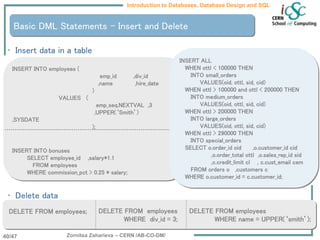
Basic DML Statements – Insert and Delete
• Insert data in a table
• Delete data
INSERT INTO employees (
emp_id ,div_id
,name ,hire_date
)
VALUES (
emp_seq.NEXTVAL ,3
,UPPER(‘Smith’)
,SYSDATE
);
INSERT INTO bonuses
SELECT employee_id ,salary*1.1
FROM employees
WHERE commission_pct > 0.25 * salary;
DELETE FROM employees; DELETE FROM employees
WHERE div_id = 3;
DELETE FROM employees
WHERE name = UPPER(‘smith’);
INSERT ALL
WHEN ottl < 100000 THEN
INTO small_orders
VALUES(oid, ottl, sid, cid)
WHEN ottl > 100000 and ottl < 200000 THEN
INTO medium_orders
VALUES(oid, ottl, sid, cid)
WHEN ottl > 200000 THEN
INTO large_orders
VALUES(oid, ottl, sid, cid)
WHEN ottl > 290000 THEN
INTO special_orders
SELECT o.order_id oid ,o.customer_id cid
,o.order_total ottl ,o.sales_rep_id sid
,c.credit_limit cl , c.cust_email cem
FROM orders o ,customers c
WHERE o.customer_id = c.customer_id;
Zornitsa Zaharieva – CERN /AB-CO-DM/
Introduction to Databases, Database Design and SQL
41/47
Basic DML Statements – Update and Merge
• Update data
• Merge data
MERGE INTO bonuses B
USING (SELECT employee_id ,salary ,department_id
FROM employees
WHERE department_id = 80) S
ON (B.employee_id = S.employee_id)
WHEN MATCHED THEN
UPDATE SET B.bonus = B.bonus + S.salary*.01
WHEN NOT MATCHED THEN
INSERT (B.employee_id, B.bonus)
VALUES (S.employee_id, S.salary*0.1);
UPDATE employees
SET salary = 1000 ;
UPDATE employees
SET salary = salary+1000;
UPDATE employees
SET salary = 1000
WHERE name=‘SMITH’;
UPDATE employees
SET salary = salary+1000
WHERE div_id = 3;
Zornitsa Zaharieva – CERN /AB-CO-DM/
Introduction to Databases, Database Design and SQL
42/47
• Transaction is a sequence of SQL statements that Oracle treats as a single
unit.
• Transaction can start with SET TRANSACTION
: READ COMMITTED mode – other DML statements (users) will wait until the end
of the transaction, if they try to change locked rows
: SERIALIZABLE mode – other DML statements (users) will get error if they try to
change locked rows
• Transaction ends with COMMIT or ROLLBACK statement.
: the set of changes is made permanent with the COMMIT statement
: part or all transactions can be undone with the ROLLBACK statement
: SAVEPOINT is a point within a transaction to which you may rollback
: Oracle implicitly commits the current transaction before or after a DDL
statement
Transactions
What happens if the database crashes in the middle of several updates?
Zornitsa Zaharieva – CERN /AB-CO-DM/
Introduction to Databases, Database Design and SQL
43/47
Best Practices in Database Design
• ‘Black box’ syndrome
: understand the features of the database and use them
• Relational database or a data ‘dump’
: let the database enforce integrity
: using the power of the relational database – manage
integrity in multi-user environment
: using PK and FK
: not only one application will access the database
: implementing constraints in the database, not in the
client or in the middle tier, is faster
: using the right datatypes
Zornitsa Zaharieva – CERN /AB-CO-DM/
Introduction to Databases, Database Design and SQL
44/47
Best Practices in Database Design
• Not using generic database models
: tables - objects, attributes, object_attributes, links
: performance problem!
• Designing to perform
• Creating a development (test) environment
• Testing with real data and under real conditions
Zornitsa Zaharieva – CERN /AB-CO-DM/
Introduction to Databases, Database Design and SQL
45/47
Development Tools
• Oracle provided tools
: Oracle Designer
: SQL* Plus
: JDeveloper
• Benthic Software - http://www.benthicsoftware.com/
: Golden
: PL/Edit
: GoldView
: at CERN - G:ApplicationsBenthicBenthic_license_CERN.html
• Microsoft Visio
• CAST - http://www.castsoftware.com/
: SQL Code-Builder
Zornitsa Zaharieva – CERN /AB-CO-DM/
Introduction to Databases, Database Design and SQL
46/47
References
[1] Ensor, D., Stevenson, I., Oracle Design, O’Reilly, 1997
[2] Kyte, T., Effective Oracle by Design, McGraw-Hill,
[3] Loney, K., Koch, G., Oracle 9i – The Complete Reference, McGraw-Hill, 2002
[4] Oracle course guide, Data Modeling and Relational Database Design, Oracle, 1996
[5] Rothwell, D., Databases: An Introduction, McGraw-Hill, 1993
[6] Ullman, J., Principles of Databases and Knowledge-Base Systems volumn 1,
Computer Science Press, 1988
[7] Oracle on-line documentation
http://oracle-documentation.web.cern.ch/oracle-documentation/
Zornitsa Zaharieva – CERN /AB-CO-DM/
Introduction to Databases, Database Design and SQL
47/47
End;
Thank you for your attention!
Zornitsa.Zaharieva@cern.ch
Introduction to Databases, Database Design and SQL
Information Requirements – CERN Controls Example
“There is a need to keep an index of all the controls entities and their parameters coming from
different controls systems. Each controls entity has a name, description and location. For every
entity there might be several parameters that are characterized by their name, description, unit,
quantity code, data type and system they are sent from. This database will be accessed and
exchange data with some of the existing databases related to the accelerators controls. It will
ensure that every parameter name is unique among all existing controls systems.”
Naming db
Zornitsa Zaharieva – CERN /AB-CO-DM/
additional slides
A1
Introduction to Databases, Database Design and SQL
Information Requirements – CERN Controls Example
Samples of the data that has to be stored:
controls_entity
name: VPIA.10020
description: Vacuum Pump Sputter Ion type A in location 10020
entity_code: VPIA
expert_name: VPIA_10020
accelerator: SPS
location_name: 10020
location_class: SPS_RING_POS
location_class_description: SPS Ring position
entity_parameter
name: VPIA.10020:PRESSURE
description: Pressure of Vacuum Pump Sputter Ion type A in location 10020
expert_name: VPIA.10020.PR
unit_id: mb
unit_description: millibar
data_type: NUMERIC
quantity_code: PRESSURE
system_name: SPS_VACUUM
system_description: SPS Vacuum
additional slides
A2
Introduction to Databases, Database Design and SQL
ER Modeling Conventions
• If you use Oracle Designer the following convention is used:
ENTITY
Soft box
Singular name
Unique
Uppercase
attribute
Singular name
Unique within the entity
Lowercase
Mandatory (*)
Optional (o)
Unique identifier (#)
Note: There are different conventions for representing the ER model!
ENTITY_PARAMETER
# id
* description
o expert_name
* unit_id
* unit_description
example
additional slides
A3
Introduction to Databases, Database Design and SQL
ER Modeling Conventions
• If you use Oracle Designer the following convention is used:
Relationship
Name – descriptive phrase
Line connecting to entities
Mandatory - solid line
Optional - dashed line
One - single line
Many - crow’s foot
Note: There are different conventions for representing the ER model!
additional slides
A4
Introduction to Databases, Database Design and SQL
1st Normal Form
• 1st Normal Form - All table attributes’ values must be atomic
: multi-values are not allowed
• By definition a relational table is in 1st Normal Form
additional slides
A5
Introduction to Databases, Database Design and SQL
2nd Normal Form
• 2nd Normal Form - Every non-key attribute is fully functionally dependent
on the PK
: no partial dependencies
: every attribute must be dependent on the entire PK
Solution:
: for each attribute in the PK that is involved in a partial dependency, create a
new table
: all attributes that are partially dependent on that attribute should be moved to
the new table
LOCATIONS(lc_class_id, lc_name, lc_class_description)
LOCATIONS (loc_class_id, loc_name)
LOCATION_CLASSES (lc_class_id, lc_class_description)
Definition: functional dependency (A -> B)
If attribute B is functionally dependent on attribute A,
then for every instance of A you can determine the value of B
additional slides
A6
Introduction to Databases, Database Design and SQL
3nd Normal Form
• No transitive dependencies for non-key attributes
Solution:
: for each non-key attribute A that depends upon another
non-key attribute B create a new table
: create PK of the new table as attribute B
: create a FK in the original table referencing the PK of the new table
Definition: Transitive dependence
When a non-key attribute depends on another non-key
attribute.
ENTITY_PARAMETERS(ep_id,…,unit_id, unit_description)
ENTITY_PARAMETERS(ep_id,…,unit_id)
UNITS(unit_id, unit_descrption)
additional slides
A7
Introduction to Databases, Database Design and SQL
Oracle Datatypes (excerpt)
• CHAR (size) fixed-length char array
• VARCHAR2(size) variable-length char string
• NUMBER (precision, scale) any numeric
• DATE date and time with seconds precision
• TIMESTAMP data and time with nano-seconds precision
• CLOB char large object
• BLOB binary large object
• BINARY_FLOAT 32 bit floating point
• BINARY_DOUBLE 64 bit floating point
• … + some others
additional slides
A8

Introduction to database design and relations

  • 1.
    Introduction to Databases, DatabaseDesign and SQL Zornitsa Zaharieva CERN Accelerators and Beams Department Controls Group, Data Management Section /AB-CO-DM/ 08-SEP-2005
  • 2.
    Zornitsa Zaharieva –CERN /AB-CO-DM/ 2/47 Introduction to Databases, Database Design and SQL : Introduction to Databases : Main Database Concepts : Conceptual Design - Entity-Relationship Model : Logical Design - Relational Model : Normalization and Denormalization : Introduction to SQL : Implementing the Relational Model through DDL : DML Statements – SELECT, INSERT, DELETE, UPDATE, MERGE : Transactions : Best Practices in Database Design Contents
  • 3.
    Zornitsa Zaharieva –CERN /AB-CO-DM/ Introduction to Databases, Database Design and SQL 3/47
  • 4.
    Zornitsa Zaharieva –CERN /AB-CO-DM/ Introduction to Databases, Database Design and SQL 4/47 Introduction to Databases • Data stored in file systems – problems with : redundancy : maintenance : security : efficient access to the data • Database Management Systems Software tools that enable the management (definition, creation, maintenance and use) of large amounts of interrelated data stored in a computer accessible media.
  • 5.
    Zornitsa Zaharieva –CERN /AB-CO-DM/ Introduction to Databases, Database Design and SQL 5/47 Capabilities of a Database Management System • Manage persistent data • Access large amounts of data efficiently • Support for at least one data model • Support for certain high-level language that allow the user to define the structure of the data, access data, and manipulate data • Transaction management – the capability to provide correct, concurrent access to the database by many users at once • Access control – the ability to limit access to data by unauthorized users, and the ability to check the validity of data • Resiliency – the ability to recover from system failures without losing data
  • 6.
    Zornitsa Zaharieva –CERN /AB-CO-DM/ Introduction to Databases, Database Design and SQL 6/47 Data Model • A mathematical abstraction (formalism) through which the user can view the data • Has two parts 1. A notation for describing data 2. A set of operations used to manipulate that data • Examples of data models : relational model : network model : hierarchical model : object model
  • 7.
    Zornitsa Zaharieva –CERN /AB-CO-DM/ Introduction to Databases, Database Design and SQL 7/47 Design Phases • Difficulties in designing the DB’s effectively brought design methodologies based on data models • Database development process Conceptual Design Produces the initial model of the real world in a conceptual model Logical Design Consists of transforming the conceptual schema into the data model supported by the DBMS Physical Design Aims at improving the performance of the final system Business Information Requirements Conceptual Data Modeling Logical Database Design Physical Database Design Operational Database
  • 8.
    Zornitsa Zaharieva –CERN /AB-CO-DM/ Introduction to Databases, Database Design and SQL 8/47 Conceptual Design • The process of constructing a model of the information used in an enterprise • Is a conceptual representation of the data structures • Is independent of all physical considerations • Should be simple enough to communicate with the end user • Should be detailed enough to create the physical structure Conceptual Design Business information requirements Conceptual model (Entity-Relationship Model)
  • 9.
    Zornitsa Zaharieva –CERN /AB-CO-DM/ Introduction to Databases, Database Design and SQL 9/47 Information Requirements – CERN Controls Example “There is a need to keep an index of all the controls entities and their parameters coming from different controls systems. Each controls entity has a name, description and location. For every entity there might be several parameters that are characterized by their name, description, unit, quantity code, data type and system they are sent from. This database will be accessed and exchange data with some of the existing databases related to the accelerators controls. It will ensure that every parameter name is unique among all existing controls systems.” Naming db Zornitsa Zaharieva – CERN /AB-CO-DM/ additional slides A1
  • 10.
    Zornitsa Zaharieva –CERN /AB-CO-DM/ Introduction to Databases, Database Design and SQL 10/47 Entity-Relationship Model • The Entity-Relationship model (ER) is the most common conceptual model for database design nowadays • No attention to efficiency or physical database design • Describes data as entities, attributes, and relationships • It is assumed that the Entity-Relationship diagram will be turned into one of the other available models during the logical design Entity-relationship model Hierarchical model Network model Relational model
  • 11.
    Zornitsa Zaharieva –CERN /AB-CO-DM/ Introduction to Databases, Database Design and SQL 11/47 Entity Remote Database /edmsdb/ Local Database /cerndb1/ • A thing of significance about which the business needs to store information trivial example: employee, department CERN controls example: controls_entity, location, entity_parameter, system, quantity_code, data_type • Entity instance – an individual occurrence of a given entity trivial example: a single employee CERN controls example: a given system (e.g. SPS Vacuum) Note: Be careful when establishing the ‘boundaries’ for the entity, e.g. entity employee – all employees in the company or all employees in a given department – depends on the requirements “a thing that exists and is distinguishable” J. Ullman
  • 12.
    Zornitsa Zaharieva –CERN /AB-CO-DM/ Introduction to Databases, Database Design and SQL 12/47 Attributes • Attributes are properties which describe the entity attributes of system - id, description, comments • Attributes associate with each instance of an entity a value from a domain of values for that attribute set of integers, real numbers, character strings • Attributes can be : optional : mandatory • A key - an attribute or a set of attributes, whose values uniquely identify each instance of a given entity SYSTEM # id * description o comments
  • 13.
    Zornitsa Zaharieva –CERN /AB-CO-DM/ Introduction to Databases, Database Design and SQL 13/47 Relationships • Associations between entities examples: employees are assigned to departments entity_parameters are generated by systems • Degree - number of entities associated with a relationship (most common case - binary) • Cardinality - indicates the maximum possible number of entity occurrences • Existence - indicates the minimum number of entity occurrences set of integers, real numbers, character strings : mandatory : optional SYSTEM # id * description ENTITY_PARAMETER # id * description o expert_name …… produces is generated by
  • 14.
    Zornitsa Zaharieva –CERN /AB-CO-DM/ Introduction to Databases, Database Design and SQL 14/47 Relationship Cardinality • One-to-One (1:1) one manager is a head of one department Note: Usually this is an assumption about the real world that the database designer could choose to make or not to. • One-to-Many (1:N) one system could generate many parameters one parameter is generated by only one system • Many-to-Many (N:M) many employees are assigned to one project one employee is assigned to many projects
  • 15.
    Zornitsa Zaharieva –CERN /AB-CO-DM/ Introduction to Databases, Database Design and SQL 15/47 CERN Controls Example • Entity-Relationship diagram example – LHC Naming Database
  • 16.
    Zornitsa Zaharieva –CERN /AB-CO-DM/ Introduction to Databases, Database Design and SQL 16/47 Logical Design Logical Design Conceptual model (Entity-Relationship Model) Normalized Relational Model Business Information Requirements Conceptual Data Modeling Logical Database Design Physical Database Design Operational Database Logical Database Design • Translate the conceptual representation into the logical data model supported by the DBMS
  • 17.
    Zornitsa Zaharieva –CERN /AB-CO-DM/ Introduction to Databases, Database Design and SQL 17/47 Relational Model • The most popular model for database implementation nowadays • Supports powerful, yet simple and declarative languages with which operations on data are expressed • Value-oriented model • Represents data in the form of relations • Data structures – relational tables • Data integrity – tables have to satisfy integrity constraints • Relational database – a collection of relations or two-dimensional tables
  • 18.
    Zornitsa Zaharieva –CERN /AB-CO-DM/ Introduction to Databases, Database Design and SQL 18/47 • Composed by named columns and unnamed rows • The rows represent occurrences of the entity • Every table has a unique name • Columns within a table have unique names • Order of columns is irrelevant • Every row is unique • Order of rows is irrelevant • Every field value is atomic (contains a single value) Relational Table
  • 19.
    Zornitsa Zaharieva –CERN /AB-CO-DM/ Introduction to Databases, Database Design and SQL 19/47 Primary Key (PK) and Foreign Key (FK) • Primary Key - a column or a set of columns that uniquely identify each row in a table • Composite (compound) key • Role is to enforce integrity - every table must have a primary key • For every row the PK : must have a non-null value : the value must be unique : the value must not change or become ‘null’ during the table lifetime : columns with the above mentioned characteristics are candidate keys • Foreign Key - column(s) in a table that serves as a PK of another table • Enforces referential integrity by completing an association between two tables
  • 20.
    Zornitsa Zaharieva –CERN /AB-CO-DM/ Introduction to Databases, Database Design and SQL 20/47 Data Integrity • Refers to the accuracy and consistency of the data by applying integrity constraint rules Constraint type Explanation _________________________________________________________________________ _ Entity Integrity No part of a PK can be NULL ----------------------------------------------------------------------------------- Referential Integrity A FK must match an existing PK value or else be NULL ----------------------------------------------------------------------------------- Column Integrity A column must contain only values consistent with the defined data format of the column ----------------------------------------------------------------------------------- User-defined Integrity The data stored in the database must comply with the business rules
  • 21.
    Zornitsa Zaharieva –CERN /AB-CO-DM/ Introduction to Databases, Database Design and SQL 21/47 From Entity-Relationship Model to Relational Model Entity-Relationship model Entity Attribute Key Relationship Relational model Relational table Column (attribute) Primary Key (candidate keys) Foreign Key SYSTEMS PK SYS_ID SYS_DESCRIPTION SYSTEM # id * description
  • 22.
    Zornitsa Zaharieva –CERN /AB-CO-DM/ Introduction to Databases, Database Design and SQL 22/47 Relationships Transformations • Binary 1:1 relationships Solution : introduce a foreign key in the table on the optional side • Binary 1:N relationship Solution : introduce a foreign key in the table on the ‘many’ side • M:N relationships Solution : create a new table; : introduce as a composite Primary Key of the new table, the set of PKs of the original two tables
  • 23.
    Zornitsa Zaharieva –CERN /AB-CO-DM/ Introduction to Databases, Database Design and SQL 23/47 CERN Controls Example • Relational Model diagram example – before normalization
  • 24.
    Zornitsa Zaharieva –CERN /AB-CO-DM/ Introduction to Databases, Database Design and SQL 24/47 Normalization 1st Normal Form 2nd Normal Form 3rd Normal Form Boyce/Codd Normal Form 4th Normal Form 5th Normal Form Normalized relational db model Relational db model • A series of steps followed to obtain a database design that allows for consistent storage and avoiding duplication of data • A process of decomposing relationships with ‘anomalies’ • The normalization process passes through fulfilling different Normal Forms • A table is said to be in a certain normal form if it satisfies certain constraints • Originally Dr. Codd defined 3 Normal Forms, later on several more were added • For most practical purposes databases are considered normalized if they adhere to 3rd Normal Form
  • 25.
    Zornitsa Zaharieva –CERN /AB-CO-DM/ Introduction to Databases, Database Design and SQL 25/47 Denormalization • Queries against a fully normalized database often perform poorly Explanation: Current RDBMSs implement the relational model poorly. A true relational DBMS would allow for a fully normalized database at the logical level, whilst providing physical storage of data that is tuned for high performance. • Two approaches are used Approach 1: Keep the logical design normalized, but allow the DBMS to store additional redundant information on disk to optimize query response (indexes, materialized views, etc.). In this case it is the DBMS software's responsibility to ensure that any redundant copies are kept consistent. Approach 2: Use denormalization to improve performance, at the cost of reduced consistency
  • 26.
    Zornitsa Zaharieva –CERN /AB-CO-DM/ Introduction to Databases, Database Design and SQL 26/47 Denormalization • Denormalization is the process of attempting to optimize the performance of a database by adding redundant data • This may achieve (may not!) an improvement in query response, but at a cost • There should be a new set of constraints added that specify how the redundant copies of information must be kept synchronized • Denormalization can be hazardous : increase in logical complexity of the database design : complexity of the additional constraints • It is the database designer's responsibility to ensure that the denormalized database does not become inconsistent
  • 27.
    Zornitsa Zaharieva –CERN /AB-CO-DM/ Introduction to Databases, Database Design and SQL 27/47 CERN Controls Example •Relational Model diagram example – after normalization
  • 28.
    Zornitsa Zaharieva –CERN /AB-CO-DM/ Introduction to Databases, Database Design and SQL 28/47 Structured Query Language • Most commonly implemented relational query language • SQL : originally developed by IBM : official ANSI standard • Used to create, manipulate and maintain a relational database by using  Data Definition Language (DDL) : defines the database schema by creating, replacing, altering and dropping objects – e.g. CREATE, DROP, ALTER, RENAME, TRUNCATE table  Data Manipulation Language (DML) : manipulates the data in the tables by inserting, updating, deleting and querying data – e.g. SELECT, INSERT, UPDATE, DELETE  Data Control Language (DCL) : controls access to the database schema and its objects – e.g. GRANT, REVOKE privileges : guarantees database consistency and integrity
  • 29.
    Zornitsa Zaharieva –CERN /AB-CO-DM/ Introduction to Databases, Database Design and SQL 29/47 Database Schema Implementation Definition: Database schema is a collection of logical structures of data • The implementation of the database schema is realized through the DDL part of SQL • Although there is a standard for SQL, there might be some features when writing the SQL scripts that are vendor specific • Some commercially available RDBMS : Oracle : DB2 – IBM : Microsoft SQL Server : Microsoft Access : mySQL
  • 30.
    Zornitsa Zaharieva –CERN /AB-CO-DM/ Introduction to Databases, Database Design and SQL 30/47 Create Table • Create table - describes the layout of the table by providing : table name : column names : datatype for each column : integrity constraints – PK, FK, column constraints, default values, not null CREATE TABLE systems ( sys_id VARCHAR2(20) ,sys_description VARCHAR2(100) ); • Each attribute of a relation (column in a table) in a RDBMS has a datatype that defines the domain of values this attribute can have • The datatype for each column has to be specified when creating a table : ANSI standard : Oracle specific implementation
  • 31.
    Zornitsa Zaharieva –CERN /AB-CO-DM/ Introduction to Databases, Database Design and SQL 31/47 Constraints • Primary Key ALTER TABLE systems ADD (CONSTRAINT SYSTEM_PK PRIMARY KEY (sys_id)); • Foreign Key ALTER TABLE entity_parameters ADD (CONSTRAINT EP_SYS_FK FOREIGN KEY (system_id) REFERENCES systems(sys_id)) • Unique Key ALTER TABLE entity_parameters ADD (CONSTRAINT EP_UNQ UNIQUE (ep_name));
  • 32.
    Zornitsa Zaharieva –CERN /AB-CO-DM/ Introduction to Databases, Database Design and SQL 32/47 Sequences • A db object that generates in in/de-creasing order a unique integer number • Can be used as PK for a table (in the absence of a more ‘natural’ choice) • Better than generating ID in application code : very efficient thanks to caching : uniqueness over multiple sessions, transaction safe • Get sequence values : current value : next value SELECT ep_seq.NEXTVAL FROM DUAL; SELECT ep_seq.CURRVAL FROM DUAL; CREATE SEQUENCE ep_seq START WITH 1 NOMAXVALUE NOMINVALUE NOCYCLE NOCACHE
  • 33.
    Zornitsa Zaharieva –CERN /AB-CO-DM/ Introduction to Databases, Database Design and SQL 33/47 Basic DML Statements - SELECT • Retrieve all available data in a table • Retrieve a sub-set of the available columns treating NULL values and set the order of the rows in the result set • Retrieve all distinct values in a column • Assign pseudonyms to the columns to retrieve and concatenating column values • Data can be grouped and summary values computed SELECT * FROM employees; SELECT DISTINCT div_id FROM employees; SELECT name ,NVL(email, ‘-’) FROM employees ORDER BY name ASC; SELECT first_name || name AS employee_name FROM employees; SELECT customer_id, COUNT(*) AS orders_per_customer FROM orders GROUP BY customer_id;
  • 34.
    Zornitsa Zaharieva –CERN /AB-CO-DM/ Introduction to Databases, Database Design and SQL 34/47 Set Operators – Combining Multiple Queries • Union without duplicates (1+2) • Union with duplicates (1+2+3) • Intersect (3) • Minus (1) SELECT name FROM visitors UNION SELECT name FROM employees; SELECT name FROM visitors INTERSECT SELECT name FROM employees; SELECT name FROM visitors MINUS SELECT name FROM employees; SELECT name FROM visitors UNION ALL SELECT name FROM employees; 1 2 3
  • 35.
    Zornitsa Zaharieva –CERN /AB-CO-DM/ Introduction to Databases, Database Design and SQL 35/47 Restricting the Data Selection • Need to restrict and filter the rows of data that are displayed • Clauses and Operators : WHERE : comparisons operators (=, >, < …..) : BETWEEN, IN : LIKE : logical operators (AND,OR,NOT) SELECT name FROM employees WHERE salary > 10000; SELECT * FROM employees WHERE emp_id = 30; SELECT * FROM employees WHERE div_id = 20 AND hiredate > TO_DATE(‘01-01-2000', ‘DD-MM-YYYY'); SELECT * FROM employees WHERE name LIKE ‘C%’; SELECT COUNT(*) FROM employees WHERE salary BETWEEN 1000 AND 2000; SELECT div_name FROM divisions WHERE div_id IN ( SELECT div_id FROM employees WHERE salary > 2000);
  • 36.
    Zornitsa Zaharieva –CERN /AB-CO-DM/ Introduction to Databases, Database Design and SQL 36/47 NATURAL Join • Relates rows of two different tables sharing common values in one or more columns of each table • Typical case: a foreign key referring to a primary key SELECT e.ename ,d.dname FROM emp e ,dept d WHERE e.deptno = d.deptno; What are the names of the employees and their departments? DEPT PK DEPTNO DNAME LOC EMP PK EMPNO ENAME JOB FK2 MGR HIREDATE SAL COMM FK1 DEPTNO DEPTNO=DEPTNO EMPNO=MGR
  • 37.
    Zornitsa Zaharieva –CERN /AB-CO-DM/ Introduction to Databases, Database Design and SQL 37/47 Subqueries • Logically, think of sub-queries in the following way: Sub-queries (inner queries) execute once before the main query The sub-query results are used by the main query (outer query) SELECT ename FROM emp WHERE deptno = (SELECT deptno FROM emp WHERE ename = 'CLARK'); Who works in the same department as Clark? DEPT PK DEPTNO DNAME LOC EMP PK EMPNO ENAME JOB FK2 MGR HIREDATE SAL COMM FK1 DEPTNO DEPTNO=DEPTNO EMPNO=MGR
  • 38.
    Zornitsa Zaharieva –CERN /AB-CO-DM/ Introduction to Databases, Database Design and SQL 38/47 Correlated Sub-queries • In previous sub-queries the inner query was executed only once before the main query and the same inner query result applies to all outer query rows • The inner query is evaluated for each row produced by the outer query SELECT empno, ename, sal, deptno FROM emp e WHERE sal > (SELECT AVG(sal) FROM emp WHERE deptno = e.deptno) ORDER BY deptno, sal DESC; Who are the employees that receive more than the average salary of their department?
  • 39.
    Zornitsa Zaharieva –CERN /AB-CO-DM/ Introduction to Databases, Database Design and SQL 39/47 Inline views – Sub-queries in the FROM clause • We can use a “inline view” as the data source on which the main query is executed (FROM clause) SQL> SELECT ename, sal, MAX(sal), deptno FROM emp; SELECT ename, sal, MAX(sal), deptno FROM emp * ERROR at line 1: ORA-00937: not a single-group group function What are the employees salaries and the maximum salary in their department? SELECT e.ename ,e.sal ,a.maxsal ,a.deptno FROM emp e, (SELECT max(sal) maxsal ,deptno FROM emp GROUP BY deptno) a WHERE e.deptno = a.deptno ORDER BY e.deptno ,e.sal DESC;
  • 40.
    Zornitsa Zaharieva –CERN /AB-CO-DM/ Introduction to Databases, Database Design and SQL 40/47 Basic DML Statements – Insert and Delete • Insert data in a table • Delete data INSERT INTO employees ( emp_id ,div_id ,name ,hire_date ) VALUES ( emp_seq.NEXTVAL ,3 ,UPPER(‘Smith’) ,SYSDATE ); INSERT INTO bonuses SELECT employee_id ,salary*1.1 FROM employees WHERE commission_pct > 0.25 * salary; DELETE FROM employees; DELETE FROM employees WHERE div_id = 3; DELETE FROM employees WHERE name = UPPER(‘smith’); INSERT ALL WHEN ottl < 100000 THEN INTO small_orders VALUES(oid, ottl, sid, cid) WHEN ottl > 100000 and ottl < 200000 THEN INTO medium_orders VALUES(oid, ottl, sid, cid) WHEN ottl > 200000 THEN INTO large_orders VALUES(oid, ottl, sid, cid) WHEN ottl > 290000 THEN INTO special_orders SELECT o.order_id oid ,o.customer_id cid ,o.order_total ottl ,o.sales_rep_id sid ,c.credit_limit cl , c.cust_email cem FROM orders o ,customers c WHERE o.customer_id = c.customer_id;
  • 41.
    Zornitsa Zaharieva –CERN /AB-CO-DM/ Introduction to Databases, Database Design and SQL 41/47 Basic DML Statements – Update and Merge • Update data • Merge data MERGE INTO bonuses B USING (SELECT employee_id ,salary ,department_id FROM employees WHERE department_id = 80) S ON (B.employee_id = S.employee_id) WHEN MATCHED THEN UPDATE SET B.bonus = B.bonus + S.salary*.01 WHEN NOT MATCHED THEN INSERT (B.employee_id, B.bonus) VALUES (S.employee_id, S.salary*0.1); UPDATE employees SET salary = 1000 ; UPDATE employees SET salary = salary+1000; UPDATE employees SET salary = 1000 WHERE name=‘SMITH’; UPDATE employees SET salary = salary+1000 WHERE div_id = 3;
  • 42.
    Zornitsa Zaharieva –CERN /AB-CO-DM/ Introduction to Databases, Database Design and SQL 42/47 • Transaction is a sequence of SQL statements that Oracle treats as a single unit. • Transaction can start with SET TRANSACTION : READ COMMITTED mode – other DML statements (users) will wait until the end of the transaction, if they try to change locked rows : SERIALIZABLE mode – other DML statements (users) will get error if they try to change locked rows • Transaction ends with COMMIT or ROLLBACK statement. : the set of changes is made permanent with the COMMIT statement : part or all transactions can be undone with the ROLLBACK statement : SAVEPOINT is a point within a transaction to which you may rollback : Oracle implicitly commits the current transaction before or after a DDL statement Transactions What happens if the database crashes in the middle of several updates?
  • 43.
    Zornitsa Zaharieva –CERN /AB-CO-DM/ Introduction to Databases, Database Design and SQL 43/47 Best Practices in Database Design • ‘Black box’ syndrome : understand the features of the database and use them • Relational database or a data ‘dump’ : let the database enforce integrity : using the power of the relational database – manage integrity in multi-user environment : using PK and FK : not only one application will access the database : implementing constraints in the database, not in the client or in the middle tier, is faster : using the right datatypes
  • 44.
    Zornitsa Zaharieva –CERN /AB-CO-DM/ Introduction to Databases, Database Design and SQL 44/47 Best Practices in Database Design • Not using generic database models : tables - objects, attributes, object_attributes, links : performance problem! • Designing to perform • Creating a development (test) environment • Testing with real data and under real conditions
  • 45.
    Zornitsa Zaharieva –CERN /AB-CO-DM/ Introduction to Databases, Database Design and SQL 45/47 Development Tools • Oracle provided tools : Oracle Designer : SQL* Plus : JDeveloper • Benthic Software - http://www.benthicsoftware.com/ : Golden : PL/Edit : GoldView : at CERN - G:ApplicationsBenthicBenthic_license_CERN.html • Microsoft Visio • CAST - http://www.castsoftware.com/ : SQL Code-Builder
  • 46.
    Zornitsa Zaharieva –CERN /AB-CO-DM/ Introduction to Databases, Database Design and SQL 46/47 References [1] Ensor, D., Stevenson, I., Oracle Design, O’Reilly, 1997 [2] Kyte, T., Effective Oracle by Design, McGraw-Hill, [3] Loney, K., Koch, G., Oracle 9i – The Complete Reference, McGraw-Hill, 2002 [4] Oracle course guide, Data Modeling and Relational Database Design, Oracle, 1996 [5] Rothwell, D., Databases: An Introduction, McGraw-Hill, 1993 [6] Ullman, J., Principles of Databases and Knowledge-Base Systems volumn 1, Computer Science Press, 1988 [7] Oracle on-line documentation http://oracle-documentation.web.cern.ch/oracle-documentation/
  • 47.
    Zornitsa Zaharieva –CERN /AB-CO-DM/ Introduction to Databases, Database Design and SQL 47/47 End; Thank you for your attention! Zornitsa.Zaharieva@cern.ch
  • 48.
    Introduction to Databases,Database Design and SQL Information Requirements – CERN Controls Example “There is a need to keep an index of all the controls entities and their parameters coming from different controls systems. Each controls entity has a name, description and location. For every entity there might be several parameters that are characterized by their name, description, unit, quantity code, data type and system they are sent from. This database will be accessed and exchange data with some of the existing databases related to the accelerators controls. It will ensure that every parameter name is unique among all existing controls systems.” Naming db Zornitsa Zaharieva – CERN /AB-CO-DM/ additional slides A1
  • 49.
    Introduction to Databases,Database Design and SQL Information Requirements – CERN Controls Example Samples of the data that has to be stored: controls_entity name: VPIA.10020 description: Vacuum Pump Sputter Ion type A in location 10020 entity_code: VPIA expert_name: VPIA_10020 accelerator: SPS location_name: 10020 location_class: SPS_RING_POS location_class_description: SPS Ring position entity_parameter name: VPIA.10020:PRESSURE description: Pressure of Vacuum Pump Sputter Ion type A in location 10020 expert_name: VPIA.10020.PR unit_id: mb unit_description: millibar data_type: NUMERIC quantity_code: PRESSURE system_name: SPS_VACUUM system_description: SPS Vacuum additional slides A2
  • 50.
    Introduction to Databases,Database Design and SQL ER Modeling Conventions • If you use Oracle Designer the following convention is used: ENTITY Soft box Singular name Unique Uppercase attribute Singular name Unique within the entity Lowercase Mandatory (*) Optional (o) Unique identifier (#) Note: There are different conventions for representing the ER model! ENTITY_PARAMETER # id * description o expert_name * unit_id * unit_description example additional slides A3
  • 51.
    Introduction to Databases,Database Design and SQL ER Modeling Conventions • If you use Oracle Designer the following convention is used: Relationship Name – descriptive phrase Line connecting to entities Mandatory - solid line Optional - dashed line One - single line Many - crow’s foot Note: There are different conventions for representing the ER model! additional slides A4
  • 52.
    Introduction to Databases,Database Design and SQL 1st Normal Form • 1st Normal Form - All table attributes’ values must be atomic : multi-values are not allowed • By definition a relational table is in 1st Normal Form additional slides A5
  • 53.
    Introduction to Databases,Database Design and SQL 2nd Normal Form • 2nd Normal Form - Every non-key attribute is fully functionally dependent on the PK : no partial dependencies : every attribute must be dependent on the entire PK Solution: : for each attribute in the PK that is involved in a partial dependency, create a new table : all attributes that are partially dependent on that attribute should be moved to the new table LOCATIONS(lc_class_id, lc_name, lc_class_description) LOCATIONS (loc_class_id, loc_name) LOCATION_CLASSES (lc_class_id, lc_class_description) Definition: functional dependency (A -> B) If attribute B is functionally dependent on attribute A, then for every instance of A you can determine the value of B additional slides A6
  • 54.
    Introduction to Databases,Database Design and SQL 3nd Normal Form • No transitive dependencies for non-key attributes Solution: : for each non-key attribute A that depends upon another non-key attribute B create a new table : create PK of the new table as attribute B : create a FK in the original table referencing the PK of the new table Definition: Transitive dependence When a non-key attribute depends on another non-key attribute. ENTITY_PARAMETERS(ep_id,…,unit_id, unit_description) ENTITY_PARAMETERS(ep_id,…,unit_id) UNITS(unit_id, unit_descrption) additional slides A7
  • 55.
    Introduction to Databases,Database Design and SQL Oracle Datatypes (excerpt) • CHAR (size) fixed-length char array • VARCHAR2(size) variable-length char string • NUMBER (precision, scale) any numeric • DATE date and time with seconds precision • TIMESTAMP data and time with nano-seconds precision • CLOB char large object • BLOB binary large object • BINARY_FLOAT 32 bit floating point • BINARY_DOUBLE 64 bit floating point • … + some others additional slides A8