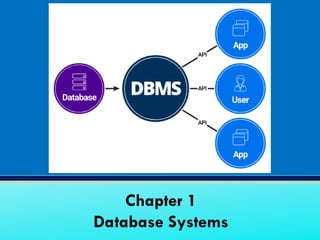
Chapter 1
Database Systems
•Logically related data stored in a single logical
data repository
• Physically distributed among multiple storage facilities
• DBMS eliminates most of file system’s problems
•Current generation DBMS software:
• Stores data structures, relationships between structures, and
access paths
• Defines, stores, and manages all access paths and
components
2
DATABASE SYSTEMS
3
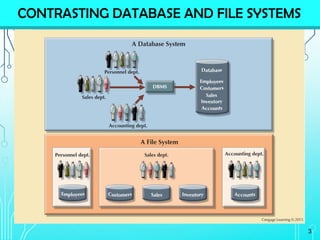
CONTRASTING DATABASE AND FILE SYSTEMS
4
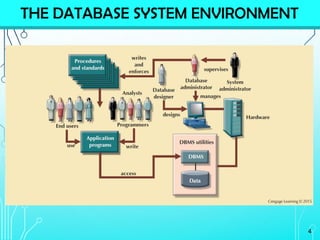
THE DATABASE SYSTEM ENVIRONMENT
5
DBMS FUNCTIONS
Data dictionary management
• Data dictionary: Stores definitions of the data elements and their relationships
Data storage management
• Performance tuning: Ensures efficient performance of the database in terms of
storage and access speed
Data transformation and presentation
• Transforms entered data to conform to required data structures
Security management
• Enforces user security and data privacy
6
DBMS FUNCTIONS
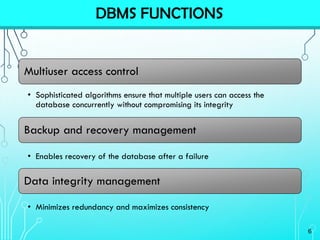
Multiuser access control
• Sophisticated algorithms ensure that multiple users can access the
database concurrently without compromising its integrity
Backup and recovery management
• Enables recovery of the database after a failure
Data integrity management
• Minimizes redundancy and maximizes consistency
7
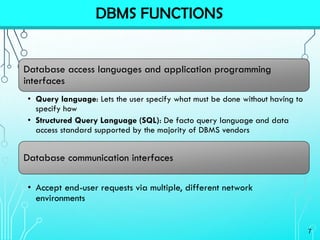
DBMS FUNCTIONS
Database access languages and application programming
interfaces
• Query language: Lets the user specify what must be done without having to
specify how
• Structured Query Language (SQL): De facto query language and data
access standard supported by the majority of DBMS vendors
Database communication interfaces
• Accept end-user requests via multiple, different network
environments
•SDLC
• System Development Life Cycle
• Detailed, well-planned development process
• Time-consuming, but comprehensive
• Long development cycle
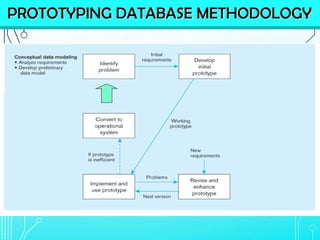
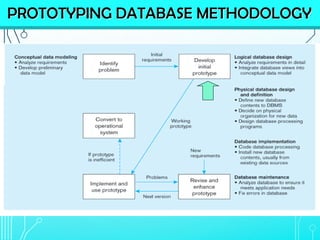
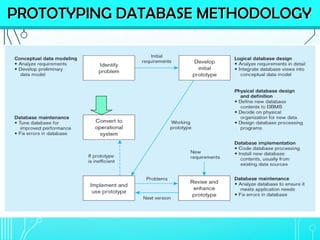
•Prototyping
• Rapid application development (RAD)
• Cursory attempt at conceptual data modeling
• Define database during development of initial prototype
• Repeat implementation and maintenance activities with new
prototype versions
TWO APPROACHES TO DATABASE AND IS DEVELOPMENT
SYSTEMS DEVELOPMENT LIFE CYCLE
Planning
Analysis
Physical Design
Implementation
Maintenance
Logical Design
SYSTEMS DEVELOPMENT LIFE CYCLE (CONT.)
Planning
Analysis
Physical Design
Implementation
Maintenance
Logical Design
Planning Purpose–preliminary understanding
Deliverable–request for study
Database activity–
enterprise modeling and
early conceptual data
modeling
SYSTEMS DEVELOPMENT LIFE CYCLE (CONT.)
Planning
Analysis
Physical Design
Implementation
Maintenance
Logical Design
Analysis
Purpose–thorough requirements analysis and
structuring
Deliverable–functional system specifications
Database activity–thorough
and integrated conceptual
data modeling
SYSTEMS DEVELOPMENT LIFE CYCLE (CONT.)
Planning
Analysis
Physical Design
Implementation
Maintenance
Logical Design
Logical Design
Purpose–information requirements elicitation
and structure
Deliverable–detailed design specifications
Database activity–
logical database design
(transactions, forms,
displays, views, data
integrity and security)
SYSTEMS DEVELOPMENT LIFE CYCLE (CONT.)
Planning
Analysis
Physical Design
Implementation
Maintenance
Logical Design
Physical Design
Purpose–develop technology and
organizational specifications
Deliverable–program/data
structures, technology purchases,
organization redesigns
Database activity–
physical database design (define
database to DBMS, physical
data organization, database
processing programs)
SYSTEMS DEVELOPMENT LIFE CYCLE (CONT.)
Planning
Analysis
Physical Design
Implementation
Maintenance
Logical Design
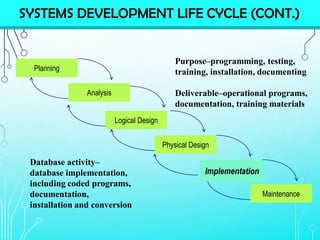
Implementation
Purpose–programming, testing,
training, installation, documenting
Deliverable–operational programs,
documentation, training materials
Database activity–
database implementation,
including coded programs,
documentation,
installation and conversion
SYSTEMS DEVELOPMENT LIFE CYCLE (CONT.)
Planning
Analysis
Physical Design
Implementation
Maintenance
Logical Design
Maintenance
Purpose–monitor, repair, enhance
Deliverable–periodic audits
Database activity–
database maintenance,
performance analysis
and tuning, error
corrections
PROTOTYPING DATABASE METHODOLOGY
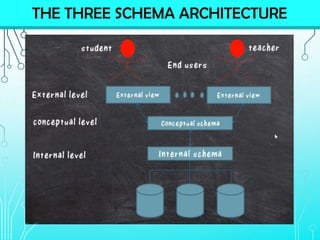
THE THREE SCHEMA ARCHITECTURE
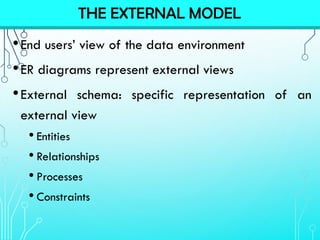
•End users’ view of the data environment
•ER diagrams represent external views
•External schema: specific representation of an
external view
• Entities
• Relationships
• Processes
• Constraints
THE EXTERNAL MODEL
•External Schema/external view
• User Views
• Subsets of Conceptual Schema
• Can be determined from business-function/data entity
matrices
• DBA determines schema for different users.
• Describe the specific part, that the specific user group
is interested in and hides rest of the database, for the
user group.
• Has different external views for different users.
DATABASE SCHEMA
•Conceptual Schema
• Describe the structure of the whole database for a
community of users.
• Hide the details of physical storage structures and
concentrates on describing entities, data types,
relationships, user operations, and constraints
• E-R models
DATABASE SCHEMA
•Internal Schema
• Describes the physical storage of structure of the
database.
• Uses a physical data model to describe the complete
details of data storage and access paths for the
database.
• Physical structures
• Logical structures
DATABASE SCHEMA
DATA ABSTRACTION LEVELS
•Easy to identify specific data required to support
each business unit’s operations
•Facilitates designer’s job by providing feedback
about the model’s adequacy
•Ensures security constraints in database design
•Simplifies application program development
THE EXTERNAL MODEL (CONT’D.)
•Represents global view of the entire database
•All external views integrated into single global
view: conceptual schema
•ER model most widely used
•ERD graphically represents the conceptual schema
THE CONCEPTUAL MODEL
CONCEPTUAL MODEL SCHOOL
•Provides a relatively easily understood macro level
view of data environment
•Independent of both software and hardware
• Does not depend on the DBMS software used to
implement the model
• Does not depend on the hardware used in the
implementation of the model
• Changes in hardware or software do not affect
database design at the conceptual level
THE CONCEPTUAL MODEL (CONT’D.)
•Representation of the database as “seen” by the
DBMS
• Maps the conceptual model to the DBMS
•Internal schema depicts a specific representation of an
internal model
•Depends on specific database software
• Change in DBMS software requires internal model be
changed
•Logical independence: change internal model without
affecting conceptual model
THE INTERNAL MODEL
INTERNAL MODEL FOR SCHOOL
•Operates at lowest level of abstraction
• Describes the way data are saved on storage media
such as disks or tapes
•Requires the definition of physical storage and
data access methods
•Relational model aimed at logical level
• Does not require physical-level details
•Physical independence: changes in physical model
do not affect internal model
THE PHYSICAL MODEL
DATABASE CAREER OPPORTUNITIES
35
•Coronel, Morris, Database Systems Design,
Implementation and Management. 11th Edition
•Hoffer, J., Ramesh, V., Topi, H. (2013). Modern
Database Management 11th Edition, Prentice Hall.
REFERENCE
“
”
IF YOU CANNOT DO GREAT
THINGS, DO SMALL THINGS IN
A GREAT WAY.
Napoleon Hill
THANKS!
Any questions?
You can find me at
delfirome@yahoo.com
0929 804 2327
38

02 - DatabaseConcepts.pdf

  • 1.
  • 2.
    •Logically related datastored in a single logical data repository • Physically distributed among multiple storage facilities • DBMS eliminates most of file system’s problems •Current generation DBMS software: • Stores data structures, relationships between structures, and access paths • Defines, stores, and manages all access paths and components 2 DATABASE SYSTEMS
  • 3.
  • 4.
  • 5.
    5 DBMS FUNCTIONS Data dictionarymanagement • Data dictionary: Stores definitions of the data elements and their relationships Data storage management • Performance tuning: Ensures efficient performance of the database in terms of storage and access speed Data transformation and presentation • Transforms entered data to conform to required data structures Security management • Enforces user security and data privacy
  • 6.
    6 DBMS FUNCTIONS Multiuser accesscontrol • Sophisticated algorithms ensure that multiple users can access the database concurrently without compromising its integrity Backup and recovery management • Enables recovery of the database after a failure Data integrity management • Minimizes redundancy and maximizes consistency
  • 7.
    7 DBMS FUNCTIONS Database accesslanguages and application programming interfaces • Query language: Lets the user specify what must be done without having to specify how • Structured Query Language (SQL): De facto query language and data access standard supported by the majority of DBMS vendors Database communication interfaces • Accept end-user requests via multiple, different network environments
  • 8.
    •SDLC • System DevelopmentLife Cycle • Detailed, well-planned development process • Time-consuming, but comprehensive • Long development cycle •Prototyping • Rapid application development (RAD) • Cursory attempt at conceptual data modeling • Define database during development of initial prototype • Repeat implementation and maintenance activities with new prototype versions TWO APPROACHES TO DATABASE AND IS DEVELOPMENT
  • 9.
    SYSTEMS DEVELOPMENT LIFECYCLE Planning Analysis Physical Design Implementation Maintenance Logical Design
  • 10.
    SYSTEMS DEVELOPMENT LIFECYCLE (CONT.) Planning Analysis Physical Design Implementation Maintenance Logical Design Planning Purpose–preliminary understanding Deliverable–request for study Database activity– enterprise modeling and early conceptual data modeling
  • 11.
    SYSTEMS DEVELOPMENT LIFECYCLE (CONT.) Planning Analysis Physical Design Implementation Maintenance Logical Design Analysis Purpose–thorough requirements analysis and structuring Deliverable–functional system specifications Database activity–thorough and integrated conceptual data modeling
  • 12.
    SYSTEMS DEVELOPMENT LIFECYCLE (CONT.) Planning Analysis Physical Design Implementation Maintenance Logical Design Logical Design Purpose–information requirements elicitation and structure Deliverable–detailed design specifications Database activity– logical database design (transactions, forms, displays, views, data integrity and security)
  • 13.
    SYSTEMS DEVELOPMENT LIFECYCLE (CONT.) Planning Analysis Physical Design Implementation Maintenance Logical Design Physical Design Purpose–develop technology and organizational specifications Deliverable–program/data structures, technology purchases, organization redesigns Database activity– physical database design (define database to DBMS, physical data organization, database processing programs)
  • 14.
    SYSTEMS DEVELOPMENT LIFECYCLE (CONT.) Planning Analysis Physical Design Implementation Maintenance Logical Design Implementation Purpose–programming, testing, training, installation, documenting Deliverable–operational programs, documentation, training materials Database activity– database implementation, including coded programs, documentation, installation and conversion
  • 15.
    SYSTEMS DEVELOPMENT LIFECYCLE (CONT.) Planning Analysis Physical Design Implementation Maintenance Logical Design Maintenance Purpose–monitor, repair, enhance Deliverable–periodic audits Database activity– database maintenance, performance analysis and tuning, error corrections
  • 16.
  • 17.
  • 18.
  • 19.
  • 20.
  • 21.
    THE THREE SCHEMAARCHITECTURE
  • 22.
    •End users’ viewof the data environment •ER diagrams represent external views •External schema: specific representation of an external view • Entities • Relationships • Processes • Constraints THE EXTERNAL MODEL
  • 23.
    •External Schema/external view •User Views • Subsets of Conceptual Schema • Can be determined from business-function/data entity matrices • DBA determines schema for different users. • Describe the specific part, that the specific user group is interested in and hides rest of the database, for the user group. • Has different external views for different users. DATABASE SCHEMA
  • 24.
    •Conceptual Schema • Describethe structure of the whole database for a community of users. • Hide the details of physical storage structures and concentrates on describing entities, data types, relationships, user operations, and constraints • E-R models DATABASE SCHEMA
  • 25.
    •Internal Schema • Describesthe physical storage of structure of the database. • Uses a physical data model to describe the complete details of data storage and access paths for the database. • Physical structures • Logical structures DATABASE SCHEMA
  • 27.
  • 28.
    •Easy to identifyspecific data required to support each business unit’s operations •Facilitates designer’s job by providing feedback about the model’s adequacy •Ensures security constraints in database design •Simplifies application program development THE EXTERNAL MODEL (CONT’D.)
  • 29.
    •Represents global viewof the entire database •All external views integrated into single global view: conceptual schema •ER model most widely used •ERD graphically represents the conceptual schema THE CONCEPTUAL MODEL
  • 30.
  • 31.
    •Provides a relativelyeasily understood macro level view of data environment •Independent of both software and hardware • Does not depend on the DBMS software used to implement the model • Does not depend on the hardware used in the implementation of the model • Changes in hardware or software do not affect database design at the conceptual level THE CONCEPTUAL MODEL (CONT’D.)
  • 32.
    •Representation of thedatabase as “seen” by the DBMS • Maps the conceptual model to the DBMS •Internal schema depicts a specific representation of an internal model •Depends on specific database software • Change in DBMS software requires internal model be changed •Logical independence: change internal model without affecting conceptual model THE INTERNAL MODEL
  • 33.
  • 34.
    •Operates at lowestlevel of abstraction • Describes the way data are saved on storage media such as disks or tapes •Requires the definition of physical storage and data access methods •Relational model aimed at logical level • Does not require physical-level details •Physical independence: changes in physical model do not affect internal model THE PHYSICAL MODEL
  • 35.
  • 36.
    •Coronel, Morris, DatabaseSystems Design, Implementation and Management. 11th Edition •Hoffer, J., Ramesh, V., Topi, H. (2013). Modern Database Management 11th Edition, Prentice Hall. REFERENCE
  • 37.
    “ ” IF YOU CANNOTDO GREAT THINGS, DO SMALL THINGS IN A GREAT WAY. Napoleon Hill
  • 38.
    THANKS! Any questions? You canfind me at delfirome@yahoo.com 0929 804 2327 38