SSASIT - Surat
Computer Programming & Utilization
Pointers
Prepared By:
Lalji Shiyani
Students of ssasit
1
Introduction
Pointers
Pointers are the variable that contains
the address of another variable within
memory.
2
Pointer Variable Declarations and
Initialization
Pointer variables
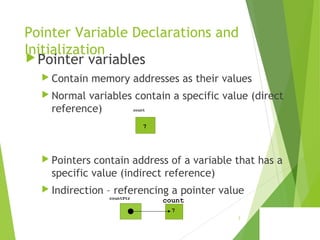
 Contain memory addresses as their values
 Normal variables contain a specific value (direct
reference)
 Pointers contain address of a variable that has a
specific value (indirect reference)
 Indirection – referencing a pointer value
 
count
7
count
7
countPtr
3
Pointer Variable Declarations and
Initialization
 Pointer declarations
 * used with pointer variables
int *myPtr;
 Declares a pointer to an int (pointer of type int *)
 Multiple pointers require using a * before each variable
declaration
int *myPtr1, *myPtr2;
 Can declare pointers to any data type
 Initialize pointers to 0, NULL, or an address
 0 or NULL – points to nothing (NULL preferred)
4
Need of Pointer
• It enhances the capability of the language in manipulating
the data.
• It reduces the size of the program.
• It is used for creating data structures such as linked lists,
trees, graphs etc.
• It is used to pass information between different functions
in both directions.
• It increases the execution speed of the program.
• If used with array of strings, then it reduces the storage
space
requirement.
• With pointers, we can use dynamic memory allocation.
5
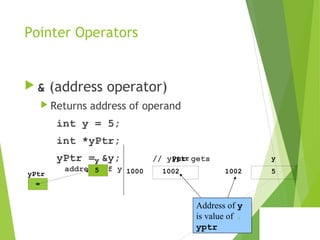
Pointer Operators
& (address operator)
 Returns address of operand
int y = 5;
int *yPtr;
yPtr = &y; // yPtr gets
address of y
yPtr
y
5
yptr
1000 1002
y
1002 5
Address of y
is value of
yptr
6
Pointer Operators
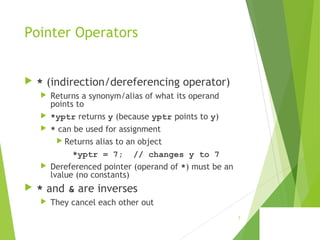
 * (indirection/dereferencing operator)
 Returns a synonym/alias of what its operand
points to
 *yptr returns y (because yptr points to y)
 * can be used for assignment
 Returns alias to an object
*yptr = 7; // changes y to 7
 Dereferenced pointer (operand of *) must be an
lvalue (no constants)
 * and & are inverses
 They cancel each other out
7
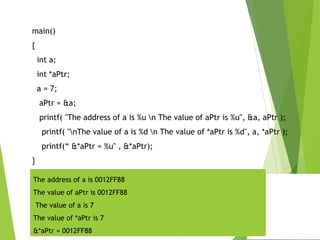
main()
{
int a;
int *aPtr;
a = 7;
aPtr = &a;
printf( "The address of a is %u n The value of aPtr is %u", &a, aPtr );
printf( "nThe value of a is %d n The value of *aPtr is %d", a, *aPtr );
printf(“ &*aPtr = %u" , &*aPtr);
}
The address of a is 0012FF88
The value of aPtr is 0012FF88
The value of a is 7
The value of *aPtr is 7
&*aPtr = 0012FF88
8
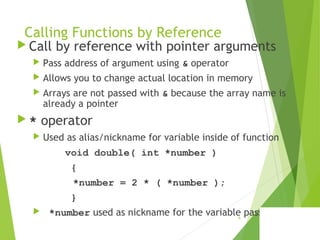
Calling Functions by Reference
 Call by reference with pointer arguments
 Pass address of argument using & operator
 Allows you to change actual location in memory
 Arrays are not passed with & because the array name is
already a pointer
 * operator
 Used as alias/nickname for variable inside of function
void double( int *number )
{
*number = 2 * ( *number );
}
 *number used as nickname for the variable passed9
© 2000 Prentice Hall, Inc.
All rights reserved.
1. Function prototype
1.1 Initialize variables
2. Call function
3. Define function
Program Output
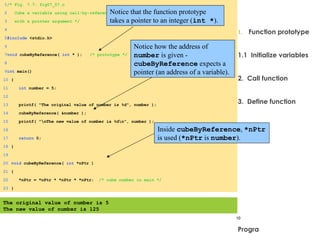
1/* Fig. 7.7: fig07_07.c
2 Cube a variable using call-by-reference
3 with a pointer argument */
4
5#include <stdio.h>
6
7void cubeByReference( int * ); /* prototype */
8
9int main()
10 {
11 int number = 5;
12
13 printf( "The original value of number is %d", number );
14 cubeByReference( &number );
15 printf( "nThe new value of number is %dn", number );
16
17 return 0;
18 }
19
20 void cubeByReference( int *nPtr )
21 {
22 *nPtr = *nPtr * *nPtr * *nPtr; /* cube number in main */
23 }
The original value of number is 5
The new value of number is 125
Notice how the address of
number is given -
cubeByReference expects a
pointer (an address of a variable).
Inside cubeByReference, *nPtr
is used (*nPtr is number).
Notice that the function prototype
takes a pointer to an integer (int *).
10
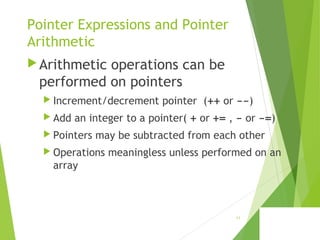
Pointer Expressions and Pointer
Arithmetic
Arithmetic operations can be
performed on pointers
 Increment/decrement pointer (++ or --)
 Add an integer to a pointer( + or += , - or -=)
 Pointers may be subtracted from each other
 Operations meaningless unless performed on an
array
11
Pointer Expressions and Pointer
Arithmetic5 element int array on machine with 4
byte ints
 vPtr points to first element v[ 0 ]
at location 3000 (vPtr = 3000)
 vPtr += 2; sets vPtr to 3008
vPtr points to v[ 2 ] (incremented by 2), but
the machine has 4 byte ints, so it points to
address 3008
pointer variable vPtr
v[0] v[1] v[2] v[4]v[3]
3000 3004 3008 3012 3016
location
12
Pointer Expressions and Pointer
Arithmetic
Subtracting pointers
 Returns number of elements from one to the
other. If
vPtr2 = v[ 2 ];
vPtr = v[ 0 ];
 vPtr2 - vPtr would produce 2
Pointer comparison ( <, == , > )
 See which pointer points to the higher numbered
array element
 Also, see if a pointer points to 0
13
The Relationship Between Pointers and
Arrays
 Arrays and pointers closely related
 Array name like a constant pointer
 Pointers can do array subscripting operations
 Declare an array b[ 5 ] and a pointer bPtr
 To set them equal to one another use:
bPtr = b;
The array name (b) is actually the address of first
element of the array b[ 5 ]
bPtr = &b[ 0 ]
Explicitly assigns bPtr to address of first element of b
14
The Relationship Between Pointers and
Arrays
 Element b[ 3 ]
Can be accessed by *( bPtr + 3 )
Where n is the offset. Called pointer/offset
notation
Can be accessed by bptr[ 3 ]
Called pointer/subscript notation
bPtr[ 3 ] same as b[ 3 ]
Can be accessed by performing pointer arithmetic
on the array itself
*( b + 3 )
15
Arrays of Pointers Arrays can contain pointers
 For example: an array of strings
char *suit[ 4 ] = { "Hearts", "Diamonds",
"Clubs", "Spades" };
 Strings are pointers to the first character
 char * – each element of suit is a pointer to a char
 The strings are not actually stored in the array suit, only pointers to the
strings are stored
 suit array has a fixed size, but strings can be of any size
suit[3]
suit[2]
suit[1]
suit[0] ’H’ ’e’ ’a’ ’r’ ’t’ ’s’ ’0’
’D’ ’i’ ’a’ ’m’ ’o’ ’n’ ’d’ ’s’ ’0’
’C’ ’l’ ’u’ ’b’ ’s’ ’0’
’S’ ’p’ ’a’ ’d’ ’e’ ’s’ ’0’
 
16

Pointers

  • 1.
    SSASIT - Surat ComputerProgramming & Utilization Pointers Prepared By: Lalji Shiyani Students of ssasit 1
  • 2.
    Introduction Pointers Pointers are thevariable that contains the address of another variable within memory. 2
  • 3.
    Pointer Variable Declarationsand Initialization Pointer variables  Contain memory addresses as their values  Normal variables contain a specific value (direct reference)  Pointers contain address of a variable that has a specific value (indirect reference)  Indirection – referencing a pointer value   count 7 count 7 countPtr 3
  • 4.
    Pointer Variable Declarationsand Initialization  Pointer declarations  * used with pointer variables int *myPtr;  Declares a pointer to an int (pointer of type int *)  Multiple pointers require using a * before each variable declaration int *myPtr1, *myPtr2;  Can declare pointers to any data type  Initialize pointers to 0, NULL, or an address  0 or NULL – points to nothing (NULL preferred) 4
  • 5.
    Need of Pointer •It enhances the capability of the language in manipulating the data. • It reduces the size of the program. • It is used for creating data structures such as linked lists, trees, graphs etc. • It is used to pass information between different functions in both directions. • It increases the execution speed of the program. • If used with array of strings, then it reduces the storage space requirement. • With pointers, we can use dynamic memory allocation. 5
  • 6.
    Pointer Operators & (addressoperator)  Returns address of operand int y = 5; int *yPtr; yPtr = &y; // yPtr gets address of y yPtr y 5 yptr 1000 1002 y 1002 5 Address of y is value of yptr 6
  • 7.
    Pointer Operators  *(indirection/dereferencing operator)  Returns a synonym/alias of what its operand points to  *yptr returns y (because yptr points to y)  * can be used for assignment  Returns alias to an object *yptr = 7; // changes y to 7  Dereferenced pointer (operand of *) must be an lvalue (no constants)  * and & are inverses  They cancel each other out 7
  • 8.
    main() { int a; int *aPtr; a= 7; aPtr = &a; printf( "The address of a is %u n The value of aPtr is %u", &a, aPtr ); printf( "nThe value of a is %d n The value of *aPtr is %d", a, *aPtr ); printf(“ &*aPtr = %u" , &*aPtr); } The address of a is 0012FF88 The value of aPtr is 0012FF88 The value of a is 7 The value of *aPtr is 7 &*aPtr = 0012FF88 8
  • 9.
    Calling Functions byReference  Call by reference with pointer arguments  Pass address of argument using & operator  Allows you to change actual location in memory  Arrays are not passed with & because the array name is already a pointer  * operator  Used as alias/nickname for variable inside of function void double( int *number ) { *number = 2 * ( *number ); }  *number used as nickname for the variable passed9
  • 10.
    © 2000 PrenticeHall, Inc. All rights reserved. 1. Function prototype 1.1 Initialize variables 2. Call function 3. Define function Program Output 1/* Fig. 7.7: fig07_07.c 2 Cube a variable using call-by-reference 3 with a pointer argument */ 4 5#include <stdio.h> 6 7void cubeByReference( int * ); /* prototype */ 8 9int main() 10 { 11 int number = 5; 12 13 printf( "The original value of number is %d", number ); 14 cubeByReference( &number ); 15 printf( "nThe new value of number is %dn", number ); 16 17 return 0; 18 } 19 20 void cubeByReference( int *nPtr ) 21 { 22 *nPtr = *nPtr * *nPtr * *nPtr; /* cube number in main */ 23 } The original value of number is 5 The new value of number is 125 Notice how the address of number is given - cubeByReference expects a pointer (an address of a variable). Inside cubeByReference, *nPtr is used (*nPtr is number). Notice that the function prototype takes a pointer to an integer (int *). 10
  • 11.
    Pointer Expressions andPointer Arithmetic Arithmetic operations can be performed on pointers  Increment/decrement pointer (++ or --)  Add an integer to a pointer( + or += , - or -=)  Pointers may be subtracted from each other  Operations meaningless unless performed on an array 11
  • 12.
    Pointer Expressions andPointer Arithmetic5 element int array on machine with 4 byte ints  vPtr points to first element v[ 0 ] at location 3000 (vPtr = 3000)  vPtr += 2; sets vPtr to 3008 vPtr points to v[ 2 ] (incremented by 2), but the machine has 4 byte ints, so it points to address 3008 pointer variable vPtr v[0] v[1] v[2] v[4]v[3] 3000 3004 3008 3012 3016 location 12
  • 13.
    Pointer Expressions andPointer Arithmetic Subtracting pointers  Returns number of elements from one to the other. If vPtr2 = v[ 2 ]; vPtr = v[ 0 ];  vPtr2 - vPtr would produce 2 Pointer comparison ( <, == , > )  See which pointer points to the higher numbered array element  Also, see if a pointer points to 0 13
  • 14.
    The Relationship BetweenPointers and Arrays  Arrays and pointers closely related  Array name like a constant pointer  Pointers can do array subscripting operations  Declare an array b[ 5 ] and a pointer bPtr  To set them equal to one another use: bPtr = b; The array name (b) is actually the address of first element of the array b[ 5 ] bPtr = &b[ 0 ] Explicitly assigns bPtr to address of first element of b 14
  • 15.
    The Relationship BetweenPointers and Arrays  Element b[ 3 ] Can be accessed by *( bPtr + 3 ) Where n is the offset. Called pointer/offset notation Can be accessed by bptr[ 3 ] Called pointer/subscript notation bPtr[ 3 ] same as b[ 3 ] Can be accessed by performing pointer arithmetic on the array itself *( b + 3 ) 15
  • 16.
    Arrays of PointersArrays can contain pointers  For example: an array of strings char *suit[ 4 ] = { "Hearts", "Diamonds", "Clubs", "Spades" };  Strings are pointers to the first character  char * – each element of suit is a pointer to a char  The strings are not actually stored in the array suit, only pointers to the strings are stored  suit array has a fixed size, but strings can be of any size suit[3] suit[2] suit[1] suit[0] ’H’ ’e’ ’a’ ’r’ ’t’ ’s’ ’0’ ’D’ ’i’ ’a’ ’m’ ’o’ ’n’ ’d’ ’s’ ’0’ ’C’ ’l’ ’u’ ’b’ ’s’ ’0’ ’S’ ’p’ ’a’ ’d’ ’e’ ’s’ ’0’   16