Embedded C – Part II
Arrays & Functions
Team Emertxe
Functions
Why Functions?
● Reusability
● Functions can be stored in library & re-used
● When some specific code is to be used more than once, at different places, functions
avoids repeatition of the code.
● Divide & Conquer
● A big & difficult problem can be divided into smaller sub-problems and solved using
divide & conquer technique
● Modularity can be achieved.
● Code can be easily understandable & modifiable.
● Functions are easy to debug & test.
● One can suppress, how the task is done inside the function, which is called
Abstraction.
Parameters, Arguments and Return
Values
Parameters, Arguments
and Return Values
● Parameters are also commonly referred to as arguments, though arguments
are more properly thought of as the actual values or references assigned to
the parameter variables when the subroutine is called at runtime.
● When discussing code that is calling into a subroutine,any values or references
passed into the subroutine are the arguments, and the place in the code
where these values or references are given is the parameter list.
● When discussing the code inside the subroutine definition, the variables in the
subroutine’s parameter list are the parameters, while the values of the
parameters at runtime are the arguments.
Parameters, Arguments
and Return Values
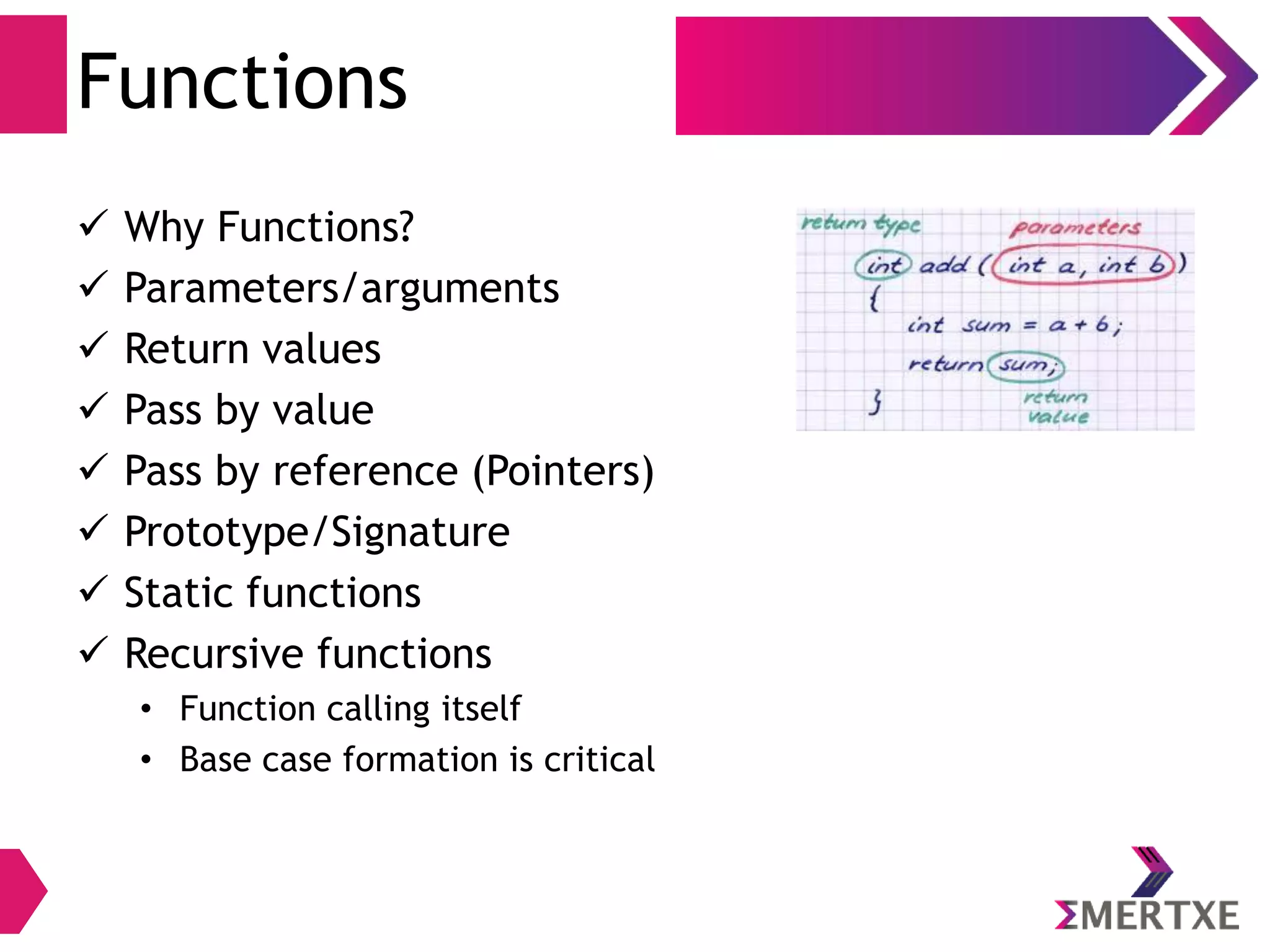
Actual Arguments
Formal ArgumentsReturn
type
Example
Function and the Stack
P1
P2
P3
P4
:
:
:
Pn-1
Pn
RAM
Command line
Arguments
Stack
HOLE
Heap
.BSS(Uninitialized
Data segment)
Initialized data
Segment
Code Segment
Data
Segment
Parameter List
Return Address
Local Variables
StackMemory Layout
Various Passing Mechanisms
Various Passing
Mechanisms
Pass by Value Pass by reference
● This method copies the actual value of an
argument into the formal parameter of the
function.
● In this case, changes made to the
parameter inside the function have no
effect on the actual argument.
● This method copies the address of an
argument into the formal parameter.
●
Inside the function, the address is used to
access the actual argument used in the
call. This means that changes made to the
parameter affect the argument.
Pass by value
ExampleExample
O / P ???
Pass by reference
Example
O / P ???
Pass by value &
Pass by reference
DIY
Problem 1:
Write a function to swap two integers passed from main function.
Problem 2:
Write a function to perform both sum & product of two different integers
passed from main function.
Ignoring Function’s Return
Value
Ingnoring the function's
return value

In C tradition, you can choose to ignore to capture the

return value from a method:
● Function read_int returning an int
And collecting in variable i in the
main function.
● Main function ignoring the return
value.
Introduction : Arrays
Introduction
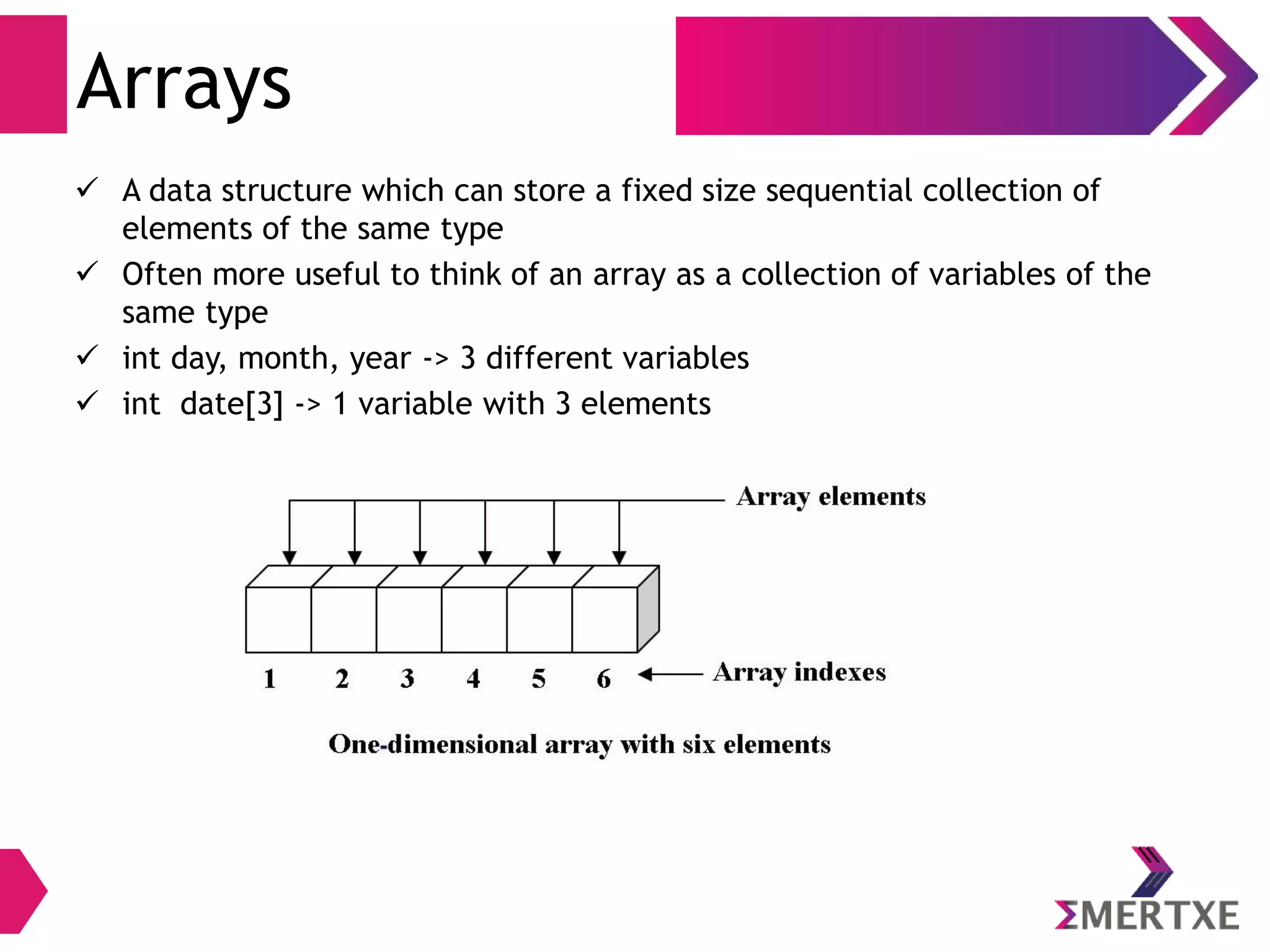
● An array is a collection of data of similar data type.
● Example:
If we want to store the ages of 5 different people, then we can use array instead
of using 5 different variables.
● The mory alloaction will be contiguos.
● A specific element in an array is accessed by an index.
Array: Declaration
Syntax
type arrayName [ SIZE ];
Example
To declare an array to store ages of 5 people
int age[ 5 ];
Total Memory
Total Memory = SIZE * sizeof(dataType)
= 5 * sizeof( int ) // Assuming sizeof(int) = 4
= 5 * 4
= 20 bytes
Array: Definition
Example
To declare an array to store ages of 5 people
int age[ 5 ] = {10, 20, 30, 40, 50};
Memory Allocation
10 20 30 40 50
age[0]
age[4]
age[3]
age[2]
age[1]
100 104 108 112 116

DIY : Write a program to add all the elements of the array.
Array: Passing to function
DIY: WAF to sort the elements of the array in asc / des order.
Returning the array from the
function
Array: Passing to function
Static keyword is used to retain the values between the function

calls
Variadic functions
Variadic Functions:
Introduction
● Variadic functions can be called with any number of trailing arguments.
For example,
printf(), scanf() are common variadic funtions
● Variadic functions can be called in the usual way with individual arguments.
syntax
return_type function_name(parameter list, ...);
Variadic Functions:
How are defined & used
Defining and using a variadic function involves three steps:
step 1: Variadic functions are defined using an ellipsis (‘…’) in the argument list,
and using special macros to access the variable arguments.
For example,
step 2: Declare the function as variadic, using a prototype with an ellipsis (‘…’),
in all the files which call it.
Step 3: Call the function by writing the fixed arguments followed by the
additional variable arguments.
Variadic Functions:
Arguments access macros
● Descriptions of the macros used to retrieve variable arguments.
● These macros are defined in the header file stdarg.h
Type/
Macros
Description
va_list The type va_list is used for argument pointer variables
va_start This macro initializes the argument pointer variable ap to point to the first
of the optional arguments of the current function; last-required must be
the last required argument to the function
va_arg The va_arg macro returns the value of the next optional argument, and
modifies the value of ap to point to the subsequent argument. Thus,
successive uses of va_arg return successive optional arguments
va_end This ends the use of ap
Variadic Functions:
Example
Recursive functions
Recursive Function
● Function calling itself
Steps:
1. Identification of the base case.
2. Writing the recursive case.
Example Factorial of a number
n !
1 n = 0 (Base case)
n * (n – 1) ! n > 0 (Recursive case)
Recursive Functions:
Example
Recursive Functions:
Example
Stay connected
About us: Emertxe is India’s one of the top IT finishing schools & self learning
kits provider. Our primary focus is on Embedded with diversification focus on
Java, Oracle and Android areas
Branch Office: Corporate Headquarters:
Emertxe Information Technologies, Emertxe Information Technologies,
No-1, 9th Cross, 5th Main, 83, Farah Towers, 1st
Floor,
Jayamahal Extension, MG Road,
Bangalore, Karnataka 560046 Bangalore, Karnataka - 560001
T: +91 809 555 7333 (M), +91 80 41289576 (L)
E: training@emertxe.com
https://www.facebook.com/Emertxe https://twitter.com/EmertxeTweet https://www.slideshare.net/EmertxeSlides
THANK YOU

C Programming - Refresher - Part II

  • 1.
    Embedded C –Part II Arrays & Functions Team Emertxe
  • 2.
  • 3.
    Why Functions? ● Reusability ●Functions can be stored in library & re-used ● When some specific code is to be used more than once, at different places, functions avoids repeatition of the code. ● Divide & Conquer ● A big & difficult problem can be divided into smaller sub-problems and solved using divide & conquer technique ● Modularity can be achieved. ● Code can be easily understandable & modifiable. ● Functions are easy to debug & test. ● One can suppress, how the task is done inside the function, which is called Abstraction.
  • 4.
  • 5.
    Parameters, Arguments and ReturnValues ● Parameters are also commonly referred to as arguments, though arguments are more properly thought of as the actual values or references assigned to the parameter variables when the subroutine is called at runtime. ● When discussing code that is calling into a subroutine,any values or references passed into the subroutine are the arguments, and the place in the code where these values or references are given is the parameter list. ● When discussing the code inside the subroutine definition, the variables in the subroutine’s parameter list are the parameters, while the values of the parameters at runtime are the arguments.
  • 6.
    Parameters, Arguments and ReturnValues Actual Arguments Formal ArgumentsReturn type Example
  • 7.
    Function and theStack P1 P2 P3 P4 : : : Pn-1 Pn RAM Command line Arguments Stack HOLE Heap .BSS(Uninitialized Data segment) Initialized data Segment Code Segment Data Segment Parameter List Return Address Local Variables StackMemory Layout
  • 8.
  • 9.
    Various Passing Mechanisms Pass byValue Pass by reference ● This method copies the actual value of an argument into the formal parameter of the function. ● In this case, changes made to the parameter inside the function have no effect on the actual argument. ● This method copies the address of an argument into the formal parameter. ● Inside the function, the address is used to access the actual argument used in the call. This means that changes made to the parameter affect the argument.
  • 10.
  • 11.
  • 12.
    Pass by value& Pass by reference DIY Problem 1: Write a function to swap two integers passed from main function. Problem 2: Write a function to perform both sum & product of two different integers passed from main function.
  • 13.
  • 14.
    Ingnoring the function's returnvalue  In C tradition, you can choose to ignore to capture the  return value from a method: ● Function read_int returning an int And collecting in variable i in the main function. ● Main function ignoring the return value.
  • 15.
  • 16.
    Introduction ● An arrayis a collection of data of similar data type. ● Example: If we want to store the ages of 5 different people, then we can use array instead of using 5 different variables. ● The mory alloaction will be contiguos. ● A specific element in an array is accessed by an index.
  • 17.
    Array: Declaration Syntax type arrayName[ SIZE ]; Example To declare an array to store ages of 5 people int age[ 5 ]; Total Memory Total Memory = SIZE * sizeof(dataType) = 5 * sizeof( int ) // Assuming sizeof(int) = 4 = 5 * 4 = 20 bytes
  • 18.
    Array: Definition Example To declarean array to store ages of 5 people int age[ 5 ] = {10, 20, 30, 40, 50}; Memory Allocation 10 20 30 40 50 age[0] age[4] age[3] age[2] age[1] 100 104 108 112 116  DIY : Write a program to add all the elements of the array.
  • 19.
    Array: Passing tofunction DIY: WAF to sort the elements of the array in asc / des order.
  • 20.
    Returning the arrayfrom the function
  • 21.
    Array: Passing tofunction Static keyword is used to retain the values between the function  calls
  • 22.
  • 23.
    Variadic Functions: Introduction ● Variadicfunctions can be called with any number of trailing arguments. For example, printf(), scanf() are common variadic funtions ● Variadic functions can be called in the usual way with individual arguments. syntax return_type function_name(parameter list, ...);
  • 24.
    Variadic Functions: How aredefined & used Defining and using a variadic function involves three steps: step 1: Variadic functions are defined using an ellipsis (‘…’) in the argument list, and using special macros to access the variable arguments. For example, step 2: Declare the function as variadic, using a prototype with an ellipsis (‘…’), in all the files which call it. Step 3: Call the function by writing the fixed arguments followed by the additional variable arguments.
  • 25.
    Variadic Functions: Arguments accessmacros ● Descriptions of the macros used to retrieve variable arguments. ● These macros are defined in the header file stdarg.h Type/ Macros Description va_list The type va_list is used for argument pointer variables va_start This macro initializes the argument pointer variable ap to point to the first of the optional arguments of the current function; last-required must be the last required argument to the function va_arg The va_arg macro returns the value of the next optional argument, and modifies the value of ap to point to the subsequent argument. Thus, successive uses of va_arg return successive optional arguments va_end This ends the use of ap
  • 26.
  • 27.
  • 28.
    Recursive Function ● Functioncalling itself Steps: 1. Identification of the base case. 2. Writing the recursive case. Example Factorial of a number n ! 1 n = 0 (Base case) n * (n – 1) ! n > 0 (Recursive case)
  • 29.
  • 30.
  • 31.
    Stay connected About us:Emertxe is India’s one of the top IT finishing schools & self learning kits provider. Our primary focus is on Embedded with diversification focus on Java, Oracle and Android areas Branch Office: Corporate Headquarters: Emertxe Information Technologies, Emertxe Information Technologies, No-1, 9th Cross, 5th Main, 83, Farah Towers, 1st Floor, Jayamahal Extension, MG Road, Bangalore, Karnataka 560046 Bangalore, Karnataka - 560001 T: +91 809 555 7333 (M), +91 80 41289576 (L) E: training@emertxe.com https://www.facebook.com/Emertxe https://twitter.com/EmertxeTweet https://www.slideshare.net/EmertxeSlides
  • 32.