Linkers & Loaders –  A Programmers Perspective Sandeep Grover (sgrover@quicklogic.com) Quicklogic, India
Agenda.. Basic concepts Object Files Program Loading Linking with static libraries Linking with dynamic libraries
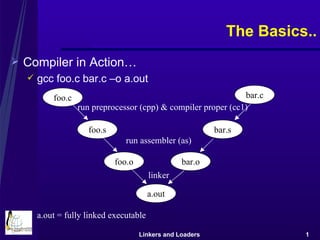
The Basics.. Compiler in Action… gcc foo.c bar.c –o a.out a.out = fully linked executable run assembler (as) foo.c bar.c foo.s bar.s foo.o bar.o a.out run preprocessor (cpp) & compiler proper (cc1) linker
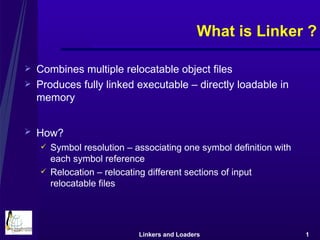
What is Linker ? Combines multiple relocatable object files Produces fully linked executable – directly loadable in memory How?   Symbol resolution – associating one symbol definition with each symbol reference Relocation – relocating different sections of input relocatable files
Object files.. Types –  Relocatable : Requires linking to create executable  Executable : Loaded directly into memory for execution Shared Objects : Linked dynamically, at run time or load time Formats –  a.out, IBM360, OMF, COFF, PE, ELF, ELF-64 … http://www.nondot.org/~sabre/os/articles/ExecutableFileFormats/
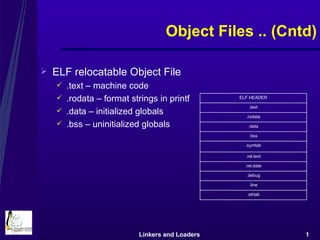
Object Files .. (Cntd) ELF relocatable Object File .text – machine code .rodata – format strings in printf .data – initialized globals .bss – uninitialized globals .strtab .line .debug .rel.data .rel.text .symtab .bss .data .rodata .text ELF HEADER
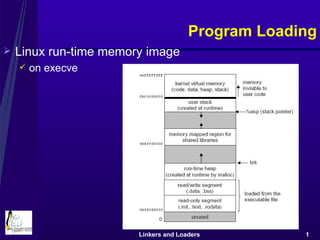
Program Loading Linux run-time memory image on execve
Symbol Resolution.. 3 types of symbols resolved during linking Non-static global symbols defined by object file Extern global symbols referenced by object file Static symbols local to object file/function Local Automatic variables : managed on stack & not of interest to linkers
Symbol Resolution ..(Cntd) Resolving Global Symbols –  Strong Symbols : functions, initialized global variables Weak Symbols : uninitialized global variables Rules of thumb –  Multiple strong symbols – not allowed Given a strong and multiple weak symbols, choose the strong symbol Given multiple weak symbols, choose any weak symbol
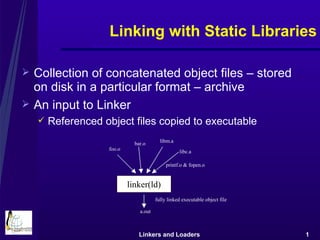
Linking with Static Libraries Collection of concatenated object files – stored on disk in a particular format – archive An input to Linker Referenced object files copied to executable libm.a printf.o & fopen.o linker(ld) foo.o bar.o libc.a a.out fully linked executable object file
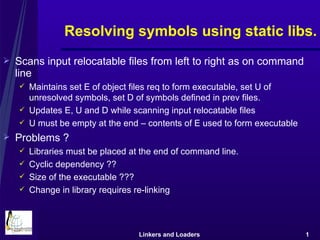
Resolving symbols using static libs. Scans input relocatable files from left to right as on command line Maintains set E of object files req to form executable, set U of unresolved symbols, set D of symbols defined in prev files. Updates E, U and D while scanning input relocatable files U must be empty at the end – contents of E used to form executable Problems ? Libraries must be placed at the end of command line. Cyclic dependency ?? Size of the executable ??? Change in library requires re-linking
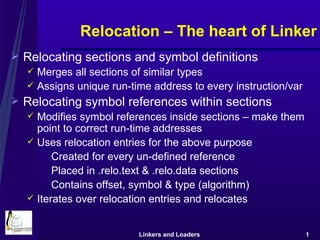
Relocation – The heart of Linker Relocating sections and symbol definitions Merges all sections of similar types Assigns unique run-time address to every instruction/var Relocating symbol references within sections Modifies symbol references inside sections – make them point to correct run-time addresses Uses relocation entries for the above purpose Created for every un-defined reference Placed in .relo.text & .relo.data sections Contains offset, symbol & type (algorithm) Iterates over relocation entries and relocates
Dynamic Linking – Shared Libraries Addresses disadvantages of static libraries Ensures one copy of text & data in memory  Change in shared library does not require executable to be built again Loaded at run-time by dynamic linker, at arbitrary memory address, linked with programs in memory On loading, dynamic linker relocates text & data of shared object; also relocates any references in executable to symbols defined in shared object E.g. .so files in Linux/Sun; .sl in HPUX; DLLs in Microsoft Windows Can be loaded dynamically in the middle of execution – dlopen, dlsym, dlclose calls in Linux/Sun; shl_load, shl_findsym in HPUX, LoadLibrary, GetProcAddress in Windows
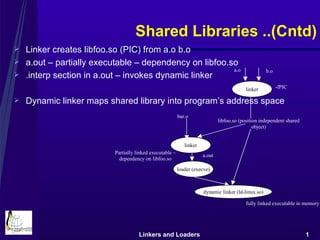
Shared Libraries ..(Cntd) Linker creates libfoo.so (PIC) from a.o b.o a.out – partially executable – dependency on libfoo.so .interp section in a.out – invokes dynamic linker Dynamic linker maps shared library into program’s address space linker linker a.o b.o libfoo.so (position independent shared object) bar.o loader (execve) dynamic linker (ld-linux.so) Partially linked executable – dependency on libfoo.so a.out fully linked executable in memory -fPIC
Position Independent Code (PIC) Important property – required by shared libraries No absolute addresses – hence can be loaded and executed at any address Uses PC-relative/indirect addressing Indirect addressing – required for externally defined functions and globals Uses Global Offset Table (GOT) to resolve unreferenced global variables Uses a Procedure Linkage Table (PLT) along with GOT to resolve unreferenced functions GOT resides at the start of data segment, GOT entries are fixed at run-time to point to correct run-time address Lazy binding of function calls
Thank You all !! References – http://www.iecc.com/linker  - Linker book by John Levine http://docs.hp.com/hpux/onlinedocs/B2355-90655/B2355-90655.html  - HPUX Linkers and Libraries guide http://docs.sun.com/db?p=/doc/816-1386  - Sun Linkers and Libraries guide http://www.linuxjournal.com/article.php?sid=6463  - An article on Linkers and Loaders by Sandeep Grover Questions ???? -- Sandeep Grover <sgrover@quicklogic.com>

Linkers And Loaders

  • 1.
    Linkers & Loaders– A Programmers Perspective Sandeep Grover (sgrover@quicklogic.com) Quicklogic, India
  • 2.
    Agenda.. Basic conceptsObject Files Program Loading Linking with static libraries Linking with dynamic libraries
  • 3.
    The Basics.. Compilerin Action… gcc foo.c bar.c –o a.out a.out = fully linked executable run assembler (as) foo.c bar.c foo.s bar.s foo.o bar.o a.out run preprocessor (cpp) & compiler proper (cc1) linker
  • 4.
    What is Linker? Combines multiple relocatable object files Produces fully linked executable – directly loadable in memory How? Symbol resolution – associating one symbol definition with each symbol reference Relocation – relocating different sections of input relocatable files
  • 5.
    Object files.. Types– Relocatable : Requires linking to create executable Executable : Loaded directly into memory for execution Shared Objects : Linked dynamically, at run time or load time Formats – a.out, IBM360, OMF, COFF, PE, ELF, ELF-64 … http://www.nondot.org/~sabre/os/articles/ExecutableFileFormats/
  • 6.
    Object Files ..(Cntd) ELF relocatable Object File .text – machine code .rodata – format strings in printf .data – initialized globals .bss – uninitialized globals .strtab .line .debug .rel.data .rel.text .symtab .bss .data .rodata .text ELF HEADER
  • 7.
    Program Loading Linuxrun-time memory image on execve
  • 8.
    Symbol Resolution.. 3types of symbols resolved during linking Non-static global symbols defined by object file Extern global symbols referenced by object file Static symbols local to object file/function Local Automatic variables : managed on stack & not of interest to linkers
  • 9.
    Symbol Resolution ..(Cntd)Resolving Global Symbols – Strong Symbols : functions, initialized global variables Weak Symbols : uninitialized global variables Rules of thumb – Multiple strong symbols – not allowed Given a strong and multiple weak symbols, choose the strong symbol Given multiple weak symbols, choose any weak symbol
  • 10.
    Linking with StaticLibraries Collection of concatenated object files – stored on disk in a particular format – archive An input to Linker Referenced object files copied to executable libm.a printf.o & fopen.o linker(ld) foo.o bar.o libc.a a.out fully linked executable object file
  • 11.
    Resolving symbols usingstatic libs. Scans input relocatable files from left to right as on command line Maintains set E of object files req to form executable, set U of unresolved symbols, set D of symbols defined in prev files. Updates E, U and D while scanning input relocatable files U must be empty at the end – contents of E used to form executable Problems ? Libraries must be placed at the end of command line. Cyclic dependency ?? Size of the executable ??? Change in library requires re-linking
  • 12.
    Relocation – Theheart of Linker Relocating sections and symbol definitions Merges all sections of similar types Assigns unique run-time address to every instruction/var Relocating symbol references within sections Modifies symbol references inside sections – make them point to correct run-time addresses Uses relocation entries for the above purpose Created for every un-defined reference Placed in .relo.text & .relo.data sections Contains offset, symbol & type (algorithm) Iterates over relocation entries and relocates
  • 13.
    Dynamic Linking –Shared Libraries Addresses disadvantages of static libraries Ensures one copy of text & data in memory Change in shared library does not require executable to be built again Loaded at run-time by dynamic linker, at arbitrary memory address, linked with programs in memory On loading, dynamic linker relocates text & data of shared object; also relocates any references in executable to symbols defined in shared object E.g. .so files in Linux/Sun; .sl in HPUX; DLLs in Microsoft Windows Can be loaded dynamically in the middle of execution – dlopen, dlsym, dlclose calls in Linux/Sun; shl_load, shl_findsym in HPUX, LoadLibrary, GetProcAddress in Windows
  • 14.
    Shared Libraries ..(Cntd)Linker creates libfoo.so (PIC) from a.o b.o a.out – partially executable – dependency on libfoo.so .interp section in a.out – invokes dynamic linker Dynamic linker maps shared library into program’s address space linker linker a.o b.o libfoo.so (position independent shared object) bar.o loader (execve) dynamic linker (ld-linux.so) Partially linked executable – dependency on libfoo.so a.out fully linked executable in memory -fPIC
  • 15.
    Position Independent Code(PIC) Important property – required by shared libraries No absolute addresses – hence can be loaded and executed at any address Uses PC-relative/indirect addressing Indirect addressing – required for externally defined functions and globals Uses Global Offset Table (GOT) to resolve unreferenced global variables Uses a Procedure Linkage Table (PLT) along with GOT to resolve unreferenced functions GOT resides at the start of data segment, GOT entries are fixed at run-time to point to correct run-time address Lazy binding of function calls
  • 16.
    Thank You all!! References – http://www.iecc.com/linker - Linker book by John Levine http://docs.hp.com/hpux/onlinedocs/B2355-90655/B2355-90655.html - HPUX Linkers and Libraries guide http://docs.sun.com/db?p=/doc/816-1386 - Sun Linkers and Libraries guide http://www.linuxjournal.com/article.php?sid=6463 - An article on Linkers and Loaders by Sandeep Grover Questions ???? -- Sandeep Grover <sgrover@quicklogic.com>