POINTERS INC++
BY -
SAI TARLEKAR
Points
 Introduction.
 Declaration and initialization of pointers.
 Small program.
 Thumb rule.
 Pointer Variable.
 Pointer Arithmetic.
 Reference Variable.
 Reference as function arguments
What is a Pointer???
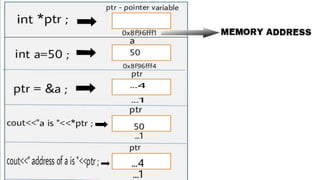
 A pointer is a variable which holds the memory address
of another variable.
 This memory address is the location of another variable
where it has been stored as memory.
 Therefore if a variable contains the address of another
variable is said to point to the second.
Declaration and Initialization of
Pointers
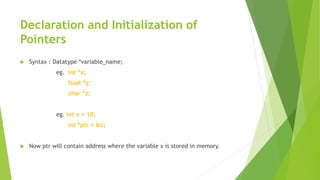
 Syntax : Datatype *variable_name;
eg. int *x;
float *y;
char *z;
eg. int x = 10;
int *ptr = &x;
 Now ptr will contain address where the variable x is stored in memory.
int *ptr;
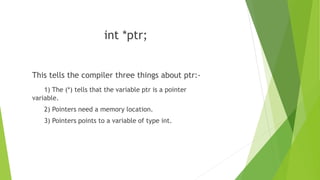
This tells the compiler three things about ptr:-
1) The (*) tells that the variable ptr is a pointer
variable.
2) Pointers need a memory location.
3) Pointers points to a variable of type int.
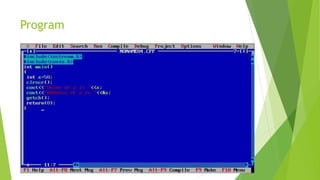
Program
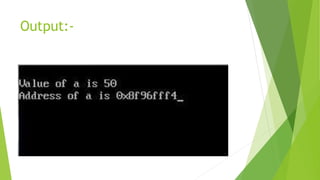
Output:-
More info….
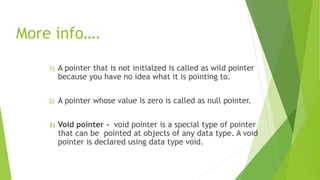
1) A pointer that is not initialzed is called as wild pointer
because you have no idea what it is pointing to.
2) A pointer whose value is zero is called as null pointer.
3) Void pointer - void pointer is a special type of pointer
that can be pointed at objects of any data type. A void
pointer is declared using data type void.
Thumb rule of pointers:-
1) Type must be same to the variable whose address is going
to pass to the pointer.
2) When you want to pass the address of the variable use ‘&’
before the variable name.
3) When you want to pass the value of the variable use ‘*’
before the pointer.
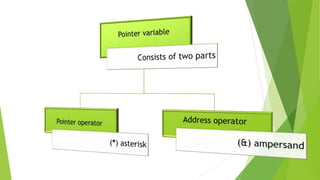
Pointer operator
 A pointer operator or a pointer variable is represented by a
combination of asterisk(*) with a variable name.
Syntax:-
data_type *pointer_variable;
eg. If a variable of character data type and also declared as *
(asterisk) with another variable it means the variable is of type
“Pointer to character”.
char *ptr;
where ptr is a pointer variable which holds the address of an
character data type.
Address Operator
 An address operator can be represented by a combination of and (ampersand)
with a pointer variable.
 The and is a unary operator that returns the memory address of its operand.
Syntax:-
data_type variable1;
data_type variable=&variable1;
Eg:-
int x;
int *ptr=&x;
It means that ptr receives the address of x;
Pointer Arithmetic
 Two arithmetic operations, addition and subtraction, may be
performed on pointers. When we add 1 to a pointer, we are
actually adding the size of data type in bytes, the pointer is
pointing at.
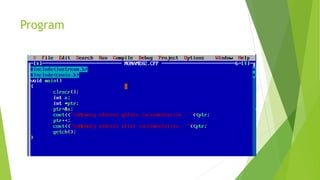
Eg. int *x; x++;
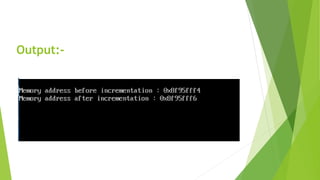
 If current address of x is 1000, then x++ statement will increase x
by 2(size of int data type) and makes it 1002, not 1001.
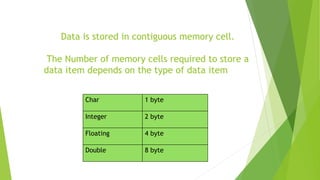
Data is stored in contiguous memory cell.
The Number of memory cells required to store a
data item depends on the type of data item
Char 1 byte
Integer 2 byte
Floating 4 byte
Double 8 byte
Program
Output:-
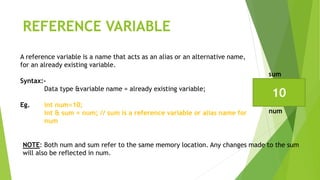
REFERENCE VARIABLE
A reference variable is a name that acts as an alias or an alternative name,
for an already existing variable.
Syntax:-
Data type &variable name = already existing variable;
Eg. int num=10;
int & sum = num; // sum is a reference variable or alias name for
num
NOTE: Both num and sum refer to the same memory location. Any changes made to the sum
will also be reflected in num.
10
sum
num
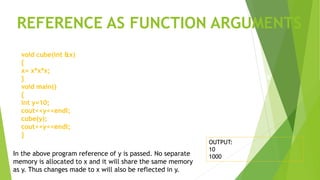
void cube(int &x)
{
x= x*x*x;
}
void main()
{
int y=10;
cout<<y<<endl;
cube(y);
cout<<y<<endl;
}
x
In the above program reference of y is passed. No separate
memory is allocated to x and it will share the same memory
as y. Thus changes made to x will also be reflected in y.
OUTPUT:
10
1000
REFERENCE AS FUNCTION ARGUMENTS
y
100
Program
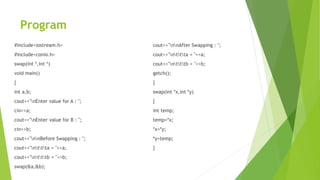
#include<iostream.h>
#include<conio.h>
swap(int *,int *)
void main()
{
int a,b;
cout<<"nEnter value for A : ";
cin>>a;
cout<<"nEnter value for B : ";
cin>>b;
cout<<"nnBefore Swapping : ";
cout<<"nttta = "<<a;
cout<<"ntttb = "<<b;
swap(&a,&b);
cout<<"nnAfter Swapping : ";
cout<<"nttta = "<<a;
cout<<"ntttb = "<<b;
getch();
}
swap(int *x,int *y)
{
int temp;
temp=*x;
*x=*y;
*y=temp;
}
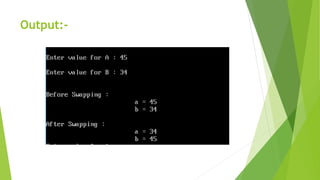
Output:-
Pointers in c++

Pointers in c++

  • 1.
  • 2.
    Points  Introduction.  Declarationand initialization of pointers.  Small program.  Thumb rule.  Pointer Variable.  Pointer Arithmetic.  Reference Variable.  Reference as function arguments
  • 3.
    What is aPointer???  A pointer is a variable which holds the memory address of another variable.  This memory address is the location of another variable where it has been stored as memory.  Therefore if a variable contains the address of another variable is said to point to the second.
  • 4.
    Declaration and Initializationof Pointers  Syntax : Datatype *variable_name; eg. int *x; float *y; char *z; eg. int x = 10; int *ptr = &x;  Now ptr will contain address where the variable x is stored in memory.
  • 5.
    int *ptr; This tellsthe compiler three things about ptr:- 1) The (*) tells that the variable ptr is a pointer variable. 2) Pointers need a memory location. 3) Pointers points to a variable of type int.
  • 6.
  • 7.
  • 9.
    More info…. 1) Apointer that is not initialzed is called as wild pointer because you have no idea what it is pointing to. 2) A pointer whose value is zero is called as null pointer. 3) Void pointer - void pointer is a special type of pointer that can be pointed at objects of any data type. A void pointer is declared using data type void.
  • 10.
    Thumb rule ofpointers:- 1) Type must be same to the variable whose address is going to pass to the pointer. 2) When you want to pass the address of the variable use ‘&’ before the variable name. 3) When you want to pass the value of the variable use ‘*’ before the pointer.
  • 12.
    Pointer operator  Apointer operator or a pointer variable is represented by a combination of asterisk(*) with a variable name. Syntax:- data_type *pointer_variable; eg. If a variable of character data type and also declared as * (asterisk) with another variable it means the variable is of type “Pointer to character”. char *ptr; where ptr is a pointer variable which holds the address of an character data type.
  • 13.
    Address Operator  Anaddress operator can be represented by a combination of and (ampersand) with a pointer variable.  The and is a unary operator that returns the memory address of its operand. Syntax:- data_type variable1; data_type variable=&variable1; Eg:- int x; int *ptr=&x; It means that ptr receives the address of x;
  • 14.
    Pointer Arithmetic  Twoarithmetic operations, addition and subtraction, may be performed on pointers. When we add 1 to a pointer, we are actually adding the size of data type in bytes, the pointer is pointing at. Eg. int *x; x++;  If current address of x is 1000, then x++ statement will increase x by 2(size of int data type) and makes it 1002, not 1001.
  • 15.
    Data is storedin contiguous memory cell. The Number of memory cells required to store a data item depends on the type of data item Char 1 byte Integer 2 byte Floating 4 byte Double 8 byte
  • 16.
  • 17.
  • 18.
    REFERENCE VARIABLE A referencevariable is a name that acts as an alias or an alternative name, for an already existing variable. Syntax:- Data type &variable name = already existing variable; Eg. int num=10; int & sum = num; // sum is a reference variable or alias name for num NOTE: Both num and sum refer to the same memory location. Any changes made to the sum will also be reflected in num. 10 sum num
  • 19.
    void cube(int &x) { x=x*x*x; } void main() { int y=10; cout<<y<<endl; cube(y); cout<<y<<endl; } x In the above program reference of y is passed. No separate memory is allocated to x and it will share the same memory as y. Thus changes made to x will also be reflected in y. OUTPUT: 10 1000 REFERENCE AS FUNCTION ARGUMENTS y 100
  • 20.
    Program #include<iostream.h> #include<conio.h> swap(int *,int *) voidmain() { int a,b; cout<<"nEnter value for A : "; cin>>a; cout<<"nEnter value for B : "; cin>>b; cout<<"nnBefore Swapping : "; cout<<"nttta = "<<a; cout<<"ntttb = "<<b; swap(&a,&b); cout<<"nnAfter Swapping : "; cout<<"nttta = "<<a; cout<<"ntttb = "<<b; getch(); } swap(int *x,int *y) { int temp; temp=*x; *x=*y; *y=temp; }
  • 21.