Data Models
Content
• Introduction
• Types
• Description
INTRODUCTION
• Data Model defines how data is connected to each other and how they are
process and stored inside the system.
• Data Model gives an idea that how the final system look like after its
complete impletation
• The Relational Model, which uses a table-based format, is the most
common Database Model.
• Data Models are used to show how data is stored, connected ,
accesed and updated in the data management system.
Types of Database Models
• Relational Database Model
• Hierarchial Database Model
• Network Database Model
• Entity Relational Database Model
Hierarchial Database Model
* developed by IBM, in the 1950s.
* The Hierarchical Model was the first database management
system model.
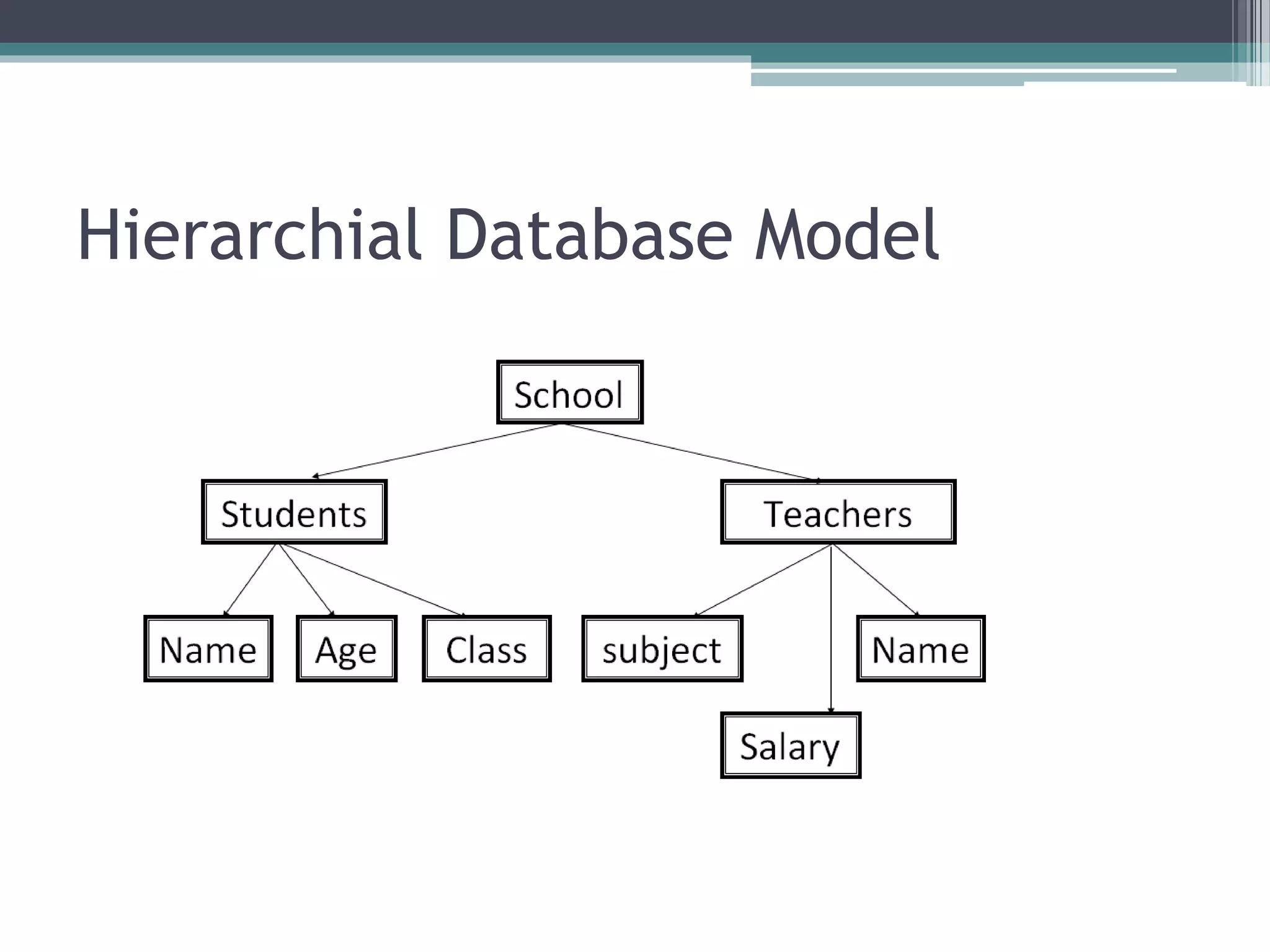
* This concept uses a hierarchical tree structure to organise the data.
• The data is organized into a tree-like structure where each record
consists of one parent record and many children.
* The Hierarchy starts from the root data and then its extends the
form of a tree adding child notes to the parents notes.
Hierarchial Database Model
Features
• 1. Parent-Child Relationship.
• 2. One-to-many Relationship.
• 3. Deletion Problem.
• 4. If a Parent node is related then child node is
automatically deleted.
Advantages
• simple hierarchical database structure.
• It has data sharing as all data are held in a
common database data and therefore sharing of
data becomes practical.
• Any changes in the parent node is automatically
reflected in the child node so integrity of the
data is maintain.
Disadvantages
• 1. it is quite complex to implement.
• 2.This model also lacks flexibility as the changes
in the new tables or segments often yield very
complex system management tasks.
Relational Database Model
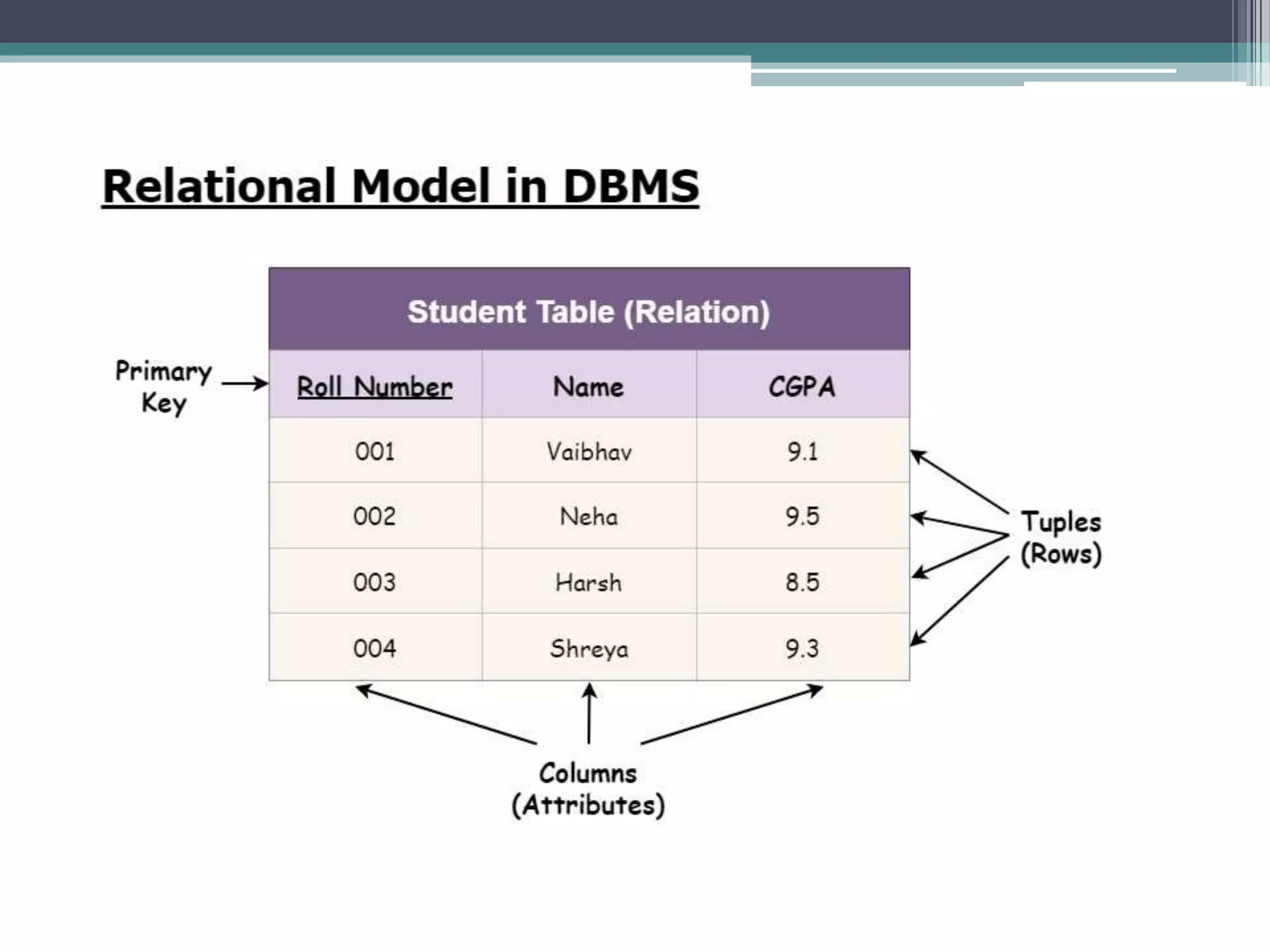
• Relational Model was proposed by E.F. Codd to
model data in the form of relations or tables.
• A relational database stores data in the form of
relations (tables).
IMPORTANT TERMINOLOGIES
• Attribute: Attributes are the properties that define a relation.
e.g.; ROLL_NO, NAME
• Tuple: Each row in the relation is known as tuple.
• Column: Column represents the set of values for a particular
attribute..
Network Model
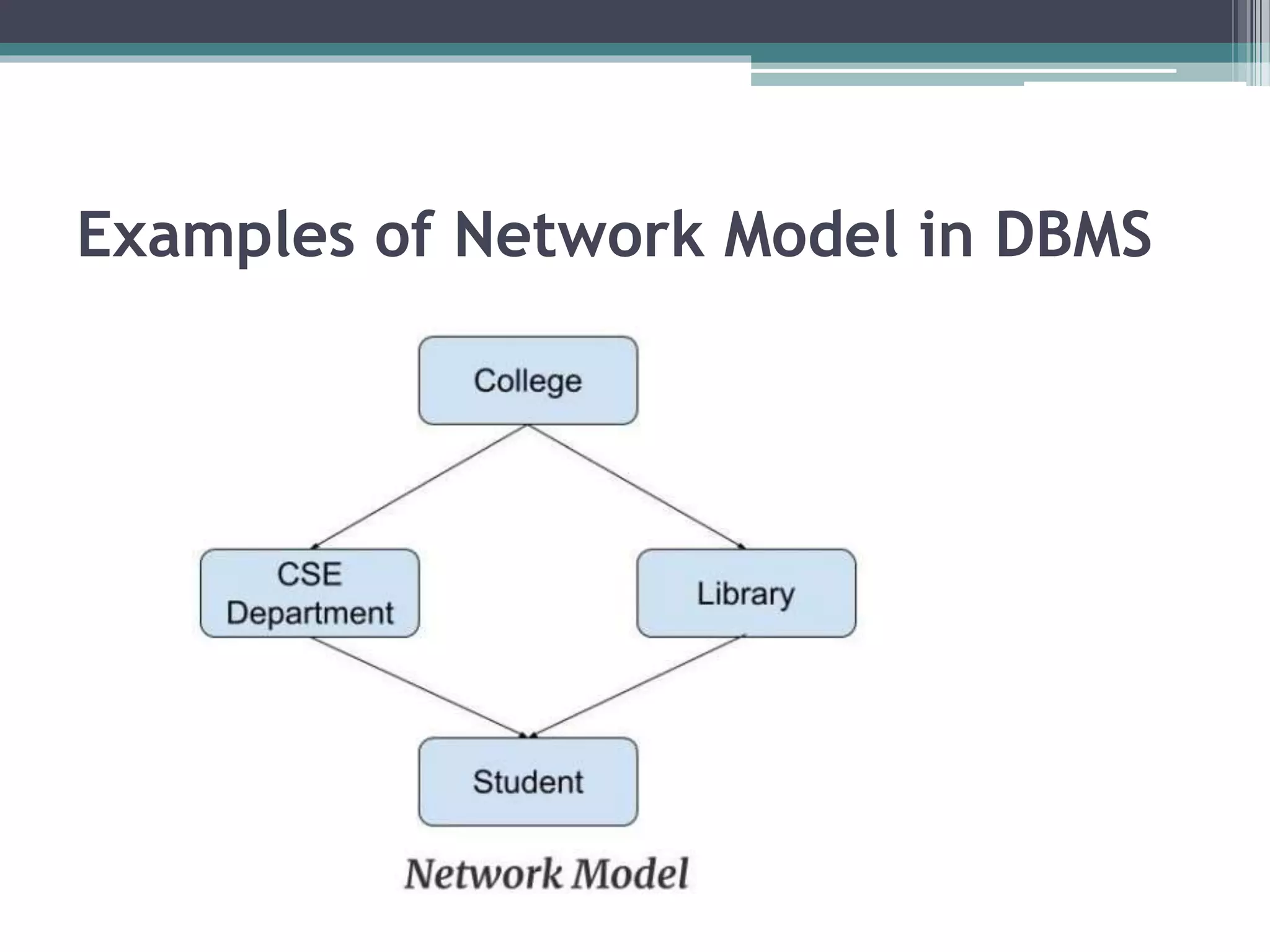
• The Network Model in DBMS is a hierarchical model that is used
to represent the many-to-many relationship among the database.
• It is represented in the form of a graph hence it is a simple and easy-
to-construct database model.
• An entity can have various parents.
• All the entities are interconnected with each other as a connected
network.
Examples of Network Model in DBMS
EntityRelational DatabaseModel
• ER model stands for an Entity-Relationship model.
• Entity relationship (ER) models are based on the
real-world entities and their relationships.
• An Entity–relationship model (ER
model) describes the structure of a database with
the help of a diagram, which is known as Entity
Relationship Diagram (ER Diagram).
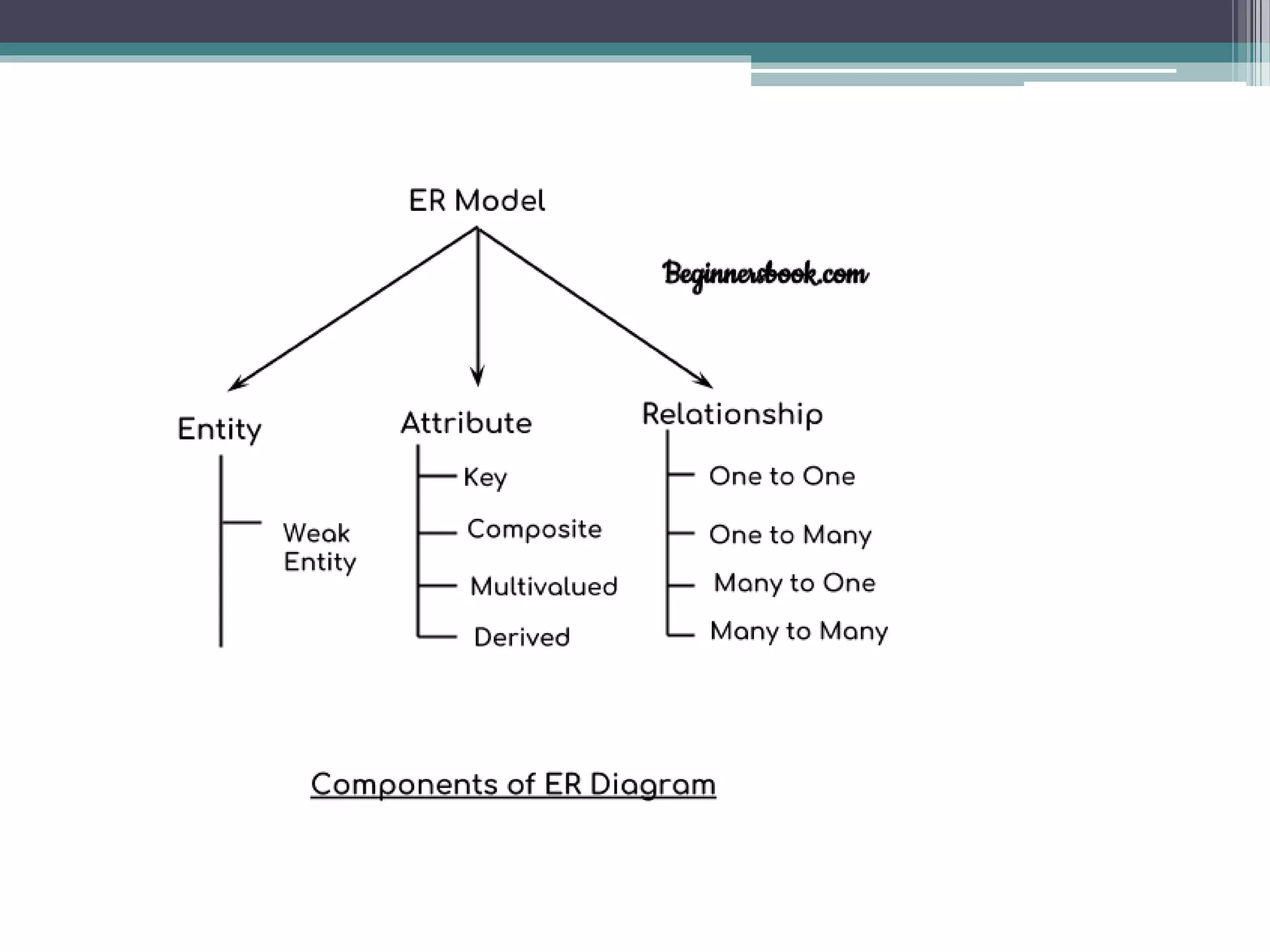
An ER diagram has three main components:
1. Entity
2. Attribute
3. Relationship
1. Entity
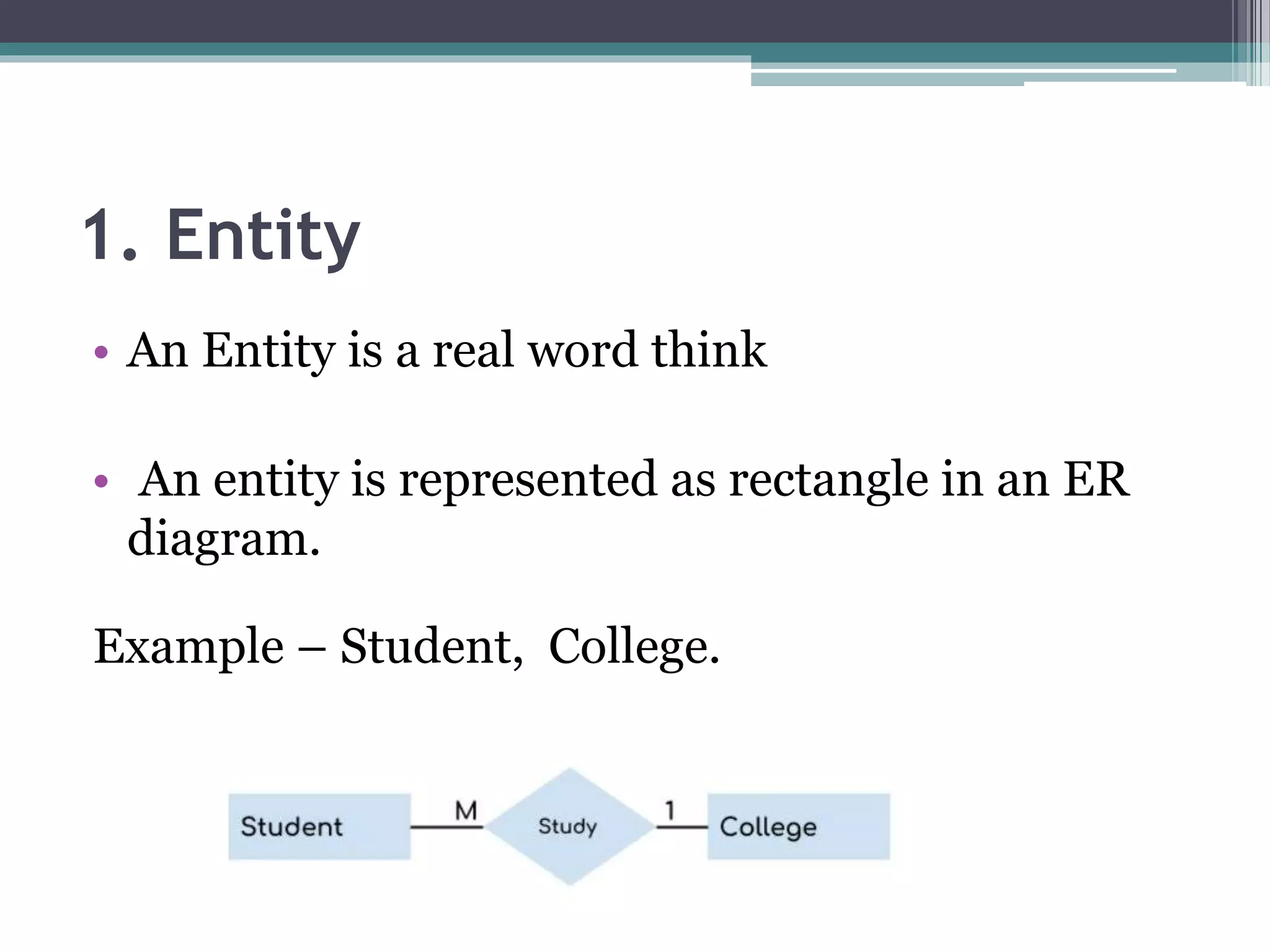
• An Entity is a real word think
• An entity is represented as rectangle in an ER
diagram.
Example – Student, College.
2. Attribute
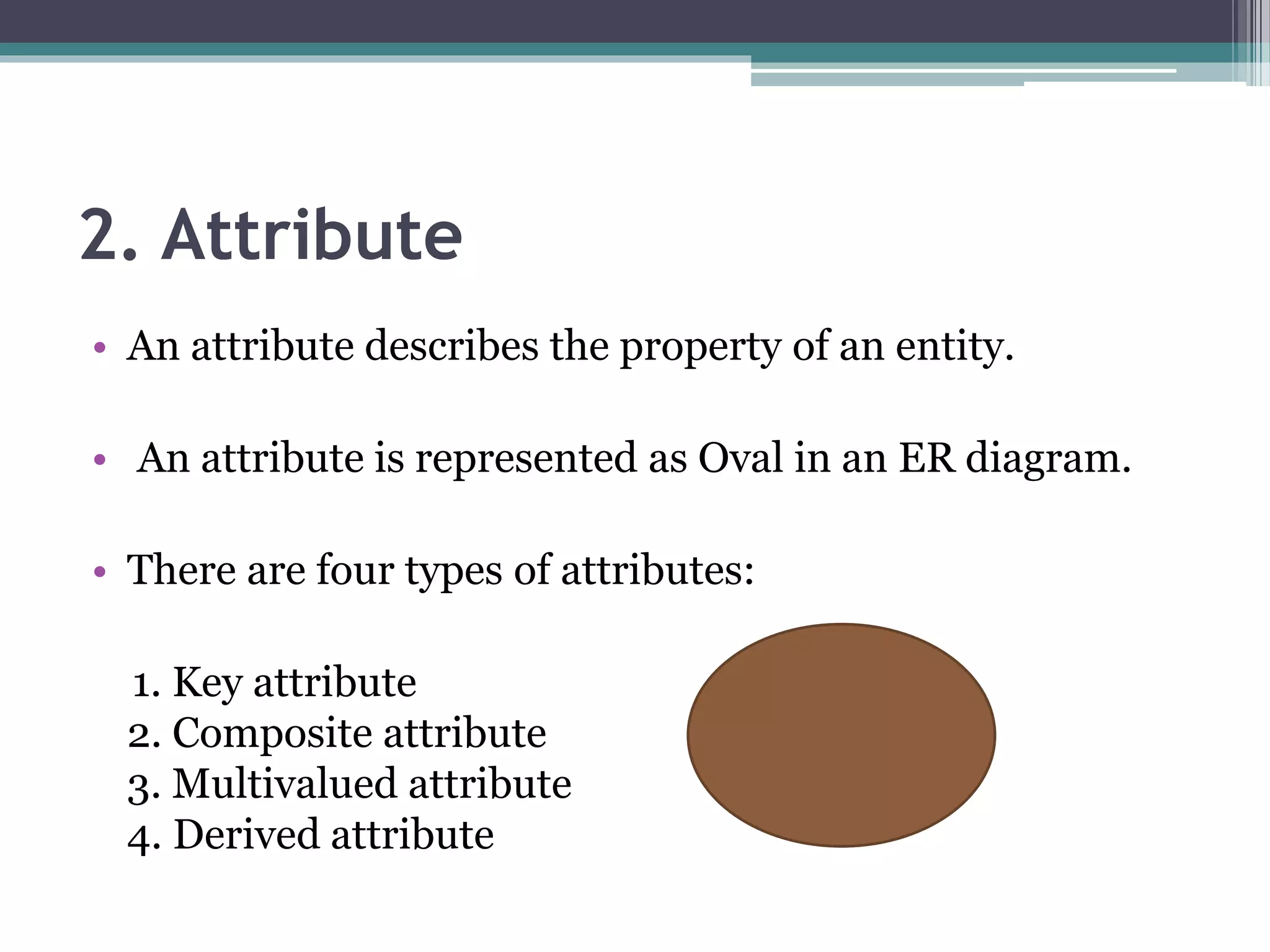
• An attribute describes the property of an entity.
• An attribute is represented as Oval in an ER diagram.
• There are four types of attributes:
1. Key attribute
2. Composite attribute
3. Multivalued attribute
4. Derived attribute
3. Relationship
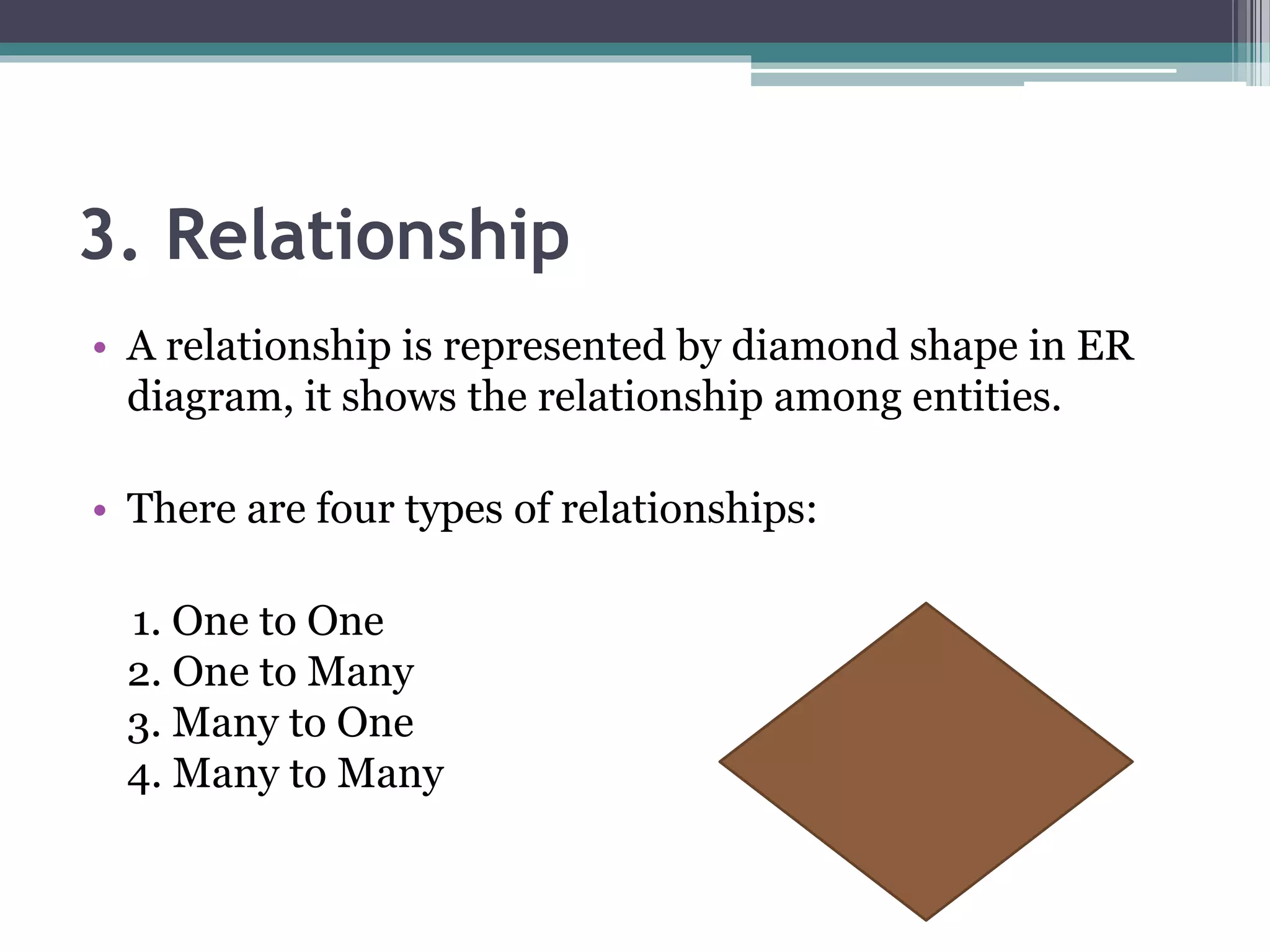
• A relationship is represented by diamond shape in ER
diagram, it shows the relationship among entities.
• There are four types of relationships:
1. One to One
2. One to Many
3. Many to One
4. Many to Many
Aparna RDBMS PPT.pptx

Aparna RDBMS PPT.pptx

  • 2.
  • 3.
  • 4.
    INTRODUCTION • Data Modeldefines how data is connected to each other and how they are process and stored inside the system. • Data Model gives an idea that how the final system look like after its complete impletation • The Relational Model, which uses a table-based format, is the most common Database Model. • Data Models are used to show how data is stored, connected , accesed and updated in the data management system.
  • 5.
    Types of DatabaseModels • Relational Database Model • Hierarchial Database Model • Network Database Model • Entity Relational Database Model
  • 6.
    Hierarchial Database Model *developed by IBM, in the 1950s. * The Hierarchical Model was the first database management system model. * This concept uses a hierarchical tree structure to organise the data. • The data is organized into a tree-like structure where each record consists of one parent record and many children. * The Hierarchy starts from the root data and then its extends the form of a tree adding child notes to the parents notes.
  • 7.
  • 8.
    Features • 1. Parent-ChildRelationship. • 2. One-to-many Relationship. • 3. Deletion Problem. • 4. If a Parent node is related then child node is automatically deleted.
  • 9.
    Advantages • simple hierarchicaldatabase structure. • It has data sharing as all data are held in a common database data and therefore sharing of data becomes practical. • Any changes in the parent node is automatically reflected in the child node so integrity of the data is maintain.
  • 10.
    Disadvantages • 1. itis quite complex to implement. • 2.This model also lacks flexibility as the changes in the new tables or segments often yield very complex system management tasks.
  • 11.
    Relational Database Model •Relational Model was proposed by E.F. Codd to model data in the form of relations or tables. • A relational database stores data in the form of relations (tables).
  • 12.
    IMPORTANT TERMINOLOGIES • Attribute:Attributes are the properties that define a relation. e.g.; ROLL_NO, NAME • Tuple: Each row in the relation is known as tuple. • Column: Column represents the set of values for a particular attribute..
  • 14.
    Network Model • TheNetwork Model in DBMS is a hierarchical model that is used to represent the many-to-many relationship among the database. • It is represented in the form of a graph hence it is a simple and easy- to-construct database model. • An entity can have various parents. • All the entities are interconnected with each other as a connected network.
  • 15.
    Examples of NetworkModel in DBMS
  • 16.
    EntityRelational DatabaseModel • ERmodel stands for an Entity-Relationship model. • Entity relationship (ER) models are based on the real-world entities and their relationships. • An Entity–relationship model (ER model) describes the structure of a database with the help of a diagram, which is known as Entity Relationship Diagram (ER Diagram).
  • 18.
    An ER diagramhas three main components: 1. Entity 2. Attribute 3. Relationship
  • 19.
    1. Entity • AnEntity is a real word think • An entity is represented as rectangle in an ER diagram. Example – Student, College.
  • 20.
    2. Attribute • Anattribute describes the property of an entity. • An attribute is represented as Oval in an ER diagram. • There are four types of attributes: 1. Key attribute 2. Composite attribute 3. Multivalued attribute 4. Derived attribute
  • 21.
    3. Relationship • Arelationship is represented by diamond shape in ER diagram, it shows the relationship among entities. • There are four types of relationships: 1. One to One 2. One to Many 3. Many to One 4. Many to Many