Seyed Mohamad Javad Beheshtian
beheshtraya@gmail.com
Isfahan University of Technology
Spring 2014
Oracle Database
Introduction
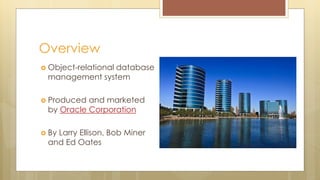
 Object-relational database
management system
 Produced and marketed
by Oracle Corporation
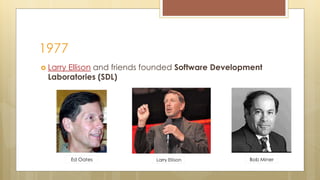
 By Larry Ellison, Bob Miner
and Ed Oates
Overview
Technical Timeline
 Larry Ellison and friends founded Software Development
Laboratories (SDL)
1977
 Oracle Version 1, written in assembly language, runs on
PDP-11 under RSX, in 128K of memory.
 Oracle V1 is never officially released.
1978
 SDL changed its company-name to "Relational Software,
Inc." (RSI)
 Introduced its product Oracle V2 as an early relational
database system.
1979
 Often cited as the first commercially sold RDBMS.
 The version did not support transactions, but implemented
the basic SQL functionality of queries and joins.
1979 (Cont’d)
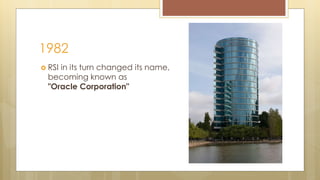
 RSI in its turn changed its name,
becoming known as
"Oracle Corporation"
1982
 The company released Oracle version 3
 It had re-written using the C programming language
1983
 Supported COMMIT and ROLLBACK functionality for
transactions
 Version 3 extended platform support from the existing Digital
VAX/VMS systems to include Unix environments
1983 (Cont’d)
 Oracle Corporation released Oracle version 4,
 Supported read-consistency.
 In October it also released the first Oracle for the IBM PC.
1984
 Oracle Corporation released Oracle version 5
 Supported the client–server model
 Networks becoming more widely available in the mid-1980s
1985
 Oracle RDBMS version 6 came out
 It support for PL/SQL, row-level locking and hot backups.
1988
 Oracle's procedural language extension for SQL
 Available in Oracle, TimesTen in-memory, and IBM DB2
PL/SQL
 Oracle Corporation entered the application-products market
and developed its ERP product
 Later to become part of the Oracle E-Business Suite
 Based on the Oracle relational database
1989
 The release of Oracle Applications
 Oracle Applications refers to the non-database and non-
middleware parts of Oracle's software portfolio.
 ERP, CRM, SCM, …
1990
 Oracle version 7 appeared
 Support for referential integrity, stored procedures and
triggers
1992
 Oracle Corporation released version 8
 Supported object-oriented development and multimedia
applications.
1997
 Release of Oracle8i
 Aimed to provide a database inter-operating better with the
Internet
 The i in the name stands for "Internet".
1999
 The Oracle8i database incorporated a native Java virtual
machine
 Oracle JVM, also known as "Aurora"
1999 (Cont’d)
 Oracle E-Business Suite 11i pioneers integrated enterprise
application software
2000
 Oracle9i went into release with 400 new features
 Support to read and write XML documents
2001
 Provided an option for Oracle RAC "Real Application Clusters“
 computer-cluster database, as a replacement for the Oracle
Parallel Server (OPS) option.
2001 (Cont’d)
 Provides software for clustering and high availability
 Allows multiple computers to run Oracle RDBMS software
simultaneously while accessing a single database
 Performance, scalability and resilience
Oracle RAC
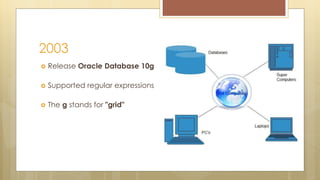
 Release Oracle Database 10g
 Supported regular expressions
 The g stands for "grid"
2003
 Oracle Corporation announces Unbreakable Linux
 Acquires i-flex
2006
 Oracle 10g r2 sets a new world record TPC-H 3000 GB
benchmark result
 Oracle Corporation released Oracle Database 11g for Linux
and for Microsoft Windows
2007
 Oracle Corporation acquires BEA Systems
2008
 Oracle Corporation acquires Sun Microsystems.
2010
 Oracle Corporation acquires FatWire Software.
2011
 Oracle Corporation acquires Endeca Technologies Inc.
2011 (Cont’d)
 Rerelease Oracle Database 12c
 For Linux, Solaris and Windows
 The c stands for "cloud"
2013
 12c Enterprise edition
 12c Standard edition
 12c Standard One edition
 12c Personal edition
 11g Express edition
Current Versions & Editions
 Yahoo !
 Amazon
 LinkedIn (also use MySQL)
Oracle Famous Users
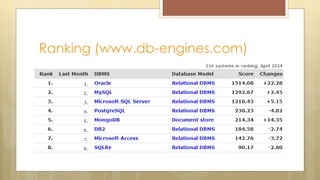
Ranking (www.db-engines.com)
Some Features
 Cold Backup
 done with the database in a shutdown state
 provides a complete copy of the database
 Hot Backup
 taken while the database is active
 can only give a read-consistent copy
 doesn't handle active transactions
Backup
 C++: Oracle C++ Call Interface (OCCI)
 Java: JDBC Driver (Customized)
 .NET: ODP.NET (optimized ADO.NET for Oracle)
 Python: cx_Oracle
Programming API
Oracle Multitenant
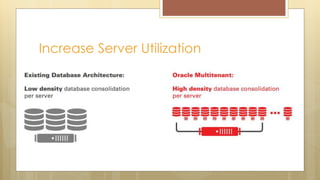
Increase Server Utilization
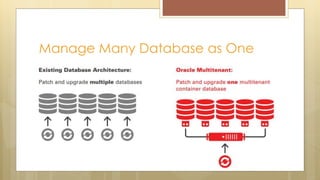
Manage Many Database as One
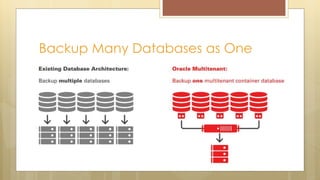
Backup Many Databases as One
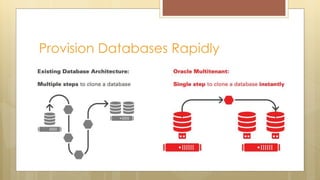
Provision Databases Rapidly
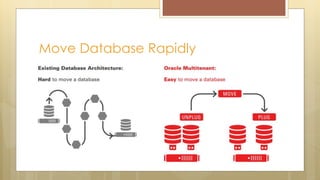
Move Database Rapidly
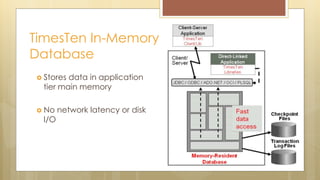
 Stores data in application
tier main memory
 No network latency or disk
I/O
TimesTen In-Memory
Database
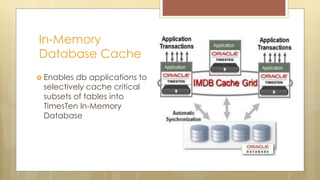
 Enables db applications to
selectively cache critical
subsets of tables into
TimesTen In-Memory
Database
In-Memory
Database Cache
Installing Oracle Database
&
Creating a Database
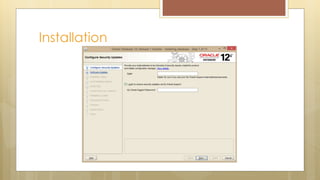
 Oracle Universal Installer (OUI)
 A graphical user interface utility that install new Oracle
Database software
Installation
Installation
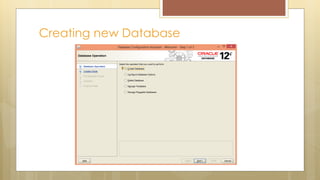
Creating new Database
Tools & Environments
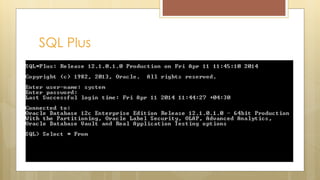
 The most basic Oracle Database utility
 A Basic command-line interface
 The first thing you work with it in Oracle DBMS
SQL Plus
SQL Plus
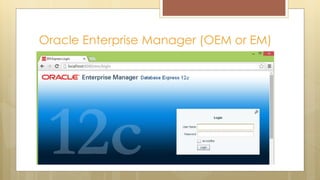
 Set of web-based tools
 Manage software and hardware produced by Oracle
 HTTP or HTTPS
Oracle Enterprise Manager (OEM or EM)
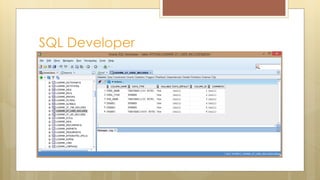
 IDE for working with SQL in Oracle databases
 Use Java Development Kit
 Can connect to non-Oracle databases
 works with IBM DB2, Microsoft SQL Server, MySQL, Sybase, …
SQL Developer
SQL Developer
SQL Developer

Oracle database introduction

  • 1.
    Seyed Mohamad JavadBeheshtian beheshtraya@gmail.com Isfahan University of Technology Spring 2014 Oracle Database Introduction
  • 2.
     Object-relational database managementsystem  Produced and marketed by Oracle Corporation  By Larry Ellison, Bob Miner and Ed Oates Overview
  • 3.
  • 4.
     Larry Ellisonand friends founded Software Development Laboratories (SDL) 1977
  • 5.
     Oracle Version1, written in assembly language, runs on PDP-11 under RSX, in 128K of memory.  Oracle V1 is never officially released. 1978
  • 6.
     SDL changedits company-name to "Relational Software, Inc." (RSI)  Introduced its product Oracle V2 as an early relational database system. 1979
  • 7.
     Often citedas the first commercially sold RDBMS.  The version did not support transactions, but implemented the basic SQL functionality of queries and joins. 1979 (Cont’d)
  • 8.
     RSI inits turn changed its name, becoming known as "Oracle Corporation" 1982
  • 9.
     The companyreleased Oracle version 3  It had re-written using the C programming language 1983
  • 10.
     Supported COMMITand ROLLBACK functionality for transactions  Version 3 extended platform support from the existing Digital VAX/VMS systems to include Unix environments 1983 (Cont’d)
  • 11.
     Oracle Corporationreleased Oracle version 4,  Supported read-consistency.  In October it also released the first Oracle for the IBM PC. 1984
  • 12.
     Oracle Corporationreleased Oracle version 5  Supported the client–server model  Networks becoming more widely available in the mid-1980s 1985
  • 13.
     Oracle RDBMSversion 6 came out  It support for PL/SQL, row-level locking and hot backups. 1988
  • 14.
     Oracle's procedurallanguage extension for SQL  Available in Oracle, TimesTen in-memory, and IBM DB2 PL/SQL
  • 15.
     Oracle Corporationentered the application-products market and developed its ERP product  Later to become part of the Oracle E-Business Suite  Based on the Oracle relational database 1989
  • 16.
     The releaseof Oracle Applications  Oracle Applications refers to the non-database and non- middleware parts of Oracle's software portfolio.  ERP, CRM, SCM, … 1990
  • 17.
     Oracle version7 appeared  Support for referential integrity, stored procedures and triggers 1992
  • 18.
     Oracle Corporationreleased version 8  Supported object-oriented development and multimedia applications. 1997
  • 19.
     Release ofOracle8i  Aimed to provide a database inter-operating better with the Internet  The i in the name stands for "Internet". 1999
  • 20.
     The Oracle8idatabase incorporated a native Java virtual machine  Oracle JVM, also known as "Aurora" 1999 (Cont’d)
  • 21.
     Oracle E-BusinessSuite 11i pioneers integrated enterprise application software 2000
  • 22.
     Oracle9i wentinto release with 400 new features  Support to read and write XML documents 2001
  • 23.
     Provided anoption for Oracle RAC "Real Application Clusters“  computer-cluster database, as a replacement for the Oracle Parallel Server (OPS) option. 2001 (Cont’d)
  • 24.
     Provides softwarefor clustering and high availability  Allows multiple computers to run Oracle RDBMS software simultaneously while accessing a single database  Performance, scalability and resilience Oracle RAC
  • 25.
     Release OracleDatabase 10g  Supported regular expressions  The g stands for "grid" 2003
  • 26.
     Oracle Corporationannounces Unbreakable Linux  Acquires i-flex 2006
  • 27.
     Oracle 10gr2 sets a new world record TPC-H 3000 GB benchmark result  Oracle Corporation released Oracle Database 11g for Linux and for Microsoft Windows 2007
  • 28.
     Oracle Corporationacquires BEA Systems 2008
  • 29.
     Oracle Corporationacquires Sun Microsystems. 2010
  • 30.
     Oracle Corporationacquires FatWire Software. 2011
  • 31.
     Oracle Corporationacquires Endeca Technologies Inc. 2011 (Cont’d)
  • 32.
     Rerelease OracleDatabase 12c  For Linux, Solaris and Windows  The c stands for "cloud" 2013
  • 33.
     12c Enterpriseedition  12c Standard edition  12c Standard One edition  12c Personal edition  11g Express edition Current Versions & Editions
  • 34.
     Yahoo ! Amazon  LinkedIn (also use MySQL) Oracle Famous Users
  • 35.
  • 36.
  • 37.
     Cold Backup done with the database in a shutdown state  provides a complete copy of the database  Hot Backup  taken while the database is active  can only give a read-consistent copy  doesn't handle active transactions Backup
  • 38.
     C++: OracleC++ Call Interface (OCCI)  Java: JDBC Driver (Customized)  .NET: ODP.NET (optimized ADO.NET for Oracle)  Python: cx_Oracle Programming API
  • 39.
  • 40.
  • 41.
  • 42.
  • 43.
  • 44.
  • 45.
     Stores datain application tier main memory  No network latency or disk I/O TimesTen In-Memory Database
  • 46.
     Enables dbapplications to selectively cache critical subsets of tables into TimesTen In-Memory Database In-Memory Database Cache
  • 47.
  • 48.
     Oracle UniversalInstaller (OUI)  A graphical user interface utility that install new Oracle Database software Installation
  • 49.
  • 50.
  • 51.
  • 52.
     The mostbasic Oracle Database utility  A Basic command-line interface  The first thing you work with it in Oracle DBMS SQL Plus
  • 53.
  • 54.
     Set ofweb-based tools  Manage software and hardware produced by Oracle  HTTP or HTTPS Oracle Enterprise Manager (OEM or EM)
  • 55.
  • 56.
     IDE forworking with SQL in Oracle databases  Use Java Development Kit  Can connect to non-Oracle databases  works with IBM DB2, Microsoft SQL Server, MySQL, Sybase, … SQL Developer
  • 57.
  • 58.

Editor's Notes

  • #6 RSX-11 is a family of real-time operating systems mainly for PDP-11 computers created by Digital Equipment Corporation(DEC), common in the late 1970s and early 1980s.
  • #9 to align itself more closely with its flagship product.
  • #15 Similar to T-Sql in Microsoft sql server Or PL/pgsql in post
  • #18 referential integrity == foreign key
  • #25 Shared-nothing Shared-everything Oracle provide shared-nothing
  • #26 emphasizing a marketing thrust of presenting 10g as "grid computing ready".)
  • #27 Internet service Clouded service Financial Banking Specially in India
  • #29 enterprise infrastructure software products
  • #30 Sun Solaris -> Oracle Solaris
  • #31 web content management system
  • #32  search engine software vendor
  • #39 C++ : enables C++ programmers to use the full range of Oracle database operations, including SQL statement processing and object manipulation. Efficient auth
  • #40 US$350.00
  • #46 US$460.00
  • #47 US$460.00
  • #55 Database Control --> Grid control --> Cloud control
  • #57 Entity Relationship Diagrams Geospatial data viewer