DATA MODEL
Asst.Prof. Rupali Lohar
Dept. of Computer Science & Engineering
B. R. Harne College Of Engineering & Technology, Karav, Post Vangani (W Tal
Ambernath, Mumbai, Maharashtra 421503
DATA MODEL
A Database model defines the logical design and structure of a
database and defines how data will be stored, accessed and updated in
a database management system.
Types of Data Model
• Hierarchical Model
• Network Model
• Entity-Relationship Model
• Relational Model
• Object-Oriented Data Model
Hierarchical Model
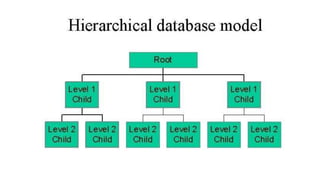
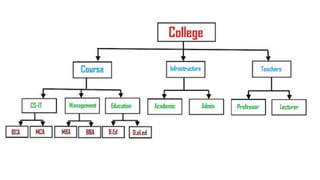
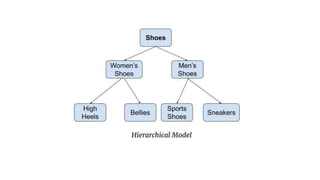
• Hierarchical Model was the first DBMS model. This model organizes
the data in the hierarchical tree structure. The hierarchy starts from
the root which has root data and then it expands in the form of a tree
adding child node to the parent node. This model easily represents
some of the real-world relationships like food recipes, sitemap of a
website etc.
Advantages of Hierarchical Model
• It is very simple and fast to traverse through a tree-like structure.
• Any change in the parent node is automatically reflected in the child
node so, the integrity of data is maintained.
Disadvantages of Hierarchical Model
• Complex relationships are not supported.
• As it does not support more than one parent of the child node so if we
have some complex relationship where a child node needs to have two
parent node then that can't be represented using this model.
• If a parent node is deleted then the child node is automatically deleted.
Network Model
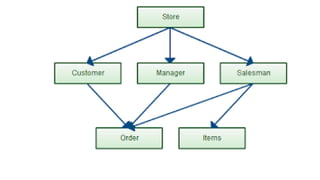
• This model is an extension of the hierarchical model. It was the most
popular model before the relational model. This model is the same as
the hierarchical model, the only difference is that a record can have
more than one parent. It replaces the hierarchical tree with a graph.
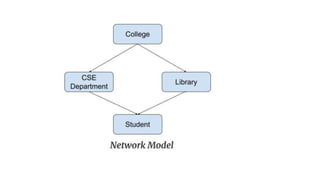
Example: In the example below we can see that node student has two
parents i.e. CSE Department and Library. This was earlier not possible
in the hierarchical model.
Advantages of Network Model
• The data can be accessed faster as compared to the hierarchical
model. each a particular node. So the data can be accessed in many
ways.
• As there is a parent-child relationship so data integrity is present. Any
change in parent record is reflected in the child record.
Disadvantages of Network Model
• As more complex. Any change like updation, deletion, insertion is very
complex.
Entity-Relationship Model
• Entity-Relationship Model or simply ER Model is a high-level data
model diagram. In this model, we represent the real-world problem in
the pictorial form
• It is also very easy for the developers to understand the system by
just looking at the ER diagram. We use the ER diagram as a visual tool
to represent an ER Model. ER diagram has the following three
components:
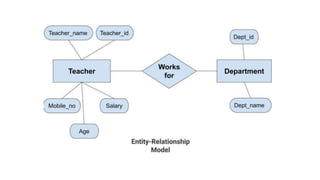
• Entities: Entity is a real-world thing. It can be a person, place, or even
a concept. Example: Teachers, Students, Course, Building,
Department, etc are some of the entities of a School Management
System.
• Attributes: An entity contains a real-world property called attribute.
This is the characteristics of that attribute. Example: The entity
teacher has the property like teacher id, salary, age, etc.
• Relationship: Relationship tells how two attributes are related.
Example: Teacher works for a department.
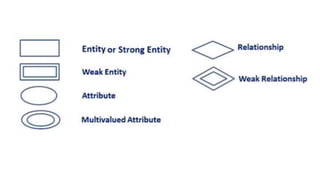
• Rectangle: Represents Entity sets.
• Ellipses: Attributes
• Diamonds: Relationship Set
• Lines: They link attributes to Entity Sets and Entity sets to
Relationship Set
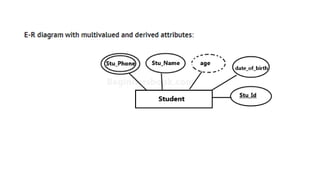
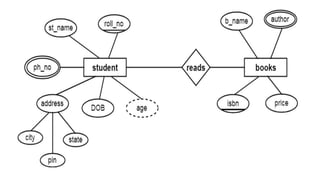
• Double Ellipses: Multivalued Attributes
• Dashed Ellipses: Derived Attributes
• Double Rectangles: Weak Entity Sets
• Double Lines: Total participation of an entity in a relationship set
Advantages of ER Model
• Simple: Conceptually ER Model is very easy to build.
• Effective Communication Tool: This model is used widely by the database
designers for communicating their ideas.
• Easy Conversion to any Model: This model maps well to the relational
model and can be easily converted relational model by converting the ER
model to the table. This model can also be converted to any other model
like network model, hierarchical model etc.
Disadvantages of ER Model
• Hidden information: Some information might be lost or hidden in the ER
model. As it is a high-level view so there are chances that some details of
information might be hidden.
Relational Model
• Relational Model is the most widely used model. In this model, the
data is maintained in the form of a two-dimensional table. All the
information is stored in the form of row and columns. The basic
structure of a relational model is tables. So, the tables are also called
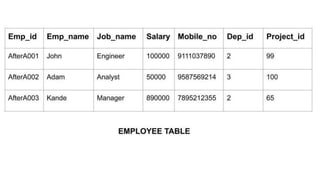
relations in the relational model. Example: In this example, we have
an Employee table.
Advantages of Relational Model
• Simple
• Scalable
• Structural Independence
Disadvantages of Relational Model
• Hardware Overheads: more powerful hardware computers and data
storage devices.
• Bad Design: As the relational model is very easy to design and use. So
the users don't need to know how the data is stored in order to
access it.
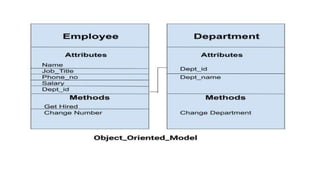
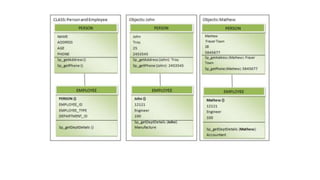
Object-Oriented Data Model
• The real-world problems are more closely represented through the
object-oriented data model. In this model, both the data and
relationship are present in a single structure known as an object
Data model
Data model
Data model

Data model

  • 1.
    DATA MODEL Asst.Prof. RupaliLohar Dept. of Computer Science & Engineering B. R. Harne College Of Engineering & Technology, Karav, Post Vangani (W Tal Ambernath, Mumbai, Maharashtra 421503
  • 2.
    DATA MODEL A Databasemodel defines the logical design and structure of a database and defines how data will be stored, accessed and updated in a database management system.
  • 3.
    Types of DataModel • Hierarchical Model • Network Model • Entity-Relationship Model • Relational Model • Object-Oriented Data Model
  • 4.
    Hierarchical Model • HierarchicalModel was the first DBMS model. This model organizes the data in the hierarchical tree structure. The hierarchy starts from the root which has root data and then it expands in the form of a tree adding child node to the parent node. This model easily represents some of the real-world relationships like food recipes, sitemap of a website etc.
  • 8.
    Advantages of HierarchicalModel • It is very simple and fast to traverse through a tree-like structure. • Any change in the parent node is automatically reflected in the child node so, the integrity of data is maintained. Disadvantages of Hierarchical Model • Complex relationships are not supported. • As it does not support more than one parent of the child node so if we have some complex relationship where a child node needs to have two parent node then that can't be represented using this model. • If a parent node is deleted then the child node is automatically deleted.
  • 9.
    Network Model • Thismodel is an extension of the hierarchical model. It was the most popular model before the relational model. This model is the same as the hierarchical model, the only difference is that a record can have more than one parent. It replaces the hierarchical tree with a graph. Example: In the example below we can see that node student has two parents i.e. CSE Department and Library. This was earlier not possible in the hierarchical model.
  • 12.
    Advantages of NetworkModel • The data can be accessed faster as compared to the hierarchical model. each a particular node. So the data can be accessed in many ways. • As there is a parent-child relationship so data integrity is present. Any change in parent record is reflected in the child record. Disadvantages of Network Model • As more complex. Any change like updation, deletion, insertion is very complex.
  • 13.
    Entity-Relationship Model • Entity-RelationshipModel or simply ER Model is a high-level data model diagram. In this model, we represent the real-world problem in the pictorial form • It is also very easy for the developers to understand the system by just looking at the ER diagram. We use the ER diagram as a visual tool to represent an ER Model. ER diagram has the following three components:
  • 14.
    • Entities: Entityis a real-world thing. It can be a person, place, or even a concept. Example: Teachers, Students, Course, Building, Department, etc are some of the entities of a School Management System. • Attributes: An entity contains a real-world property called attribute. This is the characteristics of that attribute. Example: The entity teacher has the property like teacher id, salary, age, etc. • Relationship: Relationship tells how two attributes are related. Example: Teacher works for a department.
  • 15.
    • Rectangle: RepresentsEntity sets. • Ellipses: Attributes • Diamonds: Relationship Set • Lines: They link attributes to Entity Sets and Entity sets to Relationship Set • Double Ellipses: Multivalued Attributes • Dashed Ellipses: Derived Attributes • Double Rectangles: Weak Entity Sets • Double Lines: Total participation of an entity in a relationship set
  • 20.
    Advantages of ERModel • Simple: Conceptually ER Model is very easy to build. • Effective Communication Tool: This model is used widely by the database designers for communicating their ideas. • Easy Conversion to any Model: This model maps well to the relational model and can be easily converted relational model by converting the ER model to the table. This model can also be converted to any other model like network model, hierarchical model etc. Disadvantages of ER Model • Hidden information: Some information might be lost or hidden in the ER model. As it is a high-level view so there are chances that some details of information might be hidden.
  • 21.
    Relational Model • RelationalModel is the most widely used model. In this model, the data is maintained in the form of a two-dimensional table. All the information is stored in the form of row and columns. The basic structure of a relational model is tables. So, the tables are also called relations in the relational model. Example: In this example, we have an Employee table.
  • 23.
    Advantages of RelationalModel • Simple • Scalable • Structural Independence Disadvantages of Relational Model • Hardware Overheads: more powerful hardware computers and data storage devices. • Bad Design: As the relational model is very easy to design and use. So the users don't need to know how the data is stored in order to access it.
  • 24.
    Object-Oriented Data Model •The real-world problems are more closely represented through the object-oriented data model. In this model, both the data and relationship are present in a single structure known as an object