
1
Presented by :
1.Kartik N. Kalpande.

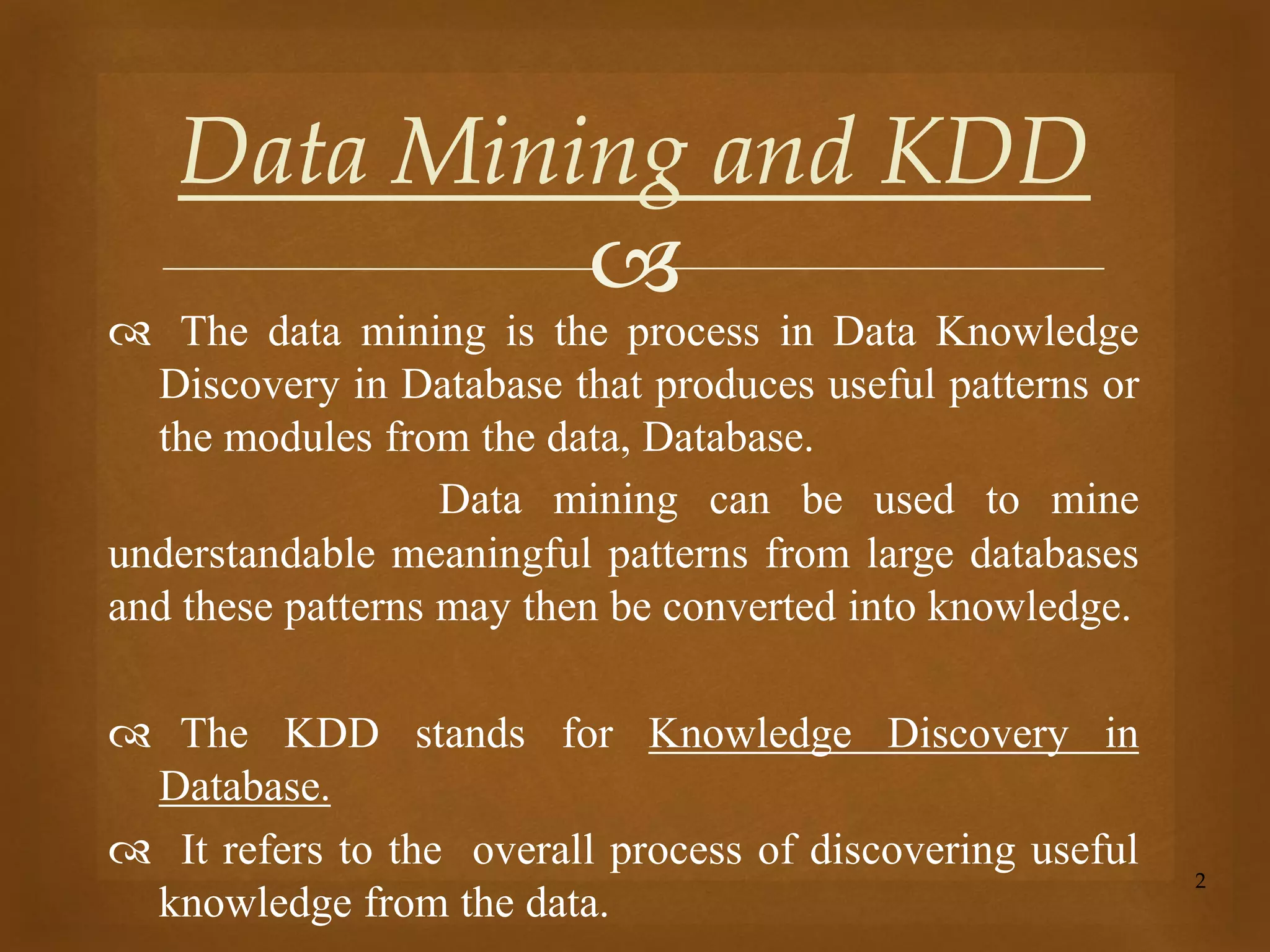
 The data mining is the process in Data Knowledge
Discovery in Database that produces useful patterns or
the modules from the data, Database.
Data mining can be used to mine
understandable meaningful patterns from large databases
and these patterns may then be converted into knowledge.
 The KDD stands for Knowledge Discovery in
Database.
 It refers to the overall process of discovering useful
knowledge from the data.
2
Data Mining and KDD

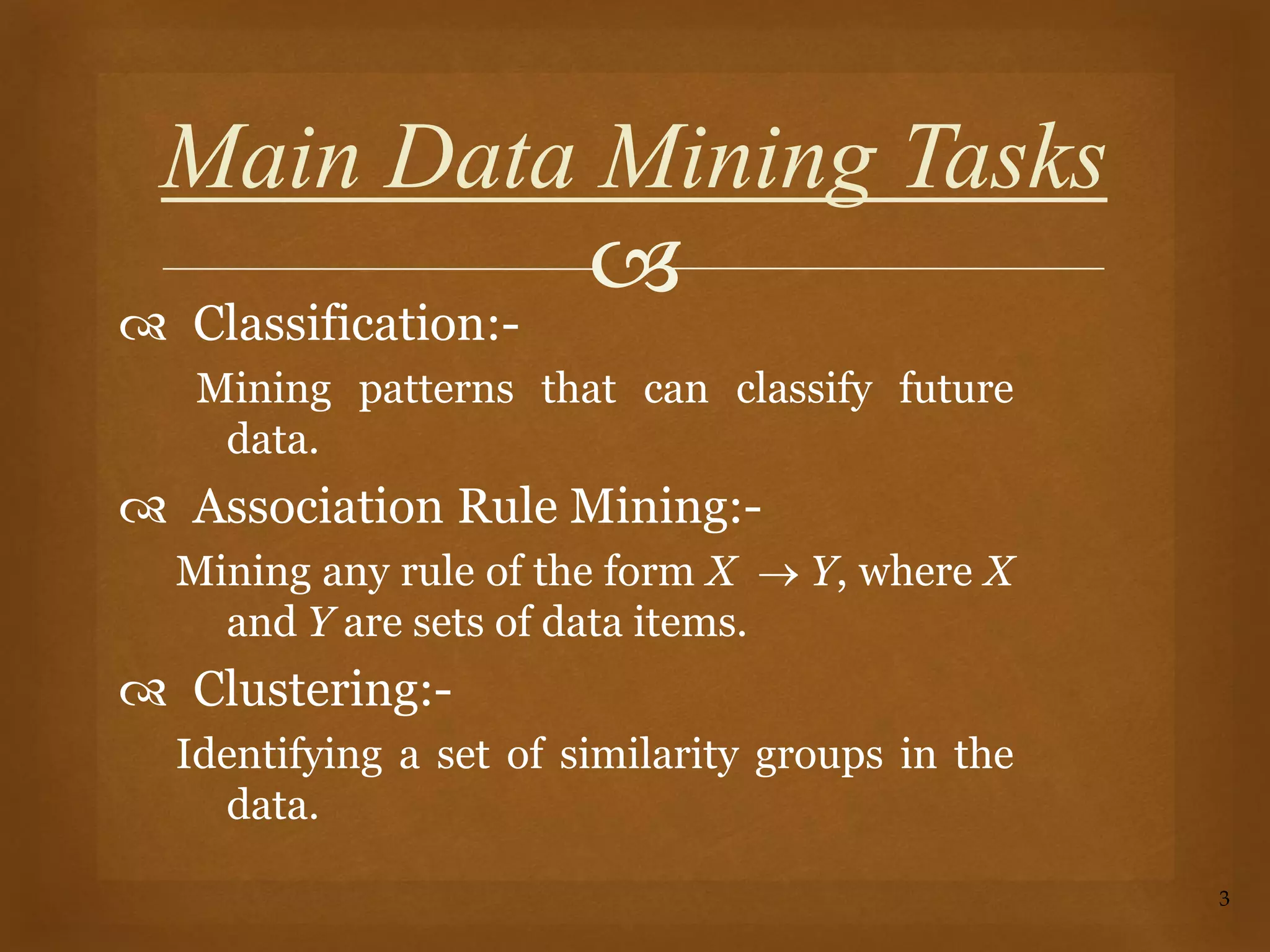
 Classification:-
Mining patterns that can classify future
data.
 Association Rule Mining:-
Mining any rule of the form X  Y, where X
and Y are sets of data items.
 Clustering:-
Identifying a set of similarity groups in the
data.
3
Main Data Mining Tasks
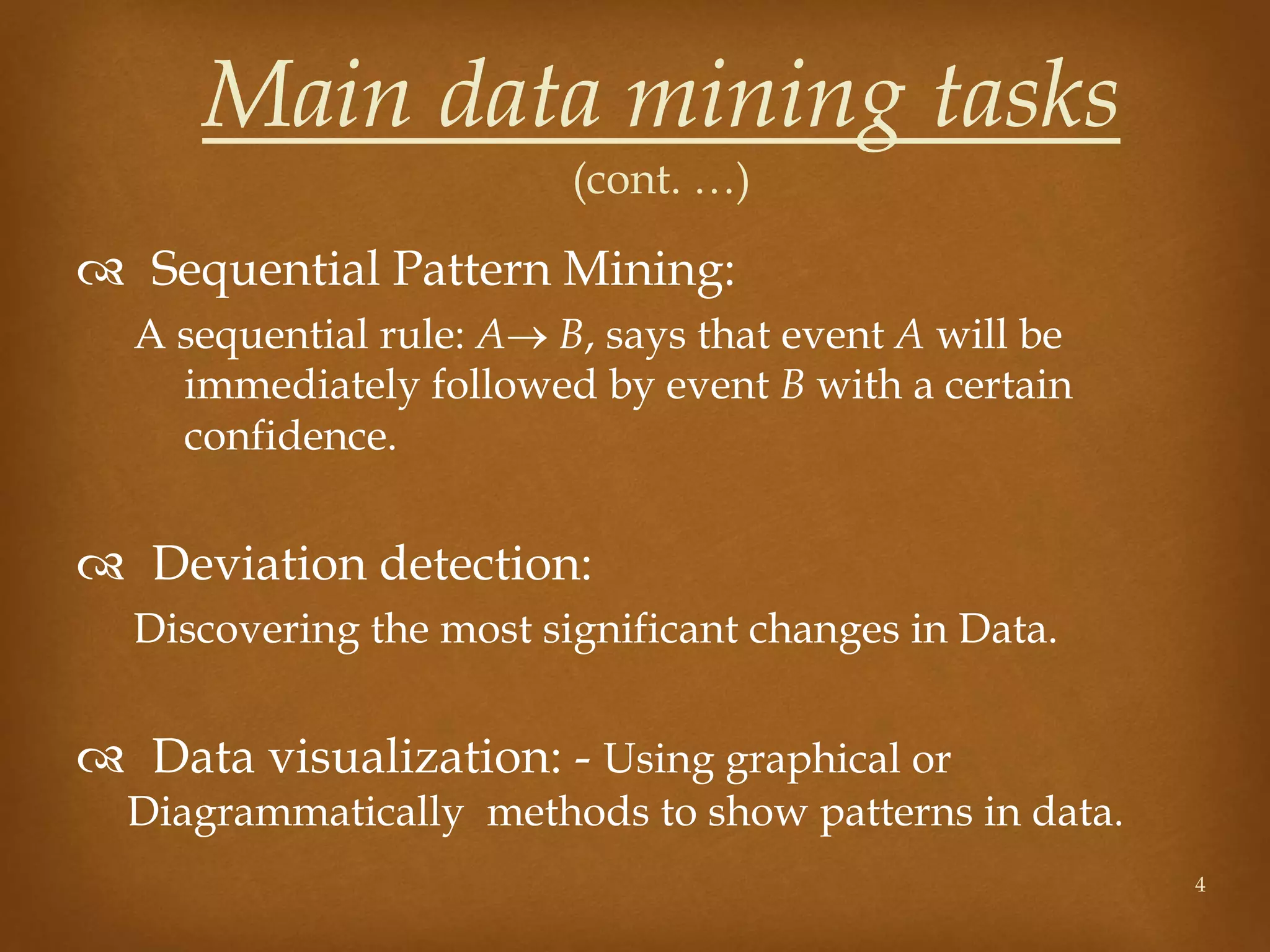
 Sequential Pattern Mining:
A sequential rule: A B, says that event A will be
immediately followed by event B with a certain
confidence.
 Deviation detection:
Discovering the most significant changes in Data.
 Data visualization: - Using graphical or
Diagrammatically methods to show patterns in data.
4
Main data mining tasks
(cont. …)

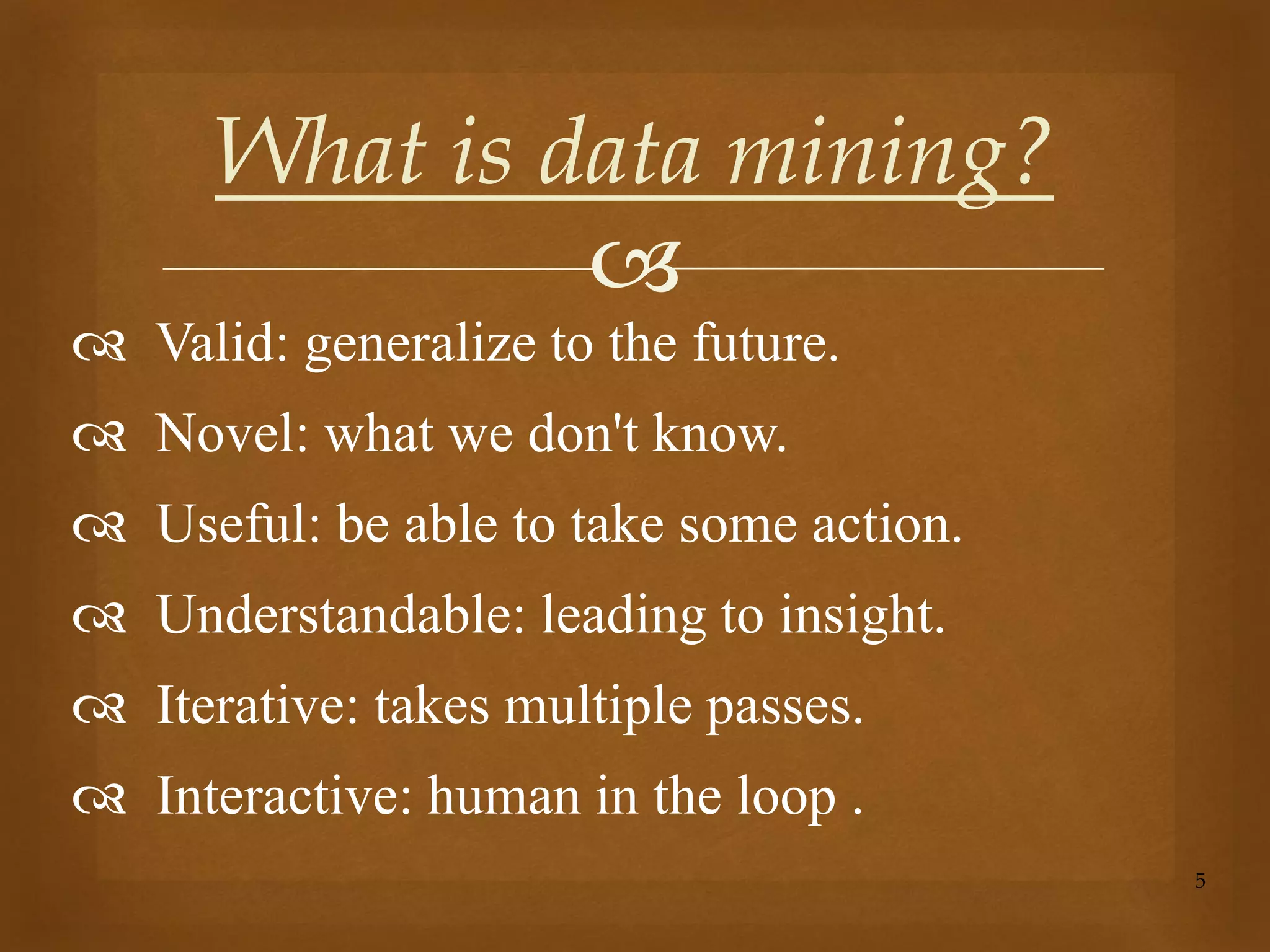
 Valid: generalize to the future.
 Novel: what we don't know.
 Useful: be able to take some action.
 Understandable: leading to insight.
 Iterative: takes multiple passes.
 Interactive: human in the loop .
5
What is data mining?
6
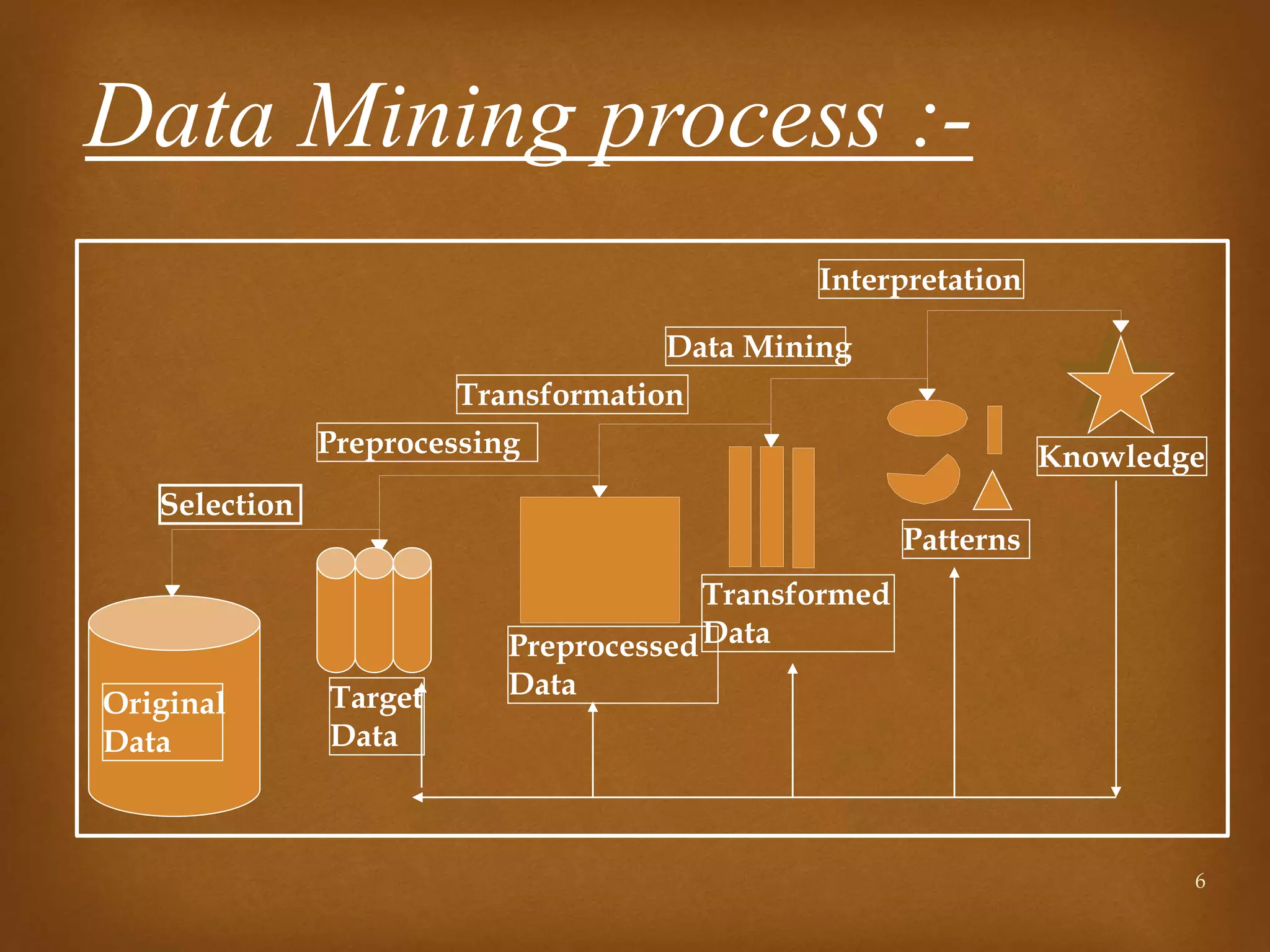
Data Mining process :-
Original
Data
Target
Data
Preprocessed
Data
Transformed
Data
Patterns
Knowledge
Selection
Preprocessing
Transformation
Data Mining
Interpretation

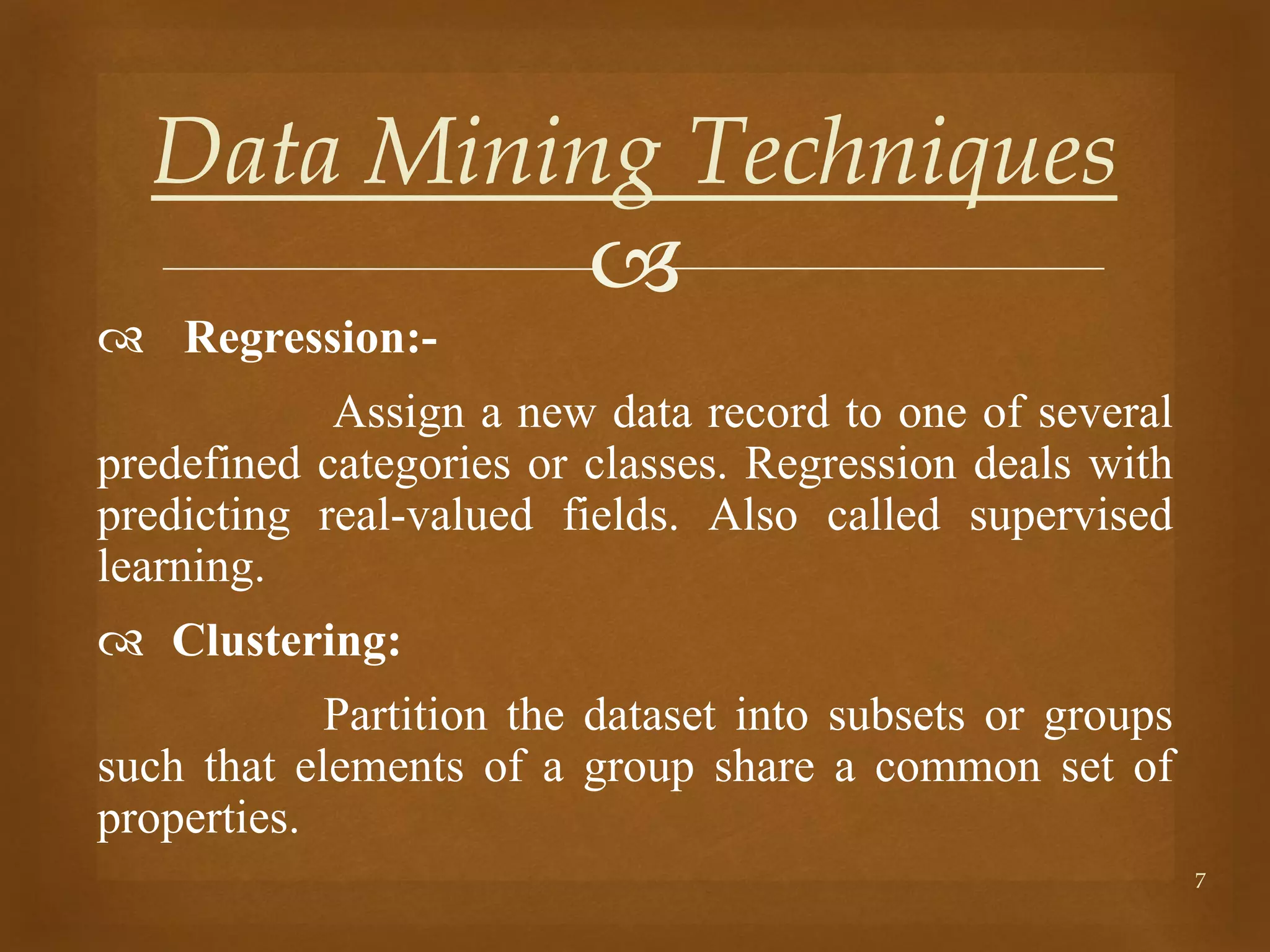
 Regression:-
Assign a new data record to one of several
predefined categories or classes. Regression deals with
predicting real-valued fields. Also called supervised
learning.
 Clustering:
Partition the dataset into subsets or groups
such that elements of a group share a common set of
properties.
7
Data Mining Techniques

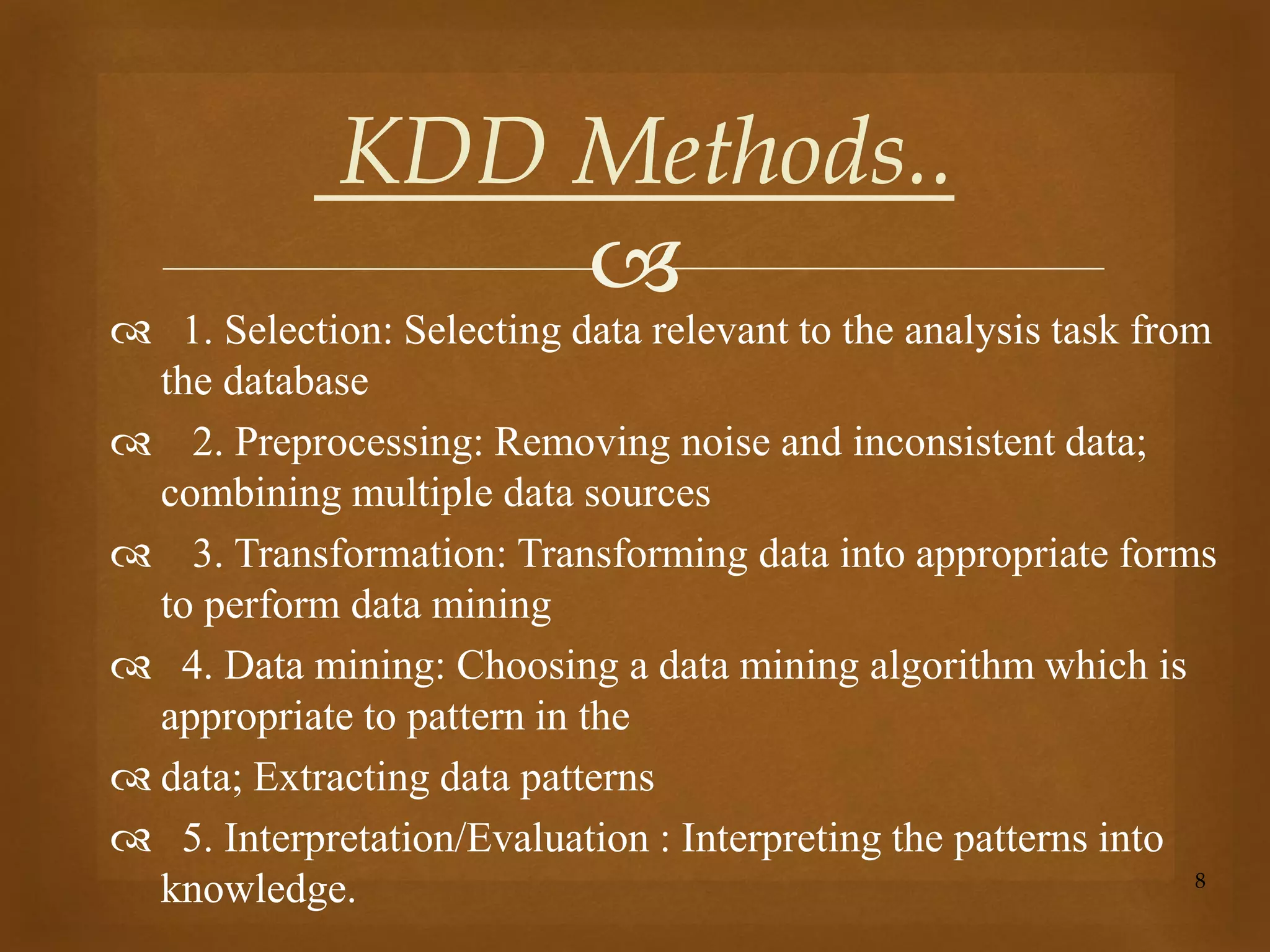
 1. Selection: Selecting data relevant to the analysis task from
the database
 2. Preprocessing: Removing noise and inconsistent data;
combining multiple data sources
 3. Transformation: Transforming data into appropriate forms
to perform data mining
 4. Data mining: Choosing a data mining algorithm which is
appropriate to pattern in the
 data; Extracting data patterns
 5. Interpretation/Evaluation : Interpreting the patterns into
knowledge. 8
KDD Methods..
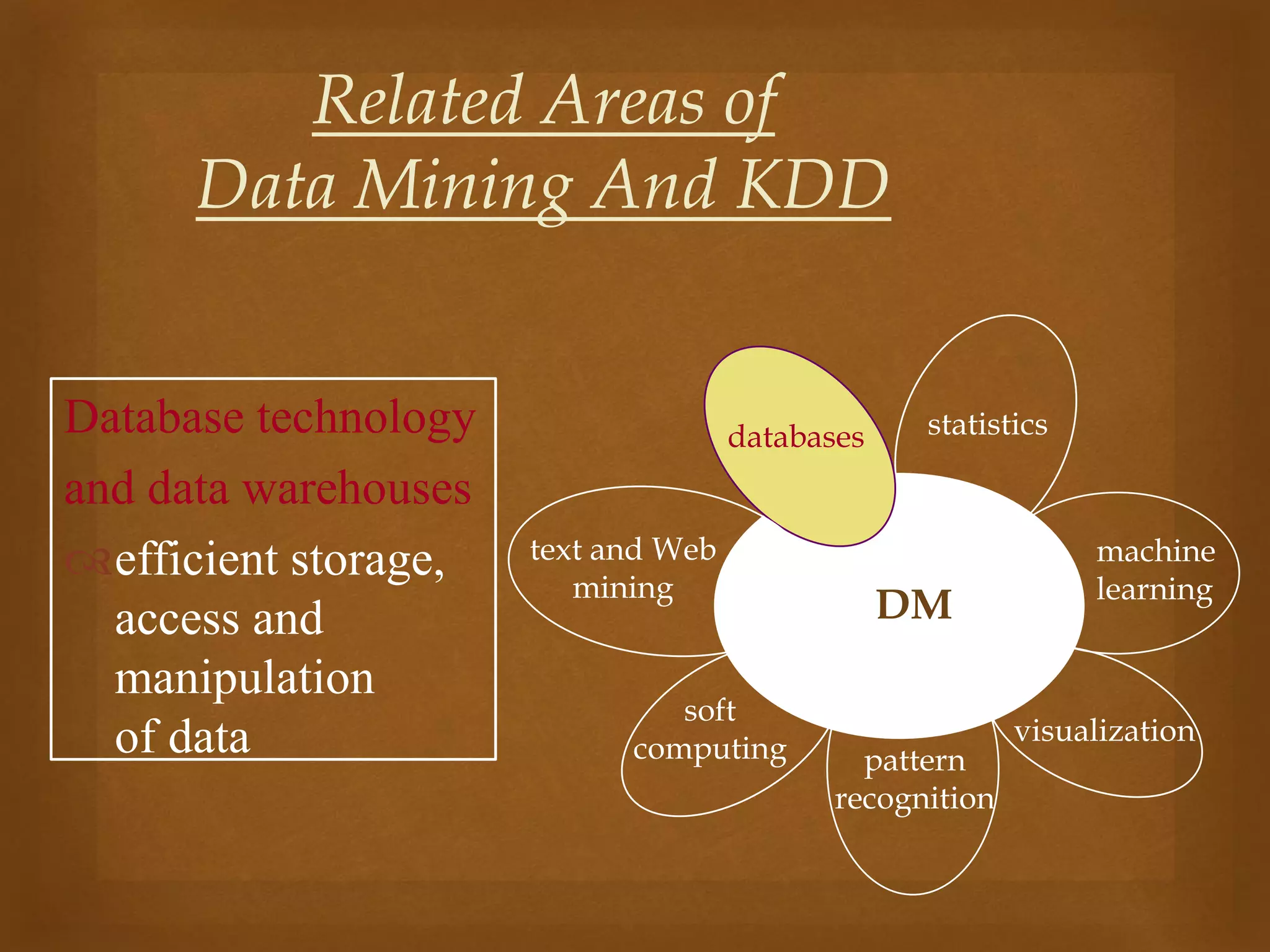
Related Areas of
Data Mining And KDD
Database technology
and data warehouses
efficient storage,
access and
manipulation
of data
DM
statistics
machine
learning
visualization
text and Web
mining
soft
computing pattern
recognition
databases
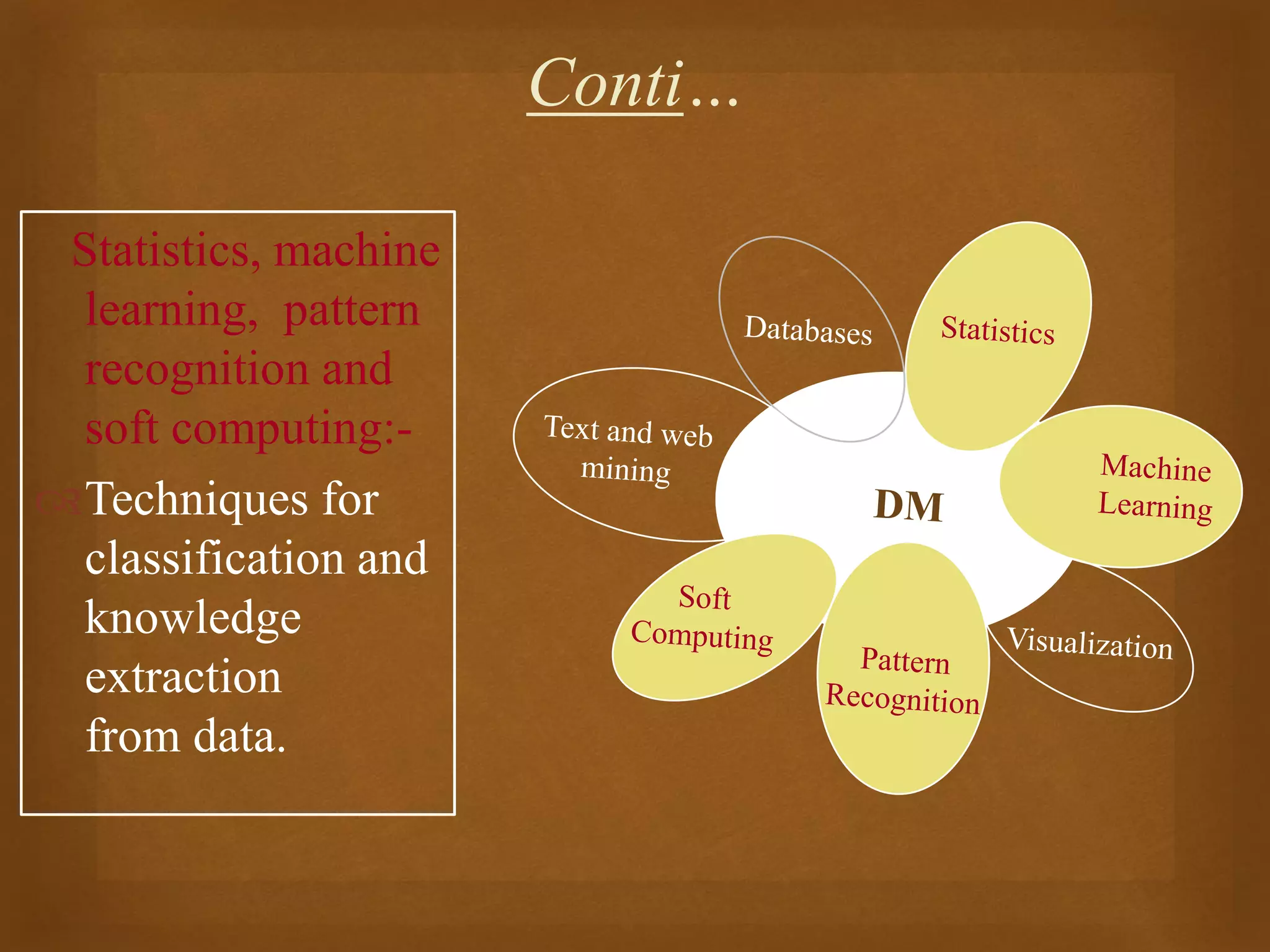
Conti…
Statistics, machine
learning, pattern
recognition and
soft computing:-
Techniques for
classification and
knowledge
extraction
from data.
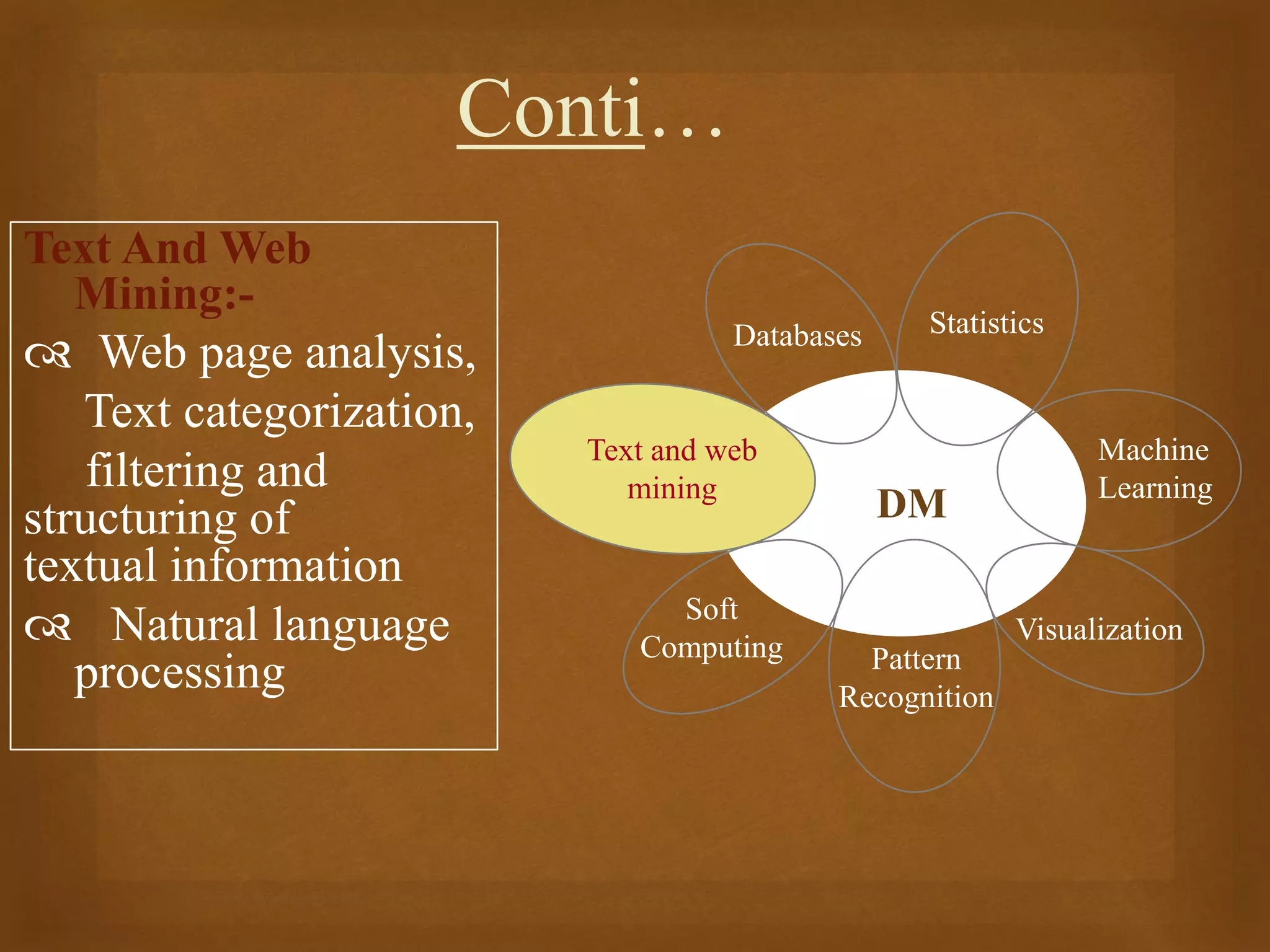
Conti…
Text And Web
Mining:-
 Web page analysis,
Text categorization,
filtering and
structuring of
textual information
 Natural language
processing
DM
Statistics
Machine
Learning
Visualization
Text and web
mining
Soft
Computing Pattern
Recognition
Databases
Text and web
mining

 Knowledge discovery can be broadly defined as the
automated discovery of novel and useful
information from commercial databases. Data
mining is one step at the core of the knowledge
discovery process, dealing with the extraction of
patterns and relationships from large amounts of
data. Data Mining Techniques are used to analyze
data and extract useful information from large
amount of data.
Conclusion..
13

Data Mining and Knowledge

  • 1.
  • 2.
      The datamining is the process in Data Knowledge Discovery in Database that produces useful patterns or the modules from the data, Database. Data mining can be used to mine understandable meaningful patterns from large databases and these patterns may then be converted into knowledge.  The KDD stands for Knowledge Discovery in Database.  It refers to the overall process of discovering useful knowledge from the data. 2 Data Mining and KDD
  • 3.
      Classification:- Mining patternsthat can classify future data.  Association Rule Mining:- Mining any rule of the form X  Y, where X and Y are sets of data items.  Clustering:- Identifying a set of similarity groups in the data. 3 Main Data Mining Tasks
  • 4.
     Sequential PatternMining: A sequential rule: A B, says that event A will be immediately followed by event B with a certain confidence.  Deviation detection: Discovering the most significant changes in Data.  Data visualization: - Using graphical or Diagrammatically methods to show patterns in data. 4 Main data mining tasks (cont. …)
  • 5.
      Valid: generalizeto the future.  Novel: what we don't know.  Useful: be able to take some action.  Understandable: leading to insight.  Iterative: takes multiple passes.  Interactive: human in the loop . 5 What is data mining?
  • 6.
    6 Data Mining process:- Original Data Target Data Preprocessed Data Transformed Data Patterns Knowledge Selection Preprocessing Transformation Data Mining Interpretation
  • 7.
      Regression:- Assign anew data record to one of several predefined categories or classes. Regression deals with predicting real-valued fields. Also called supervised learning.  Clustering: Partition the dataset into subsets or groups such that elements of a group share a common set of properties. 7 Data Mining Techniques
  • 8.
      1. Selection:Selecting data relevant to the analysis task from the database  2. Preprocessing: Removing noise and inconsistent data; combining multiple data sources  3. Transformation: Transforming data into appropriate forms to perform data mining  4. Data mining: Choosing a data mining algorithm which is appropriate to pattern in the  data; Extracting data patterns  5. Interpretation/Evaluation : Interpreting the patterns into knowledge. 8 KDD Methods..
  • 9.
    Related Areas of DataMining And KDD Database technology and data warehouses efficient storage, access and manipulation of data DM statistics machine learning visualization text and Web mining soft computing pattern recognition databases
  • 10.
    Conti… Statistics, machine learning, pattern recognitionand soft computing:- Techniques for classification and knowledge extraction from data.
  • 11.
    Conti… Text And Web Mining:- Web page analysis, Text categorization, filtering and structuring of textual information  Natural language processing DM Statistics Machine Learning Visualization Text and web mining Soft Computing Pattern Recognition Databases Text and web mining
  • 12.
      Knowledge discoverycan be broadly defined as the automated discovery of novel and useful information from commercial databases. Data mining is one step at the core of the knowledge discovery process, dealing with the extraction of patterns and relationships from large amounts of data. Data Mining Techniques are used to analyze data and extract useful information from large amount of data. Conclusion..
  • 13.