Communications Systems
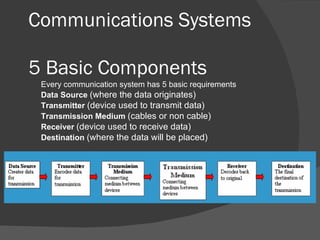
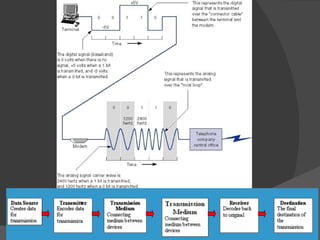
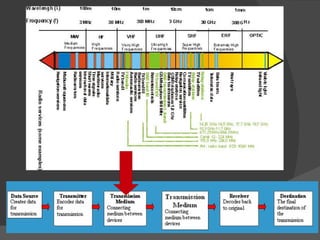
5 Basic Components Communications Systems Every communication system has 5 basic requirements Data Source   (where the data originates)
Transmitter  (device used to transmit data)
Transmission Medium   (cables or non cable)
Receiver  (device used to receive data)
Destination   (where the data will be placed)
 
 
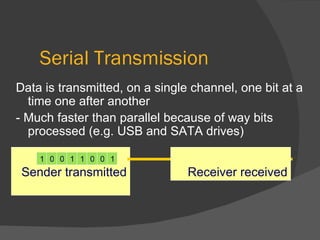
Data is transmitted, on a single channel, one bit at a time one after another - Much faster than parallel because of way bits processed (e.g. USB and SATA drives) Serial Transmission Sender transmitted Receiver received 1 0 1 0 0 1 1 0
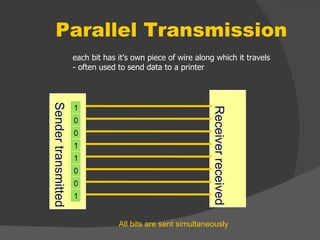
Receiver received each bit has it’s own piece of wire along which it travels - often used to send data to a printer Parallel Transmission Sender transmitted All bits are sent simultaneously 1 0 0 1 1 0 0 1
Why Not use Parallel Instead of serial? Due to inconsistencies on channels data arrives at different times
Because of the way it is transmitted packet switching cannot be used
The above two points makes parallel slower than serial and requires higher bandwidth.
Parallel transmissions are rarely used anymore
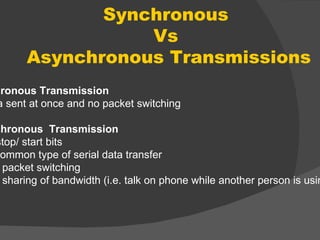
Synchronous Transmission all data sent at once and no packet switching Asynchronous  Transmission   Uses stop/ start bits
most common type of serial data transfer
Allows packet switching
Allows sharing of bandwidth (i.e. talk on phone while another person is using internet) Synchronous  Vs  Asynchronous Transmissions
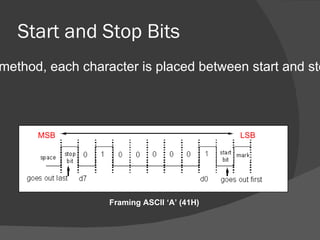
Start and Stop Bits In the asynchronous method, each character is placed between start and stop bits ( framing )  Framing ASCII ‘A’ (41H) LSB MSB
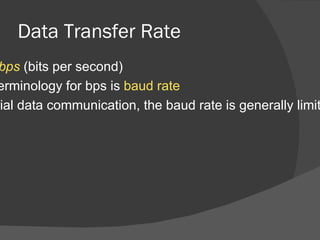
Data Transfer Rate Rate of data transfer:  bps   (bits per second)

Data communication basics

Editor's Notes

  • #17 Easy to add extra computers . If computer goes down it doesn’t affect rest of network