Class work Data flow, Signals, Networking addressing, Devices
Submitted to:
Pranab Bandhu Nath
Lecturer
Department of CSE
City university
Page:1
Page:02
Data Communications
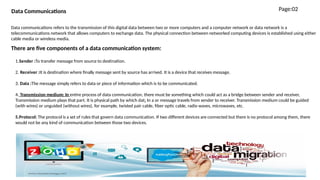
Data communications refers to the transmission of this digital data between two or more computers and a computer network or data network is a
telecommunications network that allows computers to exchange data. The physical connection between networked computing devices is established using either
cable media or wireless media.
There are five components of a data communication system:
1.Sender :To transfer message from source to destination.
2. Receiver :It is destination where finally message sent by source has arrived. It is a device that receives message.
3. Data :The message simply refers to data or piece of information which is to be communicated.
4. Transmission medium: In entire process of data communication, there must be something which could act as a bridge between sender and receiver,
Transmission medium plays that part. It is physical path by which dat: In a or message travels from sender to receiver. Transmission medium could be guided
(with wires) or unguided (without wires), for example, twisted pair cable, fiber optic cable, radio waves, microwaves, etc.
5.Protocol: The protocol is a set of rules that govern data communication. If two different devices are connected but there is no protocol among them, there
would not be any kind of communication between those two devices. 
Page:03
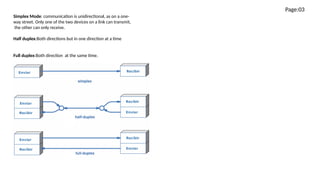
Simplex Mode: communication is unidirectional, as on a one-
way street. Only one of the two devices on a link can transmit,
the other can only receive.
 
Half duplex:Both directions but in one direction at a time
Full duplex:Both direction at the same time.
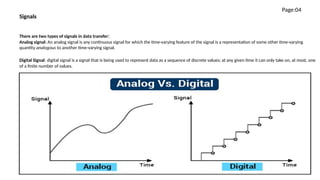
There are two types of signals in data transfer:
Analog signal: An analog signal is any continuous signal for which the time-varying feature of the signal is a representation of some other time-varying
quantity analogous to another time-varying signal.
Digital Signal: digital signal is a signal that is being used to represent data as a sequence of discrete values; at any given time it can only take on, at most, one
of a finite number of values.
Signals
Page:04
Page:05
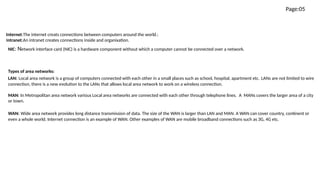
Internet:The internet creats connections between computers around the world.:
Intranet:An intranet creates connections inside and organixation.
NIC: Network interface card (NIC) is a hardware component without which a computer cannot be connected over a network.
Types of area networks:
LAN: Local area network is a group of computers connected with each other in a small places such as school, hospital, apartment etc. LANs are not limited to wire
connection, there is a new evolution to the LANs that allows local area network to work on a wireless connection.
MAN: In Metropolitan area network various Local area networks are connected with each other through telephone lines.  A  MANs covers the larger area of a city
or town.
WAN: Wide area network provides long distance transmission of data. The size of the WAN is larger than LAN and MAN. A WAN can cover country, continent or
even a whole world. Internet connection is an example of WAN. Other examples of WAN are mobile broadband connections such as 3G, 4G etc.
Page:06
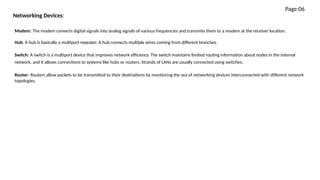
Networking Devices:
Modem: The modem converts digital signals into analog signals of various frequencies and transmits them to a modem at the receiver location. 
Hub: A hub is basically a multiport repeater. A hub connects multiple wires coming from different branches.
Switch: A switch is a multiport device that improves network efficiency. The switch maintains limited routing information about nodes in the internal
network, and it allows connections to systems like hubs or routers. Strands of LANs are usually connected using switches.
Router: Routers allow packets to be transmitted to their destinations by monitoring the sea of networking devices interconnected with different network
topologies.
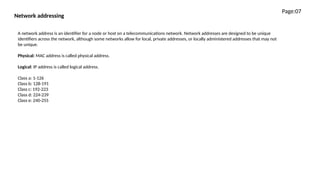
Network addressing
A network address is an identifier for a node or host on a telecommunications network. Network addresses are designed to be unique
identifiers across the network, although some networks allow for local, private addresses, or locally administered addresses that may not
be unique.
Physical: MAC address is called physical address.
Logical: IP address is called logical address.
Class a: 1-126
Class b: 128-191
Class c: 192-223
Class d: 224-239
Class e: 240-255
Page:07

Dc ass-2-1834902082 md.ismail.pptm

  • 1.
    Class work Dataflow, Signals, Networking addressing, Devices Submitted to: Pranab Bandhu Nath Lecturer Department of CSE City university Page:1
  • 2.
    Page:02 Data Communications Data communicationsrefers to the transmission of this digital data between two or more computers and a computer network or data network is a telecommunications network that allows computers to exchange data. The physical connection between networked computing devices is established using either cable media or wireless media. There are five components of a data communication system: 1.Sender :To transfer message from source to destination. 2. Receiver :It is destination where finally message sent by source has arrived. It is a device that receives message. 3. Data :The message simply refers to data or piece of information which is to be communicated. 4. Transmission medium: In entire process of data communication, there must be something which could act as a bridge between sender and receiver, Transmission medium plays that part. It is physical path by which dat: In a or message travels from sender to receiver. Transmission medium could be guided (with wires) or unguided (without wires), for example, twisted pair cable, fiber optic cable, radio waves, microwaves, etc. 5.Protocol: The protocol is a set of rules that govern data communication. If two different devices are connected but there is no protocol among them, there would not be any kind of communication between those two devices. 
  • 3.
    Page:03 Simplex Mode: communicationis unidirectional, as on a one- way street. Only one of the two devices on a link can transmit, the other can only receive.   Half duplex:Both directions but in one direction at a time Full duplex:Both direction at the same time.
  • 4.
    There are twotypes of signals in data transfer: Analog signal: An analog signal is any continuous signal for which the time-varying feature of the signal is a representation of some other time-varying quantity analogous to another time-varying signal. Digital Signal: digital signal is a signal that is being used to represent data as a sequence of discrete values; at any given time it can only take on, at most, one of a finite number of values. Signals Page:04
  • 5.
    Page:05 Internet:The internet creatsconnections between computers around the world.: Intranet:An intranet creates connections inside and organixation. NIC: Network interface card (NIC) is a hardware component without which a computer cannot be connected over a network. Types of area networks: LAN: Local area network is a group of computers connected with each other in a small places such as school, hospital, apartment etc. LANs are not limited to wire connection, there is a new evolution to the LANs that allows local area network to work on a wireless connection. MAN: In Metropolitan area network various Local area networks are connected with each other through telephone lines.  A  MANs covers the larger area of a city or town. WAN: Wide area network provides long distance transmission of data. The size of the WAN is larger than LAN and MAN. A WAN can cover country, continent or even a whole world. Internet connection is an example of WAN. Other examples of WAN are mobile broadband connections such as 3G, 4G etc.
  • 6.
    Page:06 Networking Devices: Modem: Themodem converts digital signals into analog signals of various frequencies and transmits them to a modem at the receiver location.  Hub: A hub is basically a multiport repeater. A hub connects multiple wires coming from different branches. Switch: A switch is a multiport device that improves network efficiency. The switch maintains limited routing information about nodes in the internal network, and it allows connections to systems like hubs or routers. Strands of LANs are usually connected using switches. Router: Routers allow packets to be transmitted to their destinations by monitoring the sea of networking devices interconnected with different network topologies.
  • 7.
    Network addressing A networkaddress is an identifier for a node or host on a telecommunications network. Network addresses are designed to be unique identifiers across the network, although some networks allow for local, private addresses, or locally administered addresses that may not be unique. Physical: MAC address is called physical address. Logical: IP address is called logical address. Class a: 1-126 Class b: 128-191 Class c: 192-223 Class d: 224-239 Class e: 240-255 Page:07