Data Collection
 The first issue in the data collection process is to
determine whether the information needed for the
research problem has already been
generated/collected.
Need of Data Collection
• To get information for analysis.
• To get idea about real time situation.
• For comparison between two situation.
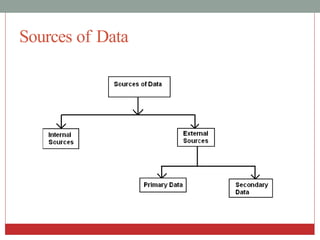
Sources of Data
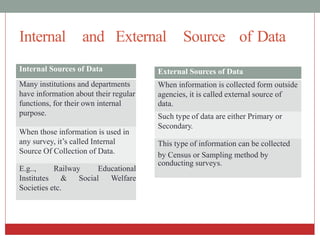
Internal and External Source of Data
by Census or Sampling method by
External Sources of Data
When information is collected form outside
agencies, it is called external source of
data.
Such type of data are either Primary or
Secondary.
This type of information can be collected
conducting surveys.
Internal Sources of Data
Many institutions and departments
have information about their regular
functions, for their own internal
purpose.
When those information is used in
any survey, it’s called Internal
Source Of Collection of Data.
E.g.., Railway Educational
Institutes & Social Welfare
Societies etc.
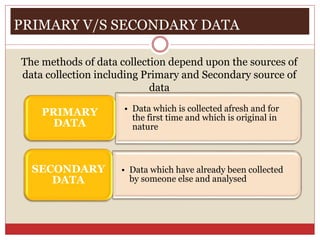
PRIMARY V/S SECONDARY DATA
The methods of data collection depend upon the sources of
data collection including Primary and Secondary source of
data
• Data which is collected afresh and for
the first time and which is original in
nature
PRIMARY
DATA
• Data which have already been collected
by someone else and analysed
SECONDARY
DATA
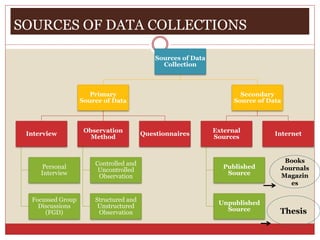
SOURCES OF DATA COLLECTIONS
Sources of Data
Collection
Primary
Source of Data
Interview
Personal
Interview
Focussed Group
Discussions
(FGD)
Observation
Method
Controlled and
Uncontrolled
Observation
Structured and
Unstructured
Observation
Questionnaires
Secondary
Source of Data
External
Sources
Published
Source
Unpublished
Source
Internet
Books
Journals
Magazin
es
Thesis
Primary Data
• Primary data are those which are collected for the first time.
• It is real time data which are collected by the researcher himself.
• This is the process of Collecting and making use of the data.
• This Data originated by the researcher specifically to address
the research problem.
OBSERVATION METHOD
 Used most commonly in studies relating to Behavioural Sciences.
 The main advantage of this method is that the subjective bias is
eliminated.
Example:
1. Study of consumer preference towards a 2 new flavour introduced by
Lay’s chips.
2. Study of the consumer behaviour for buying a particular washing
powder.
Here, the researcher/investigator will observe the
consumer choices by just recording their
preferences by either door to door survey or through
their observation at retail outlets.
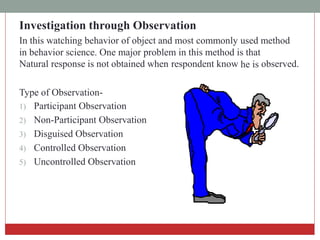
Investigation through Observation
In this watching behavior of object and most commonly used method
in behavior science. One major problem in this method is that
Natural response is not obtained when respondent know he is observed.
Type of Observation-
1) Participant Observation
2) Non-Participant Observation
3) Disguised Observation
4) Controlled Observation
5) Uncontrolled Observation
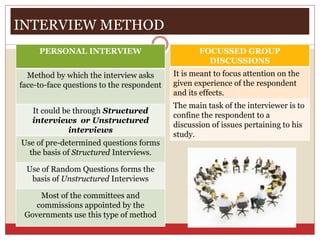
INTERVIEW METHOD
PERSONAL INTERVIEW
Method by which the interview asks
face-to-face questions to the respondent
It could be through Structured
interviews or Unstructured
interviews
Use of pre-determined questions forms
the basis of Structured Interviews.
Use of Random Questions forms the
basis of Unstructured Interviews
Most of the committees and
commissions appointed by the
Governments use this type of method
FOCUSSED GROUP
DISCUSSIONS
It is meant to focus attention on the
given experience of the respondent
and its effects.
The main task of the interviewer is to
confine the respondent to a
discussion of issues pertaining to his
study.
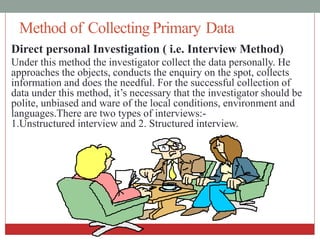
Method of Collecting Primary Data
Direct personal Investigation ( i.e. Interview Method)
Under this method the investigator collect the data personally. He
approaches the objects, conducts the enquiry on the spot, collects
information and does the needful. For the successful collection of
data under this method, it’s necessary that the investigator should be
polite, unbiased and ware of the local conditions, environment and
languages.There are two types of interviews:-
1.Unstructured interview and 2. Structured interview.
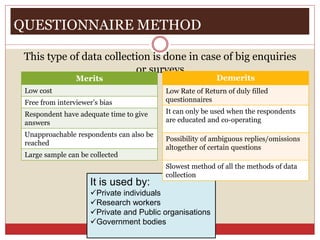
QUESTIONNAIRE METHOD
This type of data collection is done in case of big enquiries
or surveys
Merits
Low cost
Free from interviewer’s bias
Respondent have adequate time to give
answers
Unapproachable respondents can also be
reached
Large sample can be collected
It is used by:
Private individuals
Research workers
Private and Public organisations
Government bodies
Demerits
Low Rate of Return of duly filled
questionnaires
It can only be used when the respondents
are educated and co-operating
Possibility of ambiguous replies/omissions
altogether of certain questions
Slowest method of all the methods of data
collection
Example: Doctor’s Information Questionnaire
Investigation through mailed Questionnaire
Under this method the investigator may either appoint local agents/
investigators/ enumerators and mail them the questionnaire for
collecting information or collecting by his own using mail or telephone.
Detailed understanding through separate slides
PREPARATION OF QUESTIONNAIRE
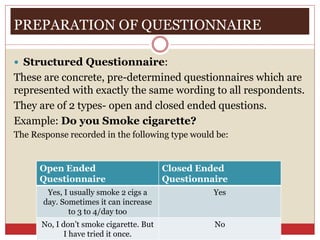
 Structured Questionnaire:
These are concrete, pre-determined questionnaires which are
represented with exactly the same wording to all respondents.
They are of 2 types- open and closed ended questions.
Example: Do you Smoke cigarette?
The Response recorded in the following type would be:
Open Ended
Questionnaire
Closed Ended
Questionnaire
Yes, I usually smoke 2 cigs a
day. Sometimes it can increase
to 3 to 4/day too
Yes
No, I don’t smoke cigarette. But
I have tried it once.
No
PREPARATION OF QUESTIONNAIRE…
 Unstructured Questionnaire:
 Here, the interviewer is only provided with a guideline on
the type of information required.
 The final framing of question is left of the interviewer’s
discretion.
 The recording of answers can be done by a tape-recorder to
achieve this goal
CHARACTERSTICS OF A GOOD QUESTION
1. It should be easily understood.
 Do you drink alcohol?
X Are you Dipsomaniac?
2. It should convey one though at a time.
 Do you have a permanent house in Delhi?
X Do you have a permanent house in Delhi and a flat in Gurgaon?
3. It should be realistic enough for the respondent to
recall.
 How many Maggie Noodle Packets do you consume annually?
X How many Maggie Noodle Packets did you consume in the last 15 days?
4. Avoid using emotional words, catch words,
phrases that are not easily understood.
CHARACTERSTICS OF A GOOD QUESTION…
5. Do not use “DIRECTING QUESTIONS” or Putting
answers in people’s mouth.
Example:
 Do you like the taste of Cadbury Bournville?
X You like the taste of Cadbury Bournville, right?
6. Size of the questionnaire should be kept minimum
7. Do not use Technical terms.
8. Control the use of open-ended questions. They are
usually difficult to analyse.
Advantages of Primary Data
 Targeted Issues are addressed.
 Data interpretation is better
 Current Data
 Proprietary Issues
Disadvantages of primary data
 High Cost
 Time Consuming
 More numbers of resources are required
 Inaccurate feedbacks
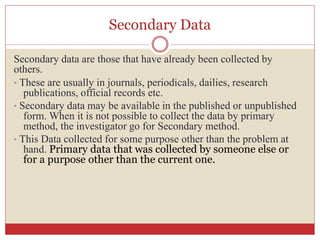
Secondary Data
Secondary data are those that have already been collected by
others.
• These are usually in journals, periodicals, dailies, research
publications, official records etc.
• Secondary data may be available in the published or unpublished
form. When it is not possible to collect the data by primary
method, the investigator go for Secondary method.
• This Data collected for some purpose other than the problem at
hand. Primary data that was collected by someone else or
for a purpose other than the current one.
Where can I use secondary data?
Proposal stage:
 Add spice to your proposal background
 Develop hypothesis for research design
Findings stage:
 Background data on market
 Support primary data/conclusions
 Provide inputs for predicting future
Sources of Secondary Research
 Internal Company Data
 Daily sales Reports
 Previous Sales Reports
 Annual Reports
 Government Publications
 Census
 Economic surveys
 Budget Document
 Bills and legislative Documents
Sources - Trade / Industry Associations
 Associations in vertical segments
 NASSCOM & MAIT (IT Industry)
 SIAM (Automobile Industry)
 CETMA, IEEMA (Electronics)
 IPPAI (Power)
 Associations in vertical segments
 Confederation of Indian Industries
 FICCI
 Regional Chamber of Commerce (like PHD Chamber of
Commerce)
Sources of Secondary Research
 International Publications
 World Bank Reports
 UN Publications
 Syndicated Sources
 Market research Companies (like IMRB - NRS, ORG
MARG - Retail Audits, etc.)
 Economic Consultancy Units (like NCAER)
 Publications
 Newspapers / Magazines
 Library
 Trade Journals
Method of sourcing information
 IMRB- Central library system (maintained by
Geeta Pandey)
 BIRD-Internal databases in a few key industries
maintained
 Public libraries (Govt. of India, Industry
associations)
 Business book suppliers
 Internet
Advantages of Secondary data
 It is economical. It saves efforts and expenses.
 It is time saving.
 It helps to make primary data collection more
specific since with the help of secondary data, we are
able to make out what are the gaps and deficiencies
and what additional information needs to be
collected.
 It helps to improve the understanding of the
problem.
 It provides a basis for comparison for the data that is
collected by the researcher.
Sources
 Population Statistics
 Statistical Abstract of India
 Estimation of National Product, 'Savings and
Capital formation: (White paper on National
Income)
 Basic Statistics Relating to Indian Economy
 India, Pocketbook of Economic Information
 Leading marketing research agencies like MARG and
ORG regularly survey consumers attitude and
opinions regarding consumption behaviour and a
variety of contemporary issues relevant to marketing
Limitations of secondary data:
 The data fitness problem:
 The accuracy problem:
 Identify the data source
 Examine the purpose for which data was
published
 Assess the source in terms of the quality of
data expected
CASE STUDY METHOD
It involves a careful and complete observation of a social unit,
a family, a institution, a cultural group or even the entire
community.
 This is a method of Study in Depth and lays more emphasis
on the analysis of a no. of events or conditions and their
interrelations.
Case Study!!
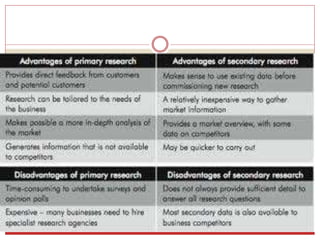
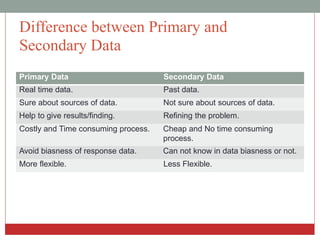
Difference between Primary and
Secondary Data
Primary Data Secondary Data
Real time data. Past data.
Sure about sources of data. Not sure about sources of data.
Help to give results/finding. Refining the problem.
Costly and Time consuming process. Cheap and No time consuming
process.
Avoid biasness of response data. Can not know in data biasness or not.
More flexible. Less Flexible.

unit 2.3.ppt

  • 1.
    Data Collection  Thefirst issue in the data collection process is to determine whether the information needed for the research problem has already been generated/collected.
  • 2.
    Need of DataCollection • To get information for analysis. • To get idea about real time situation. • For comparison between two situation.
  • 4.
  • 5.
    Internal and ExternalSource of Data by Census or Sampling method by External Sources of Data When information is collected form outside agencies, it is called external source of data. Such type of data are either Primary or Secondary. This type of information can be collected conducting surveys. Internal Sources of Data Many institutions and departments have information about their regular functions, for their own internal purpose. When those information is used in any survey, it’s called Internal Source Of Collection of Data. E.g.., Railway Educational Institutes & Social Welfare Societies etc.
  • 6.
    PRIMARY V/S SECONDARYDATA The methods of data collection depend upon the sources of data collection including Primary and Secondary source of data • Data which is collected afresh and for the first time and which is original in nature PRIMARY DATA • Data which have already been collected by someone else and analysed SECONDARY DATA
  • 7.
    SOURCES OF DATACOLLECTIONS Sources of Data Collection Primary Source of Data Interview Personal Interview Focussed Group Discussions (FGD) Observation Method Controlled and Uncontrolled Observation Structured and Unstructured Observation Questionnaires Secondary Source of Data External Sources Published Source Unpublished Source Internet Books Journals Magazin es Thesis
  • 8.
    Primary Data • Primarydata are those which are collected for the first time. • It is real time data which are collected by the researcher himself. • This is the process of Collecting and making use of the data. • This Data originated by the researcher specifically to address the research problem.
  • 9.
    OBSERVATION METHOD  Usedmost commonly in studies relating to Behavioural Sciences.  The main advantage of this method is that the subjective bias is eliminated. Example: 1. Study of consumer preference towards a 2 new flavour introduced by Lay’s chips. 2. Study of the consumer behaviour for buying a particular washing powder. Here, the researcher/investigator will observe the consumer choices by just recording their preferences by either door to door survey or through their observation at retail outlets.
  • 10.
    Investigation through Observation Inthis watching behavior of object and most commonly used method in behavior science. One major problem in this method is that Natural response is not obtained when respondent know he is observed. Type of Observation- 1) Participant Observation 2) Non-Participant Observation 3) Disguised Observation 4) Controlled Observation 5) Uncontrolled Observation
  • 11.
    INTERVIEW METHOD PERSONAL INTERVIEW Methodby which the interview asks face-to-face questions to the respondent It could be through Structured interviews or Unstructured interviews Use of pre-determined questions forms the basis of Structured Interviews. Use of Random Questions forms the basis of Unstructured Interviews Most of the committees and commissions appointed by the Governments use this type of method FOCUSSED GROUP DISCUSSIONS It is meant to focus attention on the given experience of the respondent and its effects. The main task of the interviewer is to confine the respondent to a discussion of issues pertaining to his study.
  • 12.
    Method of CollectingPrimary Data Direct personal Investigation ( i.e. Interview Method) Under this method the investigator collect the data personally. He approaches the objects, conducts the enquiry on the spot, collects information and does the needful. For the successful collection of data under this method, it’s necessary that the investigator should be polite, unbiased and ware of the local conditions, environment and languages.There are two types of interviews:- 1.Unstructured interview and 2. Structured interview.
  • 13.
    QUESTIONNAIRE METHOD This typeof data collection is done in case of big enquiries or surveys Merits Low cost Free from interviewer’s bias Respondent have adequate time to give answers Unapproachable respondents can also be reached Large sample can be collected It is used by: Private individuals Research workers Private and Public organisations Government bodies Demerits Low Rate of Return of duly filled questionnaires It can only be used when the respondents are educated and co-operating Possibility of ambiguous replies/omissions altogether of certain questions Slowest method of all the methods of data collection
  • 14.
  • 15.
    Investigation through mailedQuestionnaire Under this method the investigator may either appoint local agents/ investigators/ enumerators and mail them the questionnaire for collecting information or collecting by his own using mail or telephone. Detailed understanding through separate slides
  • 16.
    PREPARATION OF QUESTIONNAIRE Structured Questionnaire: These are concrete, pre-determined questionnaires which are represented with exactly the same wording to all respondents. They are of 2 types- open and closed ended questions. Example: Do you Smoke cigarette? The Response recorded in the following type would be: Open Ended Questionnaire Closed Ended Questionnaire Yes, I usually smoke 2 cigs a day. Sometimes it can increase to 3 to 4/day too Yes No, I don’t smoke cigarette. But I have tried it once. No
  • 17.
    PREPARATION OF QUESTIONNAIRE… Unstructured Questionnaire:  Here, the interviewer is only provided with a guideline on the type of information required.  The final framing of question is left of the interviewer’s discretion.  The recording of answers can be done by a tape-recorder to achieve this goal
  • 18.
    CHARACTERSTICS OF AGOOD QUESTION 1. It should be easily understood.  Do you drink alcohol? X Are you Dipsomaniac? 2. It should convey one though at a time.  Do you have a permanent house in Delhi? X Do you have a permanent house in Delhi and a flat in Gurgaon? 3. It should be realistic enough for the respondent to recall.  How many Maggie Noodle Packets do you consume annually? X How many Maggie Noodle Packets did you consume in the last 15 days? 4. Avoid using emotional words, catch words, phrases that are not easily understood.
  • 19.
    CHARACTERSTICS OF AGOOD QUESTION… 5. Do not use “DIRECTING QUESTIONS” or Putting answers in people’s mouth. Example:  Do you like the taste of Cadbury Bournville? X You like the taste of Cadbury Bournville, right? 6. Size of the questionnaire should be kept minimum 7. Do not use Technical terms. 8. Control the use of open-ended questions. They are usually difficult to analyse.
  • 20.
    Advantages of PrimaryData  Targeted Issues are addressed.  Data interpretation is better  Current Data  Proprietary Issues
  • 21.
    Disadvantages of primarydata  High Cost  Time Consuming  More numbers of resources are required  Inaccurate feedbacks
  • 22.
    Secondary Data Secondary dataare those that have already been collected by others. • These are usually in journals, periodicals, dailies, research publications, official records etc. • Secondary data may be available in the published or unpublished form. When it is not possible to collect the data by primary method, the investigator go for Secondary method. • This Data collected for some purpose other than the problem at hand. Primary data that was collected by someone else or for a purpose other than the current one.
  • 23.
    Where can Iuse secondary data? Proposal stage:  Add spice to your proposal background  Develop hypothesis for research design Findings stage:  Background data on market  Support primary data/conclusions  Provide inputs for predicting future
  • 24.
    Sources of SecondaryResearch  Internal Company Data  Daily sales Reports  Previous Sales Reports  Annual Reports  Government Publications  Census  Economic surveys  Budget Document  Bills and legislative Documents
  • 25.
    Sources - Trade/ Industry Associations  Associations in vertical segments  NASSCOM & MAIT (IT Industry)  SIAM (Automobile Industry)  CETMA, IEEMA (Electronics)  IPPAI (Power)  Associations in vertical segments  Confederation of Indian Industries  FICCI  Regional Chamber of Commerce (like PHD Chamber of Commerce)
  • 26.
    Sources of SecondaryResearch  International Publications  World Bank Reports  UN Publications  Syndicated Sources  Market research Companies (like IMRB - NRS, ORG MARG - Retail Audits, etc.)  Economic Consultancy Units (like NCAER)  Publications  Newspapers / Magazines  Library  Trade Journals
  • 27.
    Method of sourcinginformation  IMRB- Central library system (maintained by Geeta Pandey)  BIRD-Internal databases in a few key industries maintained  Public libraries (Govt. of India, Industry associations)  Business book suppliers  Internet
  • 28.
    Advantages of Secondarydata  It is economical. It saves efforts and expenses.  It is time saving.  It helps to make primary data collection more specific since with the help of secondary data, we are able to make out what are the gaps and deficiencies and what additional information needs to be collected.  It helps to improve the understanding of the problem.  It provides a basis for comparison for the data that is collected by the researcher.
  • 29.
    Sources  Population Statistics Statistical Abstract of India  Estimation of National Product, 'Savings and Capital formation: (White paper on National Income)  Basic Statistics Relating to Indian Economy  India, Pocketbook of Economic Information  India, Pocketbook of Economic Information
  • 30.
     Leading marketingresearch agencies like MARG and ORG regularly survey consumers attitude and opinions regarding consumption behaviour and a variety of contemporary issues relevant to marketing
  • 31.
    Limitations of secondarydata:  The data fitness problem:  The accuracy problem:  Identify the data source  Examine the purpose for which data was published  Assess the source in terms of the quality of data expected
  • 32.
    CASE STUDY METHOD Itinvolves a careful and complete observation of a social unit, a family, a institution, a cultural group or even the entire community.  This is a method of Study in Depth and lays more emphasis on the analysis of a no. of events or conditions and their interrelations. Case Study!!
  • 34.
    Difference between Primaryand Secondary Data Primary Data Secondary Data Real time data. Past data. Sure about sources of data. Not sure about sources of data. Help to give results/finding. Refining the problem. Costly and Time consuming process. Cheap and No time consuming process. Avoid biasness of response data. Can not know in data biasness or not. More flexible. Less Flexible.