What is Data Collection?
Data collection is a methodical process of gathering and analyzing
specific information to offer solutions to relevant questions and
evaluate the results.
Data is collected to be further subjected to hypothesis testing which
seeks to explain a phenomenon.
Types of Data Collection
Data collection falls under two broad categories; Primary data
collection and secondary data collection.
Primary Data Collection
Primary data collection by definition is the gathering of raw data
collected at the source. It is a process of collecting the original data
collected by a researcher for a specific research purpose. It could be
further analyzed into two segments; qualitative research and
quantitative data collection methods.
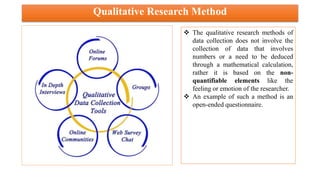
Qualitative Research Method
 The qualitative research methods of
data collection does not involve the
collection of data that involves
numbers or a need to be deduced
through a mathematical calculation,
rather it is based on the non-
quantifiable elements like the
feeling or emotion of the researcher.
 An example of such a method is an
open-ended questionnaire.
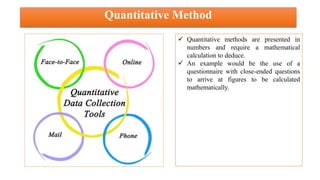
Quantitative Method
 Quantitative methods are presented in
numbers and require a mathematical
calculation to deduce.
 An example would be the use of a
questionnaire with close-ended questions
to arrive at figures to be calculated
mathematically.
Secondary Data Collection
Secondary data collection is referred to as the gathering of second-
hand data collected by an individual who is not the original user. It is
the process of collecting data that is already existing, be it already
published books, journals and/or online portals. In terms of ease, it is
much less expensive and easier to collect.
Your choice between primary data collection and secondary data
collection depend on the nature, scope and area of your research as
well as its aims and objectives.
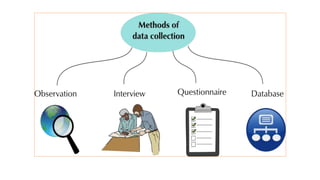
Observation: Data collection using
observation does not entail personal
contact. Counting the number of vehicles
crossing an intersection every hour would be
a good example of observational data
gathering.
INTERVIEW :- An interview is a face-to-face conversation between two
individuals with the sole purpose of collecting relevant information to
satisfy a research purpose. Interviews are of different types namely;
Structured, Semi-structured and unstructured.
a. A structured interview is a type of quantitative interview that makes
use of a standardized sequence of questioning in order to gather
relevant information about a research subject. the researcher creates a
set of interview questions in advance and these questions are asked in
the same order so that responses can easily be placed in similar
categories. A structured interview is also known as a patterned
interview, planned interview or a standardized interview.
Structured interview examples can be classified into three, namely;
the face-to-face interview, telephone interviews and
survey/questionnaires interviews.
b. In a semi-structured interview, the interviewer is at liberty to
deviate from the set interview questions and sequence as long as he or
she remains with the overall scope of the interview. In addition, a
semi-structured interview makes use of an interview guide which is an
informal grouping of topics and questions that the interviewer can ask
in different ways.
c. An unstructured interview is a type of interview that is non-
directive in nature. Here, the interviewer does not rely on a set of
standardized questions but adopts spontaneity when gathering
relevant information from the respondent.
Questionnaire: a questionnaire is a predetermined set of questions
given to a number of respondents to complete. This instrument is
good for getting information from many people. Questionnaires are
also appropriate for getting information from people that are
spread over a wide area and that are not easy to contact face-
to-face. A questionnaire should have a short explanation of what
your research is about. As with all data collection methods,
questionnaires should always adhere to ethical and moral codes of
conduct.
Databases: Sometimes we can use information that is already
stored in a database, so that we don't actually have to find the data.
Databases are simply organized lists of data - the list of learners at
your school is a kind of database. Databases can be computerized,
books or paper filing systems. A big advantage of these is that the
data is already organized and is easy to access.

Data collection method

  • 2.
    What is DataCollection? Data collection is a methodical process of gathering and analyzing specific information to offer solutions to relevant questions and evaluate the results. Data is collected to be further subjected to hypothesis testing which seeks to explain a phenomenon.
  • 3.
    Types of DataCollection Data collection falls under two broad categories; Primary data collection and secondary data collection. Primary Data Collection Primary data collection by definition is the gathering of raw data collected at the source. It is a process of collecting the original data collected by a researcher for a specific research purpose. It could be further analyzed into two segments; qualitative research and quantitative data collection methods.
  • 4.
    Qualitative Research Method The qualitative research methods of data collection does not involve the collection of data that involves numbers or a need to be deduced through a mathematical calculation, rather it is based on the non- quantifiable elements like the feeling or emotion of the researcher.  An example of such a method is an open-ended questionnaire.
  • 5.
    Quantitative Method  Quantitativemethods are presented in numbers and require a mathematical calculation to deduce.  An example would be the use of a questionnaire with close-ended questions to arrive at figures to be calculated mathematically.
  • 6.
    Secondary Data Collection Secondarydata collection is referred to as the gathering of second- hand data collected by an individual who is not the original user. It is the process of collecting data that is already existing, be it already published books, journals and/or online portals. In terms of ease, it is much less expensive and easier to collect. Your choice between primary data collection and secondary data collection depend on the nature, scope and area of your research as well as its aims and objectives.
  • 8.
    Observation: Data collectionusing observation does not entail personal contact. Counting the number of vehicles crossing an intersection every hour would be a good example of observational data gathering.
  • 9.
    INTERVIEW :- Aninterview is a face-to-face conversation between two individuals with the sole purpose of collecting relevant information to satisfy a research purpose. Interviews are of different types namely; Structured, Semi-structured and unstructured. a. A structured interview is a type of quantitative interview that makes use of a standardized sequence of questioning in order to gather relevant information about a research subject. the researcher creates a set of interview questions in advance and these questions are asked in the same order so that responses can easily be placed in similar categories. A structured interview is also known as a patterned interview, planned interview or a standardized interview. Structured interview examples can be classified into three, namely; the face-to-face interview, telephone interviews and survey/questionnaires interviews. b. In a semi-structured interview, the interviewer is at liberty to deviate from the set interview questions and sequence as long as he or she remains with the overall scope of the interview. In addition, a semi-structured interview makes use of an interview guide which is an informal grouping of topics and questions that the interviewer can ask in different ways. c. An unstructured interview is a type of interview that is non- directive in nature. Here, the interviewer does not rely on a set of standardized questions but adopts spontaneity when gathering relevant information from the respondent.
  • 10.
    Questionnaire: a questionnaireis a predetermined set of questions given to a number of respondents to complete. This instrument is good for getting information from many people. Questionnaires are also appropriate for getting information from people that are spread over a wide area and that are not easy to contact face- to-face. A questionnaire should have a short explanation of what your research is about. As with all data collection methods, questionnaires should always adhere to ethical and moral codes of conduct. Databases: Sometimes we can use information that is already stored in a database, so that we don't actually have to find the data. Databases are simply organized lists of data - the list of learners at your school is a kind of database. Databases can be computerized, books or paper filing systems. A big advantage of these is that the data is already organized and is easy to access.