Data
•Any information thathas been collected, observed, generated
or created to research finding.
Types of research Data -
1. Quantative data – based on number.
2. Qualititative data- based on categories
3.
What is DataCollection?
• It is the process by which the researcher collects the
information needed to answer the research problem.
4.
The Purpose ofData Collection
The purpose of data collection is –
•To obtain information
•To keep on record
•To make decision about important issue
•To pass information on to other.
5.
Methods of DataCollection
•Essentialy Two Types:
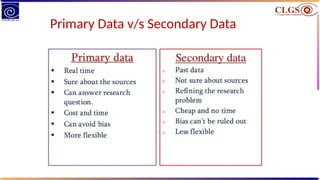
• PRIMARY DATA
•Primary data are those which are collected for the first time and
are original in character.
• SECONDARY DATA
•Secondary data are those which have already been collected by
someone else.
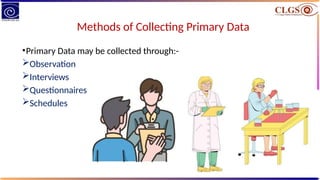
•Primary Data maybe collected through:-
Observation
Interviews
Questionnaires
Schedules
Methods of Collecting Primary Data
8.
Observation Method
•Observation methodis a method under which data collected
with the help of observation by the observer.
Types of Observation Methods-
•Structured
•Unstructured
•Participant
•Non-Participant
9.
1.Structured Observation-
•Systemic observation.
•Forstructured observation the researcher specifies in
details what is observed and how the measurement are to
be recorded.
2. Unstructured Observation-
• Observe and record behavior in a holistic way without
the use of pre determined guide.
10.
3- Participant Observation
•Whenthe observer is member of the group which he is observing
then it is Participant Observation.
4- Non-Participant Observation
• When the observer is not a member of the group.
• observer is observing people without giving any information to them
then it is Non-Participant Observation.
11.
Advantages -
•Produces Largequantities of data.
•All data obtained from observations are usable.
•The observation technique can be stopped or begin at any time.
•Relative Inexpensive.
Disadvantages-
• Time consuming
• Limited information
• Extensive Training is needed.
• Not use for studying past events or activities.
12.
Interview Method
•Interview isa process of communication or interaction
between two person to collect the relevant information for
the research.
13.
Types of interviewmethod
1. Personal Interview , it can be—
• Structured
• Unstructured
2. Telephonic Interview
14.
Advantage
•More information atgreater depth can be obtained
•The interviewer can judge the non-verbal behavior of the respondent.
•The interviewer can control over the order of the question, as in the
questionnaire, and can judge the spontaneity of the respondent as well.
•Personal information can be obtained
https://www.sociologygroup.com/advantages-disadvantages-interview-research/
15.
Disadvantage
•It is anexpensive Method
•Interviewer bias
•Respondent bias
•Time consuming
•There is a lack of accessibility to respondents
https://www.sociologygroup.com/advantages-disadvantages-interview-research/
16.
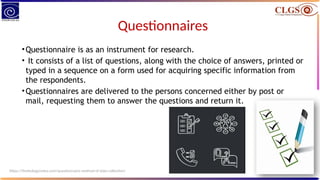
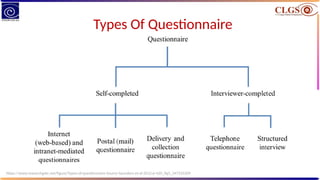
Questionnaires
•Questionnaire is asan instrument for research.
• It consists of a list of questions, along with the choice of answers, printed or
typed in a sequence on a form used for acquiring specific information from
the respondents.
•Questionnaires are delivered to the persons concerned either by post or
mail, requesting them to answer the questions and return it.
https://thebiologynotes.com/questionnaire-method-of-data-collection/
Advantage of Questionnaire
•Questionnaireslies in their uniformity i.e. all respondents see exactly the
same questions.
•It is an inexpensive method.
•Free from the bias of the interviewer, as the respondents answer the
questions in his own words.
•Respondents have enough time to think and answer.
•Due to its large coverage, respondents living in distant areas can also be
reached conveniently.
•Large samples can be used.
https://thebiologynotes.com/questionnaire-method-of-data-collection/
19.
Disadvantage Of Questionnaire
•Timeconsuming
•The respondents need to be educated and cooperative
•Possibility of unclear replies.
•The rate of non-response is high.
https://thebiologynotes.com/questionnaire-method-of-data-collection/
20.
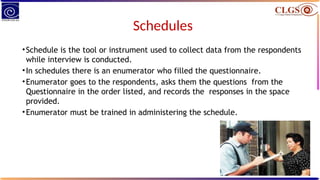
Schedules
•Schedule is thetool or instrument used to collect data from the respondents
while interview is conducted.
•In schedules there is an enumerator who filled the questionnaire.
•Enumerator goes to the respondents, asks them the questions from the
Questionnaire in the order listed, and records the responses in the space
provided.
•Enumerator must be trained in administering the schedule.
21.
Difference b/w Questionnaireand Schedule
Questionnaire
It is generally send to through mail
and no further assistance from
sender.
It is cheaper method.
Non response is high.
In questionnaire, it is not confirmed
that expected respondent have
filled the answers.
Schedule
Schedule is filled by the
enumerator or research
worker.
Costly requires field
workers.
Non response is low.
In schedule identity of
person is known.
22.
Secondary Method OfData Collection
• Data gathered and recorded by someone else
• It involves less cost, time and effort.
• Secondary data is data that is being reused. Usually in a different context.
• For example: data from a book, magazines and newspaper.
• It can be collected from internal or external sources.
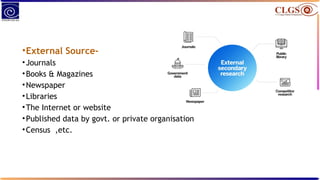
•External Source-
•Journals
•Books &Magazines
•Newspaper
•Libraries
•The Internet or website
•Published data by govt. or private organisation
•Census ,etc.
25.
Factors to beconsidered before using
secondary data
• Reliability of data - Who, when , which methods, at what time etc. must
be investigated.
• Suitability of data – Object ,scope, and nature of original inquiry should be
studied, as if the study was with different objective then that data is not
suitable for current study
• Adequacy of data– Level of accuracy,area differences then data is not
adequate for study
26.
Advantage of SecondaryData Collection
•Ease of access
•Low cost or free
•Time-saving
•Allow you to generate new insights from previous analysis
•Longitudinal analysis
•A huge amount of secondary data with a wide variety of sources
https://www.intellspot.com/secondary-data/
27.
Disadvantage Of SecondaryData
•Might be not specific to your needs
•You have no control over data quality
•Biasness
•Not timely
https://www.intellspot.com/secondary-data/
28.
Selection of properMethod for collection of Data
•Nature ,Scope and object of inquiry
•Availability of Funds
•Time Factor
•Accuracy Required







![research. data collection [Autosaved].pptx](https://cdn.slidesharecdn.com/ss_thumbnails/datacollectionautosaved-250828164458-6418451b-thumbnail.jpg?width=640&height=640&fit=bounds)


