FE5056QA: Problem Solving: Methods and Analysis
LECTURE FIVE
Describing data types and data collection types
Module Leader: Paul Bako
Email: Paul.Bako@qa.com
Name of session
This session will start at __:__
While you are waiting…
Check your audio is working
• Plug in your speakers/ headphones
before you start the session.
• If you cannot hear your tutor,
leave the session and log back in
again.
• If you still cannot hear, let
your tutor know by writing them a
message in the chat box.
If you are still experiencing
problems
• Try disconnecting and
reconnecting your PC/laptop to
the internet.
• Call 0345 074 7958 to speak to
the QAHE Online Learning support
team.
• You can also email the team on
QAHEOnlineLearning@qa.com
We are recording now!
Learning objectives
1. Types of data:
- primary / secondary
2. Data collection techniques:
- observations / interviews / questionnaires
What are the two types of data that exist?
Secondary data: data that were collected initially for some other purpose.
Primary data: collecting new data specifically for the purpose
Secondary data: Types of Secondary Data
Secondary data include both quantitative (numeric) and qualitative (non-numeric) data,
• Used principally in both descriptive and explanatory research.
• Maybe raw data where there has been little if any processing, or compiled data that have
received some form of selection or summarising.
• They may be structured data, that is organised into a format that is easy to process, such as in a
database or spreadsheet; or unstructured data, which are not easy to search or process as, in their
current form, they do not follow a predefined structure.
• Multiple-source data sets: data that have been re-combined with other data to create larger
datasets.
• Within business and management research projects secondary data are used most frequently in
case study and survey research strategies. However, there is no reason not to use secondary data in
other research strategies, including archival, action and experimental research.
Examples of Secondary Data
Most organisations collect and store a wide variety and large volume of data to support their day-
today operations:
• For example, payroll details, organisation charts, copies of letters, minutes of meetings and
business transactions including sales queries and purchases, financials (annual reports).
• Quality daily newspapers contain a wealth of data, such as reports about takeover bids,
interviews with business leaders, photographs of events, graphs and listings of companies’ share
prices.
• Government departments undertake surveys and publish official statistics covering social,
demographic and economic topics. Example: https://www.ons.gov.uk
• Consumer research organisations collect data that are used subsequently by different clients.
• Trade organisations collect data from their members on topics such as sales that are
subsequently aggregated, presented and published.
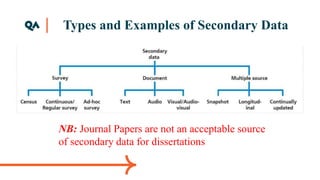
Types and Examples of Secondary Data
NB: Journal Papers are not an acceptable source
of secondary data for dissertations
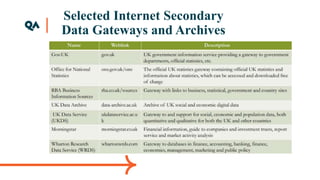
Selected Internet Secondary
Data Gateways and Archives
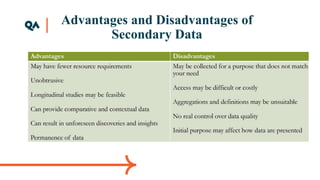
Advantages and Disadvantages of
Secondary Data
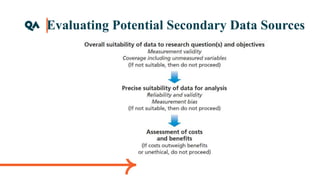
Evaluating Potential Secondary Data Sources
Primary Data Collection Techniques:
(1) Observations
Observation: The systematic viewing, recording, description, analysis and interpretation of
people’s behaviour in a given setting.
Observation methods
• Participant observation: Qualitative: Discovering the meanings that people attach to their
actions and social interactions.
• Structured observation: Quantitative: Concerned with the frequency of actions (‘what’ rather
than ‘why’). Its function is to tell you which things happen, how often and possibly when and in
what sequence rather than why they happen.
• Internet mediated observation: Involves the collection of data from online communities.
Dimensions of Observation Technique
• The structure and formality that the researcher uses in designing observation, ranging from
unstructured and informal to structured and formal
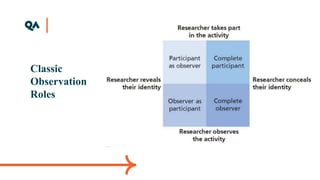
• The role of the researcher during observation comprising: their participation in the
observation setting, ranging from full participation in the activity or event being observed,
through passive observation at the margin of this activity or event, to observation in a
detached location as a non-participant
• Their decision to reveal they wish to observe the event or activity for a research purpose; or to
conceal this from those being observed, involving ethical issues that focus on informed
consent
• The nature of the observational setting, involving conducting observation in either a
naturalistic setting or in a contrived situation
Classic
Observation
Roles
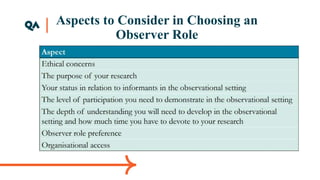
Aspects to Consider in Choosing an
Observer Role
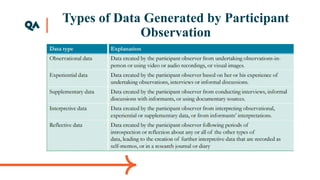
Types of Data Generated by Participant
Observation
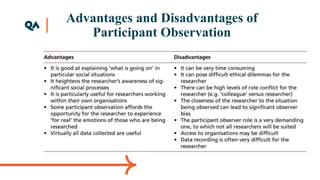
Advantages and Disadvantages of
Participant Observation
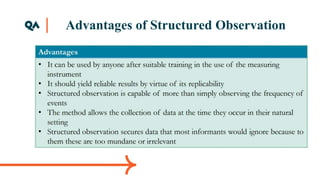
Advantages of Structured Observation
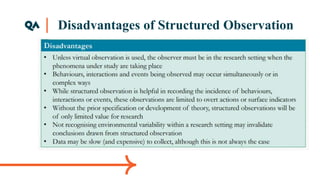
Disadvantages of Structured Observation
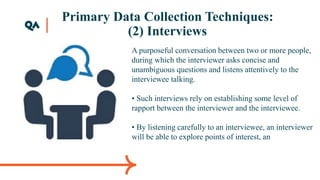
Primary Data Collection Techniques:
(2) Interviews
A purposeful conversation between two or more people,
during which the interviewer asks concise and
unambiguous questions and listens attentively to the
interviewee talking.
• Such interviews rely on establishing some level of
rapport between the interviewer and the interviewee.
• By listening carefully to an interviewee, an interviewer
will be able to explore points of interest, an
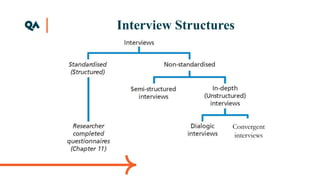
Interview Structures
• Structured interviews or quantitative research interviews: Conducted using researcher-
completed questionnaires. You read out each question from the questionnaire exactly as it is
written and in the same tone of voice so that you do not indicate any bias. Then you record the
response on a standardised schedule, usually with pre-coded answers.
• Semi-structured interviews or qualitative research interviews: You start with a predetermined
list of themes, and possibly some key questions related to these themes, to guide the conduct of
each interview.
• Unstructured or in-depth interviews: informal; They are used to explore in depth a general
area in which you are interested. This means that they do not use predetermined and written
down themes or questions to structure or guide the course of the interview. Instead, this type of
interview is entirely exploratory and emergent. You will be interested to find out which themes
emerge from the data you collect from your participants.
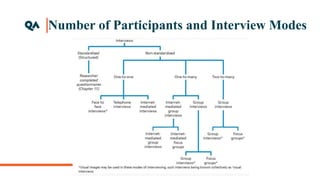
Number of Participants and Interview Modes
Group Interviews and Focus Groups
• Group interview is a general term to describe all semi-structured and in-
depth interviews conducted with two or more interviewees.
• In Focus groups the topic to be explored is predetermined and precisely
defined and the role of the researcher is to facilitate or enable discussion
amongst participants.
• In this way, a focus group is a type of group interview, but not all group
interviews should be labelled as focus groups.
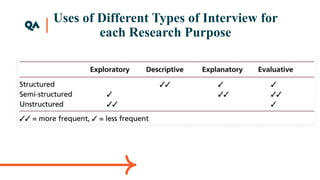
Uses of Different Types of Interview for
each Research Purpose
When to use Semi-Structured and
In-Depth Interviews
Research purpose is exploratory or explanatory.
• Establishing personal contact is important.
• Questions that need to be asked are:
Complex
Open-ended
Large in number
Likely to need to be varied in the order they are asked
Preparation for your Semi-Structured
or In-Depth Interview
• What level of knowledge about your research topic / context will be required in order to
demonstrate your competence and credibility to gain the confidence of your participants?
• What level of knowledge about the culture of your participants will be required in order to
gain their confidence before they are willing to share data?
• What will be the broad focus of your in-depth interview, or what are the themes that you
wish to explore or seek explanations for during a semi structured interview?
• What type of information, if any, will it be useful to send to each participant prior to the
interview?
• What did you agree to supply to your participant when you arranged the interview? Has this
been supplied?
• Have you considered the impact that your interview location may have on participants’
responses and for your own personal safety
Opening a Semi-Structured or
In-Depth Interview
The participant is thanked for considering the request for access and for agreeing to the
meeting.
• The purpose of the research and its progress to date were outlined briefly.
• The previously agreed right to confidentiality and anonymity was reiterated
• The participant’s right not to answer any question was emphasised and that the interview
would be stopped if the participant wished.
• The participant was told about the nature of the outputs to which the research was intended
to lead and what would happen to the data collected during and after the project.
• The offer to provide a summary of the research findings was also restated and the
participant was told when this would happen.
• The request to audio-record the interview was restated and, where agreed, this was used
subsequently.
• Summarisation of the themes to be covered, confirmation of the time available and request
to read and sign the informed consent form.
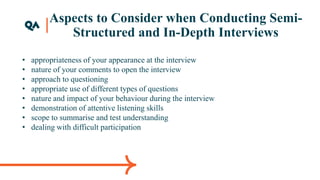
Aspects to Consider when Conducting Semi-
Structured and In-Depth Interviews
• appropriateness of your appearance at the interview
• nature of your comments to open the interview
• approach to questioning
• appropriate use of different types of questions
• nature and impact of your behaviour during the interview
• demonstration of attentive listening skills
• scope to summarise and test understanding
• dealing with difficult participation
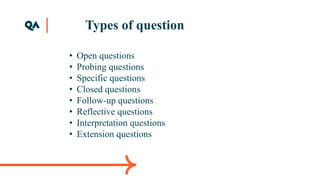
Types of question
• Open questions
• Probing questions
• Specific questions
• Closed questions
• Follow-up questions
• Reflective questions
• Interpretation questions
• Extension questions
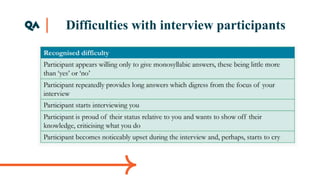
Difficulties with interview participants
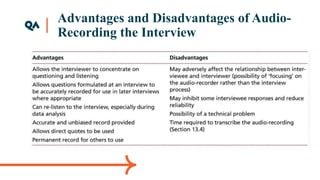
Advantages and Disadvantages of Audio-
Recording the Interview
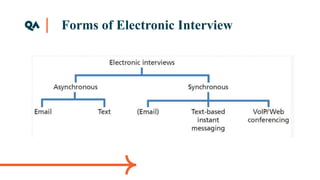
Forms of Electronic Interview
Primary Data Collection Techniques:
(3) Questionnaires
• All methods of data collection in which each person is asked to respond to the
same set of questions in a predetermined order.
• Need to ensure that it will collect the precise data that you require to answer your
research question(s) and achieve your objectives.
• Careful design of individual questions
Clear and pleasing visual presentation
Lucid explanation of the purpose
Pilot testing
Descriptive or explanatory research
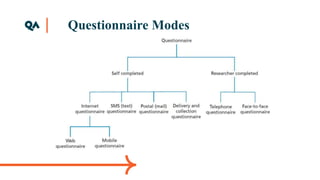
Questionnaire Modes
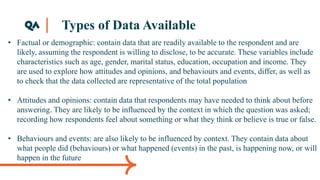
Types of Data Available
• Factual or demographic: contain data that are readily available to the respondent and are
likely, assuming the respondent is willing to disclose, to be accurate. These variables include
characteristics such as age, gender, marital status, education, occupation and income. They
are used to explore how attitudes and opinions, and behaviours and events, differ, as well as
to check that the data collected are representative of the total population
• Attitudes and opinions: contain data that respondents may have needed to think about before
answering. They are likely to be influenced by the context in which the question was asked;
recording how respondents feel about something or what they think or believe is true or false.
• Behaviours and events: are also likely to be influenced by context. They contain data about
what people did (behaviours) or what happened (events) in the past, is happening now, or will
happen in the future
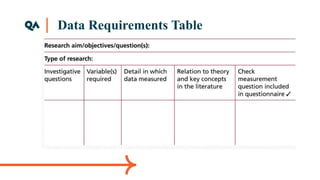
Data Requirements Table
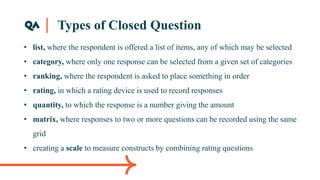
Types of Closed Question
• list, where the respondent is offered a list of items, any of which may be selected
• category, where only one response can be selected from a given set of categories
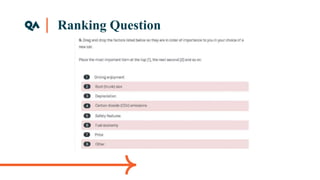
• ranking, where the respondent is asked to place something in order
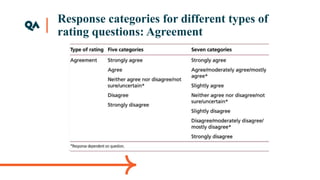
• rating, in which a rating device is used to record responses
• quantity, to which the response is a number giving the amount
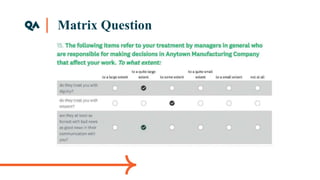
• matrix, where responses to two or more questions can be recorded using the same
grid
• creating a scale to measure constructs by combining rating questions
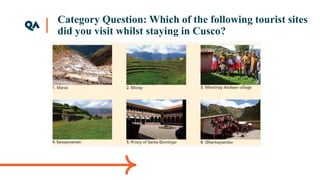
Category Question: Which of the following tourist sites
did you visit whilst staying in Cusco?
Ranking Question
Response categories for different types of
rating questions: Agreement
Matrix Question
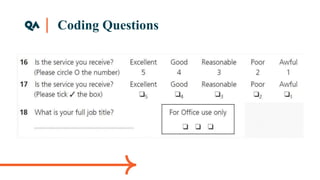
Coding Questions
Questions?

fe5056qa-week-5-lecture_1720263863397.pptx

  • 1.
    FE5056QA: Problem Solving:Methods and Analysis LECTURE FIVE Describing data types and data collection types Module Leader: Paul Bako Email: Paul.Bako@qa.com
  • 2.
    Name of session Thissession will start at __:__ While you are waiting… Check your audio is working • Plug in your speakers/ headphones before you start the session. • If you cannot hear your tutor, leave the session and log back in again. • If you still cannot hear, let your tutor know by writing them a message in the chat box. If you are still experiencing problems • Try disconnecting and reconnecting your PC/laptop to the internet. • Call 0345 074 7958 to speak to the QAHE Online Learning support team. • You can also email the team on QAHEOnlineLearning@qa.com
  • 3.
  • 4.
    Learning objectives 1. Typesof data: - primary / secondary 2. Data collection techniques: - observations / interviews / questionnaires
  • 5.
    What are thetwo types of data that exist? Secondary data: data that were collected initially for some other purpose. Primary data: collecting new data specifically for the purpose
  • 6.
    Secondary data: Typesof Secondary Data Secondary data include both quantitative (numeric) and qualitative (non-numeric) data, • Used principally in both descriptive and explanatory research. • Maybe raw data where there has been little if any processing, or compiled data that have received some form of selection or summarising. • They may be structured data, that is organised into a format that is easy to process, such as in a database or spreadsheet; or unstructured data, which are not easy to search or process as, in their current form, they do not follow a predefined structure. • Multiple-source data sets: data that have been re-combined with other data to create larger datasets. • Within business and management research projects secondary data are used most frequently in case study and survey research strategies. However, there is no reason not to use secondary data in other research strategies, including archival, action and experimental research.
  • 7.
    Examples of SecondaryData Most organisations collect and store a wide variety and large volume of data to support their day- today operations: • For example, payroll details, organisation charts, copies of letters, minutes of meetings and business transactions including sales queries and purchases, financials (annual reports). • Quality daily newspapers contain a wealth of data, such as reports about takeover bids, interviews with business leaders, photographs of events, graphs and listings of companies’ share prices. • Government departments undertake surveys and publish official statistics covering social, demographic and economic topics. Example: https://www.ons.gov.uk • Consumer research organisations collect data that are used subsequently by different clients. • Trade organisations collect data from their members on topics such as sales that are subsequently aggregated, presented and published.
  • 8.
    Types and Examplesof Secondary Data NB: Journal Papers are not an acceptable source of secondary data for dissertations
  • 9.
    Selected Internet Secondary DataGateways and Archives
  • 10.
  • 11.
  • 12.
    Primary Data CollectionTechniques: (1) Observations Observation: The systematic viewing, recording, description, analysis and interpretation of people’s behaviour in a given setting. Observation methods • Participant observation: Qualitative: Discovering the meanings that people attach to their actions and social interactions. • Structured observation: Quantitative: Concerned with the frequency of actions (‘what’ rather than ‘why’). Its function is to tell you which things happen, how often and possibly when and in what sequence rather than why they happen. • Internet mediated observation: Involves the collection of data from online communities.
  • 13.
    Dimensions of ObservationTechnique • The structure and formality that the researcher uses in designing observation, ranging from unstructured and informal to structured and formal • The role of the researcher during observation comprising: their participation in the observation setting, ranging from full participation in the activity or event being observed, through passive observation at the margin of this activity or event, to observation in a detached location as a non-participant • Their decision to reveal they wish to observe the event or activity for a research purpose; or to conceal this from those being observed, involving ethical issues that focus on informed consent • The nature of the observational setting, involving conducting observation in either a naturalistic setting or in a contrived situation
  • 14.
  • 15.
    Aspects to Considerin Choosing an Observer Role
  • 16.
    Types of DataGenerated by Participant Observation
  • 17.
    Advantages and Disadvantagesof Participant Observation
  • 18.
  • 19.
  • 20.
    Primary Data CollectionTechniques: (2) Interviews A purposeful conversation between two or more people, during which the interviewer asks concise and unambiguous questions and listens attentively to the interviewee talking. • Such interviews rely on establishing some level of rapport between the interviewer and the interviewee. • By listening carefully to an interviewee, an interviewer will be able to explore points of interest, an
  • 21.
  • 22.
    Interview Structures • Structuredinterviews or quantitative research interviews: Conducted using researcher- completed questionnaires. You read out each question from the questionnaire exactly as it is written and in the same tone of voice so that you do not indicate any bias. Then you record the response on a standardised schedule, usually with pre-coded answers. • Semi-structured interviews or qualitative research interviews: You start with a predetermined list of themes, and possibly some key questions related to these themes, to guide the conduct of each interview. • Unstructured or in-depth interviews: informal; They are used to explore in depth a general area in which you are interested. This means that they do not use predetermined and written down themes or questions to structure or guide the course of the interview. Instead, this type of interview is entirely exploratory and emergent. You will be interested to find out which themes emerge from the data you collect from your participants.
  • 23.
    Number of Participantsand Interview Modes
  • 24.
    Group Interviews andFocus Groups • Group interview is a general term to describe all semi-structured and in- depth interviews conducted with two or more interviewees. • In Focus groups the topic to be explored is predetermined and precisely defined and the role of the researcher is to facilitate or enable discussion amongst participants. • In this way, a focus group is a type of group interview, but not all group interviews should be labelled as focus groups.
  • 25.
    Uses of DifferentTypes of Interview for each Research Purpose
  • 26.
    When to useSemi-Structured and In-Depth Interviews Research purpose is exploratory or explanatory. • Establishing personal contact is important. • Questions that need to be asked are: Complex Open-ended Large in number Likely to need to be varied in the order they are asked
  • 27.
    Preparation for yourSemi-Structured or In-Depth Interview • What level of knowledge about your research topic / context will be required in order to demonstrate your competence and credibility to gain the confidence of your participants? • What level of knowledge about the culture of your participants will be required in order to gain their confidence before they are willing to share data? • What will be the broad focus of your in-depth interview, or what are the themes that you wish to explore or seek explanations for during a semi structured interview? • What type of information, if any, will it be useful to send to each participant prior to the interview? • What did you agree to supply to your participant when you arranged the interview? Has this been supplied? • Have you considered the impact that your interview location may have on participants’ responses and for your own personal safety
  • 28.
    Opening a Semi-Structuredor In-Depth Interview The participant is thanked for considering the request for access and for agreeing to the meeting. • The purpose of the research and its progress to date were outlined briefly. • The previously agreed right to confidentiality and anonymity was reiterated • The participant’s right not to answer any question was emphasised and that the interview would be stopped if the participant wished. • The participant was told about the nature of the outputs to which the research was intended to lead and what would happen to the data collected during and after the project. • The offer to provide a summary of the research findings was also restated and the participant was told when this would happen. • The request to audio-record the interview was restated and, where agreed, this was used subsequently. • Summarisation of the themes to be covered, confirmation of the time available and request to read and sign the informed consent form.
  • 29.
    Aspects to Considerwhen Conducting Semi- Structured and In-Depth Interviews • appropriateness of your appearance at the interview • nature of your comments to open the interview • approach to questioning • appropriate use of different types of questions • nature and impact of your behaviour during the interview • demonstration of attentive listening skills • scope to summarise and test understanding • dealing with difficult participation
  • 30.
    Types of question •Open questions • Probing questions • Specific questions • Closed questions • Follow-up questions • Reflective questions • Interpretation questions • Extension questions
  • 31.
  • 32.
    Advantages and Disadvantagesof Audio- Recording the Interview
  • 33.
  • 34.
    Primary Data CollectionTechniques: (3) Questionnaires • All methods of data collection in which each person is asked to respond to the same set of questions in a predetermined order. • Need to ensure that it will collect the precise data that you require to answer your research question(s) and achieve your objectives. • Careful design of individual questions Clear and pleasing visual presentation Lucid explanation of the purpose Pilot testing Descriptive or explanatory research
  • 35.
  • 36.
    Types of DataAvailable • Factual or demographic: contain data that are readily available to the respondent and are likely, assuming the respondent is willing to disclose, to be accurate. These variables include characteristics such as age, gender, marital status, education, occupation and income. They are used to explore how attitudes and opinions, and behaviours and events, differ, as well as to check that the data collected are representative of the total population • Attitudes and opinions: contain data that respondents may have needed to think about before answering. They are likely to be influenced by the context in which the question was asked; recording how respondents feel about something or what they think or believe is true or false. • Behaviours and events: are also likely to be influenced by context. They contain data about what people did (behaviours) or what happened (events) in the past, is happening now, or will happen in the future
  • 37.
  • 38.
    Types of ClosedQuestion • list, where the respondent is offered a list of items, any of which may be selected • category, where only one response can be selected from a given set of categories • ranking, where the respondent is asked to place something in order • rating, in which a rating device is used to record responses • quantity, to which the response is a number giving the amount • matrix, where responses to two or more questions can be recorded using the same grid • creating a scale to measure constructs by combining rating questions
  • 39.
    Category Question: Whichof the following tourist sites did you visit whilst staying in Cusco?
  • 40.
  • 41.
    Response categories fordifferent types of rating questions: Agreement
  • 42.
  • 43.
  • 44.

Editor's Notes

  • #3 You should start your session 15 to 30 minutes before the start time. The learners should be greeted with this slide: remember to adapt to fit your time.
  • #4 This will alert the learners to the fact you are recording and remind you to start recording!