Economic Environment
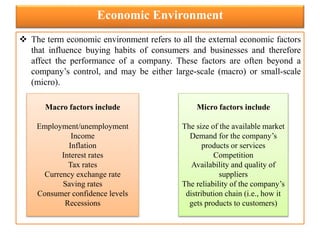
 The term economic environment refers to all the external economic factors
that influence buying habits of consumers and businesses and therefore
affect the performance of a company. These factors are often beyond a
company’s control, and may be either large-scale (macro) or small-scale
(micro).
Macro factors include
Employment/unemployment
Income
Inflation
Interest rates
Tax rates
Currency exchange rate
Saving rates
Consumer confidence levels
Recessions
Micro factors include
The size of the available market
Demand for the company’s
products or services
Competition
Availability and quality of
suppliers
The reliability of the company’s
distribution chain (i.e., how it
gets products to customers)
Economic Types
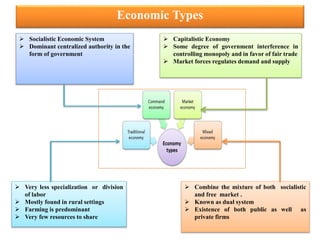
 Socialistic Economic System
 Dominant centralized authority in the
form of government
 Capitalistic Economy
 Some degree of government interference in
controlling monopoly and in favor of fair trade
 Market forces regulates demand and supply
 Very less specialization or division
of labor
 Mostly found in rural settings
 Farming is predominant
 Very few resources to share
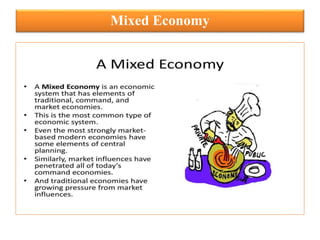
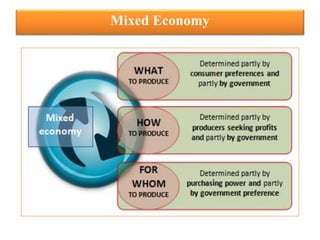
 Combine the mixture of both socialistic
and free market .
 Known as dual system
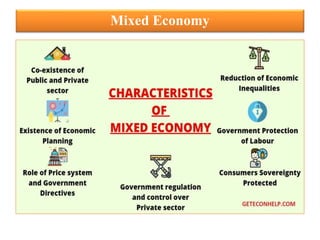
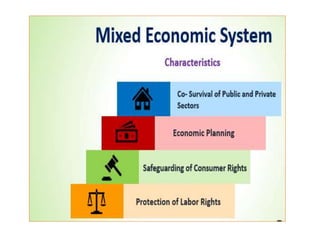
 Existence of both public as well as
private firms
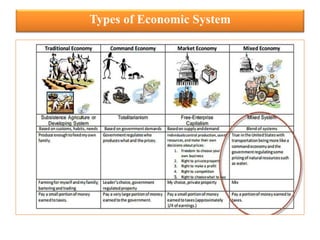
Types of Economic System
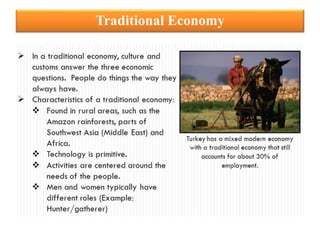
Traditional Economy
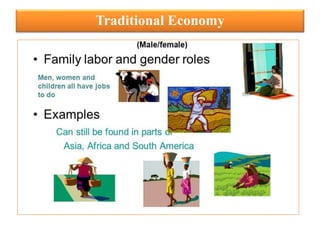
Traditional Economy
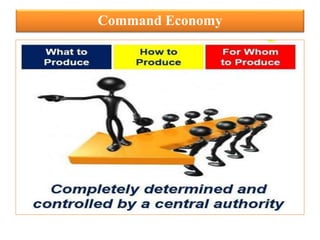
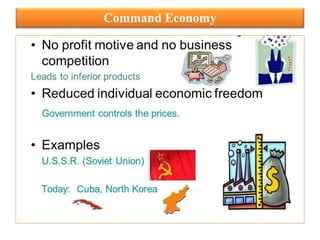
Command Economy
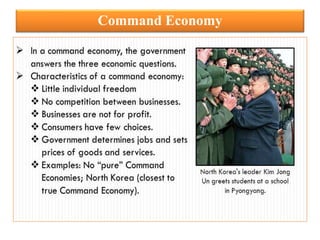
Command Economy
Command Economy
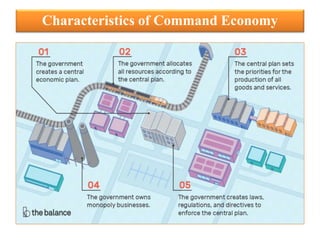
Characteristics of Command Economy
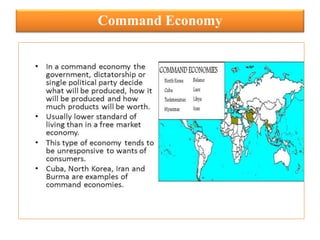
Command Economy
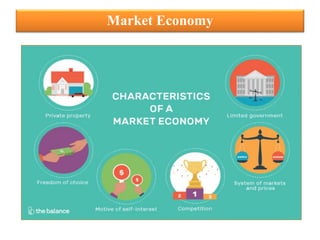
Market Economy
Market Economy
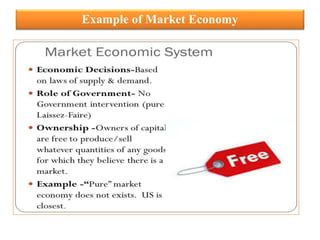
Example of Market Economy
Mixed Economy
Mixed Economy
Mixed Economy
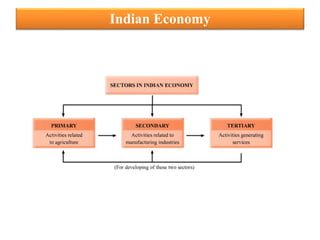
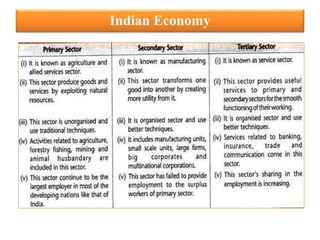
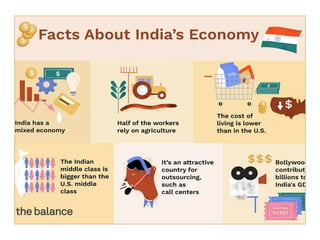
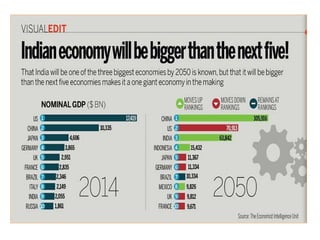
Indian Economy
Indian Economy
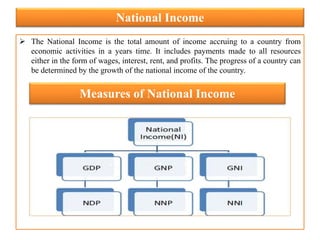
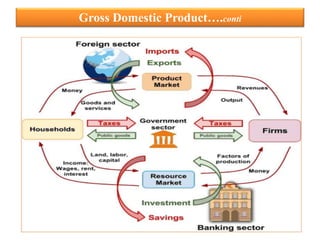
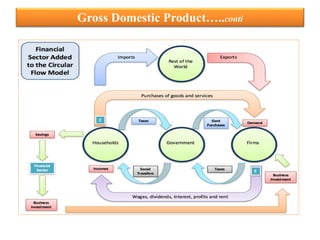
National Income
 The National Income is the total amount of income accruing to a country from
economic activities in a years time. It includes payments made to all resources
either in the form of wages, interest, rent, and profits. The progress of a country can
be determined by the growth of the national income of the country.
Measures of National Income
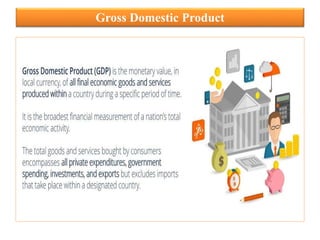
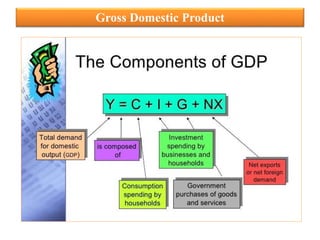
Gross Domestic Product
Gross Domestic Product…..conti
Gross Domestic Product….conti
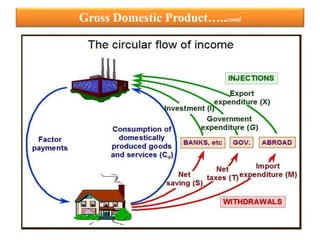
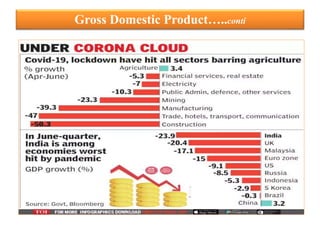
Gross Domestic Product…..conti
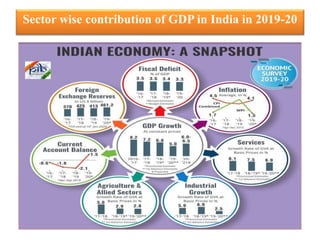
Sector wise contribution of GDP in India in 2019-20
Inflation
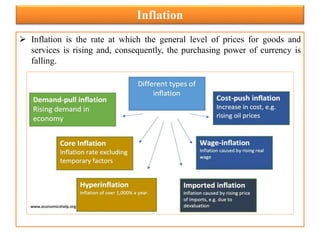
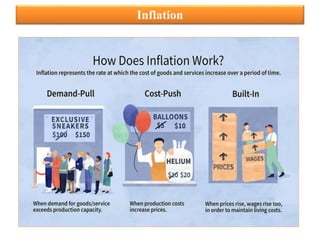
 Inflation is the rate at which the general level of prices for goods and
services is rising and, consequently, the purchasing power of currency is
falling.
Inflation
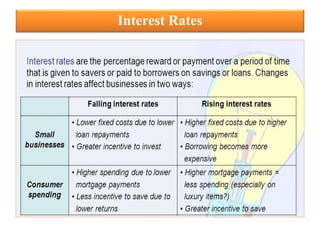
Interest Rates
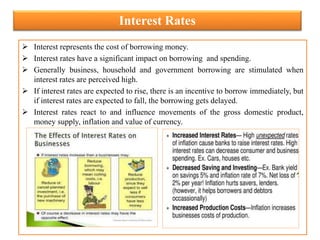
 Interest represents the cost of borrowing money.
 Interest rates have a significant impact on borrowing and spending.
 Generally business, household and government borrowing are stimulated when
interest rates are perceived high.
 If interest rates are expected to rise, there is an incentive to borrow immediately, but
if interest rates are expected to fall, the borrowing gets delayed.
 Interest rates react to and influence movements of the gross domestic product,
money supply, inflation and value of currency.
Interest Rates
Economic Planning-Importance of Planning for Economic Development
 Economic planning is often regarded as technique
of managing an economy. When the structure of an
economy becomes complex and subject to rapid
change and transformation (due to population
growth, discovery of resources, industrialization,
etc.) some sort of advance thinking becomes
necessary to resolve that complexity and to prepare
the economy for those changes. Such preparation is
called planning.
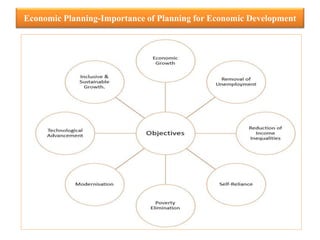
Economic Planning-Importance of Planning for Economic Development
Economic Policies- New Industrial Policy
 The main objectives of the Industrial Policy of the
Government are
(i) To maintain a sustained growth in productivity;
(ii) To enhance gainful employment
(iii) To achieve optimal utilization of human resources
(iv) To attain international competitiveness
(v) To transform India into a major partner and player in the
global arena.
To achieve these objectives, the Policy focus is on deregulating
Indian industry; allowing freedom and flexibility to the industry
in responding to market forces; and providing a policy regime
that facilitates and fosters growth.
Economic Policies- New Industrial Policy
• Consistent with the policy of liberalization of domestic
industry, the numbers of industries reserved for public sector
have also been reduced. During 2014, private investment in
Rail Infrastructure has been permitted. Consequently, at
present only two industrial sectors are reserved for public
sector: Atomic Energy.
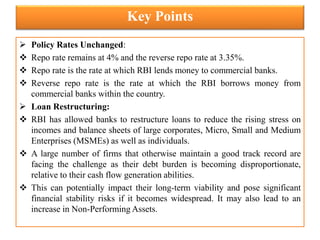
Key Points
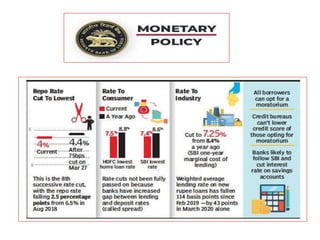
 Policy Rates Unchanged:
 Repo rate remains at 4% and the reverse repo rate at 3.35%.
 Repo rate is the rate at which RBI lends money to commercial banks.
 Reverse repo rate is the rate at which the RBI borrows money from
commercial banks within the country.
 Loan Restructuring:
 RBI has allowed banks to restructure loans to reduce the rising stress on
incomes and balance sheets of large corporates, Micro, Small and Medium
Enterprises (MSMEs) as well as individuals.
 A large number of firms that otherwise maintain a good track record are
facing the challenge as their debt burden is becoming disproportionate,
relative to their cash flow generation abilities.
 This can potentially impact their long-term viability and pose significant
financial stability risks if it becomes widespread. It may also lead to an
increase in Non-Performing Assets.
Link between Growth, Inflation and Interest Rates
 In a fast-growing economy, incomes go up quickly and more and more people
have the money to buy the existing bunch of goods.
 As more and more money chases the existing set of goods, prices of such goods
rise. In other words, inflation (which is nothing but the rate of increase in prices)
increases.
 To control inflation, a country’s central bank typically increases the interest rates
in the economy. By doing so, it incentivises people to spend less and save more
because saving becomes more profitable as interest rates go up.
 However, when growth contracts, people’s incomes hit. As a result, less and less
money is chasing the same quantity of goods. This results in either the inflation
rate decelerating or it actually contracts (also called deflation).
 In such situations, a central bank decreases interest rates so as to incentivise
spending and by that route boost economic activity in the economy.
 In the current Monetary Policy, RBI has not raised the interest rates even when
retail inflation is high because RBI is facing an odd situation at present: GDP is
contracting even as inflation is rising.
 This is happening because the pandemic has reduced demand, on the one hand,
and disrupted supply on the other. As a result falling growth and rising inflation
are happening at the same time.
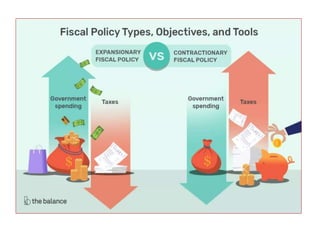
Fiscal policy in India
Fiscal policy in India is the guiding force that helps the government decide how
much money it should spend to support the economic activity, and how much
revenue it must earn from the system, to keep the wheels of the economy running
smoothly. In recent times, the importance of fiscal policy has been increasing to
achieve economic growth swiftly, both in India and across the world. Attaining
rapid economic growth is one of the key goals of fiscal policy formulated by the
Government of India. Fiscal policy, along with monetary policy, plays a crucial
role in managing a country’s economy.

Economic environment

  • 2.
    Economic Environment  Theterm economic environment refers to all the external economic factors that influence buying habits of consumers and businesses and therefore affect the performance of a company. These factors are often beyond a company’s control, and may be either large-scale (macro) or small-scale (micro). Macro factors include Employment/unemployment Income Inflation Interest rates Tax rates Currency exchange rate Saving rates Consumer confidence levels Recessions Micro factors include The size of the available market Demand for the company’s products or services Competition Availability and quality of suppliers The reliability of the company’s distribution chain (i.e., how it gets products to customers)
  • 3.
    Economic Types  SocialisticEconomic System  Dominant centralized authority in the form of government  Capitalistic Economy  Some degree of government interference in controlling monopoly and in favor of fair trade  Market forces regulates demand and supply  Very less specialization or division of labor  Mostly found in rural settings  Farming is predominant  Very few resources to share  Combine the mixture of both socialistic and free market .  Known as dual system  Existence of both public as well as private firms
  • 4.
  • 5.
  • 6.
  • 7.
  • 8.
  • 9.
  • 10.
  • 11.
  • 12.
  • 13.
  • 14.
  • 15.
  • 16.
  • 18.
  • 19.
  • 20.
  • 22.
    National Income  TheNational Income is the total amount of income accruing to a country from economic activities in a years time. It includes payments made to all resources either in the form of wages, interest, rent, and profits. The progress of a country can be determined by the growth of the national income of the country. Measures of National Income
  • 23.
  • 24.
  • 25.
  • 26.
  • 27.
  • 28.
  • 29.
    Sector wise contributionof GDP in India in 2019-20
  • 31.
    Inflation  Inflation isthe rate at which the general level of prices for goods and services is rising and, consequently, the purchasing power of currency is falling.
  • 32.
  • 33.
    Interest Rates  Interestrepresents the cost of borrowing money.  Interest rates have a significant impact on borrowing and spending.  Generally business, household and government borrowing are stimulated when interest rates are perceived high.  If interest rates are expected to rise, there is an incentive to borrow immediately, but if interest rates are expected to fall, the borrowing gets delayed.  Interest rates react to and influence movements of the gross domestic product, money supply, inflation and value of currency.
  • 34.
  • 35.
    Economic Planning-Importance ofPlanning for Economic Development  Economic planning is often regarded as technique of managing an economy. When the structure of an economy becomes complex and subject to rapid change and transformation (due to population growth, discovery of resources, industrialization, etc.) some sort of advance thinking becomes necessary to resolve that complexity and to prepare the economy for those changes. Such preparation is called planning.
  • 36.
    Economic Planning-Importance ofPlanning for Economic Development
  • 37.
    Economic Policies- NewIndustrial Policy  The main objectives of the Industrial Policy of the Government are (i) To maintain a sustained growth in productivity; (ii) To enhance gainful employment (iii) To achieve optimal utilization of human resources (iv) To attain international competitiveness (v) To transform India into a major partner and player in the global arena. To achieve these objectives, the Policy focus is on deregulating Indian industry; allowing freedom and flexibility to the industry in responding to market forces; and providing a policy regime that facilitates and fosters growth.
  • 38.
    Economic Policies- NewIndustrial Policy • Consistent with the policy of liberalization of domestic industry, the numbers of industries reserved for public sector have also been reduced. During 2014, private investment in Rail Infrastructure has been permitted. Consequently, at present only two industrial sectors are reserved for public sector: Atomic Energy.
  • 40.
    Key Points  PolicyRates Unchanged:  Repo rate remains at 4% and the reverse repo rate at 3.35%.  Repo rate is the rate at which RBI lends money to commercial banks.  Reverse repo rate is the rate at which the RBI borrows money from commercial banks within the country.  Loan Restructuring:  RBI has allowed banks to restructure loans to reduce the rising stress on incomes and balance sheets of large corporates, Micro, Small and Medium Enterprises (MSMEs) as well as individuals.  A large number of firms that otherwise maintain a good track record are facing the challenge as their debt burden is becoming disproportionate, relative to their cash flow generation abilities.  This can potentially impact their long-term viability and pose significant financial stability risks if it becomes widespread. It may also lead to an increase in Non-Performing Assets.
  • 41.
    Link between Growth,Inflation and Interest Rates  In a fast-growing economy, incomes go up quickly and more and more people have the money to buy the existing bunch of goods.  As more and more money chases the existing set of goods, prices of such goods rise. In other words, inflation (which is nothing but the rate of increase in prices) increases.  To control inflation, a country’s central bank typically increases the interest rates in the economy. By doing so, it incentivises people to spend less and save more because saving becomes more profitable as interest rates go up.  However, when growth contracts, people’s incomes hit. As a result, less and less money is chasing the same quantity of goods. This results in either the inflation rate decelerating or it actually contracts (also called deflation).  In such situations, a central bank decreases interest rates so as to incentivise spending and by that route boost economic activity in the economy.  In the current Monetary Policy, RBI has not raised the interest rates even when retail inflation is high because RBI is facing an odd situation at present: GDP is contracting even as inflation is rising.  This is happening because the pandemic has reduced demand, on the one hand, and disrupted supply on the other. As a result falling growth and rising inflation are happening at the same time.
  • 43.
    Fiscal policy inIndia Fiscal policy in India is the guiding force that helps the government decide how much money it should spend to support the economic activity, and how much revenue it must earn from the system, to keep the wheels of the economy running smoothly. In recent times, the importance of fiscal policy has been increasing to achieve economic growth swiftly, both in India and across the world. Attaining rapid economic growth is one of the key goals of fiscal policy formulated by the Government of India. Fiscal policy, along with monetary policy, plays a crucial role in managing a country’s economy.