The Incorporation of ICTs into Task-
           Based Language Learning

                                        Distinguished Fulbright Awards in Teaching


                                                                                     2010


                       DATA ANALYSIS and INTERPRETATION


                                   I do not advocate the use of technologies as a mere replacement of more
                       recognizable classroom tools, such as the blackboard and chalk or the
                       whiteboard and maker. We should envision a radical change in our teaching
                       practices not only because technologies usage is being involved, but because
                       we, as teachers, have to begin rethinking our syllabus design in terms of where
                       and when these technologies can have a positive intervention.


                                   Reading through answers from interviews with teachers, they attribute some
                       benefits to these new incorporations of LCD projector, MIMIO machine, smart
boards. All of these have made the teacher´s job easier and more comfortable
in different aspects. However, when talking about how these incorporations
have beneficial for their students, they mainly mention the “fun” factor or
entertaining nature of the activities proposed. Showing videos or asking
students to come to the front and work with the smart board, have become
standpoints of this new educational perspectives.


   Recreation as an added value of technology environments should not be
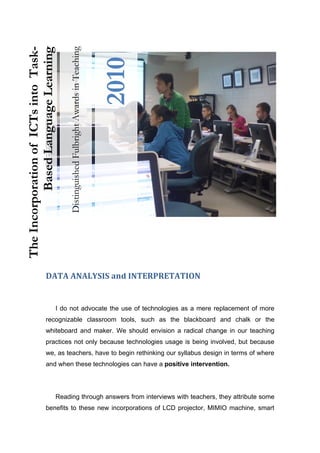
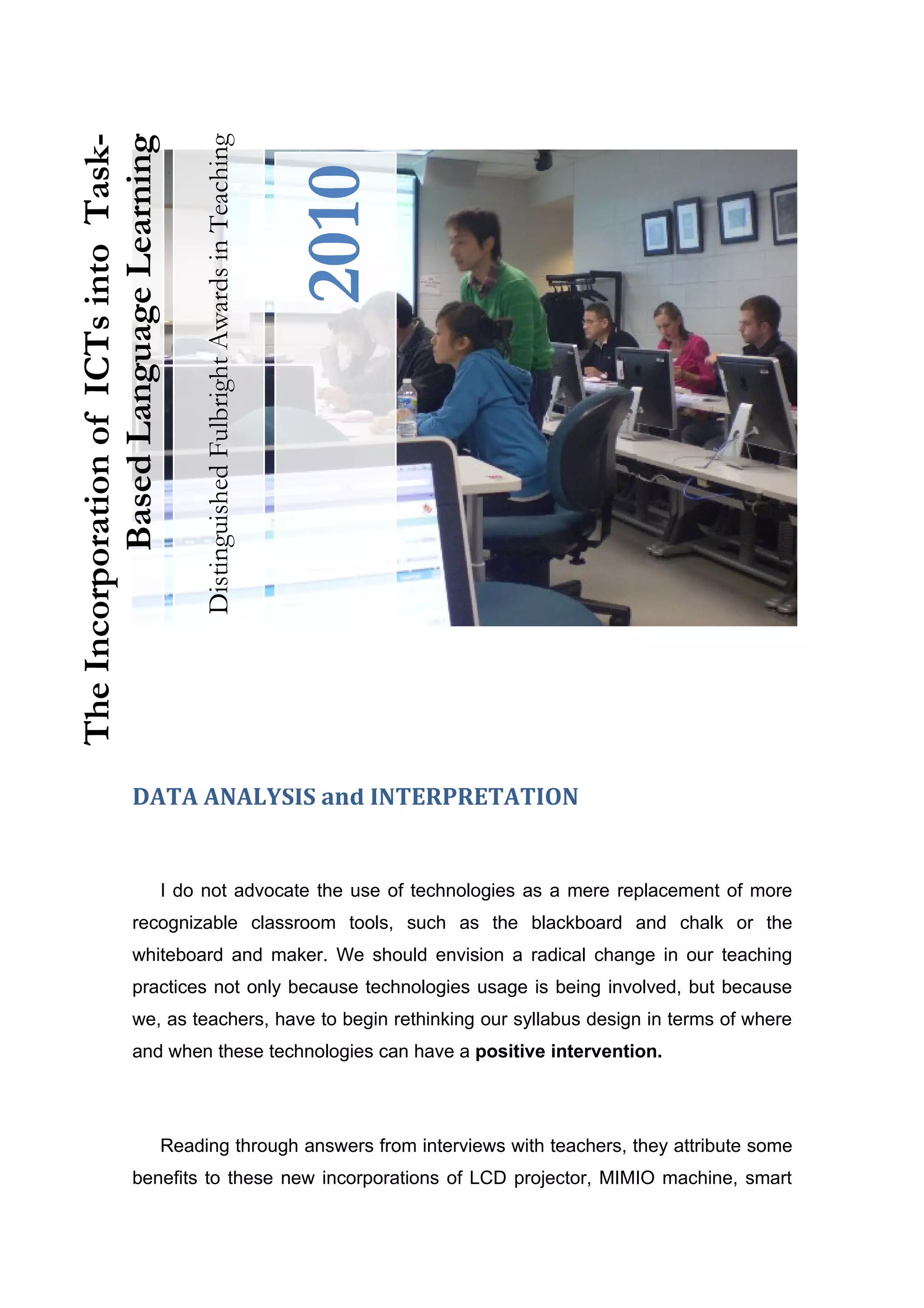
undermined. It is clear when observing the photos folder that supports this
paper that students show a relaxed body posture, amiable gestures to teachers,
who are monitoring them from ”behind” with an attentive and encouraging
attitude, answering to demands just when required, but allowing students to
follow their own pace of work.


   Nonetheless, teachers do not fully recognize the benefits of “the other
technology”: the creative, collaborative, productive tool with which they could
empower their students allowing them to meet 21st century educational goals
and ambitions.


   Without a pedagogy wrapped around them, reading WebPages represents
quite a static activity; it is only by a careful examination of new web2.0 tools that
students can take advantage of the interactivity they propose. Interactivity is
also a concept that needs some clarification, as teachers may think that
because the computer answers with an applause to right click or an “oops” to
wrong one, there is some degree of interactivity.


   Study Island and Kidspiration are two of the platforms that offer the kind of
interactivity described above. Students surf around quite a number of
interactivities that give immediate answer through sounds or graphical displays
whenever the students click the mouse.
Both a methodology TA (teacher´s assistant) and a graduate ESOL student,
mention in their interviews social networks and other web 2.0 as powerful
interactive tools where students and teachers can find a milliard of resources to
incorporate in their practices, as well as different kinds of CMC tools (e.g.,
skype, blog, wiki, etc.) which they have incorporated into the instruction. Thus, a
wider meaning can be applied to this concept after web 2.0 resources invaded
the education field. Now it should also cover the instances in which students
actively participate in some collaborative written or speaking tasks with users
connected synchronically or asynchronically in virtual contexts.


   Only one of the interviewees mentions task-based learning as a
methodological approach which can give a suitable frame inside which
language teachers can embed their technological incorporations. However, in
both field notes presented in this paper, the reader can see that teachers get
their students involved in creative tasks that involve the use of technology. Such
are the cases of the blogs being followed by students at Montgomery Blair High
School and the environmental project with which the 5th grade teacher is
working at Clarksville Elementary School discussing the issue of water in their
area, involving the kids in a wiki context in which they publish the findings of
their research.


   We need a few words of caution though; technology only offers a set of
powerful tools that are methologically neutral, which mediate our experiences in
certain ways. These experiences that we create for our students to interact with
these resources are what add value to the tool. These experiences should also
offer the 21st century curriculum certain benefits that should fit in the
traditional one.
Julian Chen, a TESOL TA, mentions “I was a bit overwhelmed by all the
Web 2.0 tools. In order to align my teaching styles with students’ digital learning
styles, I tried to explore different kinds of CMC tools (e.g., skype, blog, wiki,
etc.) and incorporated them into the instruction. In 2008, I first encountered
Second Life (SL), a 3-D virtual environment. I was impressed with the
pedagogical potential SL can offer for language learners and started to embark
on my SL journey.” Tools, once more, are neutral until we transform them.


   Another good point that can be made after reading the interviews and field
notes, is that each individual need to become acquainted with the potential
advantages that using technology can bring to their classrooms. Otherwise,
when teachers feel the technological issues are being imposed to them, from
external policies, they just reject them or participate only symbolically in the
implementation.


   Mr Read, a middle school technology teacher describes his position about
the states technology standards describing: “The seven Technology
Standards provide a specific framework for teachers to effectively implement
technology within the curriculum on many levels. “My feeling is that I and most
teachers need to review these Standards in order to be aware of the specific
recommendations. A better awareness of the Standards would facilitate a more
comprehensive implementation; however, many of these Standards are
typically employed without much thought, in my case.            Formulation of a
research   question,   use    of   multiple   sources   of   information,   various
communication channels and formats, and accessibility logistics are always
considered.”


   It is also misleading to talk about technology as a single homogeneous set.
Teachers should look deeper into the analysis of its pros and cons and
surrender to the one they feel best fit hers/ his as well as their students needs.
Blog has proved to be an excellent tool for some teachers to follow their
students’ progress in writing, asking them for journal entries and comments
about other student´s work. At the high school where I was doing my
observations I could even see students presenting their blogs to the rest of their
classmates, justifying the viewpoint expressed in their posts, and having to
answer questions and discussions which arose from those comments.


   As regards Professional Training, current´s graduate preparation rarely
includes the use of Educational Technologies as a required subject. It is to be
hoped that educational institutions start providing the necessary professional
training that will allow pre-service or novice teachers, who frequently consider
themselves as digital natives, to reflect upon the incorporation of these new
technologies also in their school life just as they are already doing in their
personal lives. Equally important is the role teachers training should have
among experienced teachers who are not digital natives, but immigrants, and as
such, may feel more reluctant to the incorporation of technologies to their
personal and professionals lives.


   If teachers are immersed in an action research team, where their new
lessons can be observed, assessed and improved, we will definitely achieve an
impact on practices that will render benefits for the institution, students and
teachers, bringing their status of critical professionals to a peak.


   The language teachers and students have to move beyond a simple
computer functional competence into a critical competence that merges them
into a new way of viewing this new accelerated world mediated by a continuous
evolving technology. It is the role of language teachers to act as mediators
between those who are in both extremes on the digital gap. We, as teachers,
can make our local realities be broadcasted globally and can bring the global
world to our local community making a contribution to bridging the existing
division.
At Samuel Ogle Middle School, the technology class run by Mr Read, does a
pretty good gob in merging Social Studies, Arts and Math curriculum into his
own technology syllabus, allowing the students to see technology as a means of
instruction rather than as an end in itself.


   Although I have pointed out earlier that technology is theoretically and
methodologically neutral, teachers have to realize the power this tool has given
them and education in general. Furthermore, they are not supposed to minimize
the political tool they have in their hands, when deciding which YouTube video
to show their class or whom to share their journals points of view with.


   No curricular innovation can prepare teachers for the swift and
overwhelming changes that take place in the world of technology. Technological
standards proposed by public policies are quite beyond the average teacher
skills. I feel that without a long-term, well intentioned institutional support, both
from a technology service and an educational technology resource person,
teachers will start feeling threatened as well as helpless.


   Technology is giving education such a unique opportunity that it cannot be
left in the hands of well intended, enthusiastic teachers who have just become
computer savvy, out of a personal hobby rather than a well informed
methodological conviction. The incorporation of technology in school needs a
thoughtful realistic course of action which requires the sensible approach in
which all the pieces of each institutional puzzle come together in basic
sustainable agreements.

Data analysis and interpretation

  • 1.
    The Incorporation ofICTs into Task- Based Language Learning Distinguished Fulbright Awards in Teaching 2010 DATA ANALYSIS and INTERPRETATION I do not advocate the use of technologies as a mere replacement of more recognizable classroom tools, such as the blackboard and chalk or the whiteboard and maker. We should envision a radical change in our teaching practices not only because technologies usage is being involved, but because we, as teachers, have to begin rethinking our syllabus design in terms of where and when these technologies can have a positive intervention. Reading through answers from interviews with teachers, they attribute some benefits to these new incorporations of LCD projector, MIMIO machine, smart
  • 2.
    boards. All ofthese have made the teacher´s job easier and more comfortable in different aspects. However, when talking about how these incorporations have beneficial for their students, they mainly mention the “fun” factor or entertaining nature of the activities proposed. Showing videos or asking students to come to the front and work with the smart board, have become standpoints of this new educational perspectives. Recreation as an added value of technology environments should not be undermined. It is clear when observing the photos folder that supports this paper that students show a relaxed body posture, amiable gestures to teachers, who are monitoring them from ”behind” with an attentive and encouraging attitude, answering to demands just when required, but allowing students to follow their own pace of work. Nonetheless, teachers do not fully recognize the benefits of “the other technology”: the creative, collaborative, productive tool with which they could empower their students allowing them to meet 21st century educational goals and ambitions. Without a pedagogy wrapped around them, reading WebPages represents quite a static activity; it is only by a careful examination of new web2.0 tools that students can take advantage of the interactivity they propose. Interactivity is also a concept that needs some clarification, as teachers may think that because the computer answers with an applause to right click or an “oops” to wrong one, there is some degree of interactivity. Study Island and Kidspiration are two of the platforms that offer the kind of interactivity described above. Students surf around quite a number of interactivities that give immediate answer through sounds or graphical displays whenever the students click the mouse.
  • 3.
    Both a methodologyTA (teacher´s assistant) and a graduate ESOL student, mention in their interviews social networks and other web 2.0 as powerful interactive tools where students and teachers can find a milliard of resources to incorporate in their practices, as well as different kinds of CMC tools (e.g., skype, blog, wiki, etc.) which they have incorporated into the instruction. Thus, a wider meaning can be applied to this concept after web 2.0 resources invaded the education field. Now it should also cover the instances in which students actively participate in some collaborative written or speaking tasks with users connected synchronically or asynchronically in virtual contexts. Only one of the interviewees mentions task-based learning as a methodological approach which can give a suitable frame inside which language teachers can embed their technological incorporations. However, in both field notes presented in this paper, the reader can see that teachers get their students involved in creative tasks that involve the use of technology. Such are the cases of the blogs being followed by students at Montgomery Blair High School and the environmental project with which the 5th grade teacher is working at Clarksville Elementary School discussing the issue of water in their area, involving the kids in a wiki context in which they publish the findings of their research. We need a few words of caution though; technology only offers a set of powerful tools that are methologically neutral, which mediate our experiences in certain ways. These experiences that we create for our students to interact with these resources are what add value to the tool. These experiences should also offer the 21st century curriculum certain benefits that should fit in the traditional one.
  • 4.
    Julian Chen, aTESOL TA, mentions “I was a bit overwhelmed by all the Web 2.0 tools. In order to align my teaching styles with students’ digital learning styles, I tried to explore different kinds of CMC tools (e.g., skype, blog, wiki, etc.) and incorporated them into the instruction. In 2008, I first encountered Second Life (SL), a 3-D virtual environment. I was impressed with the pedagogical potential SL can offer for language learners and started to embark on my SL journey.” Tools, once more, are neutral until we transform them. Another good point that can be made after reading the interviews and field notes, is that each individual need to become acquainted with the potential advantages that using technology can bring to their classrooms. Otherwise, when teachers feel the technological issues are being imposed to them, from external policies, they just reject them or participate only symbolically in the implementation. Mr Read, a middle school technology teacher describes his position about the states technology standards describing: “The seven Technology Standards provide a specific framework for teachers to effectively implement technology within the curriculum on many levels. “My feeling is that I and most teachers need to review these Standards in order to be aware of the specific recommendations. A better awareness of the Standards would facilitate a more comprehensive implementation; however, many of these Standards are typically employed without much thought, in my case. Formulation of a research question, use of multiple sources of information, various communication channels and formats, and accessibility logistics are always considered.” It is also misleading to talk about technology as a single homogeneous set. Teachers should look deeper into the analysis of its pros and cons and surrender to the one they feel best fit hers/ his as well as their students needs. Blog has proved to be an excellent tool for some teachers to follow their
  • 5.
    students’ progress inwriting, asking them for journal entries and comments about other student´s work. At the high school where I was doing my observations I could even see students presenting their blogs to the rest of their classmates, justifying the viewpoint expressed in their posts, and having to answer questions and discussions which arose from those comments. As regards Professional Training, current´s graduate preparation rarely includes the use of Educational Technologies as a required subject. It is to be hoped that educational institutions start providing the necessary professional training that will allow pre-service or novice teachers, who frequently consider themselves as digital natives, to reflect upon the incorporation of these new technologies also in their school life just as they are already doing in their personal lives. Equally important is the role teachers training should have among experienced teachers who are not digital natives, but immigrants, and as such, may feel more reluctant to the incorporation of technologies to their personal and professionals lives. If teachers are immersed in an action research team, where their new lessons can be observed, assessed and improved, we will definitely achieve an impact on practices that will render benefits for the institution, students and teachers, bringing their status of critical professionals to a peak. The language teachers and students have to move beyond a simple computer functional competence into a critical competence that merges them into a new way of viewing this new accelerated world mediated by a continuous evolving technology. It is the role of language teachers to act as mediators between those who are in both extremes on the digital gap. We, as teachers, can make our local realities be broadcasted globally and can bring the global world to our local community making a contribution to bridging the existing division.
  • 6.
    At Samuel OgleMiddle School, the technology class run by Mr Read, does a pretty good gob in merging Social Studies, Arts and Math curriculum into his own technology syllabus, allowing the students to see technology as a means of instruction rather than as an end in itself. Although I have pointed out earlier that technology is theoretically and methodologically neutral, teachers have to realize the power this tool has given them and education in general. Furthermore, they are not supposed to minimize the political tool they have in their hands, when deciding which YouTube video to show their class or whom to share their journals points of view with. No curricular innovation can prepare teachers for the swift and overwhelming changes that take place in the world of technology. Technological standards proposed by public policies are quite beyond the average teacher skills. I feel that without a long-term, well intentioned institutional support, both from a technology service and an educational technology resource person, teachers will start feeling threatened as well as helpless. Technology is giving education such a unique opportunity that it cannot be left in the hands of well intended, enthusiastic teachers who have just become computer savvy, out of a personal hobby rather than a well informed methodological conviction. The incorporation of technology in school needs a thoughtful realistic course of action which requires the sensible approach in which all the pieces of each institutional puzzle come together in basic sustainable agreements.