EDUCATION 2.0
BRINGING CLASSROOMS INTO THE 21ST
            CENTURY
Making the Move                                TEACHING FOR APPLICATION
into the 21st Century
As the world continues its move into the
twenty-first century, it is important that our
schools, classrooms, and teachers do the
same. Technologies continue to improve and
with these advances, educators are given
more and more opportunities to integrate         WORKING WITH BLINDERS ON
these into their classrooms.

Here are three articles that highlight the
journey educators are making and issues we
face as we attempt to integrate technology in
the classroom.

                                                  MAKING SCHOOL A LITTLE
                                                       LESS PAINFUL
The purpose of this article was to outline a plan for helping pre-
   service teachers develop strategies to better help them integrate
   technology into the classroom.


Jung Won Hur, from Auburn University, cited the major issue
facing the current methods for pre-service instruction. Many
colleges and schools of education focus on technical skills but
do not require students to think about how they might apply
their own skills to teaching situations (2010).


                 This potentially leaves future teachers unprepared
                 to make meaningful use of technology in their
                 own classrooms (2010).
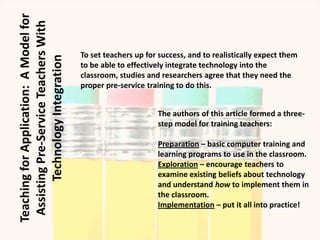
To set teachers up for success, and to realistically expect them
to be able to effectively integrate technology into the
classroom, studies and researchers agree that they need the
proper pre-service training to do this.


                      The authors of this article formed a three-
                      step model for training teachers:

                      Preparation – basic computer training and
                      learning programs to use in the classroom.
                      Exploration – encourage teachers to
                      examine existing beliefs about technology
                      and understand how to implement them in
                      the classroom.
                      Implementation – put it all into practice!
Reading this article opened my eyes to some of the issues that
educators face in terms of working to successfully integrate
technology in the classroom. There are problems that stem all
the way back to pre-service education, where they are taught
lessons from a book, create a generic lesson plan or two, and are
sent on their way. This method is a quick in-and-out way of
passing students along through the program, and does little to
prepare them for an actual classroom. Students need to be given
real world scenarios that test their beliefs and allow them to think
critically about what they’ve learned. From there, they should
test it, evaluate the results, and adjust accordingly.

This lesson applies to educators across the board, and this really
hit home as a rule to follow in my classroom from day one.


                                              All           Back to
                                            done?             the
                                             Click          articles
                                            here!
Working With Blinders On

When examining the role of technology in
the classroom, what impact do the
diverse cultural and social backgrounds of
our students play? This is a very
important question for educators and
schools to answer because it a very real
and very pertinent concern faced every
day in schools across the country.


           Columbia University professor Anand R.
           Marri posits that social backgrounds,
           particularly race, adversely affect the
           type of education a student receives,
           citing research that showed “urban
           racial/ethnic minority students are
           shown the least powerful ways to use
           technology in their educational
           experience” (2007).
Working With Blinders On
This is not to say that all hope is lost!


      Examining the educational
      mediums that students have
      access to in school (books,
      tutoring, computers, etc.), the
      more technology-based the
      resource, the more that the gap
      between minority students and
      their middle or upper class white
      peers is closed.


                   Another sign of hope for closing this gap is the
                   amount of attention paid to the issue. Marri
                   reviewed the studies of the two major social studies
                   journals, and the amount of research has increased
                   exponentially in the past ten years compared the
                   decade prior.
Working With Blinders On
This article was a little scary to read. We can sit
back and think of how wonderful it is that
schools and educators are making strides to
integrate technology into the classroom, but we
still face fundamental race and class issues.
Simply giving a laptop to a room of students is
not enough – we need to make sure that it is
being done for the right reasons and that these
students are being given powerful, useful
lessons to prepare them for success in this
evolving world where technology rules.

The positives here are hopeful. It was very
comforting to see that in terms of performance
and working towards closing the achievement
gaps in schools, that using lesson plans that are
based around the use of technology is one of
the more effective ways to accomplish this.                       All    Back to
                                                                done?      the
                                                                 Click   articles
                                                                here!
Making School a Little Less Painful through Technology

   A good article to wrap up with is
   a teacher bio from the
   September/October 2010 of
   Learning and Leading, a digital
   education journal. This profiles
   Mr. Jason Schrage, a middle
   school social studies teacher       Mr. Schrage helped his students
   who is thinking outside the box     prepare for upcoming exams by
   to teach his students.              videoconferencing with another
                                       eighth grade class from another
                                       school. Along with that teacher,
                                       Mr. Schrage led a contest between
                                       the two classes, quizzing them on
                                       information they would need for
                                       their test.
Making School a Little Less Painful through Technology
 A common problem that teachers encounter
 is finding ways to engage their students and
 keep them interested in the learning process.
 Mr. Schrage could’ve very easily assigned a
 chapter to read and had his students answer
 the review questions the followed.
 However, he got creative and not only did he
 get his students involved, he worked with a
 teacher and students from another school!

                                             “I like to dabble and explore and
                                             experiment. That’s what
                                             technology does for me. It keeps
                                             me energized, and it trickles
                                             down to the kids.”
                                              - Jason Schrage (2010)
Making School a Little Less Painful through Technology

  What Mr. Schrage did with his class is EXACTLY what this class
  has built towards and what it is helping to prepare us for as
  future educators. By getting creative and thinking outside the
  box, he energized his students and got them excited about the
  learning process by integrating technology into the classroom.
  This is a great example of just one of the things we are capable
  of doing in the class with the help of technology.


                                                                       All
                                                                     done?
                                                                      Click
                                                                     here!
Conclusion

Schools are still a long way away from catching up to the technologically savvy twenty-
first century. However, strides in the right direction are being made. The point must
be made, though, that simply supplying schools with materials is not enough.
Teachers need the proper pre-service training so they enter the field with a clear plan
for effectively integrating technology into their lesson plans. Also, we should not be
foolish enough to think that just by integrating technology into the class that it will
magically solve the social and cultural issues that our school systems face. They are
helping the problem, but they’re not a cure all. Lastly, and most importantly, we
should be hopeful for how technology will benefit us. Looking at the world around
us, it would be impossible not to see the countless benefits we’ve seen as technology
has been integrated into our lives. Let us hope that the same focus and drive will be
used to deliver the same benefits into our classrooms.


                                                                        Brandon Mitchell

Education 2.0

  • 1.
    EDUCATION 2.0 BRINGING CLASSROOMSINTO THE 21ST CENTURY
  • 2.
    Making the Move TEACHING FOR APPLICATION into the 21st Century As the world continues its move into the twenty-first century, it is important that our schools, classrooms, and teachers do the same. Technologies continue to improve and with these advances, educators are given more and more opportunities to integrate WORKING WITH BLINDERS ON these into their classrooms. Here are three articles that highlight the journey educators are making and issues we face as we attempt to integrate technology in the classroom. MAKING SCHOOL A LITTLE LESS PAINFUL
  • 3.
    The purpose ofthis article was to outline a plan for helping pre- service teachers develop strategies to better help them integrate technology into the classroom. Jung Won Hur, from Auburn University, cited the major issue facing the current methods for pre-service instruction. Many colleges and schools of education focus on technical skills but do not require students to think about how they might apply their own skills to teaching situations (2010). This potentially leaves future teachers unprepared to make meaningful use of technology in their own classrooms (2010).
  • 4.
    To set teachersup for success, and to realistically expect them to be able to effectively integrate technology into the classroom, studies and researchers agree that they need the proper pre-service training to do this. The authors of this article formed a three- step model for training teachers: Preparation – basic computer training and learning programs to use in the classroom. Exploration – encourage teachers to examine existing beliefs about technology and understand how to implement them in the classroom. Implementation – put it all into practice!
  • 5.
    Reading this articleopened my eyes to some of the issues that educators face in terms of working to successfully integrate technology in the classroom. There are problems that stem all the way back to pre-service education, where they are taught lessons from a book, create a generic lesson plan or two, and are sent on their way. This method is a quick in-and-out way of passing students along through the program, and does little to prepare them for an actual classroom. Students need to be given real world scenarios that test their beliefs and allow them to think critically about what they’ve learned. From there, they should test it, evaluate the results, and adjust accordingly. This lesson applies to educators across the board, and this really hit home as a rule to follow in my classroom from day one. All Back to done? the Click articles here!
  • 6.
    Working With BlindersOn When examining the role of technology in the classroom, what impact do the diverse cultural and social backgrounds of our students play? This is a very important question for educators and schools to answer because it a very real and very pertinent concern faced every day in schools across the country. Columbia University professor Anand R. Marri posits that social backgrounds, particularly race, adversely affect the type of education a student receives, citing research that showed “urban racial/ethnic minority students are shown the least powerful ways to use technology in their educational experience” (2007).
  • 7.
    Working With BlindersOn This is not to say that all hope is lost! Examining the educational mediums that students have access to in school (books, tutoring, computers, etc.), the more technology-based the resource, the more that the gap between minority students and their middle or upper class white peers is closed. Another sign of hope for closing this gap is the amount of attention paid to the issue. Marri reviewed the studies of the two major social studies journals, and the amount of research has increased exponentially in the past ten years compared the decade prior.
  • 8.
    Working With BlindersOn This article was a little scary to read. We can sit back and think of how wonderful it is that schools and educators are making strides to integrate technology into the classroom, but we still face fundamental race and class issues. Simply giving a laptop to a room of students is not enough – we need to make sure that it is being done for the right reasons and that these students are being given powerful, useful lessons to prepare them for success in this evolving world where technology rules. The positives here are hopeful. It was very comforting to see that in terms of performance and working towards closing the achievement gaps in schools, that using lesson plans that are based around the use of technology is one of the more effective ways to accomplish this. All Back to done? the Click articles here!
  • 9.
    Making School aLittle Less Painful through Technology A good article to wrap up with is a teacher bio from the September/October 2010 of Learning and Leading, a digital education journal. This profiles Mr. Jason Schrage, a middle school social studies teacher Mr. Schrage helped his students who is thinking outside the box prepare for upcoming exams by to teach his students. videoconferencing with another eighth grade class from another school. Along with that teacher, Mr. Schrage led a contest between the two classes, quizzing them on information they would need for their test.
  • 10.
    Making School aLittle Less Painful through Technology A common problem that teachers encounter is finding ways to engage their students and keep them interested in the learning process. Mr. Schrage could’ve very easily assigned a chapter to read and had his students answer the review questions the followed. However, he got creative and not only did he get his students involved, he worked with a teacher and students from another school! “I like to dabble and explore and experiment. That’s what technology does for me. It keeps me energized, and it trickles down to the kids.” - Jason Schrage (2010)
  • 11.
    Making School aLittle Less Painful through Technology What Mr. Schrage did with his class is EXACTLY what this class has built towards and what it is helping to prepare us for as future educators. By getting creative and thinking outside the box, he energized his students and got them excited about the learning process by integrating technology into the classroom. This is a great example of just one of the things we are capable of doing in the class with the help of technology. All done? Click here!
  • 12.
    Conclusion Schools are stilla long way away from catching up to the technologically savvy twenty- first century. However, strides in the right direction are being made. The point must be made, though, that simply supplying schools with materials is not enough. Teachers need the proper pre-service training so they enter the field with a clear plan for effectively integrating technology into their lesson plans. Also, we should not be foolish enough to think that just by integrating technology into the class that it will magically solve the social and cultural issues that our school systems face. They are helping the problem, but they’re not a cure all. Lastly, and most importantly, we should be hopeful for how technology will benefit us. Looking at the world around us, it would be impossible not to see the countless benefits we’ve seen as technology has been integrated into our lives. Let us hope that the same focus and drive will be used to deliver the same benefits into our classrooms. Brandon Mitchell