3.1.1DefineInstructionset,machineandassemblylanguage
 INSTRUCTION SET :
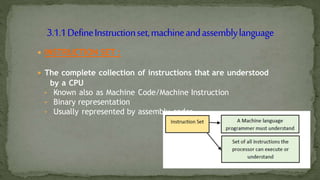
 The complete collection of instructions that are understood
by a CPU
• Known also as Machine Code/Machine Instruction
• Binary representation
• Usually represented by assembly codes
Machinelanguage:
 a binary program (or binary code).
 a sequence of instruction and operand in
binary that list the exact representation
instruction as they appear in computer
memory.
 Natural language of a particular computer
system.
 Strings of numbers or binary codes (0 or 1).
Machinelanguage:
 Machine-dependent (differ from one µP to
other µP.
 Program written in any other language must
be translated to binary representation of
instruction before they can be executed by
computer.
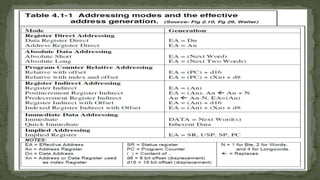
 Programmers need to know specifically the
architecture of CPU.
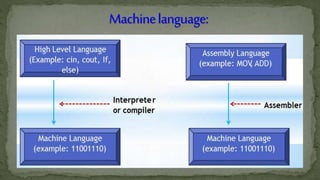
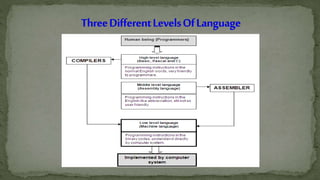
 Assembly language is a symbolic representation of
a machine language of specific processor.
Assembly language is a form that is very
dependent on the underlying architecture.
 Using english -like abbreviations (MUL), ( ADD),
(SUB)
 Assembler as translator.
 Assembler - Translate ordinary mnemonics such as
MOVE Data, Acc, into their corresponding machine
language (the only form of instruction that
computer can executed)
Easy to make compilers, debuggers and other
device tools.
Allow accessing information that is not
accessible (restricted) from high level
languages.
More function library that can be used in
programming development.
Possibility to make library function that
compatible with different compiler and
 (Development) Requires longer development time
 (Reliability & Security) Easy to makes error
 (Debug) More possibility for errors
 (Maintain) Difficult to modify because it allows
unstructured code.
 (Portability) Difficult to porting to different platforms.
platforms.
 Using everyday English and common
mathematical notation. (x = I + j)
 Overcome problems : assembly language
require many instruction to accomplish a
simple task.
 Single instruction in HLL = several AL
instructions.
 Compiler as translator.
H
HH
HH HH
HH HH HH HH
9/19/2019
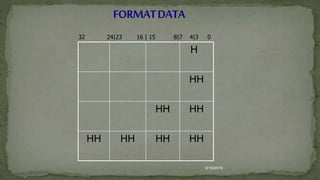
32 24|23 16 | 15 8|7 4|3 0
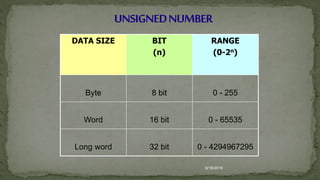
DATA SIZE BIT
(n)
RANGE
(0-2n)
Byte 8 bit 0 - 255
Word 16 bit 0 - 65535
Long word 32 bit 0 - 4294967295
9/19/2019
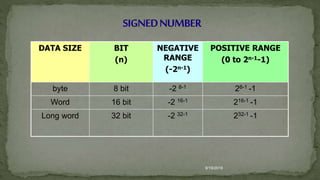
DATA SIZE BIT
(n)
NEGATIVE
RANGE
(-2n-1)
POSITIVE RANGE
(0 to 2n-1-1)
byte 8 bit -2 8-1 28-1 -1
Word 16 bit -2 16-1 216-1 -1
Long word 32 bit -2 32-1 232-1 -1
9/19/2019
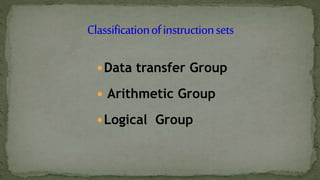
Data transfer Group
 Arithmetic Group
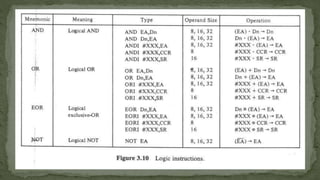
Logical Group
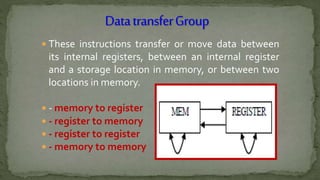
 These instructions transfer or move data between
its internal registers, between an internal register
and a storage location in memory, or between two
locations in memory.
 - memory to register
 - register to memory
 - register to register
 - memory to memory
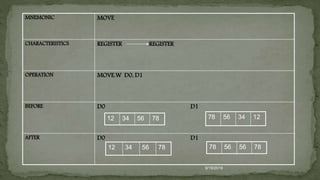
MNEMONIC MOVE
CHARACTERISTICS REGISTER REGISTER
OPERATION MOVE.W D0, D1
BEFORE D0 D1
AFTER D0 D1
78 56 34 12
78 56 56 7812 34 56 78
9/19/2019
12 34 56 78
01000 42 51
01002 55 13
9/19/2019
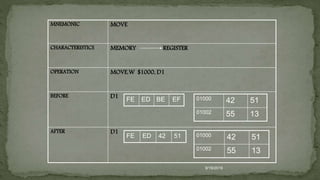
MNEMONIC MOVE
CHARACTERISTICS MEMORY REGISTER
OPERATION MOVE.W $1000, D1
BEFORE D1
AFTER D1
FE ED 42 51
EFBEEDFE
135501002
514201000
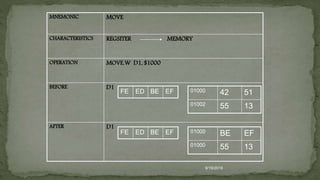
MNEMONIC MOVE
CHARACTERISTICS REGSITER MEMORY
OPERATION MOVE.W D1, $1000
BEFORE D1
AFTER D1
9/19/2019
EFBEEDFE
135501000
EFBE01000
EFBEEDFE
135501002
514201000
9/19/2019
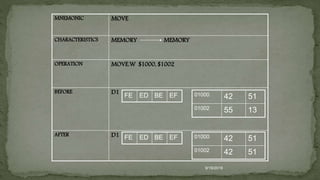
MNEMONIC MOVE
CHARACTERISTICS MEMORY MEMORY
OPERATION MOVE.W $1000, $1002
BEFORE D1
AFTER D1 EFBEEDFE
514201002
514201000
EFBEEDFE
135501002
514201000
9/19/2019
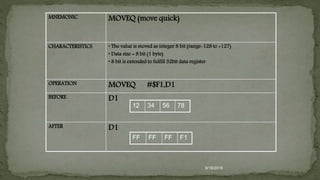
MNEMONIC MOVEQ (move quick)
CHARACTERISTICS • The value is moved as integer 8 bit (range-128 to +127)
• Data size = 8 bit (1 byte)
• 8 bit is extended to fulfill 32bit data register
OPERATION MOVEQ #$F1,D1
BEFORE D1
AFTER D1
FF FF FF F1
12 34 56 78
9/19/2019
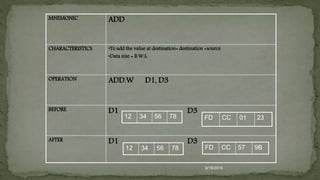
ARAHAN ARITMETIK
MNEMONIC ADD
CHARACTERISTICS •To add the value at destination= destination +source
•Data size = B.W.L
OPERATION ADD.W D1, D3
BEFORE D1 D3
AFTER D1 D3
9/19/2019
FD CC 01 23
FD CC 57 9B12 34 56 78
12 34 56 78
9/19/2019
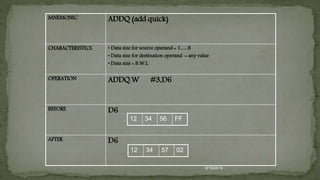
MNEMONIC ADDQ (add quick)
CHARACTERISTICS • Data size for source operand = 1…..8
• Data size for destination operand = any value
• Data size = B.W.L
OPERATION ADDQ.W #3,D6
BEFORE D6
AFTER D6
12 34 57 02
12 34 56 FF
9/19/2019
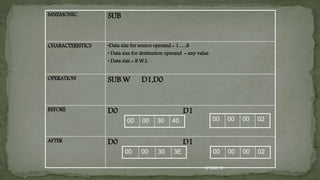
MNEMONIC SUB
CHARACTERISTICS •Data size for source operand = 1…..8
• Data size for destination operand = any value
• Data size = B.W.L
OPERATION SUB.W D1,D0
BEFORE D0 D1
AFTER D0 D1
00 00 00 0200 00 30 40
00 00 00 0200 00 30 3E
9/19/2019
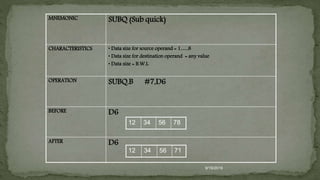
MNEMONIC SUBQ (Sub quick)
CHARACTERISTICS • Data size for source operand = 1…..8
• Data size for destination operand = any value
• Data size = B.W.L
OPERATION SUBQ.B #7,D6
BEFORE D6
AFTER D6
12 34 56 78
12 34 56 71
9/19/2019
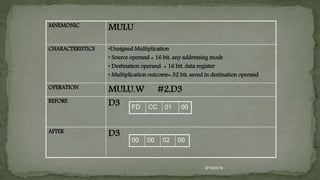
MNEMONIC MULU
CHARACTERISTICS •Unsigned Multiplication
• Source operand = 16 bit, any addressing mode
• Destination operand = 16 bit, data register
• Multiplication outcome= 32 bit, saved in destination operand
OPERATION MULU.W #2,D3
BEFORE D3
AFTER D3
FD CC 01 00
00 00 02 00
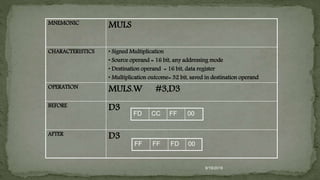
MNEMONIC MULS
CHARACTERISTICS • Signed Multiplication
• Source operand = 16 bit, any addressing mode
• Destination operand = 16 bit, data register
• Multiplication outcome= 32 bit, saved in destination operand
OPERATION MULS.W #3,D3
BEFORE D3
AFTER D3
9/19/2019
FD CC FF 00
FF FF FD 00
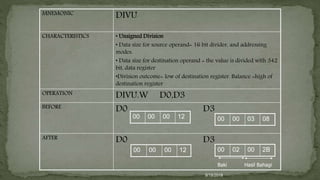
MNEMONIC DIVU
CHARACTERISTICS • Unsigned Division
• Data size for source operand= 16 bit divider, and addressing
modes.
• Data size for destination operand = the value is divided with 342
bit, data register
•Division outcome= low of destination register. Balance =high of
destination register
OPERATION DIVU.W D0,D3
BEFORE D0 D3
AFTER D0 D3
9/19/2019
00 00 03 0800 00 00 12
00 02 00 2B00 00 00 12
Baki Hasil Bahagi
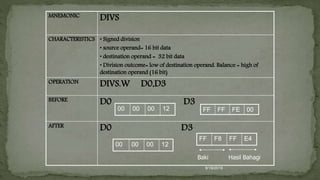
MNEMONIC DIVS
CHARACTERISTICS • Signed division
• source operand= 16 bit data
• destination operand = 32 bit data
• Division outcome= low of destination operand. Balance = high of
destination operand (16 bit)
OPERATION DIVS.W D0,D3
BEFORE D0 D3
AFTER D0 D3
9/19/2019
FF FF FE 0000 00 00 12
FF F8 FF E4
00 00 00 12
Baki Hasil Bahagi
9/19/2019
ARAHAN LOGIK
9/19/2019
MNEMONIC AND.B #$3E, D3
CHARACTERISTICS
[D3(B) AND $3E  D3 (B) ]
(8 bit data in D3 ‘AND’ with 8 bit data and the output in
D3)
OPERATION
BEFORE D3
AFTER D3
9/19/2019
74 0 1 1 1 0 1 0 0
AND 3E 0 0 1 1 1 1 1 0
34 0 0 1 1 0 1 0 0
12345674
12343634
MNEMONIC OR.B D0, D1
CHARACTERISTICS [D1 (B) or D0 (B)  D1(B) ]
(8 bit data in D1 ‘OR’ with 8 bit data in D0, and the output in D1)
OPERATION
BEFORE D0 D1
AFTER D0 D1
9/19/2019
3E 0 0 1 1 1 1 1 0
OR 74 0 1 1 1 0 1 0 0
7E 0 1 1 1 1 1 1 0
1234563E98765474
1234367E98765474
MNEMONIC NOT.B D1
CHARACTERISTICS
[D1(B) NOT  D1 ]
(The content of D1 is NOT, and the
output in D1)
OPERATION AA  1010 1010
55  0101 0101
BEFORE
AFTER
9/19/2019
12345655
123436AA
D1

Instruction Set and Assembly Language Programming

  • 2.
    3.1.1DefineInstructionset,machineandassemblylanguage  INSTRUCTION SET:  The complete collection of instructions that are understood by a CPU • Known also as Machine Code/Machine Instruction • Binary representation • Usually represented by assembly codes
  • 3.
    Machinelanguage:  a binaryprogram (or binary code).  a sequence of instruction and operand in binary that list the exact representation instruction as they appear in computer memory.  Natural language of a particular computer system.  Strings of numbers or binary codes (0 or 1).
  • 4.
    Machinelanguage:  Machine-dependent (differfrom one µP to other µP.  Program written in any other language must be translated to binary representation of instruction before they can be executed by computer.  Programmers need to know specifically the architecture of CPU.
  • 6.
     Assembly languageis a symbolic representation of a machine language of specific processor. Assembly language is a form that is very dependent on the underlying architecture.  Using english -like abbreviations (MUL), ( ADD), (SUB)  Assembler as translator.  Assembler - Translate ordinary mnemonics such as MOVE Data, Acc, into their corresponding machine language (the only form of instruction that computer can executed)
  • 7.
    Easy to makecompilers, debuggers and other device tools. Allow accessing information that is not accessible (restricted) from high level languages. More function library that can be used in programming development. Possibility to make library function that compatible with different compiler and
  • 8.
     (Development) Requireslonger development time  (Reliability & Security) Easy to makes error  (Debug) More possibility for errors  (Maintain) Difficult to modify because it allows unstructured code.  (Portability) Difficult to porting to different platforms. platforms.
  • 9.
     Using everydayEnglish and common mathematical notation. (x = I + j)  Overcome problems : assembly language require many instruction to accomplish a simple task.  Single instruction in HLL = several AL instructions.  Compiler as translator.
  • 12.
    H HH HH HH HH HHHH HH 9/19/2019 32 24|23 16 | 15 8|7 4|3 0
  • 13.
    DATA SIZE BIT (n) RANGE (0-2n) Byte8 bit 0 - 255 Word 16 bit 0 - 65535 Long word 32 bit 0 - 4294967295 9/19/2019
  • 14.
    DATA SIZE BIT (n) NEGATIVE RANGE (-2n-1) POSITIVERANGE (0 to 2n-1-1) byte 8 bit -2 8-1 28-1 -1 Word 16 bit -2 16-1 216-1 -1 Long word 32 bit -2 32-1 232-1 -1 9/19/2019
  • 15.
    Data transfer Group Arithmetic Group Logical Group
  • 16.
     These instructionstransfer or move data between its internal registers, between an internal register and a storage location in memory, or between two locations in memory.  - memory to register  - register to memory  - register to register  - memory to memory
  • 17.
    MNEMONIC MOVE CHARACTERISTICS REGISTERREGISTER OPERATION MOVE.W D0, D1 BEFORE D0 D1 AFTER D0 D1 78 56 34 12 78 56 56 7812 34 56 78 9/19/2019 12 34 56 78
  • 18.
    01000 42 51 0100255 13 9/19/2019 MNEMONIC MOVE CHARACTERISTICS MEMORY REGISTER OPERATION MOVE.W $1000, D1 BEFORE D1 AFTER D1 FE ED 42 51 EFBEEDFE 135501002 514201000
  • 19.
    MNEMONIC MOVE CHARACTERISTICS REGSITERMEMORY OPERATION MOVE.W D1, $1000 BEFORE D1 AFTER D1 9/19/2019 EFBEEDFE 135501000 EFBE01000 EFBEEDFE 135501002 514201000
  • 20.
    9/19/2019 MNEMONIC MOVE CHARACTERISTICS MEMORYMEMORY OPERATION MOVE.W $1000, $1002 BEFORE D1 AFTER D1 EFBEEDFE 514201002 514201000 EFBEEDFE 135501002 514201000
  • 21.
    9/19/2019 MNEMONIC MOVEQ (movequick) CHARACTERISTICS • The value is moved as integer 8 bit (range-128 to +127) • Data size = 8 bit (1 byte) • 8 bit is extended to fulfill 32bit data register OPERATION MOVEQ #$F1,D1 BEFORE D1 AFTER D1 FF FF FF F1 12 34 56 78
  • 22.
  • 23.
    MNEMONIC ADD CHARACTERISTICS •Toadd the value at destination= destination +source •Data size = B.W.L OPERATION ADD.W D1, D3 BEFORE D1 D3 AFTER D1 D3 9/19/2019 FD CC 01 23 FD CC 57 9B12 34 56 78 12 34 56 78
  • 24.
    9/19/2019 MNEMONIC ADDQ (addquick) CHARACTERISTICS • Data size for source operand = 1…..8 • Data size for destination operand = any value • Data size = B.W.L OPERATION ADDQ.W #3,D6 BEFORE D6 AFTER D6 12 34 57 02 12 34 56 FF
  • 25.
    9/19/2019 MNEMONIC SUB CHARACTERISTICS •Datasize for source operand = 1…..8 • Data size for destination operand = any value • Data size = B.W.L OPERATION SUB.W D1,D0 BEFORE D0 D1 AFTER D0 D1 00 00 00 0200 00 30 40 00 00 00 0200 00 30 3E
  • 26.
    9/19/2019 MNEMONIC SUBQ (Subquick) CHARACTERISTICS • Data size for source operand = 1…..8 • Data size for destination operand = any value • Data size = B.W.L OPERATION SUBQ.B #7,D6 BEFORE D6 AFTER D6 12 34 56 78 12 34 56 71
  • 27.
    9/19/2019 MNEMONIC MULU CHARACTERISTICS •UnsignedMultiplication • Source operand = 16 bit, any addressing mode • Destination operand = 16 bit, data register • Multiplication outcome= 32 bit, saved in destination operand OPERATION MULU.W #2,D3 BEFORE D3 AFTER D3 FD CC 01 00 00 00 02 00
  • 28.
    MNEMONIC MULS CHARACTERISTICS •Signed Multiplication • Source operand = 16 bit, any addressing mode • Destination operand = 16 bit, data register • Multiplication outcome= 32 bit, saved in destination operand OPERATION MULS.W #3,D3 BEFORE D3 AFTER D3 9/19/2019 FD CC FF 00 FF FF FD 00
  • 29.
    MNEMONIC DIVU CHARACTERISTICS •Unsigned Division • Data size for source operand= 16 bit divider, and addressing modes. • Data size for destination operand = the value is divided with 342 bit, data register •Division outcome= low of destination register. Balance =high of destination register OPERATION DIVU.W D0,D3 BEFORE D0 D3 AFTER D0 D3 9/19/2019 00 00 03 0800 00 00 12 00 02 00 2B00 00 00 12 Baki Hasil Bahagi
  • 30.
    MNEMONIC DIVS CHARACTERISTICS •Signed division • source operand= 16 bit data • destination operand = 32 bit data • Division outcome= low of destination operand. Balance = high of destination operand (16 bit) OPERATION DIVS.W D0,D3 BEFORE D0 D3 AFTER D0 D3 9/19/2019 FF FF FE 0000 00 00 12 FF F8 FF E4 00 00 00 12 Baki Hasil Bahagi
  • 31.
  • 32.
  • 33.
    MNEMONIC AND.B #$3E,D3 CHARACTERISTICS [D3(B) AND $3E  D3 (B) ] (8 bit data in D3 ‘AND’ with 8 bit data and the output in D3) OPERATION BEFORE D3 AFTER D3 9/19/2019 74 0 1 1 1 0 1 0 0 AND 3E 0 0 1 1 1 1 1 0 34 0 0 1 1 0 1 0 0 12345674 12343634
  • 34.
    MNEMONIC OR.B D0,D1 CHARACTERISTICS [D1 (B) or D0 (B)  D1(B) ] (8 bit data in D1 ‘OR’ with 8 bit data in D0, and the output in D1) OPERATION BEFORE D0 D1 AFTER D0 D1 9/19/2019 3E 0 0 1 1 1 1 1 0 OR 74 0 1 1 1 0 1 0 0 7E 0 1 1 1 1 1 1 0 1234563E98765474 1234367E98765474
  • 35.
    MNEMONIC NOT.B D1 CHARACTERISTICS [D1(B)NOT  D1 ] (The content of D1 is NOT, and the output in D1) OPERATION AA  1010 1010 55  0101 0101 BEFORE AFTER 9/19/2019 12345655 123436AA D1